In my latest #120months article, I explore what the “demographic divide” means for a company like Bayer: how do we ensure “Health for All, Hunger for None” in both growing populations and declining ones? https://t.co/tDTRsRqiPY
Das EU-Parlament hat heute nach jahrelanger kontroverser Debatte eine Verordnung verabschiedet, mit der die Anwendung Neuer Genomischer Techniken (NGTs) in der Pflanzenzucht einfacher wird.
Der Beschluss kommt gerade noch rechtzeitig, bevor die EU auch bei moderner Biotechnologie den Anschluss verliert. Angesichts des Klimawandels, einer wachsenden Weltbevölkerung und der steigenden Nachfrage nach Nahrungsmitteln und pflanzlichen Rohstoffen müssen wir alle Methoden nutzen, um die Landwirtschaft resilienter und produktiver zu machen.
Unser Projekt "Wie weiter mit der modernen Pflanzenzucht?" holt Wissenschaft, Wirtschaft, Politik und Zivilgesellschaft an einen Tisch, um in einem faktenbasierten Dialog strittige Fragen zu diskutieren und Möglichkeiten für eine Verständigung auszuloten. @LiberaleModerne https://t.co/RBZX7n0isU
My new #120Months issue tries to make sense of climate communication failures, and to put forward an idea of what an honest climate narrative would actually look like. https://t.co/DrT5ncfeg5
For 30 years, climate policy only meant cutting emissions, with adaptation an afterthought. That has to change – fast. My latest #120months looks at what resilience really means for nature, health and agriculture. https://t.co/z480X9aXcz
The Strait of Hormuz closure isn't just about oil. It's triggered a global fertilizer shock that could leave a billion people short of food – and has revealed structural vulnerabilities that demand fundamental changes to farming. Read my #120months: https://t.co/KDy6w4EH7Z
We're entering a second Cold War, and it's playing out on a planet where climate change multiplies geopolitical tension. Companies must navigate competing demands from Washington and Beijing with caution and sophistication. Read more in my #120months.
https://t.co/ly9flaAaNY
Water scarcity and environmental hazards exacerbate food insecurity. Through its Partnership with @UNmigration, @Bayer demonstrates its commitment to sustainable solutions. The initiative supports vulnerable communities and advances our Zero Hunger Pledge.
Grateful for today’s candid exchange at @MunSecConf on livelihoods, food security, and economic cooperation.
When people can’t sustain themselves, they are pushed to move. Strong local economies give people real choices.
Thank you @Bayer for a solutions‑driven discussion.
We're constantly told to choose between growth OR planet, development OR climate action. These false choices are paralyzing progress, meaning we must replace OR with the most powerful word in sustainability: AND. Read why here:
https://t.co/BXYMxwX5Pf
COP30 and G20 have got me thinking about how businesses face a choice: profit by worsening climate problems – or by solving them. Read more in this month’s #120months:
https://t.co/L4cJYwgkn3
The world is racing toward a 2°C temperature. Join me in this month's #120months article to discover why the next chapter in climate action must prioritize resilience, and how new global indicators can help turn ambition into real-world solutions. #COP30
https://t.co/y3SYXUW1yu
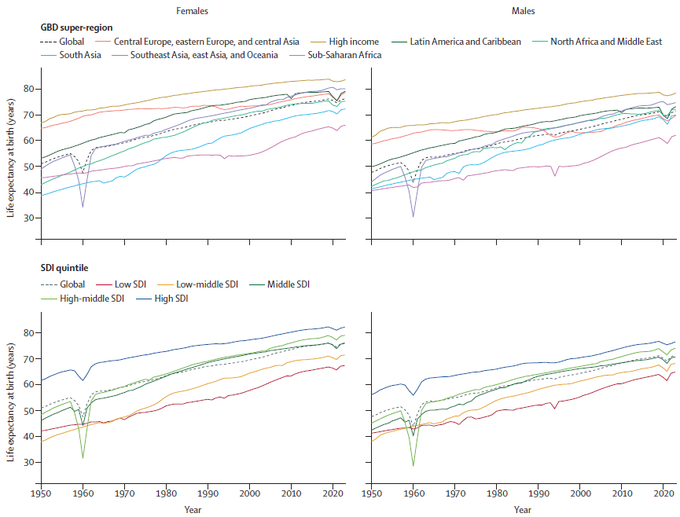
We are living longer than at any time in history, because of human ingenuity.
Vaccines stopped smallpox.
Antibiotics stopped infections.
Clean water stopped cholera.
Crop science stopped famine.
Medicine stopped early death.
Every extra year of life is a product of human innovation - not luck.
Rejecting science today would send us back to a world where “old age” meant 40.
Es ist einfach großartig zu sehen, wie viele Leute in nicht-wertschöpfenden Berufen ernsthaft glauben, dass eine Deindustrialisierung keinerlei Auswirkungen auf ihren Lifestyle haben wird.
Von meiner Seite schon mal: toi toi toi.
Wirtschaft und Politik zu eng verbunden: Wie Fortschrittsglaube in der Katastrophe enden kann - DER SPIEGEL: Ich empfehle diesen hervorragenden Artikel. Wir beschäftigen uns bei @Bayer intensiv damit, was die Geschichte für unser heutiges Handeln bedeutet. https://t.co/PjvDThDAVA
Relying solely on solutions like organic farming simply isn’t feasible. Just as solar cells play a pivotal role in the energy transition, genetic engineering is essential for agricultural transformation. (3/3)
I had the opportunity to engage in a debate on genetic engineering with Karl Bär, Member of the Bundestag (The Greens), published in Die ZEIT. I firmly believe that without innovations, we cannot sustain the continuously growing global population. (1/3) https://t.co/X7r8UnSxc8
One of the key questions is: Do we want to leverage genetic engineering in Europe? In my opinion, the answer must be a resounding YES! We need a Europe that embraces modernization to enhance our competitiveness globally and avoid unnecessary dependencies. (2/3)
Historic: Coal has been the dominant fuel source for electricity generation worldwide since the early 20th century. This era is forever over: Renewables overtook coal in the electricity mix for the first time on record 34.3% to 33.1%
https://t.co/rrqPyFq4GH
Three chemists just won the 2025 Nobel Prize in Chemistry - for building materials with rooms inside them. At the molecular scale.
The story of metal–organic frameworks (MOFs) - and how they could help save the planet.
🏅 Susumu Kitagawa – Kyoto University.
🏅 Richard Robson – University of Melbourne.
🏅 Omar Yaghi – UC Berkeley.
Their creation? Metal–Organic Frameworks.
Tiny crystalline structures with vast internal space like molecular hotels for gases.
Imagine a material full of microscopic rooms.
Each room can trap, store, or release specific molecules.
💧 Some capture water from desert air.
🌍 Others pull carbon dioxide out of the atmosphere.
☣️ Some even lock away toxic gases.
Chemistry - turned into architecture.
It started in 1989. Richard Robson tried connecting copper ions with a four-armed organic molecule.
The result?
A crystal full of empty cavities - stable in shape, but fragile in spirit.
He saw the potential but couldn’t yet hold it together.
Then came Susumu Kitagawa and Omar Yaghi.
In the 1990s and early 2000s, they cracked the code:
Kitagawa showed gases could move in and out - and predicted flexible frameworks.
Yaghi made them strong, tunable, and stable.
From fragile curiosity → functional material.
Today, scientists have built tens of thousands of MOFs.
They can be engineered for anything:
→ Capturing CO₂
→ Storing hydrogen
→ Filtering PFAS from water
→ Breaking down pollutants
→ Conducting electricity
Each design is a custom molecular tool.
It’s chemistry meeting engineering - atoms organized with the precision of architecture.
These frameworks don’t just exist. They work.
They turn invisible molecules into something we can control.
This isn’t just chemistry.
It’s future infrastructure - built one molecule at a time.