The problem, the path.
Yeah, UVXY will always melt over time, but there's always the risk that it ramps 5x or 10x on its way to collapse.
No one can weather those storms with a decent sized short position.
I think a lot of people misunderstood my
post below, so let me clarify.
The VIX is at 35.6. $UVXY is at $31.50.
My point was that the $VIX has become unreliable as an indicator for predicting market direction. That’s all.
Buying $VIX as a hedge or shorting $UVXY is an entirely different story.
As a matter of fact, $UVXY is down approximately 99.99% since inception, adjusted for reverse splits.
The reason is structural. $UVXY holds short-term VIX futures, which are usually in contango. Continuously rolling into more expensive contracts, combined with daily leverage and compounding, creates enormous long-term decay.
This isn’t technical analysis. It’s how the product works.
At $31.50, I’m willing to make a public bet.
If you short $UVXY today and manage the position correctly over the next two years, I believe you’ll make at least 40%.
If I’m wrong, I’ll quit Twitter.
Of course, position sizing and margin management are critical. $UVXY can spike hundreds of percent during market panics, and an unmanaged short can be wiped out.
The $VIX may be unreliable as a market indicator, but $UVXY’s structural decay makes it one of my favorite long-term short trades.
𝗪𝗘𝗘𝗞𝗘𝗡𝗗 𝗠𝗨𝗦𝗜𝗡𝗚𝗦: 𝗟𝗘𝗦𝗦𝗢𝗡𝗦 𝗙𝗥𝗢𝗠 𝗔 𝗕𝗥𝗨𝗧𝗔𝗟 𝗪𝗘𝗘𝗞
A good time for reflection, for myself and anyone using different strategies to navigate the markets. What worked, what didn’t, and what can we learn?
𝗟𝗘𝗦𝗦𝗢𝗡 𝟭: 𝗧𝗛𝗘 𝗩𝗜𝗫 𝗛𝗔𝗦 𝗕𝗘𝗖𝗢𝗠𝗘 𝗣𝗥𝗔𝗖𝗧𝗜𝗖𝗔𝗟𝗟𝗬 𝗨𝗡𝗨𝗦𝗔𝗕𝗟𝗘
One of my favorite indicators has lost much of its value. A sudden 10% drop in the VIX after a market decline used to signal improving sentiment. Now it drops 10%, jumps 15% the next day, and falls another 15%.
The signal has become noise. At least for now, I’m taking it off the table.
Just because something worked for years doesn’t mean it will continue working. When reality proves otherwise, abandon it.
𝗟𝗘𝗦𝗦𝗢𝗡 𝟮: MOST 𝗧𝗘𝗖𝗛𝗡𝗜𝗖𝗔𝗟 𝗔𝗡𝗔𝗟𝗬𝗦𝗜𝗦 𝗜𝗦 𝗪𝗢𝗥𝗧𝗛𝗟𝗘𝗦𝗦
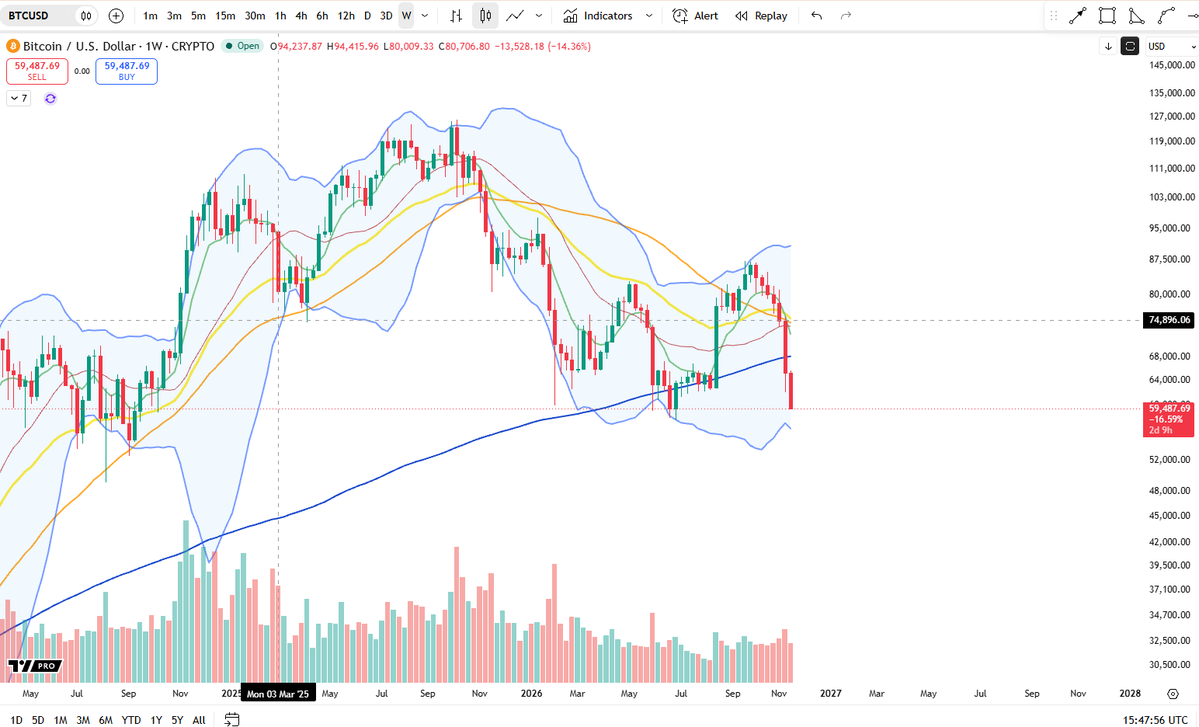
Bitcoin is the perfect example. $68K is critical support. Once broken, $65K becomes critical. Then $62K. Then $58K.
Eventually Bitcoin bounces somewhere, and technicians proudly announce that it bounced off support.
A system that explains everything after it happens but tells you nothing useful beforehand has zero value.
𝗟𝗘𝗦𝗦𝗢𝗡 𝟯: 𝗔𝗩𝗢𝗜𝗗 𝗦𝗣𝗘𝗖𝗨𝗟𝗔𝗧𝗜𝗩𝗘 𝗚𝗥𝗢𝗪𝗧𝗛 𝗦𝗧𝗢𝗖𝗞𝗦
Look at $IREN, $NBIS, $OKLO, $RGTI, $CRWV, $CIFR, $APLD and others. Many have suffered enormous drawdowns, some approaching 70% to 80%.
These stocks are often lottery tickets purchased at the worst possible time.
By the time everyone discovers the next revolutionary company, the price already reflects a dream that may never materialize.
A few might succeed, but many won’t. Even successful businesses can become terrible investments when purchased at hype valuations.
𝗟𝗘𝗦𝗦𝗢𝗡 𝟰: 𝗧𝗔𝗞𝗘 𝗣𝗥𝗢𝗙𝗜𝗧𝗦 𝗔𝗡𝗗 𝗦𝗧𝗔𝗬 𝗛𝗨𝗠𝗕𝗟𝗘
If your portfolio is up 50% or 100% in a year, congratulations. But don’t confuse extraordinary returns with your normal earning power.
We’ve seen hedge funds up 30% or 40% give back everything and turn negative.
I learned this lesson myself this quarter.
Take profits, reduce risk, and protect what you’ve earned. There’s nothing wrong with leaving money on the table.
𝗟𝗘𝗦𝗦𝗢𝗡 𝟱: 𝗡𝗘𝗩𝗘𝗥 𝗙𝗔𝗟𝗟 𝗜𝗡 𝗟𝗢𝗩𝗘 𝗪𝗜𝗧𝗛 𝗧𝗛𝗘 𝗦𝗧𝗢𝗥𝗬
Stocks can rise 100% or 300% simply because investors fall in love with a dream.
Very few dreams become reality. Identifying the winners consistently is extremely difficult. I doubt even I could do it.
The smart approach is to buy before the hype and sell when everyone else falls in love with the story.
Being right about a company isn’t the same as making money from its stock.
𝗟𝗘𝗦𝗦𝗢𝗡 𝟲: 𝗡𝗢𝗧𝗛𝗜𝗡𝗚 𝗜𝗦 𝗜𝗠𝗠𝗨𝗡𝗘 𝗧𝗢 𝗥𝗜𝗦𝗞
If $NVDA, the golden poster child of corporate excellence, can lose 45% in such a short period, while even allegations of fraud enter the conversation, what company is truly immune?
Extraordinary earnings, technology and market dominance don’t protect shareholders when sentiment changes.
Which raises the most interesting question of the week: What exactly is the market so afraid of?
𝗟𝗘𝗦𝗦𝗢𝗡 𝟳: 𝗪𝗛𝗔𝗧 𝗗𝗜𝗗 𝗪𝗢𝗥𝗞? $VIX 𝗕𝗔𝗖𝗞𝗪𝗔𝗥𝗗𝗔𝗧𝗜𝗢𝗡
One signal that continues to deserve respect. When the VIX term structure moves into significant backwardation, avoid adding risk.
Tom Lee called it a buying opportunity. The market subsequently fell another 8%.
Don’t be angry with Tom Lee or Michael Saylor. They’re promoters. The mistake is believing their predictions have special value.
Tom Lee reportedly earns around $20 million a year telling people stocks will eventually go up.
That’s like paying someone $20 million to stand outside in January and announce that summer is coming.
Eventually, he’ll be right.
𝗙𝗜𝗡𝗔𝗟 𝗧𝗛𝗢𝗨𝗚𝗛𝗧
The purpose of reflection isn’t to defend our decisions. It’s to recognize what stopped working, where we became overconfident, and what needs to change.
Stay humble. Stay flexible. Protect your capital.
Have a great weekend.
Cash on the sidelines is a myth.
If YOUR cash on the sidelines is used to buy stocks, that cash becomes THE SELLER OF THOSE SHARE'S cash on the sidelines.
You can run this through as many iterations as you want... the cash, frustratingly, keeps ending up on the dang sidelines.
🚨 JAPAN IS ABOUT TO TRIGGER SCOTT BESSENT’S BIGGEST FINANCIAL NIGHTMARE
Very dangerous statements came out from Japan.
BOJ Governor Kazuo Ueda went on-record and warned that Japan can no longer tolerate rising inflation, and says that interest rate hikes are inevitable.
Finance Minister Katayama says, “Will act without hesitation if necessary and WON'T HESITATE TO TAKE ACTION ON FX IF NEEDED.”
This is a clear signal from Japan that the U.S. interventions are over.
Why?
Japan was about to end its era of free money and initiate the catastrophic carry trade unwind. The BoJ and Finance Minister threatened of bold actions and Yuto even apologized the people of the West for the measures prepared by the BoJ.
Then boom…. U.S. Treasury Secretary directly intervened and took over BoJ operations. He stopped Japan from dumping their $1.4 Trillion Treasury holdings and instead warned the FED to expand FIMA facility and lend Japan U.S. dollars to dump it and try to save the yen.
Scott Bessent even went on to dump dollars and euros to save the yen, called himself “the house” and dared traders to short the Yen.
Japan even went on to sacrifice their own stock market as BoJ announced that it is accelerating ETF liquidations by 161%, from ¥330 BILLION to ¥860 BILLION annually.
Japan holds enormous amounts of U.S. Treasuries valued at a staggering $1.4 Trillion.
So why are Japanese equities being sold while U.S. Treasuries remain untouched by this particular plan?
Selling those instead could put pressure on American bond markets.
IT ALL FAILED. Yen is falling back to pre-intervention levels, now at 160.
Rates are surging with 10-Year yields are reaching 2.8% while the yen is falling.
The Japanese stock market officially entered bear market today declining more than 20% from its ATH in June.
Japan has no real option but to liquidate their U.S. Treasury holdings.
Unfortunately, the warning from Japan’s @yutokanzakireal is about to come true.
That would trigger the liquidity shock to U.S. yields, AI cycle, private credit market and ultimately to the financial system with the catastrophic domino effect.
The Nasdaq traded at 60× forward P/E before the dot-com bust. Today, it’s at 17×, its cheapest in 4 years. Sure, whether earnings hold up is debatable. But this is a fear-driven drawdown, not a fundamentals-driven one. Enough with the lazy dot-com comparisons and fearmongering.
Blue wave, day one scoreboard:
Amazon +7.1%
Microsoft +7.0%
Solar (TAN) +6.1%
Silver +5.0%
S&P 500 +1.8%
Tesla -2.2%
Energy (XLE) -5.3%
Lockheed -6.8%
WTI crude -7.9%
Trump Media -23.0%
Solar beat oil by 14 points. Markets voted too.
One of the most bullish signs for a stock or the market is when, after a prolonged decline, a lot of bad news comes out, yet prices stop falling.
That’s exactly what we saw today.
You’re an idealist - completely disconnected from the reality of what it takes to run even a small business much less the largest economy and most important country in the world. You’re naive & stuck in some fairy tail parable read to you in your childhood. That’s the problem with guys like you …. All talk, headlines and popular narrative but very little real world application. Respectfully - GC