Novara Media spoke to residents of Barnsley who called out rioters scapegoating immigrants: “Your problems are from the top-down people making us feel small because we’re working class. But I'm proud to be working class, and I'm proud to be anti-racist working class as well."
@o_matthias1@Xeon4f145d96s1 I don’t think it would be easier without ARRS, just easier with more doctors AND ARRS. No need to get rid of really valuable multidisciplinary team to make it only doctors and nurses in primary care.
2/2 that prevents the minority of “greedy” partners from pocketing more profit when they scrimp on staff or only employ the cheapest healthcare staff. Blanket payments will always benefit some undeserving as @UKLabour has acknowledged with winter fuel payments.
1/2 @wesstreeting what this assumes is that a practice spends 44% of their global sum on wages, but a well staffed practice may spend closer to 60% so how will the shortfall be covered? Why not ring fence the money and tailor by asking for declarations of staff wage bills.
What exactly will the 6% pay rises for GP partners, salaried GPs and practice staff mean in terms of practice finances and the global sum? Our explainer will help shed light on the intricacies of the Government's announcement https://t.co/LHYwRlkTJm
CLEAR EXPLANATION OF GP ISSUES
@DrAmirKhanGP explains why GP's have voted to take collective action (NOT a Strike) - its NOT about a pay rise, its about wanting to be able to look after patients better
@pulsetoday And what about all the other staff that keep GP practices open and running? 6% across the primary care staff, ring fenced would be even better. 🤞
The NHS ‘is already starting to see tension’ as a result of GP practices ‘pulling back’ from doing discretionary work, NHS England’s board heard today. https://t.co/UzavAT2Ng6
Latest podcast episode OUT NOW!! Learn how to get the most out of your consultation. Great patient tips and tricks that will leave both you and your clinician happy!
Nowhere near enough shouting and heckling on #PMQs. Questions are being answered in a calm and rational way. Looks like they’ve brought new writers in for this series.
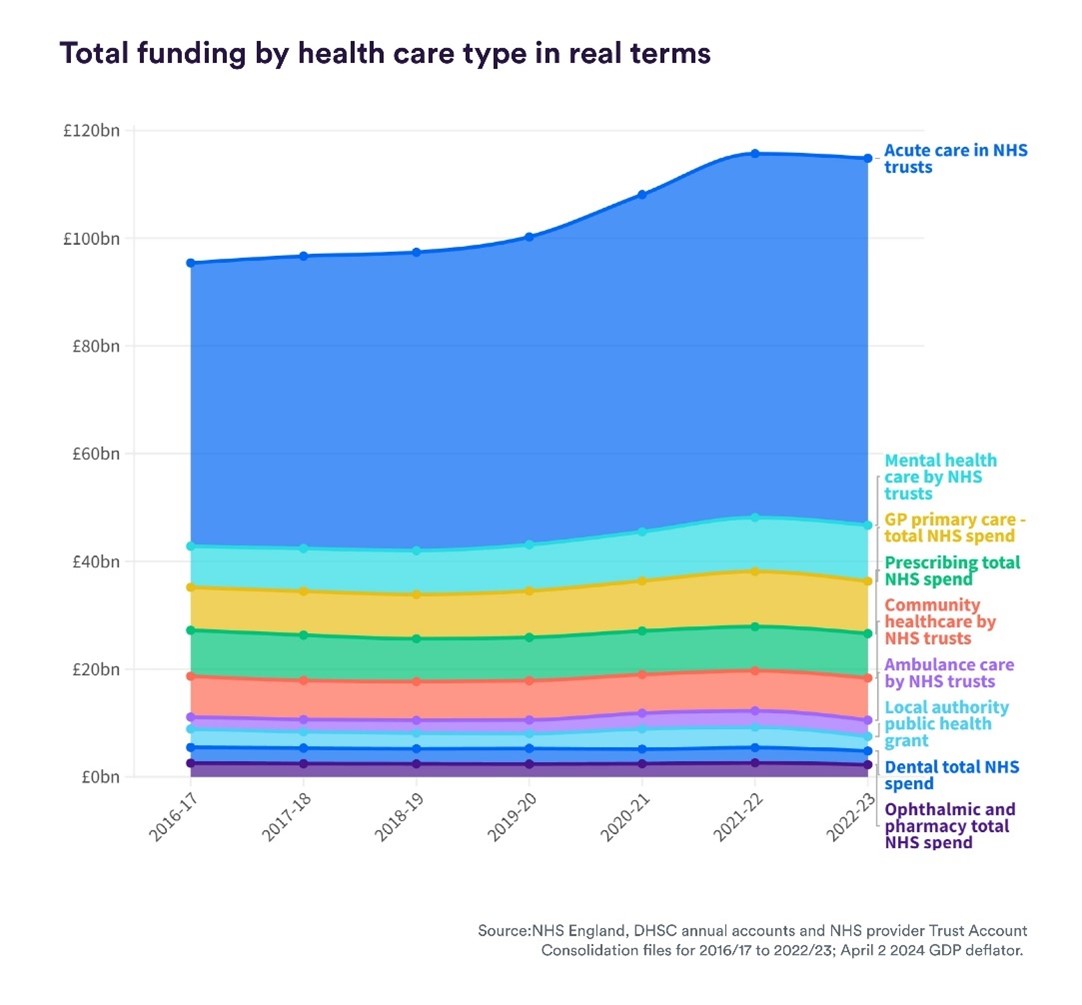
Where does the #NHS money go? We looked at how funding has been shared across different NHS services since 2016.
🏥 Community care funding has grown much more slowly than for acute care.
📉 Dentistry/ public health/ prescribing have seen real-terms cuts.
https://t.co/7X6SD4HRJB
We aspire to a different long term future for health & care. This requires more disruptive/discontinuous change, not just incremental change (see graphic). The challenge is that current health & care delivery systems are largely designed to optimise; to reliably & predictably execute complex processes (which is a great thing). However, it’s a different thing to creating something new, big or different. For new & different, we can’t assume an environment of predictability. We need to take time to explore unknowns in an atmosphere of uncertainty. That means having both a:
1)Delivery mindset: excellence, precision, standardisation, productivity; &
2)Changemaker mindset: openness, space for exploration, diversity, experimentation, failure.
The ability to operate in both modes will be key to delivering big change for the future.
See https://t.co/OJuvof1Rlc By @digitaltonto & https://t.co/gKexraAcb4 by @PaulIanTaylor. Graphic: @ACFuturesLab.