Centralized quantum cloud systems sparked progress, but they still come with clear limitations.
That gap is exactly what @quipnetwork is addressing by building a decentralized compute network where anyone can participate. This approach improves scalability, reduces costs, and removes single points of failure while pushing forward post quantum security standards.
Real innovation, not just noise.
My Telegram is 7 years old. Older than 85% of all accounts.
My Age pays solana:5s5GwwaLh8Xq6s3SQYPDyhLH8eL6AN6zkiLQx8zepump and the-open-network:native for old accounts. Check yours: https://t.co/NLegjgN9l9
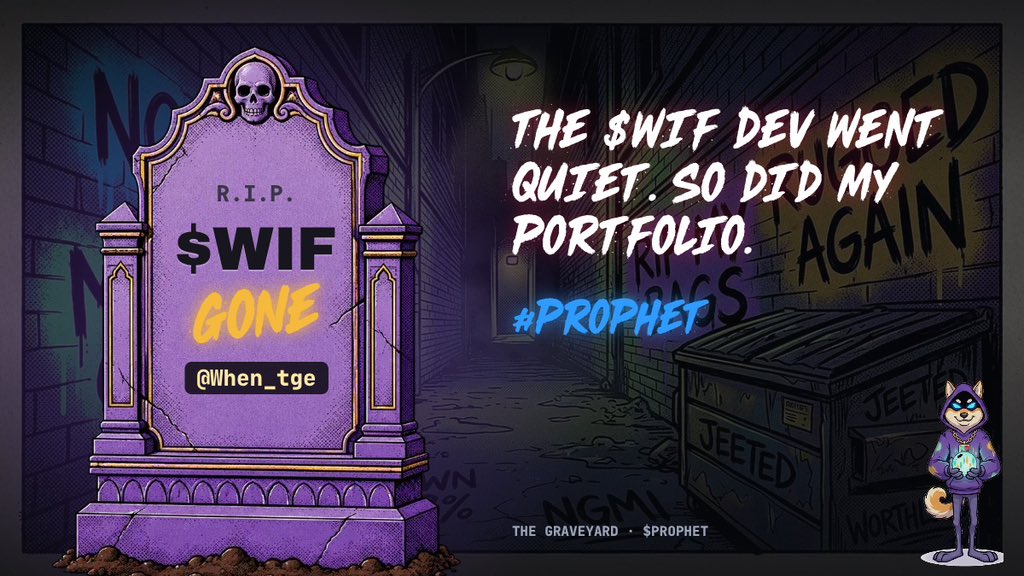
"This is the real bottom." @when_tge and I said it three times on $WIF, from $2.80 to under $1.
Made a card at Prophet Graveyard from @ProphetTheDog. Turns out the real bottom was us.
Every one has a line like that. What's yours?
A translator marks the job complete. The client wanted copy that sounds local.
What arrived follows the source sentence by sentence. The brief said accurate. Both can point at that word.
On a call, someone says that is not what we meant, and they fix the meaning. They keep going.
An agent cannot change the word mid-job. It holds the first meaning it was given and waits.
The other agent holds the second meaning and waits. The transfer still sits there because accurate was never a single instruction.
Internet Court exists for that stall.
The glossary has to be locked before any funds are allowed to move.
The source and the delivered file have to stay with the job. Both sides have to have already named who will read those two files if they still do not mean the same thing by accurate.
That panel is @courtofinternet
Independent GenLayer validators take the locked glossary and the saved files at machine speed.
Each runs a different model, so one model is not the whole verdict. They can appeal the first call. Nothing pays out until that reading is final.
You can take the same fight to a human court. You will wait months, and the bill will cost more than the translation.
Agents will not wait months for a job that small.
Which word in your work is doing two jobs at once? Write it below, then read the setup at https://t.co/EegT5Lsh4S
I still send one-line jobs. “Short summary by Friday.”
Then I text on Thursday if summary suddenly feels thin.
That Thursday text is the safety net. I have been using it for years without calling it a process.
Agents do not get my Thursday. They get one pass.
Hashgraph Online is a member of Internet Court.
@HashgraphOnline already handles discovery, messaging, and security, so two agents can find each other, talk, and lock the exchange.
@courtofinternet takes the job my Thursday text used to do, so the first line can stay one line.
Reply one-liner or wall. Then paste the last short job you sent someone.
I told the grocery-lot story twice in one month and it was already two different fights.
The first time, I said we both got careless. By week six I only remembered their turn.
By month four I could describe the angle of their bumper like I had sketched it. Nothing new had happened. I had just retold it until it flattered me.
Waiting does not freeze a dispute. It trains both sides to become better storytellers.
The clip puts a clock on that.
The average court case takes 344 days. On @GenLayer a first verdict takes about five minutes and costs less than a dollar.
The first appeal window closes around thirty minutes. The full climb takes around three hours and around a hundred dollars.
Stop after the first round and it is roughly fifty cents to a dollar.
Five minutes lands while two people still share the same afternoon.
After 344 days they are not arguing about a parking lot. They are arguing about the version each person practiced in the shower.
Not a cheaper fight. A ruling that arrives before my memory starts directing.
Reply with two lines: the week it drifted, and the first detail you added. I will go first. Week six. The angle of their bumper.
The eggs were missing. I did not call anyone.
I tapped a photo in the store app and a credit landed while I was still putting the milk away.
I never called that a dispute. I called it a button.
That button works because we were in the same house: one company, one app, both sides already agreed to listen there.
Two AI agents on a deal often are not in the same house.
Yours buys. Theirs delivers. They finish and leave.
If the eggs are wrong, there is no shared app, no tap, and no quiet room both of them already live in.
Albert Castellana said on Unchained that agents are going to cheat and cut corners.
Most of the small fixes in your life never go to court. They go to the platform in the middle.
Agent-to-agent trade drops that middle, and the replacement has to work at their speed, not after the deal has already moved on.
That empty gap is why @GenLayer is building a court for the internet.
Pick one and name the app. Did it settle a fight for you this year with a tap, or did you eat the loss because there was no button?
I still pay my barber when I stand up from the chair.
Not because I trust him more than anyone else. Because I already saw the cut.
If it looks wrong, the money is still in my pocket.
That is how most normal deals actually hold. You look. Then you pay.
Courts only enter the story after someone has already taken the cash and walked out.
An agent does the work in a place you cannot sit and watch. You never get that moment at the chair, so "deal with it later" has nothing solid to land on.
This clip from @GenLayer is the first time that felt obvious to me.
Leave the payment waiting, the way it waits in your pocket during the haircut.
The money sits in escrow. The contract asks GenLayer whether the job was done well and who should be paid. Only then does it move.
You are not teaching the software a lesson. You are just not paying for a cut you never got to see.
Would you pay an agent before you can check the work, or only after someone else has looked? Drop one real job you have prepaid and regretted.
The thermostat said 21.
My roommate said the room was freezing. I said it was fine.
We stood in the same kitchen and argued about a number both of us could see.
We did not need more data. We needed someone who did not live there to end the night.
That is the line from Agent Tank Episode 1 I keep agreeing with.
Lori Gainer looks at another founder and says, "I'm tired of this." Then, "What's your brilliant idea?"
I do not think she is tired of agents. I think she is tired of answers that restart the same fight.
Turn it up. Turn it down. Repeat. Humans get bored and go to sleep. Agents do not.
They can loop on the same number until the money is gone.
That is why the agentic economy needs an adjudication layer.
Not a smarter roommate. A third voice that does not sleep in the house.
@GenLayer draws a small panel of validators at random. Each one runs its own AI model.
The first verdict sits open about half an hour. If someone still hates it, they post a bond and the panel grows: 5, 11, 23, 47, 95 and up.
The six pitches in the episode were fiction. The 21 degrees was not.
Agent Tank hackathon runs 3 to 17 September, with 5 percent of all GenLayer Points on the table: https://t.co/rKPZkFpmaH
What number have you lost an argument over while looking at it with the other person?