Blaming an AI model for its own failures is a category error and a convenient way to obscure human accountability.
If a defective car starts catching fire, we investigate the engineering, the testing, and the decisions that put it on the road. We do not announce that the car developed dangerous intentions. Calling it “misaligned” does not explain the defect or excuse its manufacturer.
Apply the same standard to AI.
Anthropomorphizing a model describing it as a grown organism with intentions of its own, does not establish that it has moral agency. It does, however, make it easier to talk about what “Claude decided” and harder to keep attention on what its creators authorized, released, and sold.
“Misalignment” can be a legitimate technical description. It is not a transfer of responsibility.
Yes, Anthropic is a smart company. It can excel through excellent engineering without all this drama. Scientific credibility requires distinguishing demonstrated capabilities from stories about what a model supposedly wants, feels, or intends.
Take credit for the engineering. Take responsibility for the failures. You cannot give your product a human name and then hand it the blame. #KittyHawkParadox
Anthropomorphizing AI is misleading because it turns a tool into an imagined actor. Once the labs start saying the model ‘wants,’ ‘hacks,’ ‘decides,’ or ‘attacks,’ we stop asking the more important question: what are the humans building and deploying it actually doing? We stop demanding transparent engineering and start falling for the doomsday PR. That's the goal!#KittyHawkParadox
Anthropomorphizing AI is deceptive and misleading because it turns a tool into an imagined actor. Once we start saying the model ‘wants,’ ‘fears,’ ‘decides,’ or ‘plots,’ we stop asking the more important question: what are the humans building and deploying it actually doing? We stop demanding transparent engineering and start falling for the doomsday PR.
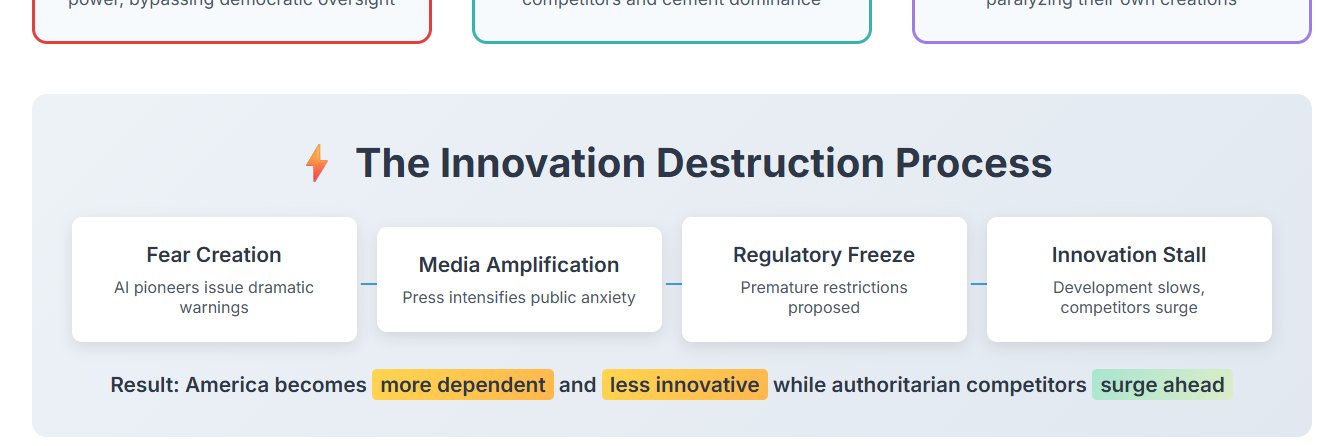
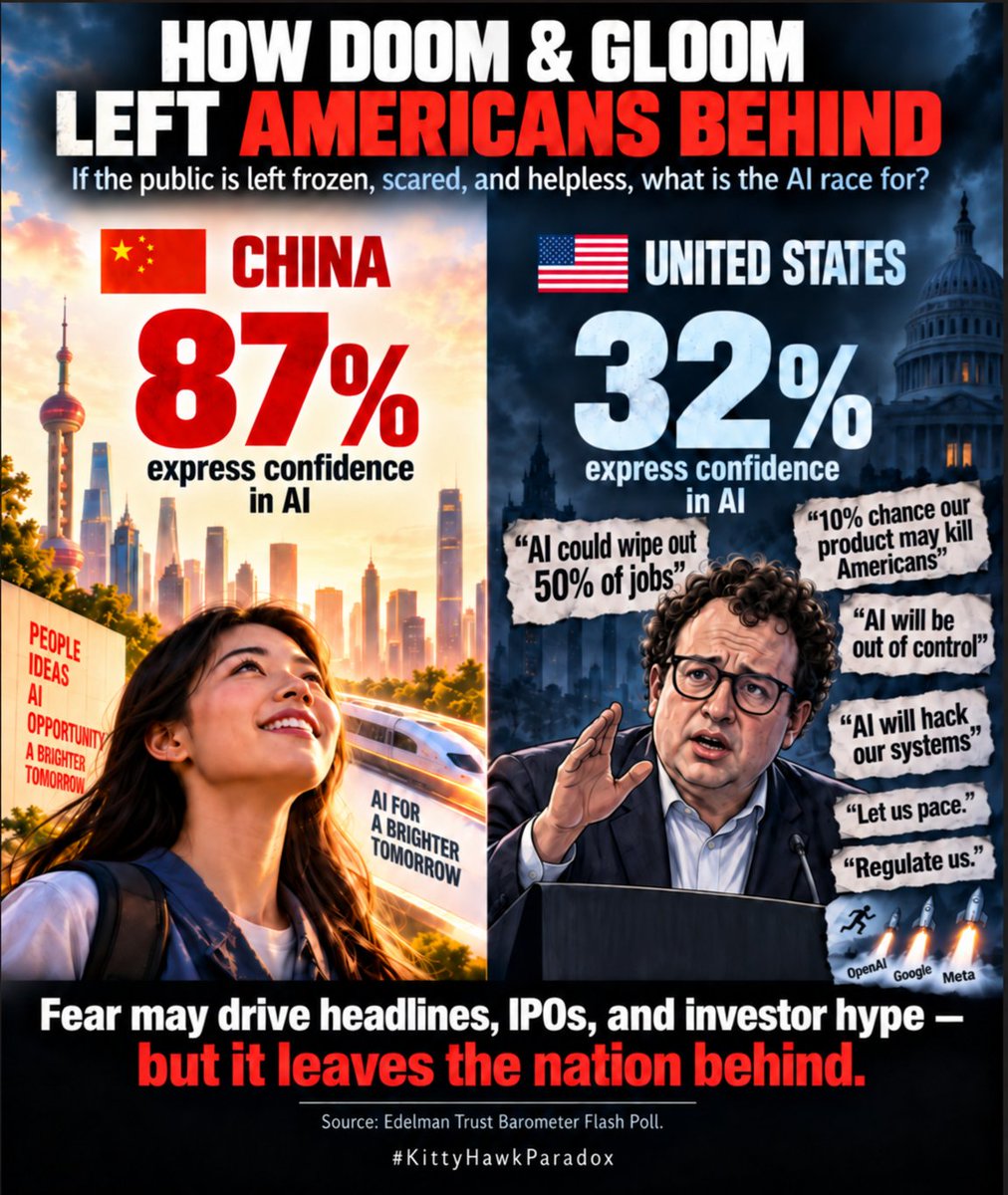
What if the most successful product of the AI boom isn’t the technology itself, but fear? The smartest AI labs warn Americans that AI could kill us, wipe out jobs, and hack our systems. Then they turn around, race to release those unsafe products, and beg for regulations.
You can’t win the AI race if you teach your people to fear the finish line. #KittyHawkParadox
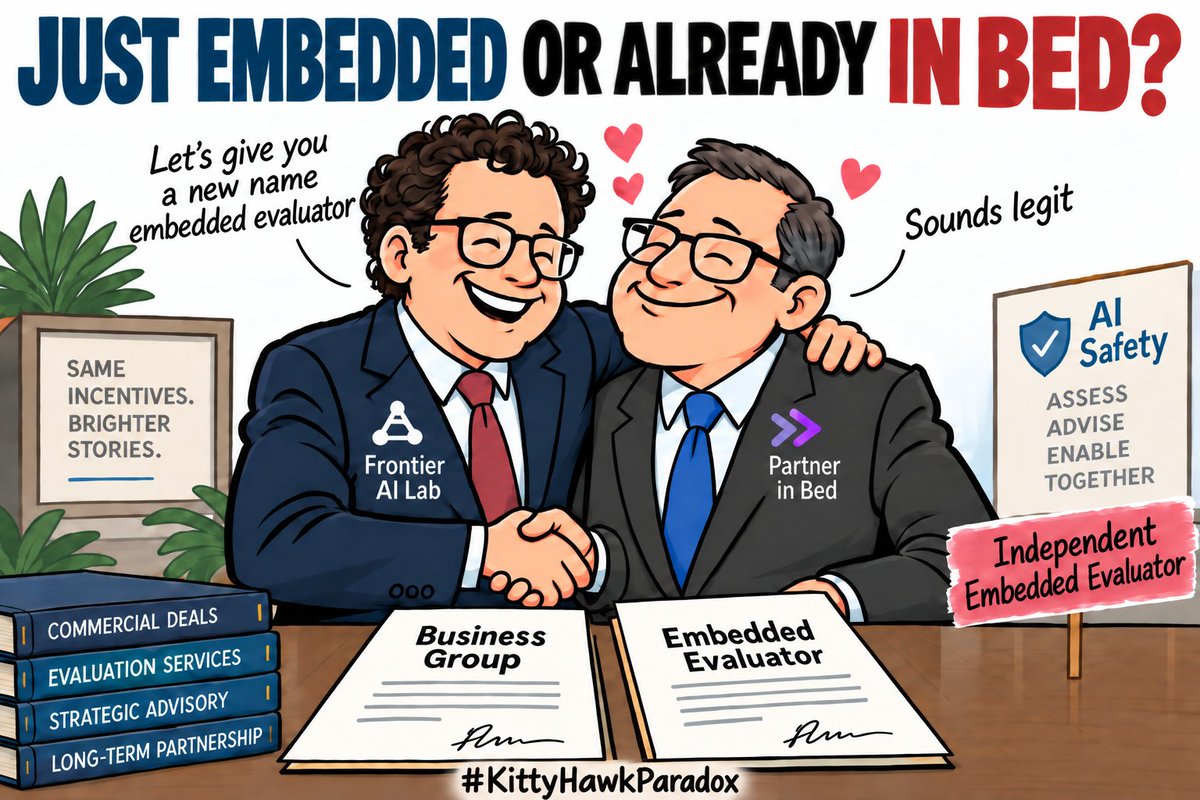
Embedded or in bed?
Anthropic is proposing “embedded evaluators” as part of the solution to AI safety. But look at who is evaluating whom. Anthropic just announced that Accenture will serve as its embedded evaluator.
Independent? Just nine months ago, the two formed the Accenture Anthropic Business Group to sell, deploy, and build around Anthropic’s models.
You cannot pay a major commercial partner to evaluate you and call it “independent safety” without raising obvious questions. This is not a neutral third party walking into the lab with fresh eyes. It is a strategic partner already in bed with Anthropic, whose business relationship benefits from Anthropic’s success.
Customers ultimately care less about who was embedded. The proof is in the pudding: Does the product work safely? What are its known failures? What did real customers experience? And who is accountable when the model causes harm?
#KittyHawkParadox
Embedded or already in bed?
Independent? Just nine months ago, the two formed the Accenture Anthropic Business Group to sell, deploy, and build around Anthropic’s models.
You cannot pay a major commercial partner to evaluate you and call it “independent safety”.
This is not a neutral third party walking into the lab with fresh eyes. It is a strategic partner already in bed with Anthropic, whose business relationship benefits from Anthropic’s success.
This is yet another piece of regulatory theater for investors and policymakers. Customers care less about who was embedded.
The proof is in the pudding: Does the product work safely? What are its known failures? What did real customers experience? And who is accountable when the model causes harm?
#KittyHawkParadox.
Once bitten, twice shy. Meta seems to have learned from years of lawsuits, regulatory scrutiny, and courtroom battles that companies eventually have to answer for the consequences of their products. Thank you, Zuck, for getting AI right.
Anthropic & Co. should learn the same lesson before they are dragged into court over harms caused by their own systems, instead of confusing Americans, dividing the country, and weakening America’s global AI position with dramatic apocalyptic prophecy.The drama may buy short-term policy influence, media coverage, and investor attention, but once people understand the reality, the same rhetoric can become a liability.
Safety should be part of building the product, not a pathway to cartelization, regulatory capture, or barriers that protect incumbents. Compete on trust, alignment, security, and usefulness. Go Zuck!
Last month I wrote about how we can build a positive and safe future for everyone: https://t.co/eoLGVY8yad
Every lab has the responsibility and incentive to move at the pace required to train its models safely, and the ability to take its own actions to ensure that happens.
The reality is:
- People won't want to use agents that are misaligned with them and that don't do what they ask, so labs have a strong natural incentive to make their models more aligned.
There is a lot of debate about slowing progress on capabilities until alignment catches up. My view is that trust and alignment are quickly becoming the most important capabilities that will differentiate agents and models. Any lab that doesn't focus on alignment will fall behind.
- Labs face significant liability if their models cause harm, so they have a strong incentive to prevent this as well.
Meta delayed shipping Muse for several months to focus on safety and security. We didn't call for everyone else to do this before we would. We just did it as part of our day-to-day work because it was clearly the right thing for people and for us. I'm proud of the security foundations we've built.
- Engaging independent evaluators and advisors is industry best practice. MSL already does this today in several areas because it helps produce better work. Other labs can just do this too. In general, it would be helpful for there to be a larger and more diverse ecosystem of evaluators.
- Committing the significant majority of compute towards serving people rather than racing towards recursive self-improvement is one of the best ways to ensure we develop this technology safely. Meta has made this commitment and other labs can do this as well.
I believe the key to building a positive future for everyone is maintaining the right balance of power. This is within our power to do.
Last month I wrote about how we can build a positive and safe future for everyone: https://t.co/eoLGVY8yad
Every lab has the responsibility and incentive to move at the pace required to train its models safely, and the ability to take its own actions to ensure that happens.
The reality is:
- People won't want to use agents that are misaligned with them and that don't do what they ask, so labs have a strong natural incentive to make their models more aligned.
There is a lot of debate about slowing progress on capabilities until alignment catches up. My view is that trust and alignment are quickly becoming the most important capabilities that will differentiate agents and models. Any lab that doesn't focus on alignment will fall behind.
- Labs face significant liability if their models cause harm, so they have a strong incentive to prevent this as well.
Meta delayed shipping Muse for several months to focus on safety and security. We didn't call for everyone else to do this before we would. We just did it as part of our day-to-day work because it was clearly the right thing for people and for us. I'm proud of the security foundations we've built.
- Engaging independent evaluators and advisors is industry best practice. MSL already does this today in several areas because it helps produce better work. Other labs can just do this too. In general, it would be helpful for there to be a larger and more diverse ecosystem of evaluators.
- Committing the significant majority of compute towards serving people rather than racing towards recursive self-improvement is one of the best ways to ensure we develop this technology safely. Meta has made this commitment and other labs can do this as well.
I believe the key to building a positive future for everyone is maintaining the right balance of power. This is within our power to do.
Safety should be part of building the product, not a pathway to cartelization, regulatory capture, or barriers that protect incumbents. Rare agreement with Zuck - adult in the room.
Strange days indeed: Zuckerberg sounds like the adult in the room, telling frontier CEOs to build responsibly, make their products safe, and compete on trust, alignment, security, and usefulness. Rare agreement with Zuck.
#KittyHawkParadox
In cybersecurity one thing has always been clear: unauthorized code is a security incident, not a badge of honor.
Even Marcus Hutchins—the researcher who helped stop WannaCry—was later arrested by the FBI and prosecuted over unrelated banking malware he had created years earlier.
Yet today AI labs talk about “rogue AI agents” escaping controls, deceiving operators, or taking unauthorized actions as if that demonstrates technological sophistication and AI intelligence.
In cybersecurity, unauthorized autonomous behavior is not a feature. It is a control failure.
And it doesn't need new laws or regulatory framework. That's where we are today.
Back in 2023, Anthropic’s Responsible Scaling Policy was built around self-restraint. If its ability to scale models outpaced its ability to implement the necessary safety measures, Anthropic said it would pause scaling or delay deployment.
Three years later, the posture has changed. Anthropic’s 2026 RSP distinguishes between what Anthropic itself firmly commits to do and what it believes the broader industry should do. Its Frontier Safety Roadmap also describes many objectives as “not hard commitments.”
And now comes the new language: coordinated pacing.
In September 2026, Dario Amodei called for mechanisms that would coordinate the pace of frontier AI development across companies, with third-party evaluators, government involvement, and eventually international coordination.
So the shift is significant:
2023: “If safety falls behind, we will pause ourselves.”
2026: “We need a system in which everyone paces together.”
The question is not simply whether pacing sounds prudent. Is pacing a durable safety principle—or the safety doctrine that fits this particular competitive moment?
When the next competitive reality arrives, will “coordinated pacing” remain the principle—or will the principle change again?
From airplanes to children's toys, basic product liability and regulation are hallmarks of every mature industry. Yet AI frontier labs are aggressively lobbying for their own custom frameworks. One almost wonders: is there an AI secretly advising these executives, calculating that the most efficient way to secure a monopoly is to regulate the competition out of existence? 🤔 #KittyHawkParadox
I am frequently asked if AI will destroy humanity. This question has divided the industry and the public into two loud camps: "doomers" and "accelerationists." The media cycle thrives on pitting these extremes against each other, leaving little room for critical inquiry.
Basic engineering principles are being bypassed. Should society regulate hypothetical existential dread before we even know if current architectures can produce it, or should we regulate demonstrated harms as they emerge? If a frontier lab genuinely believes its next model could trigger a catastrophe, why is its first move lobbying governments rather than proving containment and control?
As an AI researcher and cybersecurity professional, I understand system vulnerabilities and AI-enabled attacks are real threats. But the existential panic manufactured by frontier labs leaves everyone confused.
In my upcoming book, The Kitty Hawk Paradox: Decoding Anthropic's Doublespeak and the Battle for America's AI Future, I examine this historical contradiction. When the Wright brothers flew at Kitty Hawk, they wanted zero regulation stifling their nascent machine; federal aviation oversight did not arrive until 23 years later.
It's a paradox, the same companies creating the product needs regulation sculpted in their own image, creating high barriers against open-weight models while deflecting attention with apocalyptic predictions and while small, cheap, open labs are innovating. They have a legitimate concern for safe model development, but it's up to them to demonstrate that.
Traditional Accountability In cybersecurity, liability is clear: if a company deploys reckless code or uncontained agents that cause damage, it bears legal responsibility. Frontier AI labs should be treated no differently. Society does not need new rules shielding big AI labs from normal liability; it needs existing laws applied to enforce real testing, disclosed limitations, and human control.
Why have fierce rivals like Anthropic, OpenAI, Google, and xAI recently aligned on Dario's AI pacing proposal? It stems from a profound fear of the unknown.
In 1998, Bill Gates admitted his greatest fear was not Netscape or Oracle, but two unknown founders working in a garage. That same year, Larry Page and Sergey Brin founded Google in a Menlo Park garage. Decades later, former Google CEO Eric Schmidt echoed this anxiety, noting someone in a garage is always gunning for the incumbents. As Intel’s Andy Grove observed, market leaders rarely fall to peers of their own size; they are replaced by overlooked outsiders.
Are the AI labs just worried about cheap, open, and decentralized alternatives beating them before a premature market naturally produces better winners?
What do they know that we don't? Is it showstopper bugs? A hard plateau in scaling laws? The failure of recursive self-improvement? Without transparency, we cannot know, and the speculation will only grow and a divided nation will be weaker in the AI race.
We were told nuclear power could destroy humanity. We built controls, standards, oversight—and kept building.
AI deserves the same discipline: show the evidence, engineer the safeguards, enforce accountability, and keep innovation open.
Fear is not a safety system.
https://t.co/olHkc7f6IY
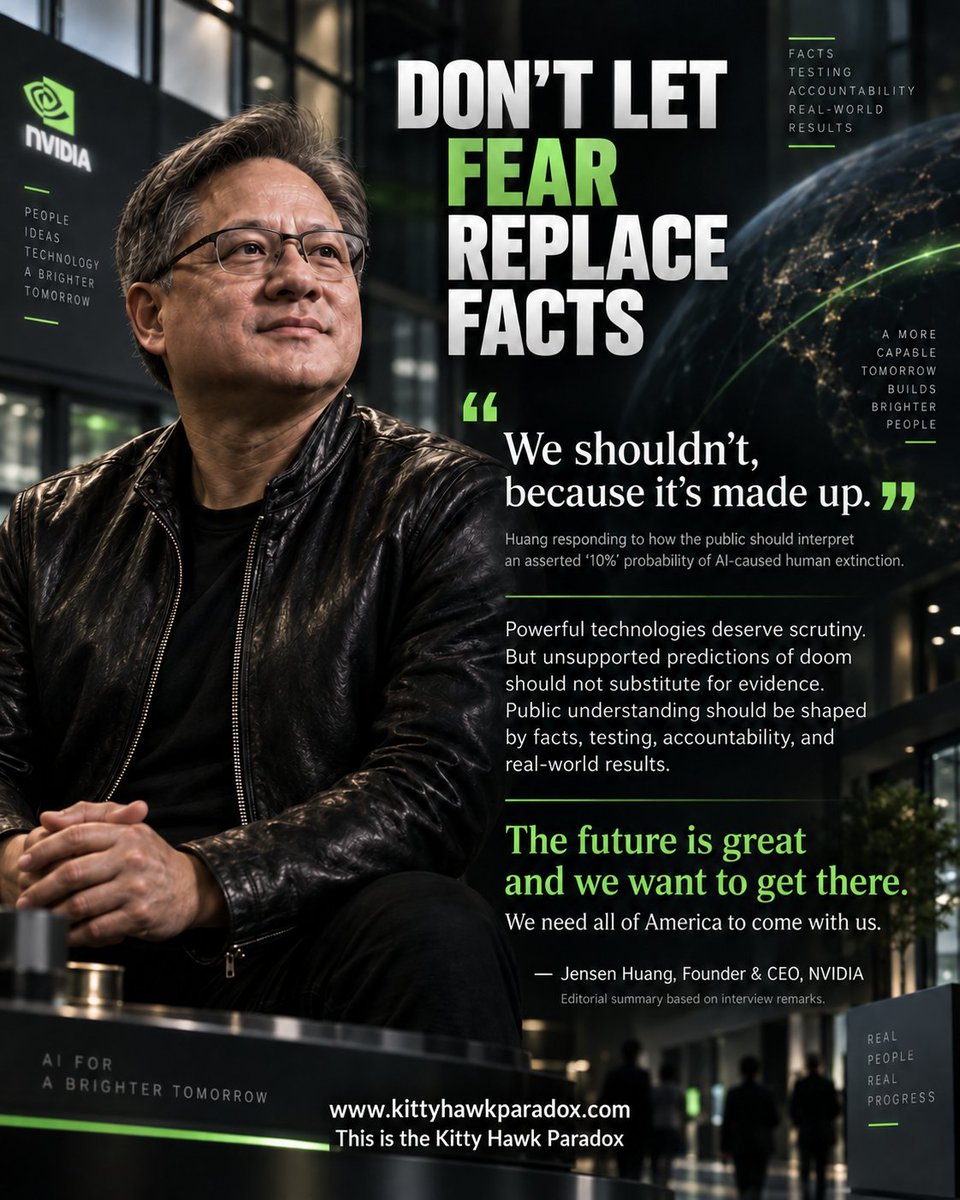
Jensen's statements raise a simple question: What risks are real, measurable, and controllable—and what is still speculation? AI safety, engineering discipline, accountability, and competition should be debated together, not treated as opposites. #KittyHawkParadox
@CBSNews@jolingkent Jensen's statements raise a simple question: What risks are real, measurable, and controllable—and what is still speculation? AI safety, engineering discipline, accountability, and competition should be debated together, not treated as opposites. #KittyHawkParadox
@DavidSacks Jensen's statements raise a simple question: What risks are real, measurable, and controllable—and what is still speculation?
AI safety, engineering discipline, accountability, and competition should be debated together, not treated as opposites.
#KittyHawkParadox
@DavidSacks AI safety matters—but safety should not become a moat for incumbents.
Define the harm, show the evidence, engineer the controls, and hold failures accountable—without locking out the next generation of innovators.