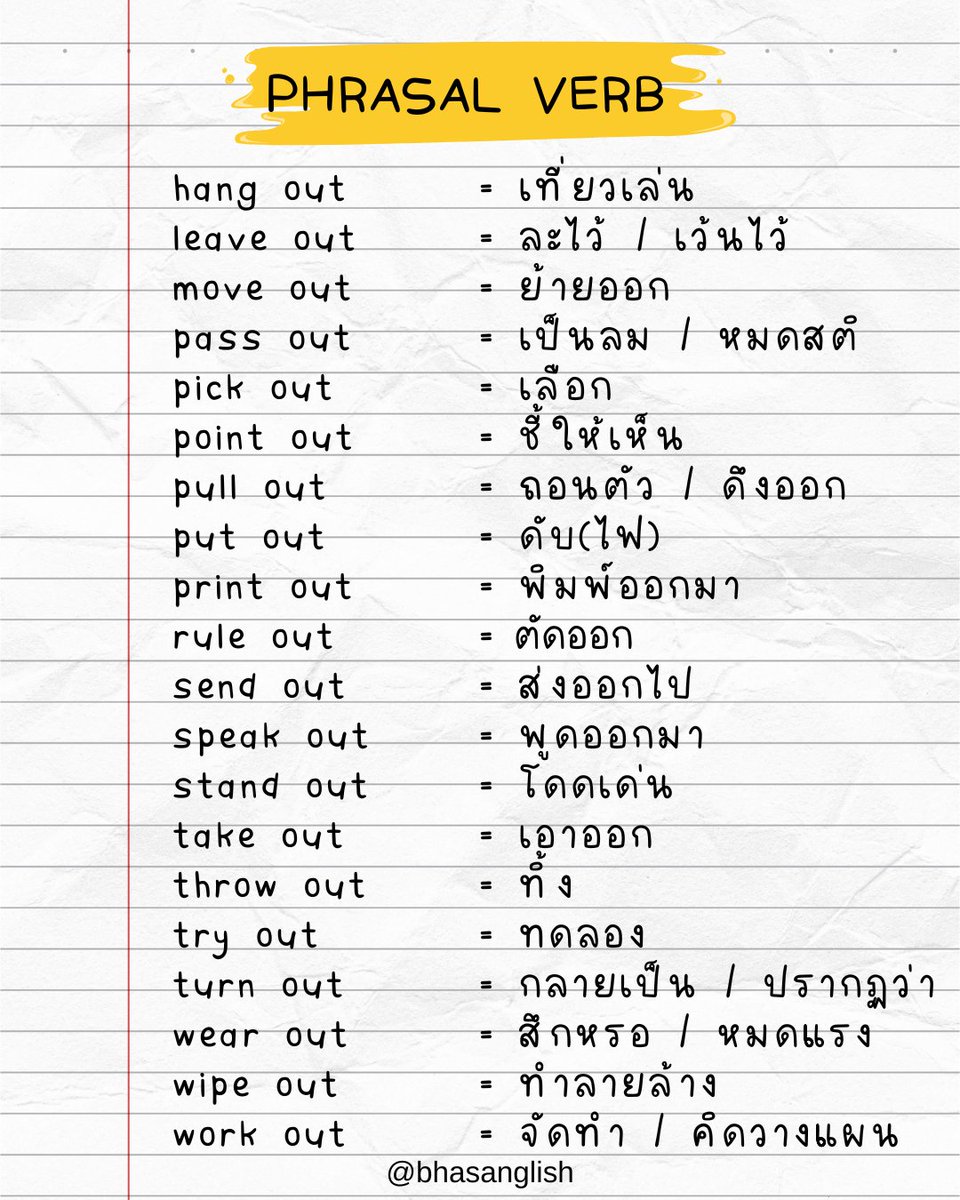
📌 รวม Phrasal Verbs ลงท้ายด้วย “out” (Part 2/2)
คำที่ข้อสอบชอบออก + ใช้จริงบ่อยมาก พร้อมตัวอย่างและคำแปลครบ
✏️hang out = เที่ยวเล่น
We hang out on weekends.
พวกเราไปเที่ยวด้วยกันวันหยุด
✏️leave out = ละไว้ / เว้นไว้
Don’t leave out any details.
อย่าละรายละเอียดใด ๆ
✏️move out = ย้ายออก
They moved out last month.
พวกเขาย้ายออกเดือนที่แล้ว
✏️pass out = เป็นลม / หมดสติ
He passed out from heat.
เขาเป็นลมเพราะความร้อน
✏️pick out = เลือก
She picked out a dress.
เธอเลือกชุดหนึ่งชุด
✏️point out = ชี้ให้เห็น
She pointed out the mistake.
เขาได้ชี้ให้เห็นข้อผิดพลาด
✏️pull out = ถอนตัว / ดึงออก
The army pulled out.
กองทัพถอนกำลังออกไป
✏️put out = ดับ
Put out the fire.
ดับไฟ
✏️print out = พิมพ์ออกมา
Print out the document.
พิมพ์เอกสารออกมา
✏️rule out = ตัดออก
We can rule out that option.
เราตัดตัวเลือกนั้นออกได้
✏️send out = ส่งออกไป
They sent out invitations.
พวกเขาส่งบัตรเชิญ
✏️speak out = พูดออกมา
She spoke out against injustice.
เธอออกมาพูดต่อต้านความไม่ยุติธรรม
✏️stand out = โดดเด่น
Her talent stands out.
พรสวรรค์ของเธอโดดเด่น
✏️take out = เอาออก
Take out the trash.
เอาขยะไปทิ้ง
✏️throw out = ทิ้ง
Throw out the old papers.
ทิ้งเอกสารเก่าไปซะ
✏️try out = ทดลอง
Let’s try out this new software.
มาลองโปรแกรมใหม่นี้กัน
✏️turn out = กลายเป็น / ปรากฏว่า
It turned out well.
มันออกมาดี
✏️wear out = สึกหรอ / หมดแรง
He wore out two pairs of shoes last year.
เขาใส่รองเท้าจนสึกไปสองคู่เมื่อปีที่แล้ว
✏️wipe out = ทำลายล้าง
The storm wiped out the village.
พายุทำลายหมู่บ้าน
✏️work out = จัดทำ / คิดวางแผน
We need to work out a seating plan.
พวกเราต้องจัดทำผังที่นั่ง
#ภาษาอังกฤษ #English #grammar
#IELTS #TOELF #TOEIC #SAT #CUTEP #TUGET
#dek69 #tcas69 #TGATENG #ALEVELENG
📌 รวม Phrasal Verbs ลงท้ายด้วย “out” (Part 1/2)
คำที่ข้อสอบชอบออก + ใช้จริงบ่อยมาก พร้อมตัวอย่างและคำแปลครบ
✏️ask out = ชวนออกเดต
He asked her out.
เขาชวนเธอออกเดต
✏️break out = ปะทุ / เกิดขึ้นกะทันหัน
A fire broke out.
ไฟไหม้เกิดขึ้น
✏️bring out = ออกวางจำหน่าย
The company brought out a new product.
บริษัทออกสินค้าใหม่
✏️burst out = ระเบิดออก / ปะทุ
She burst out laughing.
เธอหัวเราะออกมา
✏️carry out = ดำเนินการ
We're carrying out a market research survey.
พวกเรากำลังดำเนินการสำรวจวิจัยตลาด
✏️check out = ตรวจสอบ / เช็กเอาต์
Check out this website.
ลองดูเว็บไซต์นี้สิ
✏️come out = ปรากฏ / เปิดเผย / วางจำหน่าย
The book came out last year.
หนังสือออกวางจำหน่ายปีที่แล้ว
✏️cross out = ขีดฆ่า
Cross out the wrong answer.
ขีดฆ่าคำตอบที่ผิด
✏️cry out = ร้องตะโกน
He cried out in pain.
เขาร้องด้วยความเจ็บปวด
✏️die out = สูญพันธุ์ / ค่อย ๆ หายไป
Many traditions are dying out.
หลายประเพณีกำลังค่อย ๆ หายไป
✏️drop out = ลาออก / เลิกเรียน
He dropped out of college.
เขาลาออกจากมหาวิทยาลัย
✏️dry out = แห้ง
The clothes dried out.
เสื้อผ้าแห้งแล้ว
✏️eat out = กินข้าวนอกบ้าน
We eat out every Friday.
พวกเรากินข้าวนอกบ้านทุกวันศุกร์
✏️figure out = คิดออก / หาคำตอบได้
I can’t figure out this problem.
ฉันคิดโจทย์นี้ไม่ออก
✏️fill out = กรอกแบบฟอร์ม
Please fill out this application.
กรุณากรอกใบสมัครนี้
✏️find out = ค้นพบ / รู้
I found out the truth.
ฉันค้นพบความจริง
✏️get out = ออกไป
She screamed at me to get out.
เขาตะโกนใส่ฉันให้ออกไป
✏️give out = แจก
I've been giving out leaflets.
ฉันกำลังแจกใบปลิวอยู่ช่วงนี้.
✏️go out = ออกไป / ดับ
The lights went out last night.
ไฟดับเมื่อคืน
✏️hand out = แจก
The teacher handed out the papers.
ครูได้แจกเอกสารแล้ว
#ภาษาอังกฤษ #English #grammar
#IELTS #TOELF #TOEIC #SAT #CUTEP #TUGET
#dek69 #tcas69 #TGATENG #ALEVELENG
📌 รวม Phrasal Verbs ลงท้ายด้วย “in” ที่ใช้บ่อยมากในชีวิตจริงและข้อสอบ พร้อมตัวอย่าง + คำแปล เข้าใจง่ายในโพสต์เดียว
✏️break in = บุกรุก / งัดเข้า
Someone broke in last night.
มีคนบุกรุกเข้ามาเมื่อคืน
✏️call in = โทรแจ้ง / เรียกมา
She called in sick.
เขาโทรแจ้งลาป่วย
✏️check in = เช็กอิน / ลงทะเบียน
We checked in at the hotel.
เราเช็กอินที่โรงแรม
✏️chip in = ช่วยออกเงิน
We all chipped in for dinner.
พวกเราช่วยกันออกเงินค่าอาหาร
✏️count in = รวมไว้ด้วย / นับรวม
Count me in!
นับฉันรวมด้วยนะ
✏️cut in = แทรก / ตัดหน้า
Don’t cut in while I’m speaking.
อย่าแทรกตอนฉันพูด
✏️drop in = แวะมา
She dropped in for coffee.
เขาแวะมาดื่มกาแฟ
✏️fill in = กรอก
Please fill in the form.
กรุณากรอกแบบฟอร์ม
✏️give in = ยอมแพ้
He finally gave in.
ในที่สุดเขาก็ยอม
✏️hand in = ส่ง (งาน)
I handed in my assignment.
ฉันส่งงานแล้ว
✏️keep in = กักไว้ / กลั้น
The teacher kept him in after class.
ครูกักเขาไว้หลังเลิกเรียน
✏️let in = ปล่อยให้เข้า
Please let me in.
ช่วยเปิดให้ฉันเข้าไปหน่อย
✏️log in = ลงชื่อเข้าใช้ / เข้าสู่ระบบ
Please log in to your account.
กรุณาเข้าสู่ระบบบัญชีของคุณ
✏️pitch in = ช่วยกันทำ
Let’s pitch in and finish the work.
มาช่วยกันทำงานให้เสร็จ
✏️plug in = เสียบปลั๊ก
Plug in your charger.
เสียบที่ชาร์จ
✏️result in = ส่งผลให้เกิด
The mistake resulted in a delay.
ความผิดพลาดส่งผลให้เกิดความล่าช้า
✏️sign in = ลงชื่อเข้า
Please sign in at the front desk.
กรุณาลงชื่อที่เคาน์เตอร์ด้านหน้า
✏️take in = รับ / ดูดซึม
Fish take in oxygen through their gills.
ปลารับออกซิเจนผ่านทางเหงือก
✏️take part in = เข้าร่วม / มีส่วนร่วมใน
She took part in the competition.
เขาเข้าร่วมการแข่งขัน
✏️turn in = ส่ง / มอบตัว
He decided to turn himself in.
เขาตัดสินใจเข้ามอบตัวกับตำรวจ
#ภาษาอังกฤษ #English #grammar
#IELTS #TOELF #TOEIC #SAT #CUTEP #TUGET
#TGATeng #ALEVELeng
📌 รวมกริยา + to ที่ออกสอบบ่อย ใช้จริงบ่อย พร้อมตัวอย่างและคำแปล เข้าใจในโพสต์เดียว
✏️add to = เพิ่มเข้าไปใน / ทำให้เพิ่มขึ้น
His comments added to the confusion.
ความคิดเห็นของเขาทำให้ความสับสนเพิ่มขึ้น
✏️admit to = ยอมรับ / สารภาพ
She admitted to cheating.
เธอยอมรับว่าโกง
✏️agree to = ตอบตกลง (ข้อเสนอ/เงื่อนไข)
They agreed to the plan.
พวกเขาตกลงตามแผน
✏️amount to = รวมได้ / มีค่าเท่ากับ
The bill amounts to $500.
บิลรวมแล้ว 500 ดอลลาร์
✏️belong to = เป็นของ
This book belongs to me.
หนังสือเล่มนี้เป็นของฉัน
✏️come to = ผุดเข้ามาในหัว
The idea came to me in the bath.
ฉันนึกไอเดียออกตอนอยู่ในอ่างอาบน้ำ
✏️confess to = สารภาพว่าได้ทำ
He confessed to the crime.
เขาสารภาพความผิด
✏️contribute to = มีส่วนทำให้เกิด
Smoking contributes to cancer.
การสูบบุหรี่มีส่วนทำให้เกิดมะเร็ง
✏️get to = ไปถึง / ทำให้หงุดหงิด
The pressure of work is beginning to get to him.
ความกดดันจากงานกำลังเริ่มทำให้เขาหงุดหงิด
✏️hold on to = ยึดไว้ / รักษาไว้
Hold on to your ticket.
เก็บตั๋วไว้ให้ดี
✏️lead to = นำไปสู่
Lack of sleep leads to stress.
การนอนไม่พอนำไปสู่ความเครียด
✏️look forward to = ตั้งตารอ
I look forward to seeing you.
ฉันตั้งตารอที่จะเจอคุณ
✏️object to = คัดค้าน
She objected to the idea.
เธอคัดค้านความคิดนั้น
✏️react to = ตอบสนองต่อ
How did he react to the news?
เขาตอบสนองต่อข่าวอย่างไร
✏️refer to = อ้างถึง / หมายถึง
What does this word refer to?
คำนี้หมายถึงอะไร
✏️reply to = ตอบกลับ
She replied to my email.
เธอตอบอีเมลของฉัน
✏️respond to = ตอบสนอง / ตอบกลับ
The public is responding positively to these changes.
ประชาชนตอบสนองต่อการเปลี่ยนแปลงเหล่านี้ในทางที่ดี
✏️stick to = ยึดมั่น / ทำตามเดิม
Stick to the plan.
ทำตามแผนเดิมต่อไป
✏️talk to = พูดคุยกับ
I need to talk to you.
ฉันต้องคุยกับคุณ
✏️ turn to = หันไปพึ่ง / หันไปหา
She turned to her friend for help.
เธอหันไปขอความช่วยเหลือจากเพื่อน
#ภาษาอังกฤษ #English #grammar
#IELTS #TOELF #TOEIC #SAT #CUTEP #TUGET
#TGATeng #ALEVELeng
📌 รวม Verb + “of” ที่ออกสอบบ่อยและใช้จริงในชีวิตประจำวัน!
หลายคำหน้าตาคล้ายกัน แต่ความหมายต่างกันชัดเจน 👀
โพสต์นี้สรุปความหมาย + ตัวอย่างประโยค + แปลไทยแบบเข้าใจง่าย
อ่านจบ ใช้ได้ทันที ✨
✏️approve of = เห็นชอบ / เห็นด้วย
I don’t approve of his behavior.
ฉันไม่เห็นด้วยกับพฤติกรรมของเขา
✏️be accused of = ถูกกล่าวหาว่า
He was accused of stealing.
เขาถูกกล่าวหาว่าขโมย
✏️be composed of = ประกอบด้วย
The committee is composed of five members.
คณะกรรมการประกอบด้วยสมาชิกห้าคน
✏️be convicted of = ถูกตัดสินว่า
He was convicted of fraud.
เขาถูกตัดสินว่าฉ้อโกง
✏️be deprived of = ถูกพราก
He was deprived of his rights.
เขาถูกพรากสิทธิ์ไป
✏️be made of = ทำจาก
The table is made of wood.
โต๊ะตัวนี้ทำจากไม้
✏️be suspected of = ถูกสงสัยว่า
She was suspected of lying.
เขาถูกสงสัยว่าโกหก
✏️come of = เกิดจาก / เป็นผลจาก
Good may come of this.
สิ่งดี ๆ อาจเกิดจากเรื่องนี้
✏️consist of = ประกอบด้วย
The team consists of five members.
ทีมนี้ประกอบด้วยสมาชิกห้าคน
✏️dispose of = ทิ้ง
Please dispose of the waste properly.
กรุณาทิ้งขยะให้ถูกที่
✏️dream of = ฝันถึง / ใฝ่ฝันถึง
She dreams of becoming a doctor.
เขาฝันอยากเป็นหมอ
✏️get ahead of = แซงหน้า
He got ahead of his competitors.
เขาแซงหน้าคู่แข่งแล้ว
✏️get rid of = กำจัด
She got rid of old clothes.
เขากำจัดเสื้อผ้าเก่าๆ ออกไปแล้ว
✏️get out of = ออกจาก / ลงจาก
Get out of the car.
ออกจากรถ
✏️hear of = เคยได้ยินเกี่ยวกับ
Have you heard of this author?
คุณเคยได้ยินเกี่ยวกับนักเขียนคนนี้ไหม
✏️keep out of = อย่าไปยุ่ง / หลีกเลี่ยง
Keep out of trouble.
อย่าไปยุ่งกับปัญหานี้เลย
✏️know of = รู้จัก / ทราบเกี่ยวกับ
I know of him, but I don’t know him personally.
ฉันรู้จักชื่อเขา แต่ก็ไม่ได้รู้จักเป็นการส่วนตัว
✏️run out of = หมด
We ran out of time.
พวกเราหมดเวลา
✏️take care of = ดูแล / จัดการ
I’ll take care of it.
เดี๋ยวฉันจะจัดการเอง
✏️think of = คิดถึง / นึกถึง
What do you think of this idea?
คุณคิดอย่างไรกับความคิดนี้
#ภาษาอังกฤษ #English #grammar
#IELTS #TOELF #TOEIC #SAT #CUTEP #TUGET
#TGATeng #ALEVELeng
📌 รวม Phrasal Verbs ที่ลงท้ายด้วย “with” ที่ใช้บ่อยมากในชีวิตประจำวัน!
เห็นคำว่า with ง่าย ๆ แต่พอรวมกับกริยาแล้ว ความหมายเปลี่ยนทันที 😮
โพสต์นี้สรุปความหมาย + ตัวอย่าง + แปลไทยครบในที่เดียว ✨
อ่านจบ ใช้ได้จริงแน่นอน
✏️agree with = เห็นด้วยกับ
I agree with you.
ฉันเห็นด้วยกับคุณ
✏️argue with = โต้เถียงกับ
She argued with her boss.
เขาโต้เถียงกับเจ้านาย
✏️catch up with = ตามทัน
He caught up with his classmates.
เขาตามเพื่อนร่วมชั้นทัน
✏️chat with = คุยเล่นกับ
He chatted with his friends.
เขาคุยเล่นกับเพื่อน
✏️come up with = คิดหา / เสนอ
She came up with a solution.
เธอคิดวิธีแก้ปัญหาได้
✏️comply with = ปฏิบัติตาม
Employees must comply with regulations.
พนักงานต้องปฏิบัติตามกฎระเบียบ
✏️compete with = แข่งขันกับ
We have to compete with several companies.
พวกเราต้องแข่งขันกับบริษัทต่างๆ
✏️consult with = ปรึกษากับ
She consulted with a lawyer.
เขาปรึกษาทนาย
✏️coincide with = เกิดขึ้นพร้อมกันกับ
The meeting coincides with my class.
ประชุมตรงกับเวลาเรียนของฉัน
✏️cope with = รับมือกับ
He can’t cope with stress.
เขารับมือกับความเครียดไม่ได้
✏️deal with = จัดการกับ
She deals with customer complaints.
เขาจัดการข้อร้องเรียนลูกค้า
✏️do away with = กำจัด / ยกเลิก
They did away with old regulations.
พวกเขายกเลิกกฎเก่า
✏️fall out with = แตกหักกับ
He fell out with his best friend.
เขาแตกหักกับเพื่อนสนิท
✏️get along with = เข้ากันได้กับ
I get along with my coworkers.
ฉันเข้ากับเพื่อนร่วมงานได้
✏️go out with = คบหากับ
She’s going out with Tom.
เขากำลังคบกับทอม
✏️interfere with = แทรกแซง / ขัดขวาง
Noise interferes with concentration.
เสียงรบกวนขัดขวางสมาธิ
✏️keep up with = ตามให้ทัน
I can’t keep up with the workload.
ฉันตามงานไม่ทัน
✏️put up with = ทนกับ
I can’t put up with the noise.
ฉันทนเสียงดังไม่ได้
✏️stick with = ยึดมั่น / ทำต่อไป
Stick with your plan.
ทำตามแผนของคุณต่อไป
✏️talk with = พูดคุยกับ
I talked with my teacher.
ฉันคุยกับครู
#ภาษาอังกฤษ #English #grammar
#IELTS #TOELF #TOEIC #SAT #CUTEP #TUGET
#TGAT #ALEVELeng
📌 รวม Phrasal Verbs ที่ลงท้ายด้วย “for” ที่ใช้บ่อยในชีวิตจริง!
หลายคนจำคำว่า for = สำหรับ แต่พอเจอ ask for, look for, make up for กลับงง 😵💫
โพสต์นี้สรุปความหมาย + ตัวอย่างประโยค + แปลไทยแบบเข้าใจง่าย อ่านจบ ใช้ได้ทันที ✨
✏️account for = อธิบาย
How do you account for this loss?
คุณอธิบายการขาดทุนนี้อย่างไร
✏️allow for = เผื่อ / คำนึงถึง
We must allow for delays.
เราต้องเผื่อความล่าช้าไว้
✏️apply for = สมัคร
She applied for a scholarship.
เขาสมัครทุนการศึกษา
✏️arrange for = จัดการให้
I arranged for a taxi.
ฉันจัดการเรียกรถแท็กซี่ให้
✏️ask for = ขอ
She asked for help.
เขาขอความช่วยเหลือ
✏️call for = ต้องการ / เรียกร้อง
This job calls for patience.
งานนี้ต้องการความอดทน
✏️care for = ดูแล
She cares for her grandmother.
เขาดูแลคุณยาย
✏️hope for = หวัง
We hope for better results.
เราหวังผลลัพธ์ที่ดีขึ้น
✏️long for = โหยหา
He longs for freedom.
เขาโหยหาอิสรภาพ
✏️look for = มองหา
I’m looking for my keys.
ฉันกำลังมองหากุญแจ
✏️make up for = ชดเชย
He worked hard to make up for lost time.
เขาทำงานหนักเพื่อชดเชยเวลาที่เสียไป
✏️opt for = เลือก
He opted for the cheaper option.
เขาเลือกตัวเลือกที่ถูกกว่า
✏️pay for = จ่ายเงิน / ชดใช้
He paid for the damage.
เขาชดใช้ค่าเสียหาย
✏️pray for = อธิษฐานขอ
They prayed for peace.
พวกเขาอธิษฐานขอสันติภาพ
✏️prepare for = เตรียมตัวสำหรับ
She prepared for the exam.
เขาเตรียมตัวสอบ
✏️register for = ลงทะเบียน
I registered for the course.
ฉันลงทะเบียนเรียนคอร์สนี้
✏️root for = เชียร์
I root for Liverpool.
ฉันเชียร์ลิเวอร์พูล
✏️stand for = ย่อมาจาก
“UN” stands for United Nations.
UN ย่อมาจาก United Nations
✏️wait for = รอ
I’m waiting for the bus.
ฉันกำลังรอรถเมล์
✏️yearn for = ปรารถนา
She yearns for success.
เธอปรารถนาความสำเร็จ
#ภาษาอังกฤษ #English #grammar
#IELTS #TOELF #TOEIC #SAT #CUTEP #TUGET
#TGAT #ALEVEL
คำว่า everyday กับ every day
ถึงจะออกเสียงเหมือนกันเป๊ะ ๆ แต่เวลาเขียน “เว้นวรรค” ผิด ความหมายและหน้าที่เปลี่ยนทันทีนะ!
มาดูแบบเข้าใจง่าย ๆ กัน 👇
▶️ everyday (คำเดียว)
🟢 เป็น adjective (ใช้นำหน้าคำนาม)
👉 แปลว่า “ประจำวัน / ทั่วไป / ในชีวิตประจำวัน”
เช่น:
The Internet has become part of everyday life.
“อินเทอร์เน็ตได้กลายเป็นส่วนหนึ่งของชีวิตประจำวัน”
👀ข้อสังเกต
บางประโยคสามารถใช้คำว่า daily แทนได้ เช่น
The Internet has become part of daily life.
▶️ every day (สองคำ)
🔵 เป็น adverb (ขยายคำกริยา มักวางท้ายประโยค)
👉 แปลว่า “ทุกวัน”
เช่น:
I learn English every day.
“ฉันเรียนภาษาอังกฤษทุกวัน”
💡 ทริคจำ
ถ้าแทนด้วย “each day” ได้ → ใช้ every day (แยกคำ)
✨ สรุปสั้น ๆ จำให้แม่น
🟢 everyday = ขยายคำนาม = ประจำวัน
🔵 every day = ขยายคำกริยา = ทุกวัน
ต่างกันแค่ “ช่องว่าง” แต่ความหมายเปลี่ยนทันทีเลยนะ 😉
#ภาษาอังกฤษ #English #grammar
#IELTS #TOELF #TOEIC #SAT #CUTEP #TUGET
#TGAT #ALEVEL