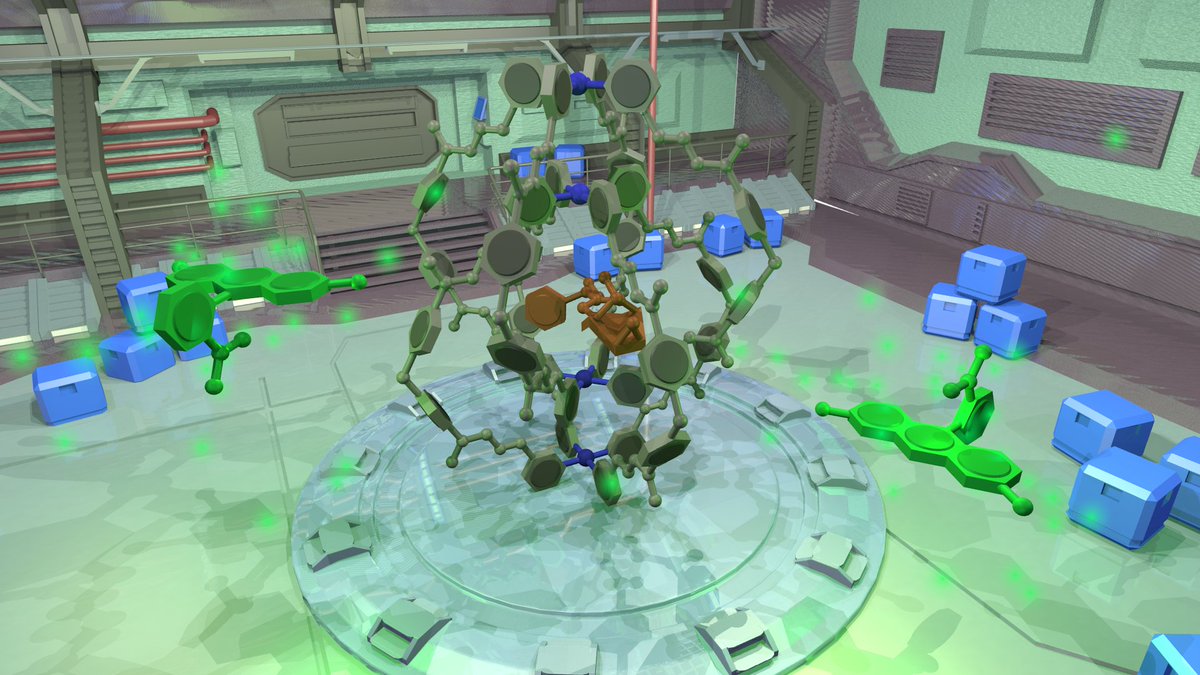
Trying to understand bond-breaking by first-row transition metal cross-coupling catalysts, congrats to Truong on the publication of his cobalt-catalyzed arylation method in @JOC_OL
https://t.co/qJQ0fw47Vh
Encapsulating xenon via dispersive interactions―Trapping #xenon in molecular cages raises an unresolved question: whether dispersion forces play the dominant role in Xe binding in solution, where competing effects such as solvophobic interactions may also contribute. In @J_A_C_S, Lu, Chen, Wang, Li et al. report the synthesis of a series of structurally analogous tetrahedral imine #cages in which the number and position of #fluorine atoms are systematically varied. Remarkably, only one member of the series exhibits a measurable affinity for xenon. Combined cavity volume analysis and theoretical calculations show that Xe–F London #dispersion interactions, together with size complementarity between guest and host cavity, are the primary determinants of xenon recognition in solution. Full article:
https://t.co/NNFYTFPCyT
In our new Account, Kavita @Kavita0809 has described cobalt catalyst development for cross-coupling of redox-active alkyl electrophiles, including redox-active sulfones
The take-away: stable organometallics are vital for productive reactivity
https://t.co/qx0C7HGCFs
In a tour de force of cobalt organometallics, PD Kavita @Kavita0809 has shed light on Csp2–Csp2 and Csp2–Csp3 cross-couplings, revealing weak field ancillary N,N ligands support diverging reactivities of high-spin and low-spin arylcobalt(II) catalysts
https://t.co/o0ZxmqmVh3
Nice to see that Click cage to #MOF with silver metal salts worked again! https://t.co/amnr2dEmSB
https://t.co/XalNozYnnT
https://t.co/vzTMhRum12 @angew_chem@Wiley_Chemistry
In our recent paper, we report for the first time, the use of carbon-carbon-bond-based radicals for the synthesis of (porous) organic cages with unique reactivity. Congratulations to Yannic for making it work 🧪🔥
https://t.co/82l1edMrbg
Congratulations @Stache_Lab for their latest in @J_A_C_S: “Universal Approach for the Depolymerization of Polyamides via Photothermal Conversion.”
Well done Deepika and Erin: https://t.co/oNMiq1TH3Z
Can ligands mimic larger portions of metalloproteins? Published in @DaltonTrans, we designed macrocylic peptides that mimic the β-sheet region at the active site of multicopper oxidases.
Article: https://t.co/0Jfc7zkqys
Our figure-eight salen dimer is now published in @InorgChem (@ACSPublications)!
In collaboration with Dr. Kondo at University of Shizuoka.
Congratulations, Wang-kun and Shiina-kun!!
https://t.co/LMmwiX0WPu
How do you make metal cations interact? Easy - just lock them in a pyrrolic cage! In our new paper just published in @InorgChem we show metallophilicity under molecular confinement! @WCh_UWr@NCN_PL https://t.co/lCQh9gACrx
🤩🤩🤩Very happy to see published in @angew_chem our work on #MolecularCages as an Indicator Displacement Assay for Sensing the Scopolamine Illicit Drug!! Many congrats to @GiovanniMG_PhD and all @IDM_UPV_UV@UPV team!
📰https://t.co/bWp1AcBjBo
In some of our first work on manganese catalyst design for C(sp3)–H activation, @Bhaswati95 has made and isolated some intriguing new multinuclear salen complexes including the titular Mn(IV)/Mn(III)/Mn(IV)-μ-oxo @DaltonTrans
https://t.co/6vw29rlN12