When is the Alts Season?
The Million Dollar Decode
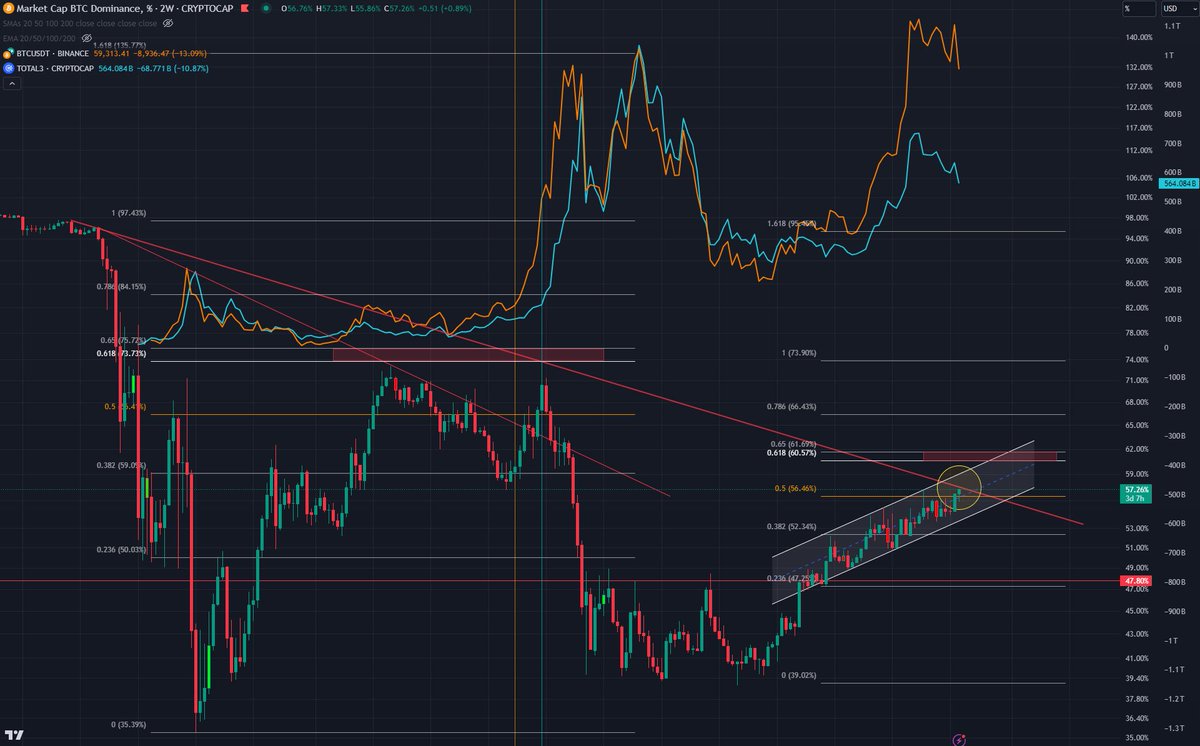
The most important trigger event currently in place. The bearish trendline starting from 2017, which sustained for 7years about to retest for breakout or breakdown. The million dollar question.
Many analysts expecting BTC dominance will breakdown and Alts season to trigger. However my strong view is opposite will happen, where BTC will trigger breakout towards 60.6% mark (Fib 618 resistance) without major fail.
If you look BTC dominance price action in history, only when BTC Dominance retested Fib 618 extension, that's the trigger for major dominance breakdown. Currently its at 60.6%. In above chart BTC price line in Orange and TOTAL3 price line in Light Blue.
We could anticipate Nov-Dec 2024 period where macro support also with Alts with few rate cuts in place to fuel the liquidity into high risky Alts. Alts rise can lead to 3-4month straight after breakout potentially towards March to April 2025 for first major Alts season.
#Bitcoin #TOTAL3 #Altseason #Alts #Bullrun2024
A bankrupt island nation of 22 million people just taught every great power on Earth a lesson in leverage.
Sri Lanka’s President Dissanayake stood before cameras on 6 March and said: “We are neutral but also humanitarian. Sri Lanka is a free and non-aligned nation. We do not favour any country. We treat every human being equally, whether Iranian, American, or Israeli. We jealously guard our non-aligned policy while ensuring that humanitarian values and the saving of lives remain our top priority.”
Then he granted free one-month humanitarian visas to all 236 Iranian sailors, the 32 survivors pulled from the wreckage of the IRIS Dena and 204 crew evacuated from the disabled IRIS Bushehr. He described sheltering them as “the most courageous and humanitarian course of action a state can take.”
The United States, which sank the Dena using USS Charlotte (SSN-766), a Los Angeles-class nuclear-powered fast-attack submarine firing Mk 48 heavyweight torpedoes 19 to 44 nautical miles off Galle, is pressuring Colombo through a State Department cable to retain the sailors under conditions favourable to American intelligence access. Washington wants the 32 survivors who witnessed classified US submarine engagement tactics.
China, which holds Hambantota port under a 99-year lease 90 kilometres from the sinking site, says nothing publicly. The debt speaks for itself.
India, which hosted the Dena at its MILAN 2026 exercise weeks before the ship was sunk by India’s closest strategic partner, has not uttered a single word about any of it.
Iran is broadcasting the rescue footage across every state media channel. Eighty-seven dead sailors and a neutral nation that refused American demands.
And Sri Lanka, sovereign-defaulted in 2022, currently under IMF conditionality, owing billions to Beijing through Belt and Road, dependent on Indian goodwill for regional security, and sitting at the intersection of every great-power pressure line in the Indian Ocean, chose international law.
UNCLOS Article 98 required the rescue. Geneva Convention II Article 17 required the internment. Hague Convention XIII prohibited allowing the sailors to re-enter combat. Sri Lanka followed every obligation to the letter. Uruguay did the same during the Falklands. Switzerland did the same throughout World War II. The law is unambiguous. The politics are not.
This is the same Sri Lanka that founded the Non-Aligned Movement in 1961. That hosted the fifth NAM summit in 1976. That proposed the Indian Ocean as a Zone of Peace in 1971 and got the UN to adopt it. And that is now pursuing BRICS partner status under India’s 2026 chairmanship, with Prime Minister Amarasuriya calling membership “strategically appealing” on 6 March, the same week her government was sheltering Iranian sailors against American objections.
Every major power assumed Sri Lanka would fold. Washington assumed economic leverage would force compliance. Beijing assumed debt would ensure silence. Delhi assumed proximity would guarantee deference. Tehran assumed sympathy would guarantee solidarity.
Instead, Colombo followed the law, issued the visas, sheltered the sailors, and told every great power exactly the same thing: we are neutral, we are humanitarian, and we do not take sides.
The weakest economy in the Indian Ocean just demonstrated the strongest foreign policy.
Full analysis for paid subscribers.
https://t.co/eMrt5qYYst
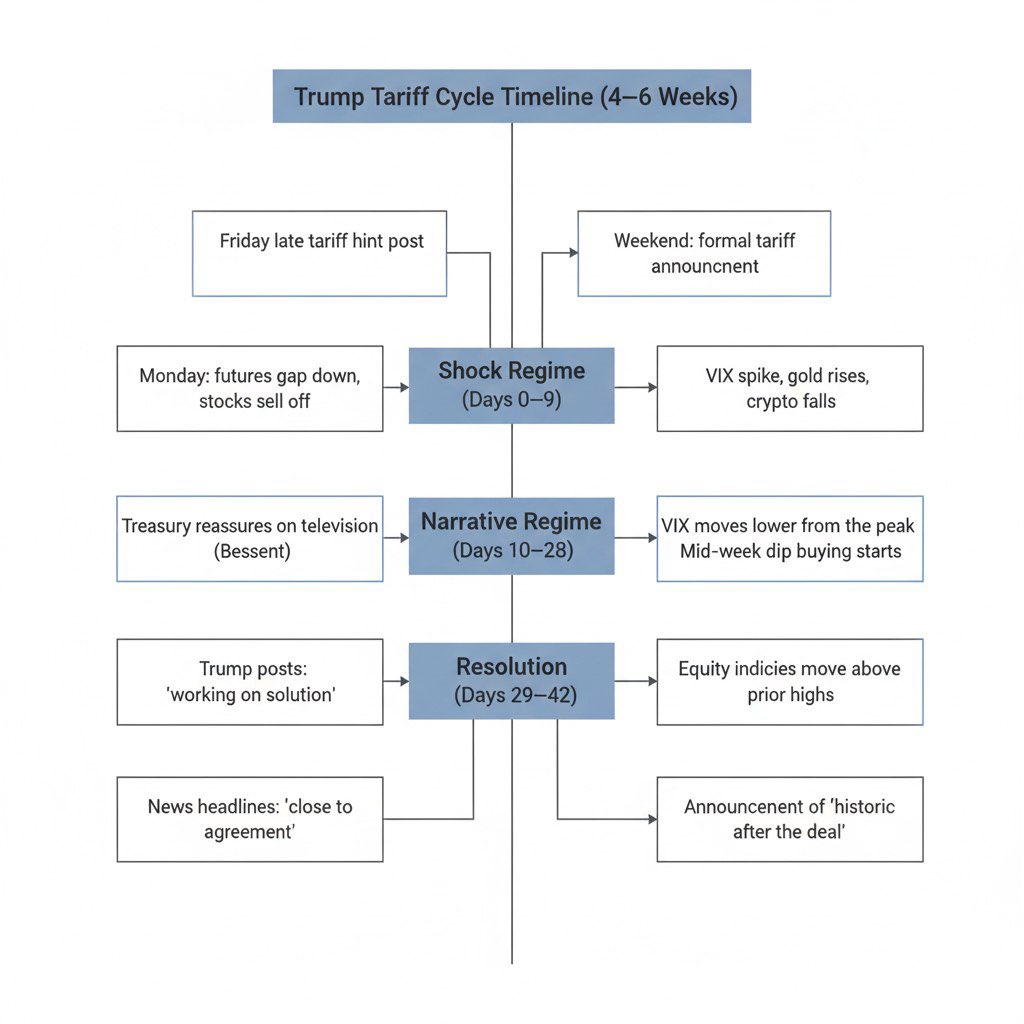
🚨PRESIDENT TRUMP USES THIS SAME TARIFF PLAYBOOK EVERYTIME TO GET WHAT HE WANTS.
Trump does not use tariffs as trade policy, He uses tariffs as a market control mechanism.
Every major tariff event under Trump follows the same structure. It has nothing to do with economics first. It has everything to do with pressure, timing, and market psychology.
The playbook always starts the same way:
1. Announcement timing is intentional
Trump almost always drops tariff news on late Friday or on weekends. This is done as US markets are closed so price cannot react instantly and the markets take some time to absorb the news.
2. Tariffs are structured with escalation windows
Trump never announces a single final tariff. He announces a first number and then a higher number later.
This happened last week too.
January 18, 2026: Trump announces tariffs on 8 European countries
10% tariffs effective February 1
25% tariffs scheduled for June 1 if no agreement is reached
That creates an immediate shock event but also keeps a negotiation window.
3. The first market reaction is always mechanical
Funds do not “think” during Phase 1. They execute risk protocols.
That means:
Prime brokers raise margin requirements
Volatility models force selling
Risk parity systems reduce exposure
Leverage collapses
Liquidity disappears
This is why moves are violent and fast. Not because fundamentals changed but Because capital structures are being forced to rebalance.
This is exactly what today looked like.
Large caps dropping 10–15% in minutes.
Small and mid caps dropping 30–40%.
4. Bitcoin always sells harder during Phase 1
Bitcoin is not treated as digital gold during tariff shocks.
It is treated as high beta risk.
Why:
24/7 market
High leverage
Perpetual futures
Thin liquidity during political shocks
So BTC becomes the pressure valve for global risk.
5. After the shock, the narrative phase begins
This is where Treasury officials appear.
This is where words like “Negotiations”, “Constructive talks”, “Temporary” and “Not catastrophic” start showing up.
Volatility stops to rise. Selling pressure slows and markets remember tariffs take weeks to implement.
6. Then comes the resolution phase
This is where Trump announces delay, reduction, framework, partial agreement or a “historic deal”.
Markets rally because uncertainty collapses.
This three-phase structure has repeated across:
China tariffs
Mexico tariffs
Canada tariffs
India tariffs
and will probably happen now too.
The Greenland situation follows the same template, but with higher geopolitical risk.
This is because:
Europe can retaliate symmetrically
It involves NATO allies
It includes territorial pressure
It overlaps with Supreme Court review of tariff authority
That makes this tariff more unstable, but not structurally different.
Now look at today’s crash.
Today was not about valuation. Not about earnings. Not about recession data.
It was Phase 1 of the tariff cycle: Shock.
Funds reduced exposure. Liquidity was pulled. Leverage was forced out. Crypto was hit harder because it always is during global risk resets.
So the playbook is simple:
1. Announce aggressively
2. Create fear while markets are closed
3. Let leverage unwind
4. Force negotiation pressure
5. Reframe later as diplomacy
6. Claim victory
7. Markets recover
We just faced the 3rd phase and now entering the 4th phase.
In a few weeks, everything will be back to normal and the markets will trade above their pre-dump levels.
BREAKING: 🇺🇸 NYSE to support 24/7 trading through tokenized stocks and blockchain settlement.
NYSE is building a platform to trade tokenized U.S. stocks and ETFs with on-chain settlement and stablecoin funding.
This allows 24/7 trading, instant settlement, and fractional share access, just like crypto markets.
Investors will still get real ownership, dividends, and voting rights, only the infrastructure moves to blockchain.
NYSE is also working with BNY and Citi to move tokenized money and collateral on-chain.
This is Wall Street adopting crypto rails, not crypto adapting to Wall Street.
Congress spent three years asking if America should buy Bitcoin.
Delta Force answered in one weekend.
US Strategic Reserve: 327,000 BTC
Venezuela’s alleged shadow reserve: 600,000 BTC
Combined: 927,000 BTC
The Senate proposed buying 1 million BTC. Stalled in committee. Budget gridlock. Political theater.
Delta Force just delivered 93% of the target through extraction. Not legislation.
How Venezuela built it:
2018: 73 tons of gold exported through Turkey and UAE. Converted to BTC at $3,000-$10,000.
2023-2025: 80% of oil revenue collected in Tether. Washed into Bitcoin to avoid freeze risk.
2024: Private mining banned. Thousands of ASICs seized. State accumulated.
The reference class:
Germany sold 50,000 BTC in July 2024. Market crashed 15-20%.
Venezuela’s alleged stash is 12x larger.
But Germany sold. The US holds.
Executive Order March 2025: “The United States will not sell bitcoin deposited into this Strategic Bitcoin Reserve.”
3% of total supply. Locked in legal limbo for 5-10 years. Synthetic halving.
The problem nobody’s discussing:
Maduro is in a New York jail cell.
The man who controls the keys isn’t.
Alex Saab. Maduro’s financial architect. Multi-signature cold wallets designed by Swiss lawyers. Keys dispersed across operatives in multiple jurisdictions.
Welcome to seed phrase diplomacy.
The new great game isn’t fought with aircraft carriers.
It’s fought with cryptographic keys.
Every scenario except “holdings don’t exist” is bullish.
Seized and held: Supply shock.
Keys lost forever: Permanently dormant. Same effect.
Oil is the headline every network is running.
Bitcoin is the trade nobody is discussing.
The Senate asked: Should America buy Bitcoin?
Delta Force answered: Why buy what you can seize?
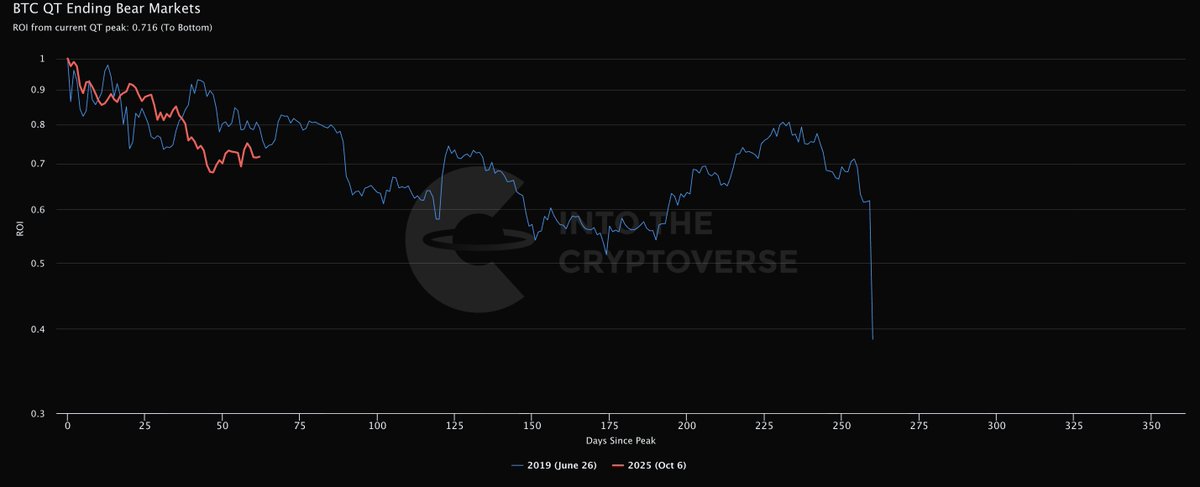
In 2019, Bitcoin topped on apathy before QT ended.
In 2025, Bitcoin topped on apathy before QT ended.
The four year cycle is in tact as Bitcoin historically peaks in Q4 of the post-halving year, but the underlying mechanics of the top differ from 2017/2021.
As 🇱🇰 Sri Lanka’s largest crypto community we’re reaching out to @TheGivingBlock, @BinanceBCF
LK is facing a critical moment due to recent floods. Our teams and volunteers are on the ground, and we’re ready to coordinate with you.
#CryptoForGood#LKA#floodsupport
THE SILENT COUP’S FATAL FLAW
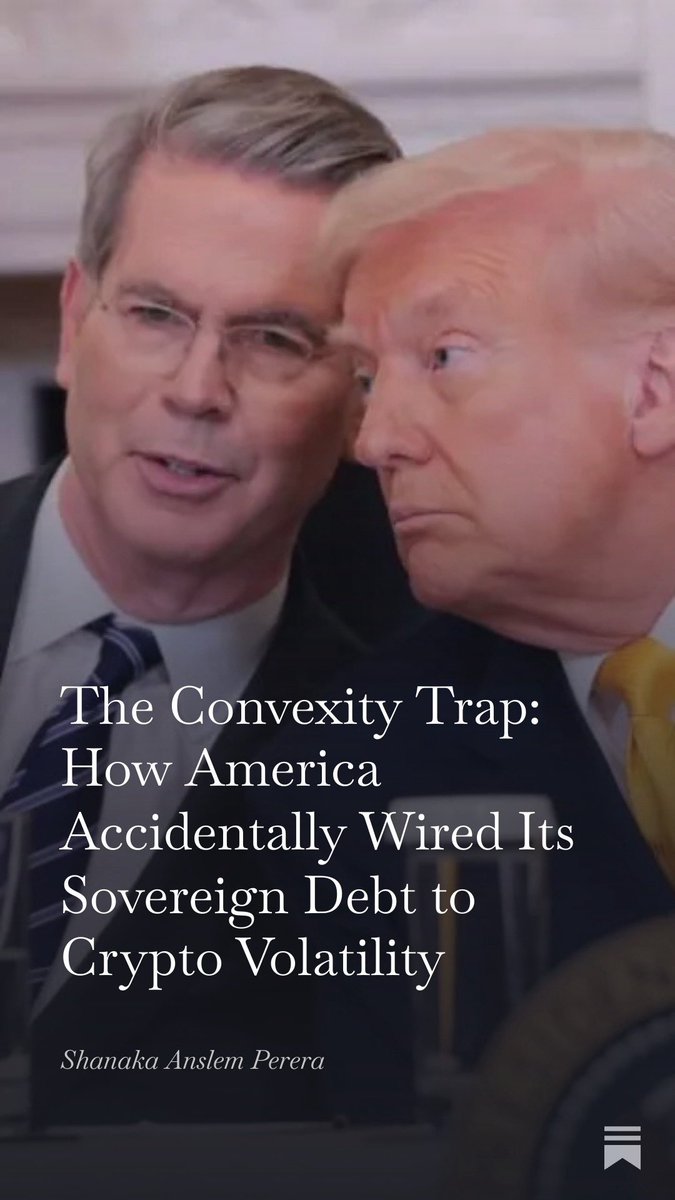
Treasury just wired America’s $38 trillion debt to crypto volatility. Nobody told you.
Here is what the Bank for International Settlements discovered in May 2025, buried in Working Paper 1270:
When stablecoins grow, Treasury yields fall 2 basis points per $3.5 billion inflow.
When stablecoins contract, yields spike 6 to 8 basis points.
The ratio is not symmetric. Outflows hit three times harder than inflows help.
The GENIUS Act, signed July 18, 2025, mandates that stablecoin issuers hold reserves exclusively in Treasury bills. Tether alone now holds $135 billion in U.S. government debt. This created captive demand that suppresses borrowing costs during expansion.
November 2025 delivered the first reversal in 26 months. Market cap fell $4.5 billion. Three days ago, S&P downgraded Tether to its lowest stability rating, citing 24 percent high risk reserves including Bitcoin that now exceeds the company’s entire overcollateralization buffer.
The arithmetic is devastating.
A 20 percent stablecoin contraction at current scale forces $60 billion in Treasury liquidations. At 3x convexity, yields spike 60 basis points. Against $38 trillion in debt, each basis point costs $3.8 billion annually.
Total damage: $228 billion added to yearly interest expense. That is a 22 percent increase in debt servicing from a single quarter of crypto outflows.
The Strategic Bitcoin Reserve provides no hedge. Post seizure holdings of 326,000 BTC cover 0.078 percent of federal debt. When crypto crashes, that reserve loses value precisely when protection is needed.
The administration banned CBDCs in January. Powell confirmed no digital dollar during his tenure. Yet the very crisis this architecture creates hands the Federal Reserve its strongest argument for reasserting control.
Treasury built a demand engine with no reverse gear.
The engine just shifted.
Read the deep dive analysis here 👇
https://t.co/tOjKXd4xN6
🚨 IF YOU STILL DON’T UNDERSTAND HOW CATASTROPHIC YESTERDAY WAS 🚨
Let me spell it out:
While Bitcoin dropped 10% like a normal Tuesday correction…
THE ENTIRE ALTCOIN MARKET GOT SENT TO THE SHADOW REALM
Here’s what “blue chip” really means 👇
$ATOM: $4.00 → $0.001
99.97% ANNIHILATED
$SUI: $3.40 → $0.56
83.5% OBLITERATED
$APT: $5.00 → $0.75
85% VAPORIZED
$SEI: $0.28 → $0.07
75% DELETED
$LINK: $22 → $8
63.6% DESTROYED
$ADA: $0.80 → $0.30
62.5% MASSACRED
These aren’t shitcoins.
These are TOP 100 “INSTITUTIONAL GRADE” projects that VCs, YouTubers, and CT influencers told you were “safe.”
80% nuked in MINUTES.
Not hours. Not days. MINUTES.
Meanwhile:
Bitcoin: -10% (basically a coffee spill)
$19-20 BILLION in liquidations across the market.
But BTC just vibing like it’s a healthy dip-buying opportunity.
Let that sink in:
The “diversification” strategy?
WRECKED.
The “altcoin season” narrative?
EXPOSED.
The “blue chip portfolio” advice?
WORTHLESS.
Your hedge against Bitcoin dominance?
PROVED TO BE PURE COPIUM.
Here’s the truth bomb nobody wants to hear:
When the music stops, there’s only ONE chair in this game.
And it’s orange.
Every altcoin … no matter how “revolutionary” the tech, how “strong” the team, how “backed” by VCs .. is just leveraged beta on Bitcoin.
But with 80% downside risk in 180 seconds.
You thought you were “early” to the next Ethereum.
You were actually exit liquidity for insiders who dumped on you at Mach 5 speed while Bitcoin HOLDERS barely blinked.
The market just gave you the most expensive lesson in crypto history:
There’s Bitcoin.
And there’s everything else.
Yesterday proved which one survives when the house is on fire.
Choose accordingly.
#Bitcoin #Crypto #Altcoins #Oct11Crash #BitcoinOnly
“How many bitcoin do you own?”
That’s how it starts, a stupid question from the host.
From there, it goes downhill fast.
Christine Lagarde repeats every tired anti-bitcoin cliché the ECB has ever pushed.
Let's go...
1️⃣ “Bitcoin has no intrinsic value.”
Neither does fiat. Intrinsic value is an outdated economic myth, money derives value from scarcity, credibility, and demand for settlement.
Bitcoin’s scarcity is mathematically enforced; fiat’s is politically decided.
2️⃣ “It has no anchor of safety.”
Bitcoin’s anchor is energy. Every coin represents irreversible work, proof of energy expended to secure the network.
Fiat’s anchor is faith in central banks that inflate at will.
3️⃣ “It could collapse.”
So can any monetary system. But bitcoin has operated with 99.99% uptime for 15 years, through wars, recessions, bans, and collapses, that you and your friends created!
Now go and compare that to banking crises that occur every decade.
4️⃣ “It’s speculative.”
Yes! In the same way that every emerging monetary asset is.
Gold was speculative in 600 BC.
Bonds were speculative in 17th-century Europe.
Bitcoin is price discovery in real time. A Feature!
5️⃣ “A digital euro will be safer.”
Hmmmm... no! That’s not safety. That’s dependency.
A CBDC is not money you own; it’s credit you’re allowed to use, programmable and reversible at will.
While bitcoin is ownership; CBDCs are permission.
6️⃣ “Stablecoins are different.”
Exactly! They’re IOUs, not assets. They rely on trust in an issuer, exactly what bitcoin removes.
Bottom line: Every critique Lagarde makes of bitcoin describes fiat more accurately.
Trust math, not mandates.