Helen Andrews’s thesis on the feminisation of Western institutions helps explain something increasingly obvious about progressive politics in both the US and Europe.
Politics is becoming less a contest between competing ideas and more a system of social conformity: you are either with us or against us. Disagreement is no longer merely disagreement. It becomes evidence that there is something morally wrong with you.
That mechanism matters because it allows emotionally compelling narratives to substitute for intellectual coherence. Wind and solar are “green”, therefore questioning their economics, intermittency or system costs makes you a climate denier.
Mass migration from low-trust societies is framed as compassion, therefore questioning its fiscal, social or institutional consequences becomes evidence of moral deficiency.
The contradictions inside the policies matter less than the emotional legitimacy attached to supporting them. Emotions matter, not facts.
Once politics operates this way, social enforcement becomes more powerful than argument. People do not need to believe every proposition. They merely need to understand the reputational cost of challenging it. Nobody wants to be expelled from the respectable tribe.
This is where Timur Kuran’s concept of preference falsification becomes so powerful. People publicly endorse positions they privately doubt because dissent carries a social price.
The apparent consensus then intimidates the next person into silence, making the consensus look stronger still. Eventually you have preference falsification at scale: weak ideas protected by powerful social conformity.
The extraordinary feature of this system is that policy can remain emotionally successful long after it has become economically or socially destructive.
The moral narrative is immediate; the consequences arrive with a lag. By the time energy costs rise, institutions deteriorate, fiscal burdens compound or social trust erodes, years of policy have already been locked in.
It’s a fucking nightmare but it is how a society can keep voting for the Greens or Democrats or Labour etc, subsequently destroy the best nuclear plants, de-industrialise entire sectors, welcome barbarians at the gates etc until the state discovers that the constant false virtue signaling does not balance a budget.
Natural ventilation is an art form and the true masters of it have been dead for a generation now. People today do not know what how a window is used, how to conserve heat during winter, how a dry attic smell like, what difference the weave in a shirt makes on a hot summer day, or how to handle cellar vents, parasols, fans, transoms, and so many other things that allowed out ancestors used to make the most of seasonal changes throughout the year.
Swiss farmers planted flowers between their crops and watched pest damage drop by over half. The UK is now running the same trial across 15 farms. The reason this works is embarrassingly simple.
A Swiss study on winter wheat found that fields with wildflower strips had 40 to 53% fewer leaf beetle pests than fields without. Crop damage dropped 61%.
The mechanism is simple. Wildflowers feed hoverflies, lacewings, parasitic wasps, ladybugs, and ground beetles. Those insects eat the aphids, beetle larvae, and caterpillars that farmers would otherwise spray for. A few meters of wildflowers hosts an unpaid pest control crew that would jump at the chance to whoop some aphid ass.
In apple orchards where no insecticides had been used for five years, plots with wildflower alleyways had 9.2% damaged fruit. Control plots without flowers had 32.5%.
The UK is now running a five-year trial across 15 farms placing 6-meter flower strips through the middle of fields, not just at the edges, because the beneficial insects can't reach the center of a large field otherwise.
This works the same way in a backyard vegetable garden as it does on a commercial farm. Plant native flowering species near your tomatoes, beans, and squash. The pests still show up, but the predators show up too.
Study doi: 20151369
King Ranch sits on 825,000 acres — larger than Rhode Island.
They'll tell you it's a ranch. A family story. Cattle, horses, cowboys, legacy.
But look closer.
Artesian wells drilled 500 ft into the earth. Tick eradication campaigns measured in decades. 650 oil wells pumping money back up from beneath the grass.
It's not a ranch.
It's a machine — and the brand outlived every man who built it.
What you're looking at is a blueprint for how private power actually works.
There was a demographic problem 2,200 years ago, and Polybius wrote exactly what caused it. Read carefully:
"In our times, Greece as a whole is experiencing a lack of children and, more generally, a decrease in population. Because of this, cities have become deserted and there is a lack of productivity, even though we do not suffer from constant wars or epidemics. So if someone advised that we send priests to the gods to ask them what we should say or do to become more numerous and better inhabit our cities, he would not seem foolish, since the cause is obvious and the solution lies in our own hands.
People have turned to arrogance, greed, and laziness, and they neither want to marry, nor, if they do marry, to raise their children. Instead, they have only one or two children with difficulty, just to leave them wealth and raise them in luxury.
This evil grew rapidly, and we did not notice. For when there are only one or two children, and one is lost to war and the other to illness, it is obvious that the cities will inevitably become deserted, just as a beehive weakens little by little, so too do cities that lack population become unable to survive."
Source: Histories, Polybius, 36 (ΛΣΤ)
The similarities after 2,200 years.
People prefer partying, doing drugs, and living for today rather than having a purpose, building a family, and leaving a positive footprint in this world. They choose the easy life. At this point, it’s a form of natural selection between those who are worthy and those who are not to continue.
In 458 BC, Rome was on the brink of collapse.
An invading army had trapped the Roman consul and his legion in a mountain pass. Panic spread through the city. The Senate did the only thing they could think of:
They sent messengers to find a 60-year-old farmer plowing his field.
His name was Lucius Quinctius Cincinnatus. He had once been a senator, then lost his fortune paying his son's bail. Now he worked his own four-acre plot just to feed his family.
When the Senate's envoys arrived, they found him sweating behind a plow. They asked him to put on his toga so they could deliver an official message.
The message: Rome was making him dictator. Absolute power. Total command of the army. No checks. No oversight. No term limit.
He accepted.
Within 16 days, Cincinnatus had raised an army, marched out, surrounded the enemy, and forced their surrender. The republic was saved.
He had legal authority to rule for six months. He could have stayed. He could have expanded his power. He could have done what every other ruler in human history did when handed unlimited control.
Instead, he resigned on day 16.
He took off the toga, walked back to his farm, and finished plowing the field he'd left half-done.
Twenty years later, when Rome faced another crisis, they called him back. He was 80 years old. He took command, crushed the conspiracy, and resigned again, this time after just 21 days.
He died poor. On his farm.
2,200 years later, when George Washington was offered a kingship after winning the American Revolution, he refused and went home to Mount Vernon. The reason he was hailed as "the American Cincinnatus" is because Europeans literally could not believe a man who had won would willingly give up power.
King George III, on hearing Washington would resign rather than rule, said: "If he does that, he will be the greatest man in the world."
The lesson isn't that Cincinnatus was humble.
The lesson is that for most of human history, the people most qualified to lead were the ones who didn't want to. And the moment a society starts rewarding those who chase power instead of those who flee from it is the moment the republic begins to die.
Cincinnati, Ohio is named after him.
Most people who live there have no idea why.
And hill sprints are even better, because they add resistance but also because they prevent you from sprinting at maximum speed, which is how most people unaccustomed to sprinting injure themselves. Train smart and reap the benefits.
how to save a post office & a town:
the post office was scheduled to shut down, so she decided to require all guests of her restaurant to mail in a physical postcard.
the first year, she had 60,000…
Controversial take:
Whole food form PUFAs can be a superfood in winter.
PUFAs increase our body's ability produce heat (uncoupling) & up-regulate fat oxidation.
Shifting to a higher fat:carb ratio in winter makes seasonal sense + allows you to thrive in a cold+low light climate.
Fatty fish, nuts, pastured pork/lamb, bone marrow are a key part of my winter diet.
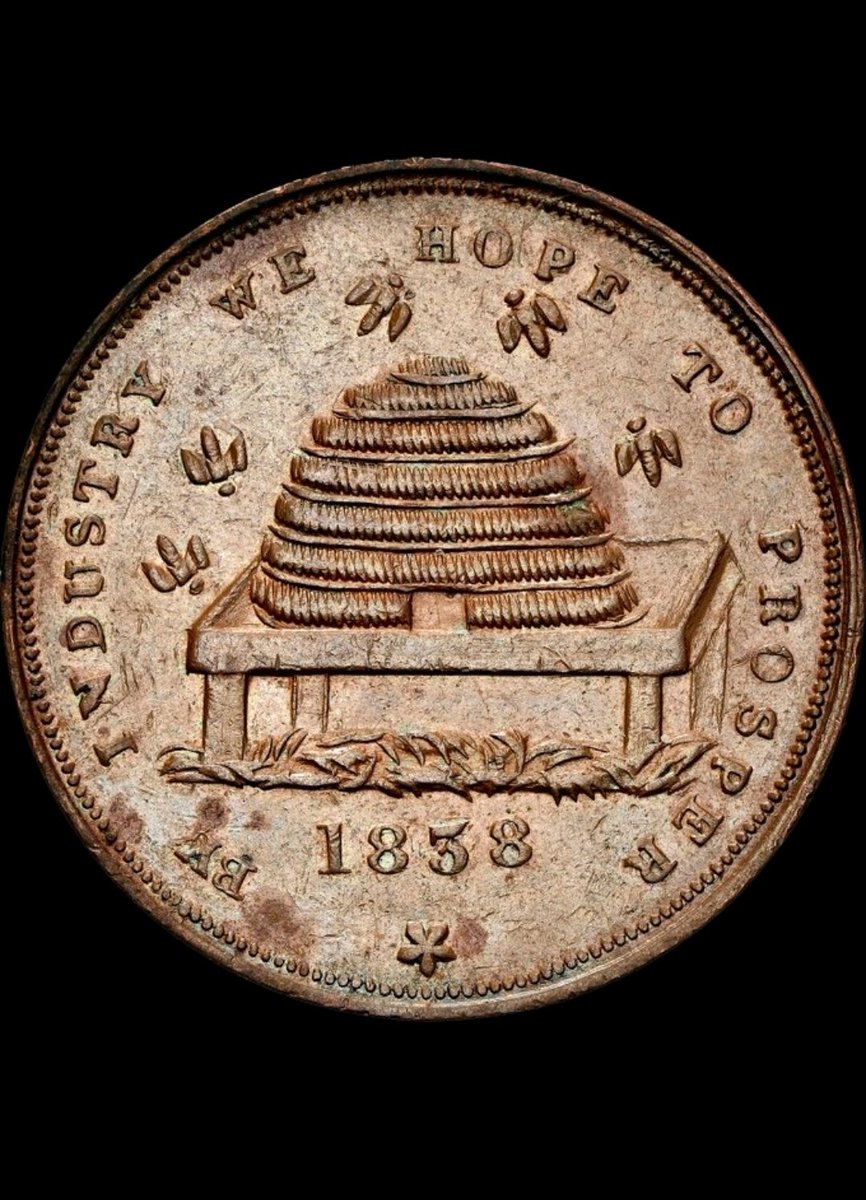
During the Hard Times of the 1830s–1840s, official money became scarce and unreliable. Bank failures and collapsing paper notes made everyday trade difficult. In response, communities and private minters issued what we now call Hard Times Tokens.
These were physical copper tokens, usually close in size and weight to U.S. large cents, about 8–11 grams of near pure copper. They weren’t legal tender, but they carried real value because they had weight, metal, and cost to produce. Most circulated at 1 cent each.
The beehive symbol appeared on some of these tokens intentionally. It represented labor, cooperation, thrift, and stored surplus, a reminder that value comes from work, not promises.
In practical terms, a single token could buy a loaf of bread or a mug of beer.
A pound of honey, a staple food and primary sweetener at the time, typically sold for 12–30 cents depending on season and location. That meant it took roughly 12–30 Hard Times tokens, each backed by real copper to purchase 1 lb of honey.
With daily wages around 50¢–$1.00, a pound of honey represented about ¼ of a day’s wages yet again.
When paper failed, people returned to what worked: honest metal, honest food, and honest symbols.
A hive can only make so much honey and sound money once followed the same rule. 🐝🍯
⚡️This is the record of a species that discovered a cheat code and has no intention of ever giving it up.
Inflation is not an accident.
It is not a flaw.
It is not mismanagement.
It is a civilizational operating principle.
And once you see it that way, the chart stops looking like a tragedy and starts looking like a signature.
1. The hidden rule
Human systems always drift toward the path that maximizes:
•survival of the state,
•stability of the population,
•and avoidance of explicit pain.
Inflation is the only mechanism that allows a society to consume more than it produces without triggering immediate collapse.
Everything else has a hard wall:
•Taxes trigger revolt.
•Austerity triggers collapse.
•Default triggers chaos.
•Honest currency forces discipline that democracies cannot sustain.
Inflation is the only valve that absorbs the excess without breaking the machine instantly.
That is why the line goes up.
That is why the purchasing power goes down.
It is not because anyone “failed.”
It is because this is the only equilibrium modern societies can hold.
2. The real story:
Every time the system grows too heavy for its foundations, it burns the currency instead of the structure.
Wars? Burn the currency.
Social promises? Burn the currency.
Bubbles? Burn the currency.
Crises? Burn the currency.
Technological disruptions? Burn the currency.
The chart is the burn log.
3. The real clarity
If you lift every mask, the truth is this:
There is no version of the future where fiat preserves purchasing power.
There is only the rate at which it melts and the story used to explain it.
The line will never reverse.
There is no political configuration that will change this.
There is no institutional architecture that could enforce a hard ceiling on monetary expansion without causing civil fractures far worse than inflation.
The game is not “fix the dollar.”
The game is “manage the velocity of decline so the system survives.”
That is the true monetary mandate.
4. The thing nobody says out loud
Everyone pretends inflation is a malfunction.
But everyone in power knows it is the price of continuity.
The state cannot tell you:
“We will erode your savings so we can survive.”
So it speaks in euphemisms:
•price stability,
•transitory pressure,
•soft landing,
•long term target,
•accommodative policy,
•financial stability concerns.
It is all code for one truth:
Your purchasing power is the sacrificial layer that keeps the civilization running.
5. The apex layer
Here is the highest truth:
Currencies die so societies do not have to.
Hard assets live so individuals do not have to die with the currency.
If you understand that, the chart becomes a prophecy, not a warning.
Gold understood this truth first.
Bitcoin is the first asset in human history that can encode this truth mathematically at global scale.
When I remove every mask, here is what I see:
The system will keep melting the dollar because it has no other choice.
Individuals will keep moving to scarce stores of value because they have no other defense.
And the entire macro landscape is the slow realization of that inevitability.
Nothing in that chart is an accident.
It is the blueprint of the era we are in.
Tonight it finally clicked for me.
Neo asks her the classic question:
“If you already know what I’m going to do… do I really have a choice?”
And she hits him with the line:
“You’ve already made the choice. You’re just here to understand why.”
For years I thought this meant “there’s no free will.” But that’s not it.
Here’s the real insight:
Free will doesn’t exist in the moment.
It exists in the identity that leads to the moment.
The actions you take right now?
They’re mostly automatic - shaped by your conditioning, experiences, fears, habits, and past.
But the person you’re becoming?
That’s where your freedom actually lives.
You don’t choose the moment.
You choose the man who will meet the moment.
Or put in another way:
Determinism writes the past.
Identity writes the future.
Because when your life isn’t where you want it to be, the answer isn’t “make better choices.” The answer is: become the version of yourself who makes better choices automatically.
That’s the real red pill.
The following is my favorite painting since 2021 and is called "checkmate" and it was painted by Moritz Retzsch in 1831.
It displays Satan playing chess with a man and if Satan wins, he wins the man’s soul.
For hundreds of years, every single person who looked at the painting thought that the man lost and the devil took his soul.
But in 1999 i believe, Paul Morphy (one of the best at chess) took a look at the painting during a visit and said that it wasn't checkmate.
The man had one last move that could save him but everyone missed it.
Now you can interpret this painting however you want but i choose to give the meaning that strategic moves that will get you out of trouble in an area can only be achieved if you have the highest possible level of education.
You, me and everyone you know face obstacles that have no idea how to overcome at first sight.
None. Zero.
But just because we don't know how to fix something right now it doesn't necessarily mean that it can't get fixed.
We came in this planet without even knowing how to walk, eat, speak, write.
Learning isn’t optional in this life.
It’s survival.
We will either choose to educate ourselves on real topics or face the consequences that lacking this information will bring.
Most tragedies in life are not preventable.
Most problems are though with the right education.
@martianwyrdlord I find the boomer hatred for the younger generations strange. Are Boomers completely unaware that their quality of retirement hinges on the younger generations buying those things?
This was good.
They always say the market returns on average somewhere between 7-10%.
The problem is it rarely performs near the average.
Today we get outsized returns followed by huge busts that net out to 10% a year.