🔘 प्राचीन भारतीय आर्थिक शब्दावली
✴️उपरिकर: अस्थायी रूप से लगाया जाने वाला अतिरिक्त भूमि कर या उपकर; अक्सर नई खेती वाली भूमि पर लगाया जाता था।
✴️उद्रंग: राज्य की विशिष्ट आवश्यकताओं के लिए एकत्र किया जाने वाला सामयिक या विशेष कर।
✴️भाग: कृषि उपज में राजा का हिस्सा (आमतौर पर 1/6 भाग)।
✴️बलि: लोगों द्वारा दी जाने वाली स्वैच्छिक धार्मिक या पारंपरिक भेंट।
✴️भोग: भूमि अनुदान से प्राप्त राजस्व या उपज; इसका अर्थ स्थानीय देय भी है।
✴️भागभोग: वस्तु या नकद के रूप में लिए जाने वाले कृषि करों के लिए प्रयुक्त संयुक्त शब्द।
✴️हिरण्य: कृषि उपज के बजाय नकद या सोने के रूप में चुकाया जाने वाला कर।
✴️राजस्व: सभी स्रोतों से प्राप्त होने वाली शाही या राज्य की आय।
✴️विष्टि: किसानों पर लगाया गया अनिवार्य श्रम सेवा
✴️पिंडक: किसी गांव या कृषकों के समूह द्वारा एकमुश्त दिया जाने वाला कर।
✴️वर्तनी: व्यापारिक मार्गों पर लगने वाले टोल और पारगमन शुल्क के लिए प्रयुक्त शब्द।
✴️गुल्मदेय: सैन्य या पुलिस चौकियों पर चुकाया जाने वाला शुल्क।
✴️पण्य: व्यापारिक वस्तु
✴️हाटक: सोने के लिए प्रयुक्त शब्द; जिसका उपयोग व्यापार और कर रिकॉर्ड में किया जाता था।
✴️अग्रहार: कर-मुक्त ब्राह्मण बस्ती या विद्वान ब्राह्मणों को दिया गया गाँव/भूमि का अनुदान।
✴️ब्रह्मदेय: धार्मिक पुण्य की प्राप्ति के लिए ब्राह्मणों को दिया जाने वाला भूमि अनुदान।
✴️देवदान/देवग्रह: मंदिरों या धार्मिक संस्थानों को दान में दी गई भूमि।
✴️सीता: मौर्य काल के दौरान राजकीय भूमि, जिसकी देखरेख 'सीताध्यक्ष' नामक अधिकारी द्वारा की जाती थी।
🔘Ancient Indian Economic Terms
✴️Uparikara: Extra land tax or assessment imposed temporarily; often on newly cultivated land.
✴️Udranga: Occasional or special tax collected for specific state needs.
✴️Bhaga: The king’s share of agricultural produce (usually 1/6th).
✴️Bali: Voluntary religious or customary offering paid by people.
✴️Bhoga: Revenue or produce enjoyed from land grants; also means local dues.
✴️Bhagabhoga: Combined term for agricultural taxes in kind or cash.
✴️Hiranya: Tax paid in cash or gold instead of produce.
✴️Rajasva/Rajashva: The royal revenue or state income from all sources.
✴️Vishti: Compulsory labour service (corvée) imposed on peasants.
✴️Pindaka: Lump-sum tax paid by a village or group of cultivators.
✴️Vartani: Used for trade-route tolls and transit duties.
✴️Gulmadeya: Dues paid at military/police outposts.
✴️Panya: Merchandise commodity
✴️Hataka: Term for gold; used in trade and tax records.
✴️Agarahara/Agrahara: Tax-free Brahmin settlement or grant of village land to learned Brahmins.
✴️Brahmadeya: Land grant made to Brahmins for religious merit.
✴️Devadana/Devagraha: Land granted to temples or religious institutions.
✴️Sita: Crown land during the Mauryan period, overseen by an official called the Sitadhyaksha.
@VIJAYYA79616212 जी अभी देखा विजय। ये हमारा ग्रुप नहीं है। टेलीग्राम पर हम बस Biharology (Official) और Biharology Quiz, इन्हीं दो प्लेटफॉर्म के रूप में मौजूद हैं।
सूचित करने के लिए धन्यवाद।❤
72वीं BPSC प्रिलिम्स में लगभग 3 महीने बचे हैं। To be precise 96 दिन।
चूंकि करेंट अफेयर्स की भूमिका अहम है, इसीलिए कुछ टॉपिक्स जिनपर ध्यान देना अत्यंत जरूरी है:
🔹Union Budget 2025-26, 2026-27
🔹Economic Survey 2024-25, 2025-26
🔹Bihar Budget 2025-26, 2026-27
🔹Bihar Economic Survey 2024-25, 2025-26
🔹NITI Aayog Reports & Indices (Data)
🔹International Reports & Indices (Data & Including India's Ranks)
🔹Forest Report 2023
🔹Census 2011 (Bihar Related Data)
🔹Periodic Labour Force Survey
🔹National Family Health Survey (NFHS-5)
🔹Bihar Global Capability Centre (GCC) Policy 2026
🔹Bihar Semiconductor Policy 2026
🔹Bihar Caste Census
🔹Bihar IT Policy 2024
🔹Bihar 18th Assembly Election
🔹1st Samrat Chaudhary Ministry
🔹Nobel Prize 2025
🔹Sports in Bihar
🔹New Industrial Developments in Bihar
🔹Bihar Saat Nishchay-1, 2, 3
इनके साथ-साथ खबरों में रहे अन्तर्राष्ट्रीय मुद्दे, उनसे जुड़े भौगौलिक क्षेत्र, ISRO, NASA, DRDO के परीक्षण, पुरस्कार, खेल जगत के महत्वपूर्ण टूर्नामेंट, खबरों में रहे व्यक्तित्व भी पढ़ कर जाएँ।
Sources जिनको फॉलो करना चाहिए:
▪️Vision IAS Monthly Current Affairs (Jan 2025- Till June 2026) [इनके वेबसाइट पर फ्री में उपलब्ध है।]
▪️PD or any regular monthly magazine (+Bihar Current Affairs)
📝BPSC PYQ Decode📝
◾️Exam: BPSC AEDO Exam, 2026
◾️Date: 17 April, 2026
◾️Subject: भारतीय राजव्यवस्था (Indian Polity)
◾️Topic: संवैधानिक निकाय (Constitutional Bodies)
◾️Ans: (D)
◾️विस्तृत व्याख्या (Detailed Explanation):
🔹भारत के नियंत्रक एवं महालेखापरीक्षक (CAG) मुख्य रूप से उन संसदीय समितियों की सहायता करते हैं जो उनकी ऑडिट रिपोर्टों की जाँच करती हैं।
🔹लोक लेखा समिति: CAG को इस समिति का "मित्र, दार्शनिक और मार्गदर्शक" कहा जाता है। यह समिति CAG द्वारा प्रस्तुत विनियोग खातों और वित्त खातों की ऑडिट रिपोर्ट की सूक्ष्म जाँच करती है।
🔹सार्वजनिक उपक्रम समिति: यह समिति सार्वजनिक क्षेत्र के उपक्रमों (PSUs) पर CAG की ऑडिट रिपोर्टों की जाँच करती है।
🔹प्राक्कलन समिति: यह समिति बजट में प्रस्तावित अनुमानों (Estimates) की जांच करती है ताकि सरकारी खर्च में मितव्ययिता लाई जा सके। यह समिति CAG द्वारा ऑडिट किए गए खातों की जांच नहीं करती है।
🔹विशेषाधिकार समिति: इसका कार्य सदन या उसके सदस्यों के विशेषाधिकारों के हनन (Breach of Privilege) के मामलों की जांच करना है।
🔹The Comptroller and Auditor General (CAG) of India primarily assists those parliamentary committees that scrutinize his audit reports.
🔹Public Accounts Committee: The CAG is referred to as the "friend, philosopher, and guide" of this committee. This committee conducts a detailed examination of the audit reports on Appropriation Accounts and Finance Accounts submitted by the CAG.
🔹Committee on Public Undertakings: This committee examines the CAG's audit reports pertaining to Public Sector Undertakings (PSUs).
🔹Estimates Committee: This committee scrutinizes the estimates proposed in the budget with a view to bringing about economy in government expenditure. This committee does not examine the accounts audited by the CAG.
🔹Committee of Privileges: Its function is to examine cases involving a breach of privilege of the House or its members.
⭕BPSC Bihar Insights⭕
✴️हजारीबाग सेंट्रल जेल फरार कांड, 1942
◾️तिथि: 9 नवंबर, 1942 (दीपावली की रात)
◾️संबंधित आंदोलन: भारत छोड़ो आंदोलन
◾️फरार होने वाले क्रांतिकारी: जयप्रकाश नारायण, योगेन्द्र शुक्ला, सूरज नारायण सिंह, शालिग्राम सिंह, गुलाब चंद गुप्ता और रामनंदन मिश्रा
◾️सरकार द्वारा घोषित इनाम: उन्हें जीवित या मृत पकड़ने में मदद करने वाली कोई भी जानकारी देने वाले को 10,000 रुपये इनाम देने की घोषणा की गई थी।
◾️तत्कालीन हजारीबाग जिला आयुक्त: के.वी.एस. रमन
◾️तत्कालीन जेल अधीक्षक: टी. नाथ
⭐नोट:
🔹हज़ारीबाग सेंट्रल जेल से फरार होने के बाद जयप्रकाश नारायण को 18 सितंबर, 1943 को अमृतसर में गिरफ्तार कर लिया गया। उस समय वह खान अब्दुल गफ्फार खान (सीमांत गांधी) से मिलने के लिए रावलपिंडी जा रहे थे।
गिरफ्तारी के बाद जयप्रकाश नारायण को लाहौर किले में ले जाया गया जो "टॉर्चर चैंबर' के रूप में कुख्यात था। वहाँ सोलह महीने के मानसिक और शारीरिक यातना के बाद उन्हें आगरा जेल में भेजा गया।
12 अप्रैल, 1946 को महात्मा गांधी की व्यक्तिगत अपील पर उन्हें तत्कालीन वायसराय लॉर्ड वेवेल द्वारा रिहा किया गया। इस दिन को "जयप्रकाश दिवस" के रूप में मनाया जाता है।
🔹भारत छोड़ो आंदोलन के दौरान 30 लाख रुपये से अधिक का सरकारी और निजी संपत्ति का नुकसान हुआ था। ब्रिटिश सरकार ने प्रतिशोध के रूप में नागरिक आबादी पर कुल मिलाकर 90 लाख रुपये से अधिक का जुर्माना लगाया था।
✴️Hazaribag Central Jail Escape, 1942
◾️Date: November 9, 1942 (Deepawali night)
◾️Associated Movement: Quit India Movement
◾️Revolutionaries who escaped: Jayaprakash Narayan, Yogendra Shukla, Suraj Narayan Singh, Shaligram Singh, Gulab Chand Gupta and Ramnandan Mishra
◾️Reward Announced by Government: Any information leading to their capture, dead or alive, would be worth Rs. 10,000.
◾️Hazaribagh District Commissioner at that time: K.V.S. Raman
◾️Jail Superintendent at that time: T. Nath
⭐Note:
🔹After successfully escape from Hazaribag Central Jail, Jayaprakash Narayan went underground and after nearly ten months of manhunt, British authorities arrested him in Amritsar on September 18, 1943 while he was on his way to Rawalpindi to meet Khan Abdul Gaffar Khan (also known as Frontier Gandhi).
Jayaprakash Narayan was taken to Lahore Fort, notorious as a "Torture Chamber’. After sixteen months of mental and physical torture followed, he was transferred to Agra Jail.
He was released on April 12, 1946 by then Viceroy Lord Wavell on the personal appeal by Mahatma Gandhi. This day is celebrated as "Jayaprakash Diwas".
🔹During Quit India Movement, property, both government and private, worth over Rs. 30 lakhs was destroyed. The British Government imposed fines totalling over Rs. 90 lakhs on the civilian population as retribution.
🎯BPSC Prelims Pulse🎯
✴️दिल्ली दरबार
🔹दिल्ली दरबार ब्रिटिश सम्राट या साम्राज्ञी के शासन शुरू होने की स्मृति में मुगल परंपरा से प्रेरित होकर दिल्ली में अंग्रेजों द्वारा आयोजित एक भव्य सभा थी।
🔹ब्रिटिश शासन के दौरान दिल्ली दरबार तीन बार आयोजित किया गया: 1877, 1903 और 1911
🔹प्रथम दिल्ली दरबार का उद्घाटन 1 जनवरी 1877 को हुआ था, जिसमें औपचारिक रूप से महारानी विक्टोरिया को "कैसर-ए-हिंद" उपाधि के साथ भारत की महारानी घोषित किया गया।
✍️नोट:
▪️"रॉयल टाइटल एक्ट 1876" के द्वारा महारानी विक्टोरिया को आधिकारिक तौर पर "भारत की महारानी" घोषित किया गया था।
▪️प्रथम दिल्ली दरबार की अत्यधिक आलोचना की गई क्योंकि इस कार्यक्रम में ऐसे समय में धन की अपव्यय की गई थी जब 1876-78 के दौरान भारत को विकराल अकाल से जूझना पड़ा था।
🔹दूसरे और तीसरे दिल्ली दरबार में क्रमशः किंग एडवर्ड सप्तम और किंग जॉर्ज पंचम के भारत के सम्राट के रूप में आरोहण का जश्न मनाया गया।
🔹किंग जॉर्ज पंचम व्यक्तिगत रूप से दिल्ली दरबार में भाग लेने वाले एकमात्र सम्राट थे।
🔹तीसरे दिल्ली दरबार के दौरान किंग जॉर्ज पंचम ने भारत की राजधानी को कलकत्ता से दिल्ली स्थानांतरित करने की घोषणा की। इसी समारोह के दौरान बंगाल विभाजन को रद्द करने की भी घोषणा की गई।
⭐रोचक तथ्य:
कलकत्ता के ब्रिटिश भारत की राजधानी होने के बावजूद 1877 में भारत के गवर्नर-जनरल और वायसराय लॉर्ड लिटन ने पहले दरबार के लिए दिल्ली का चयन किया क्योंकि भूतपूर्व मुगल राजधानी के रूप में इसका एक सांस्कृतिक महत्व था।
✴️Delhi Durbar
🔹The Delhi Durbar was a grand assembly organized by the British in Delhi, inspired by Mughal terminology, to commemorate the succession of an Emperor or Empress of Britain.
🔹During British rule, it took place thrice: 1877, 1903, and 1911.
🔹The first Delhi Durbar which was inaugurated on 1st January 1877, ceremonially proclaimed Queen Victoria as the Empress of India with the title "Kaisar-i-Hind."
✍️Note:
▪️Through "Royal Titles Act of 1876", Queen Victoria was officially proclaimed the "Empress of India".
▪️The First Delhi Durbar was criticized because it directed funds away from the Great Famine of 1876–78.
🔹The second and third Delhi Durbar celebrated ascension of King Edward VII and King George V, respectively, as the Emperor of India.
🔹King George V was the sole monarch to personally attend a Delhi Durbar.
🔹During the 3rd Delhi Durbar, the King announced the transfer of India's capital from Calcutta to Delhi. The annulment of the Partition of Bengal was also announced during this ceremony.
⭐Interesting Fact:
Despite Calcutta being the capital of British India, Lord Lytton, the then Governor-General and Viceroy of India, in 1877, selected Delhi for the venue of First Durbar, emphasizing it's being the erstwhile capital of Mughal Empire.
📝BPSC PYQ Decode📝
◾️Exam: BPSC Public Relations Officer Exam, 2025
◾️Subject: मध्यकालीन भारत (Medieval India)
◾️Topic: प्रमुख यात्री और राजदूत (Important Travellers & Envoys)
◾️Ans: (A)
◾️विस्तृत व्याख्या (Detailed Explanation):
🔹अल-बिरूनी ने पतंजलि के 'योग सूत्र' का अरबी में अनुवाद किया, जिसका शीर्षक उन्होंने "किताब बतंजल अल-हिंदी" रखा। उन्होंने सूफी मत के 'फ़ना' (स्वयं का विलोपन) और 'इश्क़' (ईश्वरीय प्रेम) के सिद्धांतों तथा पतंजलि योग की 'मुक्ति' (मोक्ष) और 'आत्मा के स्वरूप' संबंधी अवधारणाओं के बीच महत्वपूर्ण समानताएँ पाईं।
🔹अल-बिरूनी कई वर्षों तक लाहौर और मुल्तान जैसे शहरों में रहे। यहीं पर उन्होंने संस्कृत सीखी, ब्राह्मणों से परामर्श किया, और अपनी महान कृति 'किताब-उल-हिंद' लिखने के लिए पुराणों तथा भगवद्गीता का गहन अध्ययन किया।
🔹अल-बिरूनी, महमूद गज़नवी के भारत पर किए गए आक्रमणों के दौरान उसके साथ रहे।
🔹Al-Biruni translated the Yoga Sutras of Patanjali into Arabic under the title "Kitab Batanjal al-Hindi". He noted significant similarities between the Sufi doctrine of Fana (annihilation of self) and Ishq (divine love) with the Patanjali Yoga concepts of liberation (Moksha) and the nature of the soul.
🔹Al-Biruni stayed in cities like Lahore and Multan for several years. It was here that he learned Sanskrit, consulted with Brahmanas, and studied the Puranas and the Bhagavad Gita to write his magnum opus, Kitab-ul-Hind.
🔹Al-Biruni accompanied Mahmud of Ghazni during his invasions of India.
📝BPSC PYQ Decode📝
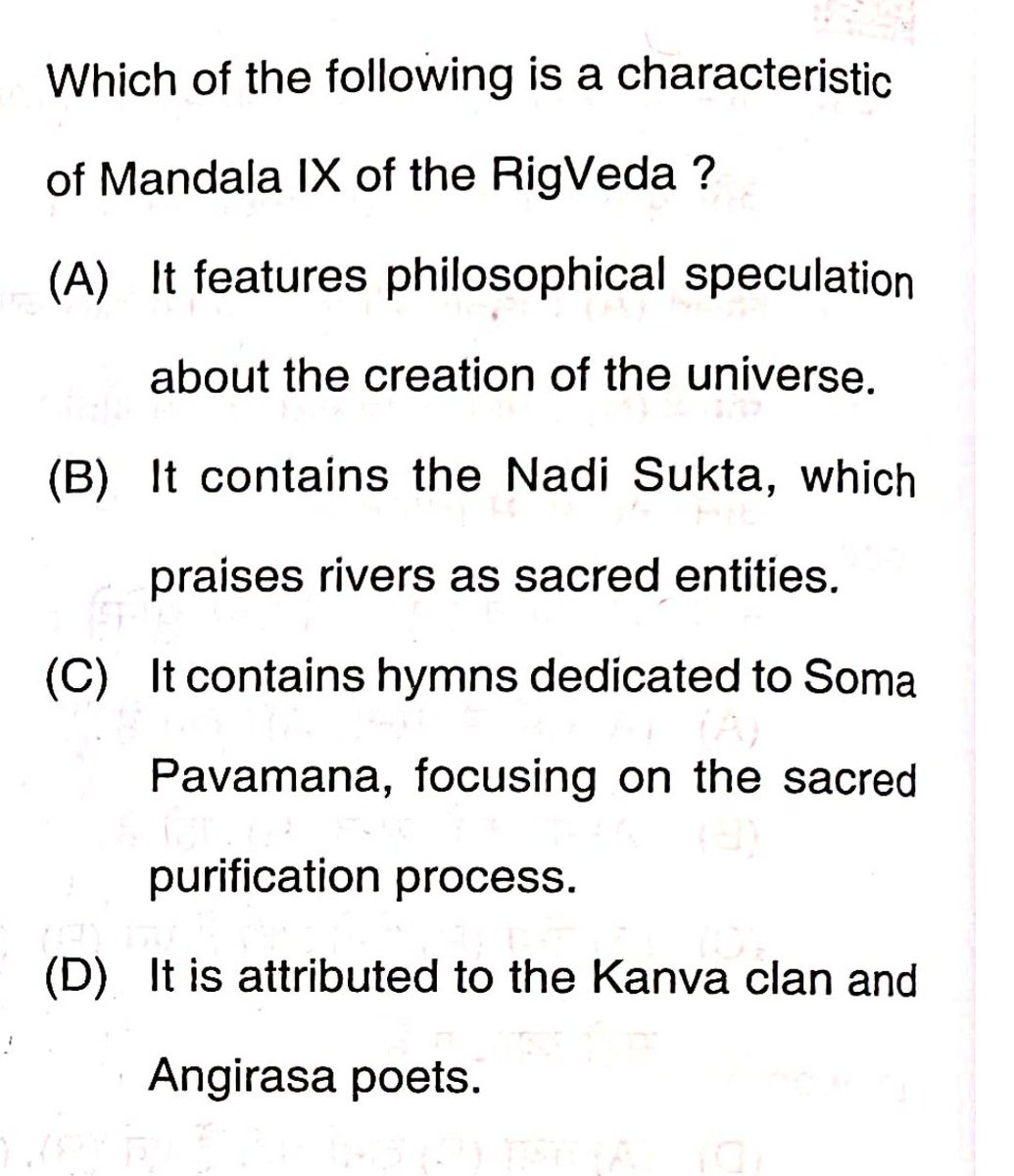
◾️Exam: BPSC AEDO Exam, 2026
◾️Exam Date: 14 April, 2026
◾️Subject: प्राचीन भारत (Ancient India)
◾️Topic: ऋग्वैदिक काल (Rigvedic Period)
◾️विस्तृत व्याख्या (Detailed Explanation:
🔹ऋग्वेद का नौवां मंडल पूरी तरह से 'सोम पवमान' (शुद्ध करने वाले सोम) को समर्पित है।
🔹इसमें 114 सूक्त हैं, जिनमें वैदिक अनुष्ठानों के दौरान पवित्र 'सोम' पेय को तैयार करने, उसे छानने और उसका सेवन करने की प्रक्रिया का वर्णन किया गया है; इसमें अक्सर शुद्धिकरण की प्रक्रिया पर विशेष ज़ोर दिया गया है। इसे प्रायः 'सोम मंडल' के नाम से भी जाना जाता है।
🔹'सोम' केवल एक अनुष्ठानिक पेय ही नहीं है, बल्कि यह एक दैवीय सत्ता और एक ब्रह्मांडीय सिद्धांत भी है, जिसका संबंध अमरता और प्रेरणा से है।
🔹दसवें मंडल में 'नदी सूक्त' शामिल है, जिसमें नदियों की पवित्र संस्थाओं के रूप में स्तुति की गई है।
🔹Mandala IX of the Rig Veda is exclusively dedicated to Soma Pavamana (Purifying Soma).
🔹It consists of 114 hymns that describe the preparation, filtration, and consumption of the sacred Soma drink during Vedic rituals, often focusing on the purification process. It is frequently referred to as the "Soma Mandala".
🔹Soma is not just a ritual drink but also a deified entity and a cosmic principle associated with immortality and inspiration.
🔹Mandala X contains the Nadi Sukta, which praises rivers as sacred entities.
📝BPSC PYQ Decode📝
◾️Exam: BPSC AEDO Exam, 2026
◾️Date: 14 April, 2026
◾️Subject: Ancient India
◾️Topic: Books & Authors
◾️Detailed Explanation:
🔹कर्पूरमंजरी की रचना 10वीं सदी के कवि-नाटककार राजशेखर ने अपनी पत्नी अवंतीसुंदरी को प्रसन्न करने के लिए सौरसेनी प्राकृत में की थी।
🔹राजशेखर गुर्जर-प्रतिहार राजाओं महेंद्रपाल प्रथम और महिपाल प्रथम के दरबारी कवि और गुरु थे।
🔹Karpuramanjari was composed by the 10th-century poet-dramatist Rajasekhara, in Sauraseni Prakrit, to please his wife, Avantisundari.
🔹Rajasekhara was the court poet and mentor of the Gurjara-Pratihara kings, such as Mahendrapala I and Mahipala I.
⭕BPSC Bihar Insights⭕
✴️गया कांग्रेस अधिवेशन, 1922
◾️यह भारतीय राष्ट्रीय कांग्रेस का 37वां अधिवेशन था।
◾️यह बिहार में आयोजित होने वाला दूसरा कांग्रेस अधिवेशन था। पहला अधिवेशन 1912 में बांकीपुर (पटना) में आयोजित हुआ था।
◾️कांग्रेस के अध्यक्ष: चित्तरंजन दास
⭐नोट:
🔹चित्तरंजन दास को "देशबंधु" के नाम से जाना जाता था।
🔹वह सुभाष चंद्र बोस के राजनीतिक गुरु भी थे।
🔹वह 1908 के अलीपुर बम कांड ट्राइल के दौरान अरबिंदो घोष के वकील थे।
◾️इस अधिवेशन में महात्मा गांधी के नेतृत्व में कांग्रेस को विधान परिषदों के चुनावों का बहिष्कार करना था, जबकि अध्यक्ष चित्तरंजन दास ने कांग्रेस से चुनावों में भाग लेने का आग्रह किया।
◾️चित्तरंजन दास, मोतीलाल नेहरू, एन.सी. केलकर, सुभाष चंद्र बोस, विट्ठलभाई पटेल और अजमल खान कांग्रेस में बदलाव चाहते थे, उन्हें प्रो-चेंजर कहा जाता था। वे चुनाव का बहिष्कार ख़त्म कर चुनाव लड़ने के पक्ष में थे।
सी. राजगोपालाचारी, मुख्तार अहमद अंसारी और वल्लभभाई पटेल को नो-चेंजर कहा जाता था। उन्होंने बहिष्कार और असहयोग जारी रखने की वकालत की।
◾️गांधी के गुट से "नो काउंसिल एंट्री" पर प्रस्ताव हारने के बाद चित्तरंजन दास ने गया सत्र में भारतीय राष्ट्रीय कांग्रेस के अध्यक्ष पद से इस्तीफा दे दिया। उन्होंने मोतीलाल नेहरू और अन्य नेताओं के साथ मिलकर 1 जनवरी, 1923 को कांग्रेस-खिलाफत स्वराज पार्टी की स्थापना की। चित्तरंजन दास इसके अध्यक्ष थे, जबकि मोतीलाल नेहरू इस पार्टी के सचिव थे।
◾️इसमें श्रमिक संगठन को लेकर प्रस्ताव भी पारित किया गया। इसका प्रस्ताव भागलपुर के दीप नारायण सिंह ने रखा था।
◾️गया कांग्रेस अधिवेशन में उल्लेखनीय प्रतिभागी:
🔹एम. सिंगारवेलु चेट्टियार: वह मद्रास के एक वकील और सामाजिक कार्यकर्ता थे। उन्होंने श्रमिक संगठन के कार्यकर्ताओं के प्रतिनिधि के रूप में भाग लिया।
🔹गुलाब तिवारी: ये ताना भगत आंदोलन के एक प्रमुख नेता थे।
⭐नोट: ताना भगत आंदोलन (1914-1920) छोटानागपुर क्षेत्र में ओरांव जनजाति के लोगों द्वारा स्थानीय ब्रिटिश अधिकारियों की नीतियों और स्थानीय जमींदारों की शोषणकारी प्रथाओं के खिलाफ एक विद्रोह था।
🔹सरोजिनी नायडू और कस्तूरबा गांधी गया अधिवेशन में भाग लेने वाली प्रमुख महिलाएँ थीं।
✴️Gaya Congress Session, 1922
◾️It was the 37th Session of Indian National Congress.
◾️It was the second Congress Session to held in Bihar. First session was held in 1912 in Bankipore (Patna).
◾️President of Congress: Chittaranjan Das
⭐Note:
🔹Chittaranjan Das was popularly known as "Deshbandhu".
🔹He was also the political mentor of Subhas Chandra Bose.
🔹He defended Aurobindo Ghosh in Alipore Bomb Case of 1908.
◾️Mahatma Gandhi insisted that the Congress should boycott the elections to the Legislative Counsils, while President Chittaranjan Das urged Congress to participate in the elections.
◾️Chittaranjan Das, Motilal Nehru, N.C. Kelkar, Subhash Chandra Bose, Vithalbhai Patel and Ajmal Khan wanted changes in the Congress were called Pro-changers. They wanted to end the boycott of legislature and contest elections.
C. Rajgopalachari, Mukhtar Ahmed Ansari and Vallabhbhai Patel were called No-changers. They advocated continuation of boycott and noncooperation.
◾️Chittaranjan Das resigned as a President of the Indian National Congress at the Gaya Session after losing a motion on "No Council Entry" to Gandhi's faction.
He along with Motilal Nehru and other leaders, founded the Congress-Khilafat Swaraj Party on January 1, 1923. Chittaranjan Das was President, while Motilal Nehru was Secretary of this party.
◾️A resolution about Labour Organization was passed. This was proposed by Deep Narayan Singh of Bhagalpur.
◾️Notable Participants in the Gaya Congress Session:
🔹M. Singaravelu Chettiar: He was a lawyer and social activist from Madras. He participated as a representative of trade union workers.
🔹Gulab Tiwari: He was the leader of Tana Bhagats.
⭐Note: Tana Bhagat Movement (1914-1920) was a uprising in Chhotanagpur area by people from Oraon tribe against the policies of the local British authorities and exploitative practices of local zamindars.
🔹Sarojini Naidu and Kasturba Gandhi were the prominent women who attended the Gaya Session.
📝BPSC PYQ Decode📝
◾️Exam: BPSC District Statistical Officer (Prelims) Exam, 2025
◾️Subject: General Knowledge
◾️Topic: Inventors and Discoverers
◾️Ans: (C)
◾️Detailed Explanation:
🔹जॉन मैकार्थी को व्यापक रूप से 'कृत्रिम बुद्धिमत्ता' [आर्टिफिशियल इंटेलिजेंस (AI)] का जनक माना जाता है।
🔹उन्होंने 1955 में "आर्टिफिशियल इंटेलिजेंस" शब्द गढ़ा और 1956 में डार्टमाउथ सम्मेलन का आयोजन किया, जिसे अध्ययन के एक क्षेत्र के रूप में AI का आधिकारिक जन्म माना जाता है।
🔹John McCarthy is widely regarded as the father of Artificial Intelligence.
🔹He coined the term "Artificial Intelligence" in 1955 and organized the Dartmouth Conference in 1956, which is considered the official birth of AI as a field of study.
⭕BPSC Bihar Insights⭕
🔶बिहार में यूरोपीय कंपनियाँ
◾️पुर्तगाली:
🔹पुर्तगाली बिहार में प्रवेश करने वाले पहले यूरोपीय थे।
🔹पुर्तगाली मुख्यतः कपड़ा, विशेषकर कपास के बदले मसालों का व्यापार करते थे।
🔹हुगली इस क्षेत्र का पहला स्थान था जहां पुर्तगालियों ने 1579-80 में अपना कारखाना स्थापित किया जब मुग़ल सम्राट अकबर ने पुर्तगाली कप्तान पेड्रो ट्रेवर्स को इसकी अनुमति दी।
🔹1599 में पुर्तगाली व्यापारियों ने बंदेल में एक कॉन्वेंट और एक चर्च का निर्माण किया जो बंगाल में पहला ईसाई चर्च था।
◾️ब्रिटिश:
🔹अंग्रेज दूसरे यूरोपीय थे जिन्होंने 1620 में पटना के आलमगंज में अपनी फैक्ट्री की स्थापना की, लेकिन 1621 में इसे बंद कर दिया गया।
🔹फिर 1651 में ब्रिटिश ईस्ट इंडिया कंपनी ने गुलज़ार बाग में फैक्ट्री को पुनर्जीवित किया।
◾️डच:
🔹डच ईस्ट इंडिया कंपनी ने भी 1632 में पटना में अपना कारखाना स्थापित किया था। इस स्थान को अब पटना कलक्ट्रेट के नाम से जाना जाता है।
◾️डेनिश:
🔹1774 में डेनिश ईस्ट इंडिया कंपनी ने पटना के नेपाली कोठी में अपना कारखाना स्थापित किया।
🔶European Companies in Bihar
◾️Portuguese:
🔹Portuguese were the first Europeans to enter Bihar.
🔹Portuguese mainly traded in spices for textile, especially cotton producing region.
🔹Hooghly was the first place in this region where the Portuguese established their factory in 1579-80 when Emperor Akbar gave permission to a Portuguese captain Pedro Travers.
🔹In 1599, the Portuguese traders built a convent and a church in Bandel which was the first Christian Church in Bengal.
◾️British:
🔹British were the second European who built their factory in Patna at Alamganj in 1620 but was got closed in 1621.
🔹Again in 1651, the British East India Company revived the factory at Gulzar Bagh.
◾️Dutch:
🔹Dutch East India Company also established their factory at Patna in 1632. This place is now known as Patna Collectorate.
◾️Danish:
🔹In 1774, Danes East India Company established their factory at Nepali Kothi in Patna.
🎯BPSC Prelims Pulse🎯
✴️उप-परमाणु कण और उनके खोजकर्ता
◾️इलेक्ट्रॉन
🔹खोजकर्ता: जे. जे. थॉमसन
🔹वर्ष: 1897
◾️प्रोटॉन
🔹खोजकर्ता: अर्नेस्ट रदरफोर्ड
🔹वर्ष: 1917 (1919 में प्रकाशित)
◾️न्यूट्रॉन
🔹खोजकर्ता: जेम्स चैडविक
🔹वर्ष: 1932
◾️फोटॉन
🔹खोजकर्ता: अल्बर्ट आइंस्टीन (सैद्धांतिक व्याख्या)
🔹वर्ष: 1905
⭐नोट: आइंस्टीन ने "प्रकाश क्वांटा" का उपयोग करके प्रकाश विद्युत प्रभाव की व्याख्या की थी, जिसे बाद में 1926 में गिल्बर्ट लुईस द्वारा "फोटॉन" नाम दिया गया।
◾️पॉज़िट्रॉन
🔹खोजकर्ता: कार्ल डी. एंडरसन
🔹वर्ष: 1932
◾️न्यूट्रिनो
🔹पूर्वानुमान: वोल्फगैंग पॉली (1930)
🔹खोजकर्ता: क्लाइड कोवान और फ्रेडरिक रेन्स (1956)
◾️मेसॉन
🔹 पूर्वानुमान: हिदेकी युकावा (1935)
🔹 खोजकर्ता: सी. एफ. पॉवेल (1947)
◾️क्वार्क
🔹प्रस्तावक: मरे गेल-मैन और जॉर्ज ज़्वेइग
🔹वर्ष: 1964
◾️हिग्स बोसॉन ("गॉड पार्टिकल")
🔹प्रस्तावक: पीटर हिग्स और अन्य (1964)
🔹खोजकर्ता: CERN (LHC) (2012)
✴️Sub-atomic Particles and their Discoverers:
◾️Electron
🔹Discoverer: J.J. Thomson
🔹Year: 1897
◾️Proton
🔹Discoverer: Ernest Rutherford
🔹Year: 1917 (Reported in 1919)
◾️Neutron
🔹Discoverer: James Chadwick
🔹Year: 1932
◾️Photon
🔹Discoverer: Albert Einstein (Theoretical explanation)
🔹Year: 1905
⭐Note: Einstein explained the Photoelectric Effect using "light quanta", which was later named as "photon" by Gilbert Lewis in 1926.
◾️Positron
🔹Discoverer: Carl D. Anderson
🔹Year: 1932
◾️Neutrino
🔹Predicted by: Wolfgang Pauli (1930)
🔹Discovered by: Clyde Cowan & Frederick Reines (1956)
◾️Meson
🔹Predicted by: Hideki Yukawa (1935)
🔹Discovered by: C.F. Powell (1947)
◾️Quarks
🔹Proposed by: Murray Gell-Mann & George Zweig
🔹Year: 1964
◾️Higgs Boson (The "God Particle")
🔹Proposed by: Peter Higgs & others (1964)
🔹Discovered by: CERN (LHC) (2012)
📝BPSC PYQ Decode📝
◾️Exam: BPSC Motor Vehicle Inspector Exam, 2025
◾️Subject: History (Modern India)
◾️Topic: Books & Authors
◾️Ans: (A)
◾️Detailed Explanation:
🔹'पाकिस्तान या Partition of India नामक पुस्तक डॉ. बी.आर. अंबेडकर द्वारा लिखी गई थी। 1940 में प्रकाशित यह कृति, भारत में एक अलग मुस्लिम राष्ट्र की मांग से जुड़े राजनीतिक, सामाजिक और धार्मिक तर्कों का विस्तृत विश्लेषण प्रस्तुत करती है।
▪️नोट: राम मनोहर लोहिया ने "भारत के विभाजन के दोषी लोग" (Guilty Men of India's Partition) लिखी।
🔹The book 'Pakistan or the Partition of India' was written by Dr. B.R. Ambedkar. Published in 1940, this work provides a detailed analysis of the political, social, and religious arguments surrounding the demand for a separate Muslim nation in India.
▪️Note: Ram Manohar Lohia wrote a book titled "Guilty Men of India's Partition".
🎯BPSC Prelims Pulse🎯
🔶 भारत की प्रमुख जनजातियाँ
🔹भील: राजस्थान, मध्य प्रदेश, गुजरात, महाराष्ट्र
◾️नोट: जनसंख्या की दृष्टि से भील भारत की सबसे बड़ी जनजाति है।
🔹गोंड: मध्य प्रदेश, छत्तीसगढ़, महाराष्ट्र, आंध्र प्रदेश, ओडिशा
◾️नोट: भारत का दूसरा सबसे बड़ा जनजातीय समूह; ऐतिहासिक रूप से अपनी "गोंड पेंटिंग" के लिए प्रसिद्ध।
🔹संथाल: झारखंड, पश्चिम बंगाल, बिहार, ओडिशा
◾️नोट: भारत की तीसरी सबसे बड़ी जनजाति। राष्ट्रपति द्रौपदी मुर्मू संथाल जनजाति से ही संबंधित हैं।
🔹थारू: उत्तराखंड, उत्तर प्रदेश और बिहार का तराई क्षेत्र
◾️नोट: अपने पूर्वजों की याद में दीपावली को 'शोक के दिन' के रूप में मनाने के लिए जानी जाती है।
🔹जारवा / सेंटिनली / ओंगे / शोम्पेन: अंडमान और निकोबार द्वीप समूह
◾️नोट: सेंटिनली दुनिया के सबसे अलग-थलग रहने वाले लोगों में से हैं।
🔹टोडा: नीलगिरि पहाड़ियाँ (तमिलनाडु)
🔹चेंचू: आंध्र प्रदेश और तेलंगाना (नल्लामाला पहाड़ियाँ)
🔹गारो, खासी, जयंतिया: मेघालय
🔹लेपचा / भूटिया: सिक्किम
🔹गद्दी / बकरवाल: हिमाचल प्रदेश, जम्मू और कश्मीर
◾️नोट: ये 'ऋतु-प्रवास' (पशुओं के साथ मौसमी प्रवास) के लिए जाने जाते हैं।
🔹अपातानी / मिशमी / निशि: अरुणाचल प्रदेश
🔹मोपला: केरल (मालाबार क्षेत्र)
🔹कुकी / मैतेई: मणिपुर
◾️नोट: ये ऐतिहासिक रूप से "कुकी-चिन" जातीय समूहों से जुड़े रहे हैं।
🔹भोटिया: उत्तराखंड
🔹वर्ली: महाराष्ट्र
◾️नोट: वर्ली पेंटिंग्स के लिए दुनिया भर में प्रसिद्ध।
🔹मीणा: राजस्थान
🔹मुंडा: झारखंड और ओडिशा
◾️नोट: बिरसा मुंडा (उलगुलान विद्रोह) इसी जनजाति से संबंधित थे।
🔹इरुला: तमिलनाडु और केरल
◾️नोट: सांप और चूहे पकड़ने में विशेषज्ञ।
🔹सहरिया: मध्य प्रदेश और राजस्थान
🔹सिद्दी: गुजरात, कर्नाटक और आंध्र प्रदेश
🔹अंगामी / एओ / चाखेसांग: नागालैंड
◾️नोट: अंगामी जनजाति हॉर्नबिल उत्सव और सेक्रेनी उत्सव के लिए प्रसिद्ध है।
🔶 Major Tribes of India
🔹Bhil: Rajasthan, Madhya Pradesh, Gujarat, Maharashtra
◾️Note: Bhil is the largest tribe in India by population.
🔹Gond: Madhya Pradesh, Chhattisgarh, Maharashtra, Andhra Pradesh, Odisha
◾️Note: The second-largest tribal group in India; historically known for their "Gond Painting."
🔹Santhal: Jharkhand, West Bengal, Bihar, Odisha
◾️Note: India’s third-largest tribe. President Droupadi Murmu belongs to the Santhal tribe.
🔹Tharu: Tarai region of Uttarakhand, Uttar Pradesh, and Bihar
◾️Note: Known for observing Diwali as a day of sorrow in memory of their ancestors.
🔹Jarawa / Sentinelese / Onge / Shompen: Andaman & Nicobar Islands
◾️Note: The Sentinelese are among the most isolated people in the world.
🔹Toda: Nilgiri Hills (Tamil Nadu)
🔹Chenchu: Andhra Pradesh and Telangana (Nallamala Hills)
🔹Garo, Khasi, Jaintia: Meghalaya
🔹Lepcha / Bhutia: Sikkim
🔹Gaddis / Bakharwal: Himachal Pradesh, Jammu & Kashmir
◾️Note: These are known for transhumance (seasonal migration with livestock).
🔹Apatani / Mishmi / Nyishi: Arunachal Pradesh
🔹Moplah: Kerala (Malabar region)
🔹Kuki / Meitei: Manipur
◾️Note: These are historically involved in the "Kuki-Chin" ethnic groups.
🔹Bhotia: Uttarakhand
🔹Warli: Maharashtra
◾️Note: Famous worldwide for Warli paintings.
🔹Meena: Rajasthan
🔹Munda: Jharkhand and Odisha
◾️Note: Birsa Munda (Ulgulan Revolt) belonged to this tribe.
🔹Irula: Tamil Nadu and Kerala
◾️ Note: Experts in snake and rat catching.
🔹Sahariya: Madhya Pradesh and Rajasthan
🔹Siddis: Gujarat, Karnataka, and Andhra Pradesh
🔹Angami / Ao / Chakhesang: Nagaland
◾️Note: The Angami tribe is famous for the Hornbill Festival and Sekrenyi festival.
📝BPSC PYQ Decode📝
◾️Exam: BPSC Lower Division Clerk Exam, 2025
◾️Subject: History (Modern India)
◾️Topic: Governor-Generals & Viceroys
◾️Ans: (D)
◾️Detailed Explanation:
🔹लॉर्ड डलहौज़ी, जो 1848 से 1856 तक गवर्नर-जनरल रहे, उन्हें ब्रिटिश साम्राज्य की सीमाओं को उसकी प्राकृतिक सीमाओं तक विस्तृत करने का श्रेय दिया जाता है। ये सीमाएँ पूर्व में इरावदी नदी से लेकर पश्चिम में सिंधु नदी तक फैली हुई थीं।
🔹दूसरे आंग्ल-बर्मा युद्ध (1852) के बाद डलहौज़ी ने निचले बर्मा (पेगू) को अपने साम्राज्य में मिला लिया, जिससे ब्रिटिश सीमा इरावदी डेल्टा तक पहुँच गई।
🔹दूसरे आंग्ल-सिख युद्ध (1848–1849) के माध्यम से डलहौज़ी ने पंजाब को अपने साम्राज्य में मिला लिया, जिससे ब्रिटिश क्षेत्र का विस्तार सिंधु नदी और अफ़ग़ान सीमा तक हो गया।
🔹Lord Dalhousie, the Governor-General from 1848 to 1856, is credited with extending the boundaries of the British Empire to its natural limits, stretching from the Irrawaddy River in the east to the Indus River in the west.
🔹Following the Second Anglo-Burmese War (1852), Dalhousie annexed Lower Burma (Pegu), bringing the British frontier to the Irrawaddy Delta.
🔹Through the Second Anglo-Sikh War (1848–1849), he annexed the Punjab, extending British territory up to the Indus River and the Afghan border.
⭕BPSC Bihar Insights⭕
✴️श्वेत व्यक्ति का बोझ
🔹सच्चिदानंद सिन्हा ने ब्रिटिश उपनिवेशवाद को भारत पर "श्वेत व्यक्ति का बोझ" कहा था।
🔹इस पंक्ति का भावार्थ कम विकसित गैर-श्वेत लोगों के मामलों का प्रबंधन करने के लिए श्वेत लोगों के कथित कर्तव्य के रूप में था।
📑नोट: "व्हाइट मैन्स बर्डन (श्वेत व्यक्ति का बोझ)" पंक्ति 1899 में कवि रुडयार्ड किपलिंग द्वारा गढ़ा गया था।
☀️सच्चिदानंद सिन्हा के बारे में मुख्य तथ्य
🔹जन्म: 1871 (आरा, बिहार)
🔹1899 में कांग्रेस में शामिल हुए।
🔹1912 में आयोजित बांकीपुर (पटना) कांग्रेस अधिवेशन के दौरान महासचिव नियुक्त किए गए।
🔹होम रूल लीग आंदोलन से जुड़ने वाले बिहार के प्रमुख नेताओं में से एक।
🔹भारत सरकार अधिनियम 1919 के तहत केंद्रीय विधानसभा की बैठकों की अध्यक्षता करने के लिए अध्यक्ष और उपाध्यक्ष पद बनाए जाने पर वह 1921 में केंद्रीय विधानसभा के पहले उपाध्यक्ष (डिप्टी स्पीकर) बने।
🔹1921 में बिहार और उड़ीसा सरकार की कार्यकारी परिषद के सदस्य बने।
🔹वह पहले भारतीय थे जिन्हें किसी प्रांत (बिहार और उड़ीसा सरकार) के वित्त सदस्य के रूप में नियुक्त किया गया था।
🔹पटना विश्वविद्यालय के कुलपति (1936-1944)
🔹भारत की संविधान सभा का अंतरिम अध्यक्ष (1946)
🔹प्रकाशक/संपादक: द बिहार टाइम्स, सर्चलाईट, इंडियन नेशन, हिंदुस्तान रिव्यू
✍️क्या आप जानते हैं?
संयुक्त राज्य अमेरिका से भारत के लिए पहला टेलीग्राम अमेरिका के पूर्व विदेश मंत्री डीन एचेसन द्वारा भारत की संविधान सभा के अंतरिम अध्यक्ष सच्चिदानंद सिन्हा को भेजा गया था, जिसमें भारत को अपना संविधान बनाने के लिए बधाई दी गई थी।
✴️White Man’s Burden
🔹Sachchidanand Sinha called British Colonialism as "White
Man’s Burden" on the Indian people.
🔹The White Man’s Burden was considered as the alleged duty of the white peoples to manage the affairs of the less-developed non-white peoples.
📑Note: The term "White Man’s Burden" was coined by poet Rudyard Kipling in 1899.
☀️Key Facts about Sachchidananda Sinha
🔹Born at Arrah in Bihar in 1871.
🔹Joined the Congress in 1899.
🔹General Secretary during the Bankipore (Patna) Congress Session held in 1912.
🔹Leader of Home Rule League Movement in Bihar.
🔹First Deputy President (Deputy Speaker) of the Central Legislative Assembly in 1921, after the Government of India Act 1919 institutionalised President and Deputy President to preside over the meetings of Central Legislative Assembly.
🔹Member of Executive Council of Government of Bihar and Orissa in 1921.
🔹First Indian who was ever appointed as a Finance Member of a Province (Government of Bihar and Orissa).
🔹Vice-Chancellor of Patna University (1936-44)
🔹Interim President of the Constituent Assembly of India (1946)
🔹Publisher/Editor: The Bihar Times, Searchlight, Indian Nation, Hindustan Review.
✍️Do You Know?
The first Telegram from USA to India was sent by Dean Acheson, the former Secretary of State of the USA, to Sachchidananda Sinha, the Interim President of the Constituent Assembly of India, congratulating India for creating its Constitution.
🎯BPSC Prelims Pulse🎯
✴️स्वतंत्रता संग्राम के दौरान प्रसिद्ध समाचार पत्र और पत्रिकाएँ
◾️बंगाल गजट (1780)
🔹संस्थापक: जेम्स ऑगस्टस हिकी
🔹तथ्य: भारत का पहला समाचार पत्र। वारेन हेस्टिंग्स की आलोचना करने के कारण इसे जब्त कर लिया गया था।
◾️संवाद कौमुदी (1821)
🔹लेखक: राजा राम मोहन राय
🔹भाषा: बंगाली
🔹उद्देश्य: सती प्रथा के विरुद्ध
◾️मिरात-उल-अखबार (1822)
🔹लेखक: राजा राम मोहन राय
🔹भाषा: फारसी (पहला फारसी अखबार)
◾️उदन्त मार्तण्ड (1826)
🔹तथ्य: भारत का पहला हिंदी समाचार पत्र
🔹संस्थापक: जुगल किशोर शुक्ल
◾️रास्त गोफ्तार (1851)
🔹लेखक: दादाभाई नौरोजी
🔹उद्देश्य: पारसी सुधार आंदोलन
◾️सोम प्रकाश (1858)
🔹संस्थापक: ईश्वर चंद्र विद्यासागर
🔹तथ्य: यह नील विद्रोह का खुलकर समर्थन करने वाला पहला अखबार था।
◾️अमृत बाजार पत्रिका (1868)
🔹संस्थापक: शिशिर कुमार घोष और मोतीलाल घोष
🔹तथ्य: यह एक बंगाली अखबार था। जब अंग्रेजों ने स्थानीय भाषा के अखबारों पर प्रतिबंध लगाने के लिए वर्नाक्युलर प्रेस एक्ट (1878) लाया, तो कानून से बचने के लिए इसे रातों-रात अंग्रेजी भाषा में बदल दिया गया।
◾️केसरी और मराठा (1881)
🔹लेखक: बाल गंगाधर तिलक
🔹तथ्य: (केसरी: मराठी भाषा में, मराठा: अंग्रेजी भाषा)
◾️वॉइस ऑफ इंडिया (1883)
🔹लेखक: दादाभाई नौरोजी
◾️प्रबुद्ध भारत (1896)
🔹लेखक: स्वामी विवेकानंद
◾️इंडियन ओपिनियन (1903)
🔹लेखक: महात्मा गांधी
🔹तथ्य: दक्षिण अफ्रीका में शुरू किया गया।
◾️द कॉमरेड (1911)
🔹लेखक: मौलाना मोहम्मद अली जौहर
🔹भाषा: अंग्रेजी
◾️अल-हिलाल (1912)
🔹लेखक: मौलाना अबुल कलाम आज़ाद
🔹तथ्य: हिंदू-मुस्लिम एकता को बढ़ावा दिया
◾️ हमदर्द (1913)
🔹लेखक: मौलाना मोहम्मद अली जौहर
🔹भाषा: उर्दू
◾️कॉमनवील (1914) और न्यू इंडिया (1914)
🔹लेखक: एनी बेसेंट
🔹उद्देश्य: होम रूल लीग को बढ़ावा देने के लिए।
◾️यंग इंडिया (1919)
🔹संपादक: महात्मा गांधी
🔹भाषा: अंग्रेजी साप्ताहिक
◾️नवजीवन (1919)
🔹संपादक: महात्मा गांधी
🔹भाषा: गुजराती/हिंदी
◾️द इंडिपेंडेंट (1919)
🔹संस्थापक: मोतीलाल नेहरू
◾️मूकनायक (1920)
🔹लेखक: डॉ. बी.आर. अंबेडकर
🔹उद्देश्य: दलित अधिकार
◾️हरिजन (1933)
🔹संपादक: महात्मा गांधी
🔹तथ्य: यरवदा जेल, पुणे, से शुरू किया गया।
✴️Famous Newspapers & Journals During Freedom Struggle
◾️Bengal Gazette (1780)
🔹Founder: James Augustus Hicky
🔹Fact: The First Newspaper of India. It was seized because it criticized Warren Hastings.
◾️Sambad Kaumudi (1821)
🔹Author: Raja Ram Mohan Roy
🔹Language: Bengali
🔹Focus: Against Sati Pratha
◾️Mirat-ul-Akhbar (1822)
🔹Author: Raja Ram Mohan Roy
🔹Language: Persian (First Persian newspaper)
◾️Udant Martand (1826)
🔹Founder: Jugal Kishore Shukla
🔹Fact: The First Hindi Newspaper of India.
◾️Rast Goftar (1851)
🔹Author: Dadabhai Naoroji
🔹Purpose: Parsi reform movement
◾️Som Prakash (1858)
🔹Founder: Ishwar Chandra Vidyasagar
🔹Fact: It was the first paper to openly support the Indigo Revolt.
◾️Amrita Bazar Patrika (1868)
🔹Founders: Sisir Kumar Ghosh and Motilal Ghosh
🔹Fact: It was a Bengali newspaper. When the British brought the Vernacular Press Act (1878) to ban local language papers, this paper converted to English overnight to escape the law.
◾️Kesari & Maratha (1881)
🔹Author: Bal Gangadhar Tilak
🔹Fact: (Kesari: Marathi; Maratha: English)
◾️Voice of India (1883)
🔹Author: Dadabhai Naoroji
◾️Prabuddha Bharat (1896)
🔹Author: Swami Vivekananda
◾️Indian Opinion (1903)
🔹Author: Mahatma Gandhi
🔹Fact: Started in South Africa.
◾️The Comrade (1911)
🔹Author: Maulana Mohammad Ali Jauhar
🔹Language: English
◾️Al-Hilal (1912)
🔹Author: Maulana Abul Kalam Azad
🔹Fact: Promoted Hindu-Muslim unity.
◾️Hamdard (1913)
🔹Author: Maulana Mohammad Ali Jauhar
🔹Language: Urdu
◾️Commonweal (1914) & New India (1914)
🔹Author: Annie Besant
🔹Purpose: To promote the Home Rule League.
◾️Young India (1919)
🔹Editor: Mahatma Gandhi
🔹Language: English Weekly
◾️Navjeevan (1919)
🔹Editor: Mahatma Gandhi
🔹Language: Gujarati/Hindi
◾️The Independent (1919)
🔹Founder: Motilal Nehru
◾️Mooknayak (1920)
🔹Author: Dr. B.R. Ambedkar
🔹Focus: Dalit rights
◾️Harijan (1933)
🔹Author: Mahatma Gandhi
🔹Fact: Started from Yerwada Jail, Pune.


![Biharology's tweet photo. 📝BPSC PYQ Decode📝
◾️Exam: BPSC District Statistical Officer (Prelims) Exam, 2025
◾️Subject: General Knowledge
◾️Topic: Inventors and Discoverers
◾️Ans: (C)
◾️Detailed Explanation:
🔹जॉन मैकार्थी को व्यापक रूप से 'कृत्रिम बुद्धिमत्ता' [आर्टिफिशियल इंटेलिजेंस (AI)] का जनक माना जाता है।
🔹उन्होंने 1955 में "आर्टिफिशियल इंटेलिजेंस" शब्द गढ़ा और 1956 में डार्टमाउथ सम्मेलन का आयोजन किया, जिसे अध्ययन के एक क्षेत्र के रूप में AI का आधिकारिक जन्म माना जाता है।
🔹John McCarthy is widely regarded as the father of Artificial Intelligence.
🔹He coined the term "Artificial Intelligence" in 1955 and organized the Dartmouth Conference in 1956, which is considered the official birth of AI as a field of study.](https://pbs.twimg.com/media/HFx_X74acAA7bqC.jpg)



![Biharology's tweet photo. 📝BPSC PYQ Decode📝
◾️Exam: BPSC District Statistical Officer (Prelims) Exam, 2025
◾️Subject: General Knowledge
◾️Topic: Inventors and Discoverers
◾️Ans: (C)
◾️Detailed Explanation:
🔹जॉन मैकार्थी को व्यापक रूप से 'कृत्रिम बुद्धिमत्ता' [आर्टिफिशियल इंटेलिजेंस (AI)] का जनक माना जाता है।
🔹उन्होंने 1955 में "आर्टिफिशियल इंटेलिजेंस" शब्द गढ़ा और 1956 में डार्टमाउथ सम्मेलन का आयोजन किया, जिसे अध्ययन के एक क्षेत्र के रूप में AI का आधिकारिक जन्म माना जाता है।
🔹John McCarthy is widely regarded as the father of Artificial Intelligence.
🔹He coined the term "Artificial Intelligence" in 1955 and organized the Dartmouth Conference in 1956, which is considered the official birth of AI as a field of study.](https://pbs.twimg.com/media/HFx_X9GbgAA7Hrg.jpg)


