@sheriffj_john Ha. Agreed: we do have a propensity for a rain shield over our area. But, in this case, we have been sitting a bit too far from the primary lifting mechanism off to our southwest. That should change a bit here in the next few hours, though.
this video is a must-watch if you’re following the Florida Learjet crash:
A meteorologist and pilot wanted to know how is it that a plane equipped with Doppler radar did not see the storm ahead?
Turns out that the onboard radar can tilt and if the pilots had tilted it downwards, they would have seen that stronger storm building up.
How did they figure this out?
They took the actual National Weather Service Doppler radar data from the storm, then recalibrated and resampled it to simulate exactly what a Learjet’s onboard Collins WXR-840 X-band radar (the 3 cm wavelength system many of these jets carry) would have seen at 35,000 feet in −47 °C air.
The result is striking. At a normal 0° tilt, the returns look like faint ice-phase echoes. A nothingburger, basically.
Tilt the same radar down roughly 5° and it suddenly lights up with the stronger lower core of a rapidly intensifying storm directly ahead.
NWS data shows the storm tops were around 31,000 ft just before the jet penetrated, shot up to 40,000 ft while they were in it, then collapsed back to ~33,000 ft after they exited.
This confirms that they flew into a storm cloud with explosive growth and collapse with violent updrafts and downdrafts, exactly the kind of thing an X-band radar looking straight ahead at cruise altitude can easily under-sample.
@EricBurrisWX walks through the radar geometry, the crystal reflectivity at those temperatures, and low-key gives one of the clearest, most technically grounded explanations out there.
If anyone is tired of the heat, we're looking at a cooldown this weekend! By Sunday, temperatures max out in 60s and even drop overnight to the upper 40s for our northern-most cities. Don't put your flip-flops away yet, we're back in the mid-70s by Tuesday. 📉🍂 #TXwx#HOUwx
Writing this in my personal capacity, but I have been flying these types of aircraft for more than 20 years, with over 8,000 hours, and have reasonable familiarity with how the charter world operates. I feel compelled to post after seeing commentary about the Lear 60 crash, from missile strikes to DEI to critiquing this poor woman’s final radio calls.
That last part is what I find most troubling. She was the second-in-command (SIC), and while she was empowered to point out mistakes as part of good crew resource management, she was doing her job, communicating with ATC right to the end in a terrifying situation. She likely knew before many of those calls that she was going to die. I have heard final calls from friends, from military pilots with thousands of hours in fighter aircraft, and they are just as heartbreaking because they know the end is approaching.
I understand the public interest given the footage and audio. But you do not know the aircraft’s maintenance history, whether there was a structural failure, if any failure was induced by turbulence, overspeed, or overcontrol, or everything happening in that cockpit. I am sure weather will be part of the investigation, but beyond that, it is speculation. The charter industry routinely hires commercial pilots very early in their careers to gain experience alongside an ATP-qualified captain before they move up to the airlines. She would still have the appropriate training, qualifications, and checkouts by an FAA examiner or designee.
Let people investigate, learn, and share the facts. Be respectful to those who perished and the families who carry their memories. God bless them and their loved ones.
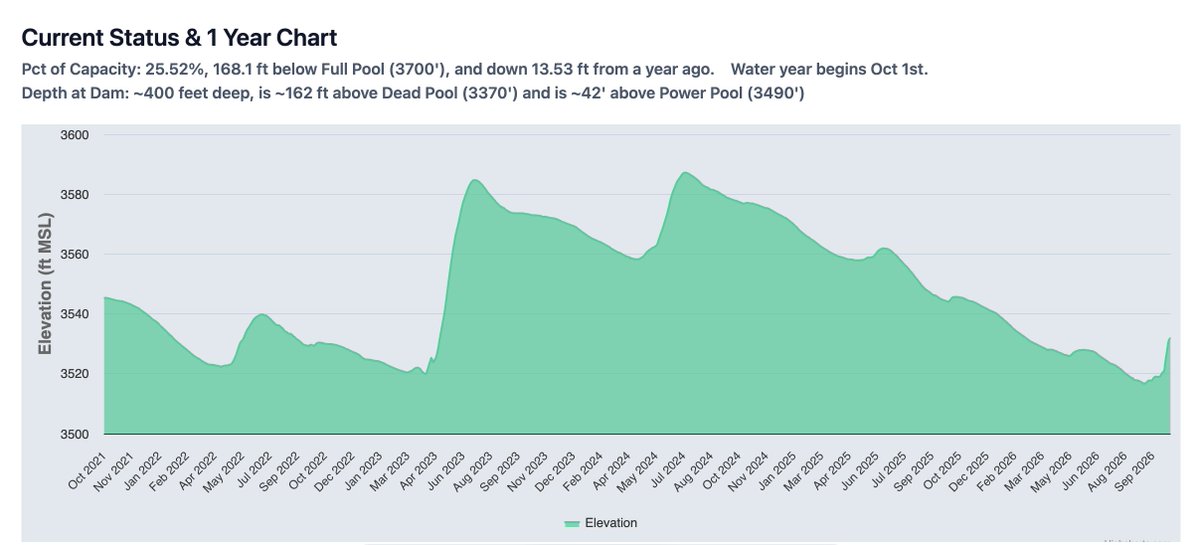
Many have been asking: "Does this at least help with the Colorado Basin water crisis?" Well, the answer is complicated. Serious costs from historic flooding vs sharp Lake Powell water level rise. Yet Powell, while rising, is still 13 feet lower than this time last year!
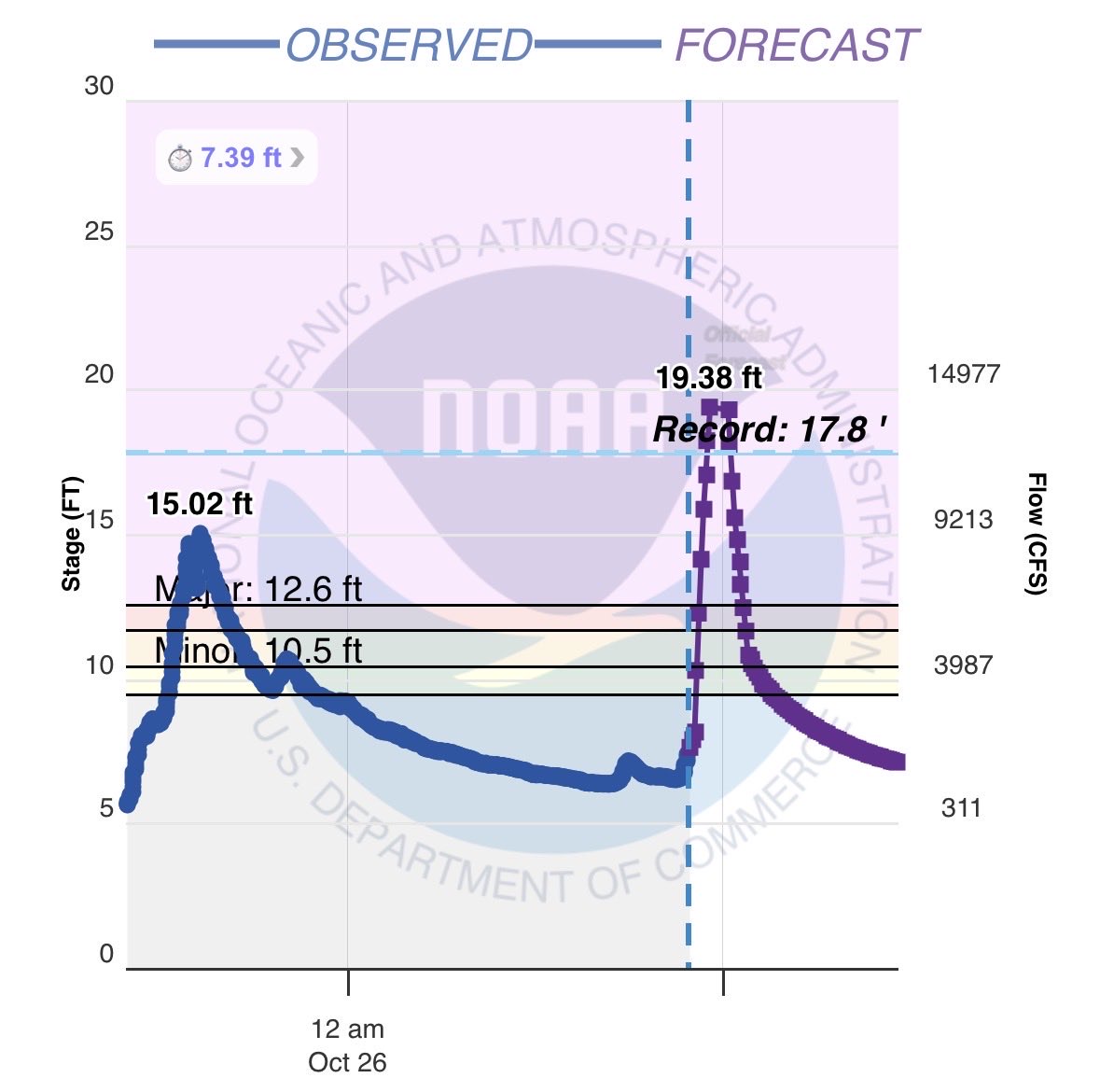
I don’t think the hydrological event in southwest Colorado is getting enough attention. This flooding event is historic and that is not hyperbole. The San Juan River at Pagosa Springs is now expected to crest at 19.38 feet; nearly 4.5 feet higher than the historic flood just last week and almost 2 feet above its all-time record.
Successive events of similar magnitudes compound impacts given that infrastructure has previously been weakened. I expect this event to cause significant damage to infrastructure across much of Southwest CO.
I feel like given all the talk about stratospheric warming and polar vortex disruption some things need to be clarified:
1. A SSW(sudden stratospheric warming) and potential subsequent reversal in winds associated with the stratospheric polar vortex DO NOT guarantee wave reflections back to the troposphere or coupling. It can have significant impacts should coupling/reflections to the lower atmosphere occur, but that is something that is still an unknown and will need to be observed in coming days and weeks. Wave reflection can have impacts sooner, coupling can take longer.
2. Notice how I said weeks… there is usually a lag period between the actual disruptive warming event/reversal itself and subsequent downward reflection and/or potential coupling. This can take time, and is still not a guarantee.
3. With the above being said this may have impacts on our pattern at 500 MB down the road come mid/late November, but right now that is TBD. In any case the Nino enhanced sub tropical jet will lead to increased storminess, with wetter and cooler potential for the southern tier of the United States as we move deeper into November, that’s just Nino climo.
So while this may be exciting for winter weather enthusiasts and while this event is extraordinary given the environment and time of year it is occurring, nothing is set in stone as of yet. Could this lead to a colder pattern later into November? Yes. Could wave propagation simply be absorbed by the stratosphere leaving a weakened vortex with little downward propagation/surface effects? Also yes. (The second scenario still doesn’t preclude downward coupling later down the road)
We know this will more likely than not significantly disrupt the polar vortex, but we still need to have some patience and observe downward coupling/wave propagation over the next 2-4 weeks. Canada is also going to remain quite warm during this time, so any true cold will need to originate via cross polar flow should we get enough polar blocking. Just several things to think about before we get either too hyped up, or too dismissive of this event at the moment.
This is amazing. Radial shear and vortex rossby waves shaping the eyewall of champi into a hexagonal shape. Similar vortex dynamics can be seen at the poles Saturn. Incredibly intense vortex represented here.
What a specimen #Champi t 7.5-8 dvorak should be somewhat weaker once it affects Taiwan to Japan’s but much larger size. But for now what a textbook super typhoon
These winds along our coast are still strong enough to elicit a High Risk of Rip Currents for our Gulf-facing beaches. Risk continues through Sunday morning. #TXwx
Here comes the "giant eraser" ... powerful mid-October cold front with dry Canadian Arctic air into this weekend.
It might be chilly for some folks!
Florida is not participating, of course.
We’re about 24 hours if not less from fall finally arriving in Houston. Gusty winds and temps falling off quickly by late tomorrow afternoon will likely need a light jacket by Friday evening. Will be somewhat of a shock to the system after we have had highs in the 90s all week. Enjoy!
That’s definitely the sub tropical jet starting to really fire as we move towards Halloween. Going to start getting very rainy in the southern tier of the U.S. it seems.
Notice that gap in the clouds down wind of Galveston Bay? It is a “bay shadow!”
Cooler bay water stabilizes the air, shutting down the rising thermals that create cloud streets. This creates clear skies stretching for miles until the air warms up again. #houwx#txwx@NWSHouston
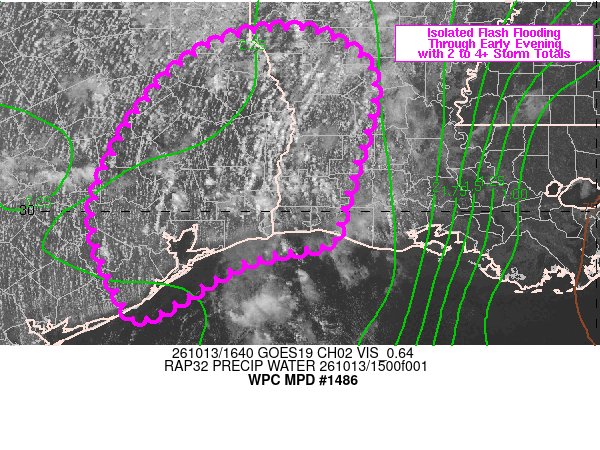
“SUMMARY...A few slow moving showers/thunderstorms are expected to impact portions of southeastern TX into western LA through the afternoon. Slow movement and high rain rates may result in Isolated flash flooding through 23Z.”
#houwx#txwx