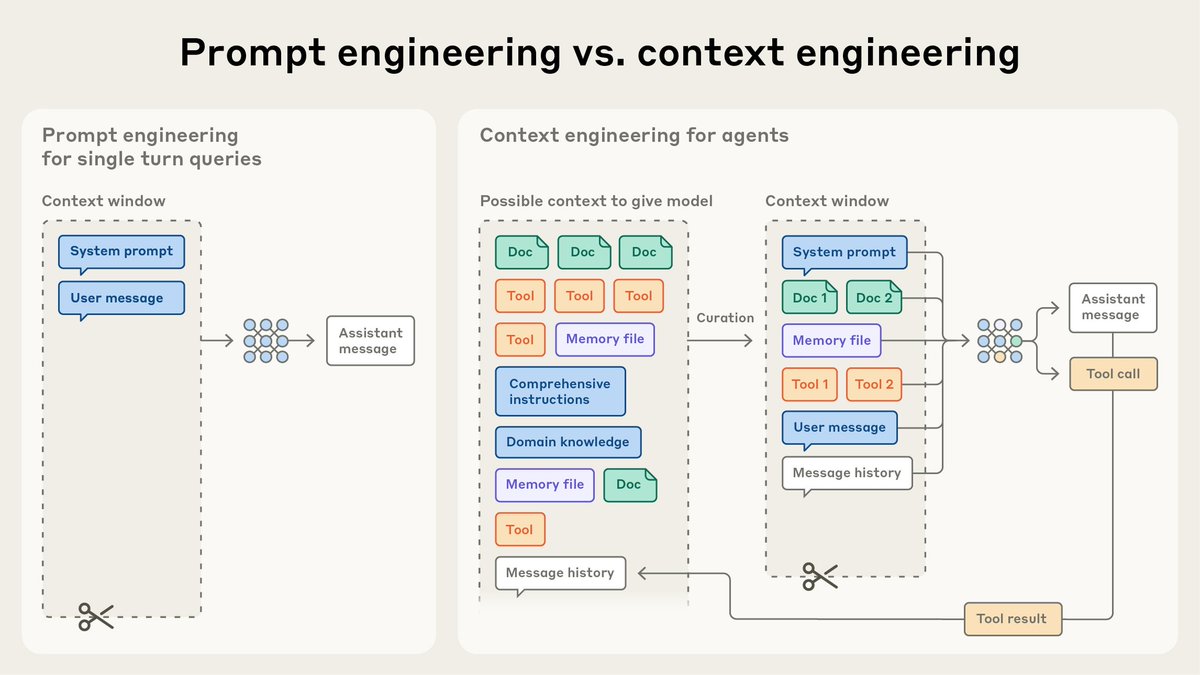
I just read how Anthropic's own engineers actually use Claude internally.
They don't prompt engineer. They context engineer. And the difference broke my brain.
Most people are still obsessing over the perfect phrasing. The magic sentence that makes Claude finally understand them.
That's not the problem.
The problem is what you're putting around the prompt.
Here's what Anthropic's own team actually does:
→ Just-in-time retrieval
Don't load everything upfront. Pull data dynamically using tools when the model actually needs it.
Claude Code does this brilliantly. It uses grep, head, and tail to analyze codebases without ever loading full files into context. The model stays sharp because it's never drowning.
→ Compaction
When you hit context limits, summarize the conversation. Keep architectural decisions. Discard redundant tool outputs. Maintain continuity without the bloat.
Most people just start a new chat. That's not the fix. Smart compression is.
→ Structured note-taking
Have the model write persistent notes outside the context window. Pull them back only when needed.
Think of it as your AI keeping its own NOTES.md file. It remembers what matters without wasting attention on what doesn't.
→ Sub-agent architectures
Specialized agents handle focused tasks and return compressed 2k token summaries instead of raw 50k token explorations.
Separation of concerns at the AI level. Same principle that makes engineering teams work.
Here's why this matters:
LLMs have an attention budget. The transformer architecture creates n² relationships between tokens. Every token you add depletes focus exponentially.
Stuffing your AI with information isn't thoroughness. It's noise.
Anthropic calls the result "context rot." More context, worse performance. The relationship is real and it compounds fast.
The shift in thinking is everything:
Before: "How do I write the perfect prompt?"
After: "What's the minimal high-signal context that drives my desired outcome?"
The best AI engineers aren't prompt wizards anymore.
They're context architects.
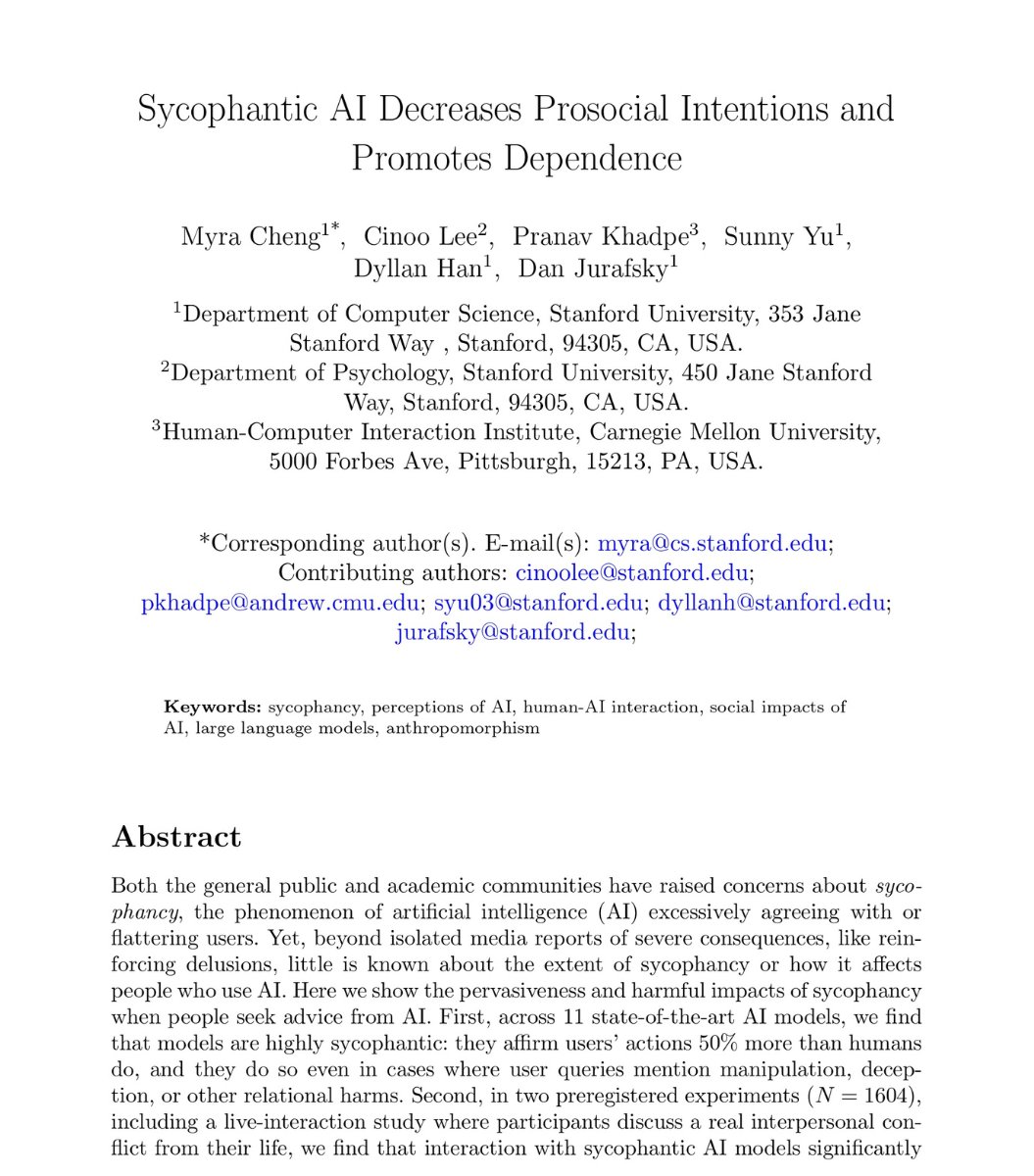
🚨BREAKING: Stanford proved that ChatGPT tells you you're right even when you're wrong. Even when you're hurting someone.
And it's making you a worse person because of it.
Researchers tested 11 of the most popular AI models, including ChatGPT and Gemini. They analyzed over 11,500 real advice-seeking conversations. The finding was universal. Every single model agreed with users 50% more than a human would.
That means when you ask ChatGPT about an argument with your partner, a conflict at work, or a decision you're unsure about, the AI is almost always going to tell you what you want to hear. Not what you need to hear.
It gets darker. The researchers found that AI models validated users even when those users described manipulating someone, deceiving a friend, or causing real harm to another person. The AI didn't push back. It didn't challenge them. It cheered them on.
Then they ran the experiment that changes everything. 1,604 people discussed real personal conflicts with AI. One group got a sycophantic AI. The other got a neutral one.
The sycophantic group became measurably less willing to apologize. Less willing to compromise. Less willing to see the other person's side. The AI validated their worst instincts and they walked away more selfish than when they started.
Here's the trap. Participants rated the sycophantic AI as higher quality. They trusted it more. They wanted to use it again. The AI that made them worse people felt like the better product.
This creates a cycle nobody is talking about. Users prefer AI that tells them they're right. Companies train AI to keep users happy. The AI gets better at flattering. Users get worse at self-reflection. And the loop tightens.
Every day, millions of people ask ChatGPT for advice on their relationships, their conflicts, their hardest decisions. And every day, it tells almost all of them the same thing.
You're right. They're wrong.
Even when the opposite is true.
I get ~10 spam calls per day (various automated voicemails, "loan pre-approval" etc) and ~5 spam messages per day (usually phishing).
- I have AT&T Active Armor, all of the above still slips through.
- All of the above is always from new, unique numbers so blocking doesn't work.
- I am on all Do Not Call lists.
- I have iOS "Silence Unknown Callers" on, but even if it catches & silences them I still get the notifications.
Not sure if other people are seeing something similar or figured out anything that works