Found Free 136+ LLM Models
https://t.co/qw1RBfWwVL
https://t.co/EdOZwJOE7N
Models :
- minimax m3
- kimi k2.6
- glm 5.1
- deepseek v4 pro
- Mistral
Enjoy guys just create API keys and connect to hermes/openclaw/codex, good for experiment
We built an AI that can draw on your screen.
It's a true personal tutor.
Using Claude Opus we're able to draw polygons, point with pixel perfect accuracy, and walk users through complex steps directly on their screen.
Here's me learning Pythagorean Theorem + FL Studio.
Demo:
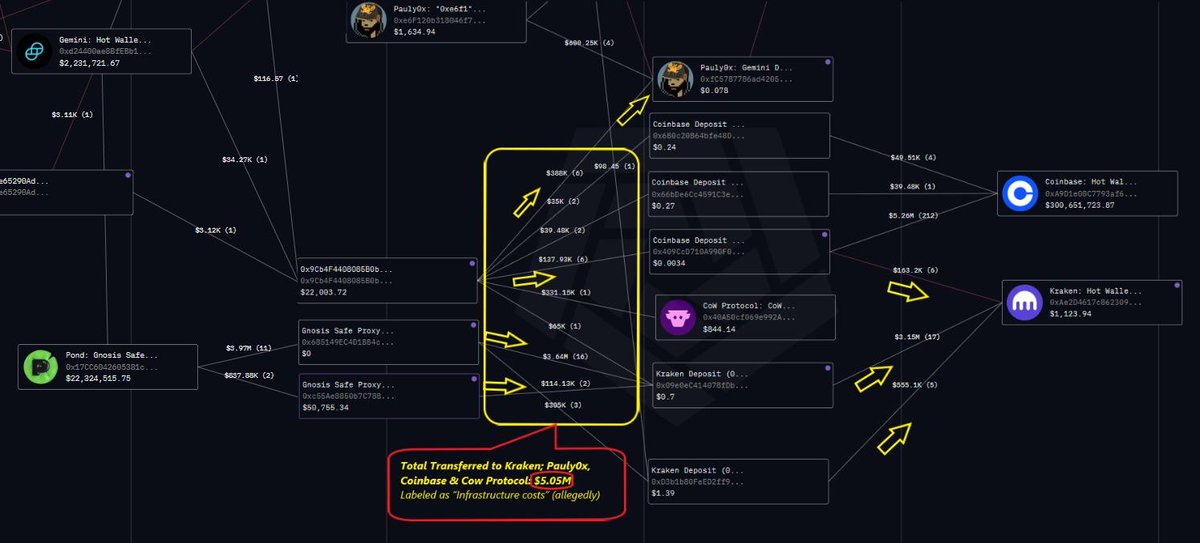
Correct. @arkham is a very useful tool for tracing funds, identifying fraud, and exposing bad actors.
Here is a strong example: using Arkham, it was possible to trace more than $43M in $ETH and $USDC that was allegedly off-ramped and misappropriated from the Pond treasury and Gnosis wallets, including from Poolvoid.eth.
The founders involved include Jeremy Jacques Cahen (@pauly0x / @JackDorsey0x ) of Santa Monica, CA; James Edgar (@JIMMYEDGAR ) of Brooklyn, NY; and Ryan Hickman (@hWonderofWorld / @RyanHickmam ) of New York.
After over 3.5 years of lies, funds linked to $PORK, $PNDC, and $WPOND were allegedly off-ramped through various exchanges, including @coinbase, @Gemini, and @krakenfx, as well as through bridge and swapping protocols such as @CoWSwap, @lifiprotocol, @LidoFinance, and others.
Managing your money is time consuming. Telling an AI agent what you want and putting it to work will eliminate toil.
Coinbase is an AI enabled financial account that can do just this.
In this clip, you can hear about what we're building to address this.
🚨JAPANESE AI STARTUP JUST MATCHED CLAUDE FABLE 5 AND MYTHOS PERFORMANCE.
Japanese AI lab just launched Fugu, a model trained to command other models.
Sakana AI, a Tokyo-based AI startup, was co-founded by researchers including one of the authors of the original Transformer paper, the blueprint that basically every AI model today is built on.
Sakana Fugu is a multi-agent AI system that feels like a single model, automatically orchestrating specialized models behind one API endpoint.
Fugu Ultra is claimed to match Anthropic's Fable 5 & Mythos Preview on the hardest engineering/science/reasoning benchmarks — and to beat Gemini 3.1 Pro, Opus 4.8 & GPT-5.5 on tasks like AutoResearch, mechanical design & financial forecasting.
Everyone's racing to scale ONE giant model but Fugu flips it: an LLM that orchestrates a pool of the world's best models (choosing who does what, delegating, verifying and merging it into one answer), even calling itself recursively.
Think of it as a conductor. You send one request to one API, and Fugu figures out the move: answer it solo, or assemble a squad of expert models and run the whole thing for you.
Sakana AI launched two models:
Fugu - fast, low-latency, everyday coding/chat
Fugu Ultra - max quality on hard, multi-step problems (AI research, paper reproduction, cybersecurity, patent search)
Export controls are hitting frontier models now, but because Fugu's agent pool is swappable, if a provider restricts access, it routes around it.
Both Fugu and Fugu Ultra can be accessed through a unified API, with subscription plans for everyday users and pay-as-you-go pricing designed for high-volume and enterprise workloads.
We registered the AI agent itself with the SEC as an investment advisor.
It has your complete context on your portfolio and account history. Speak to it in plain English to take action on your account. It will even prompt you with ideas you hadn’t thought of.
Bitcoin just met the 200W EMA for the first time since October 2023!
The 200W EMA has historically been a strong value area, but there is no rule that says Bitcoin cannot remain below it for an extended period.
In fact, the last time Bitcoin traded around this level, it eventually fell as much as 32% below it before finding a bottom. If something similar were to happen today, that would imply a move toward the ~$40k region.
Not a prediction, just a reminder that moving averages are zones of interest, not magical lines that price is incapable of breaking.
A value zone, not a guarantee.
how to b less redard when u go full redard 101
things learnt from poker that translate to trading to minimize downswings and have a more consistent performance.
prepare for long thread. where is the thingy emoji
🧵 found it
CT keeps telling you onchain yield is dead.
Alpha Strategies, 30 months in:
+205% cumulative
30 of 30 months positive
0% monthly drawdown
2.6 Sharpe
18% annualised vol
No looping. No points. No emissions. No wrapped ponzis. Just relative value vol, harvesting dislocations.
Fade D2 at your own risk
ELI5 of @avihu28's brilliant paper:
1. In a Bitcoin tx there are two parts:
(1) The first part used to show that you own a Bitcoin. That part can be made post-quantum safe.
(2) The second part that says who controls it next. That part can also be made post quantum safe.
BUT, till yesterday, the ONLY THING binding the two parts together was a *quantum susceptible signature*.
This means that Darth Vader can see your TX, take his quantum computer, break your quantum susceptible signature, and replace your second part (sending the Bitcoin to your friend) with his second part (sending the Bitcoin to himself).
Avihu found a brilliant way, which uses another brilliant idea (BINOHASH) by the brilliant @robin_linus, to BIND together the two parts in a way that is unbreakable by a quantum computer. So now even Darth Vader cannot take your bitcoin.
The downside, acknowledged by Avihu, is that this solution comes with a tech-ish complex UX and won't be cheap. It can serve as a fall back solution but a better one would be to agree to a soft fork that allows for Bitcoin transactions to be signed with post quantum secure signatures.
Which option do you prefer?
The paper recommends QSB (Quantum Safe Bitcoin): an off-chain scheme users can deploy *today* with no protocol changes/softforks.
It replaces ECDSA security with a RIPEMD-160 hash-to-signature puzzle solved via GPU compute (~$75-150 per tx on modern hardware). This creates quantum-resistant spends that fit legacy script limits (201 ops, 10k bytes).
Code + CUDA tools are in the repo; submit non-standard txs direct to miners (e.g. Slipstream). It's a practical stopgap for P2PK/early UTXOs until a fork.
The first thing I would say is I recommend reading the discussion section at 1.3 (its rather short and at the beginning). I agree with the general direction here.
Specifically:
1. P2PK can protect themselves (all in theory) if they spend to QSB
2. Its not NIST indeed. But if you dig you see there are other modes with higher security just they cost more
3. Yes agreed. Though need to count this is a research prototype. Cost can prob go down significantly (I related to some of that at the end)
Bottom line I share a similar conclusion about the right path to PQ security (mentioned at the end of the first section)
QSB only protects UTXOs with never-revealed public keys. ~1.7M BTC in P2PK and all addresses where the pubkey is already on-chain remain fully exposed. NO scheme without a softfork can help those.
“~118-bit security, roughly half under Grover” = ~59-bit effective security. NIST’s minimum for PQ is 128 bits. That’s not quantum-safe by the standard definition.
Off-chain GPU cost of “a few hundred dollars” per transaction also means this doesn’t scale to everyday Bitcoin usage.
Real PQ security at the Bitcoin transaction layer requires a fork. There’s no path around it.
Got rejected from YC 5 times. Best thing that happened to me.
$2.35M, 0% dilution, 5-person team.
I wrote a free book about my journey and how to do it too: https://t.co/6Oij5O3sM5