Es ist immer bequem zu sagen, dass Herkunft, Hautfarbe oder sexuelle Orientierung „egal“ seien, wenn man selbst nicht zu den Gruppen gehört, die wegen genau dieser Merkmale benachteiligt werden.
Wer nicht von Ausgrenzung betroffen ist, kann leicht übersehen, warum Sichtbarkeit und Anerkennung für andere wichtig sind.
Wenn dann behauptet wird, Menschen wollten nur besonders sichtbar sein, klingt das schnell so, als wären ihre Erfahrungen und Probleme nebensächlich. Dabei geht es nicht darum, Aufmerksamkeit um ihrer selbst willen zu bekommen, sondern darum, auf reale Ungleichheiten und Diskriminierung hinzuweisen.
Solange Menschen wegen ihrer Identität ausgegrenzt oder benachteiligt werden, reicht es nicht zu sagen, dass alles egal sein sollte. Eine gerechte Gesellschaft entsteht nicht dadurch, dass man Unterschiede ignoriert, sondern dadurch, dass man die Folgen von Benachteiligung ernst nimmt und ihnen entgegenwirkt.
Erst wenn niemand mehr wegen seiner Herkunft, Hautfarbe oder sexuellen Orientierung Nachteile erfährt, kann man wirklich davon sprechen, dass diese Merkmale keine Rolle mehr spielen.
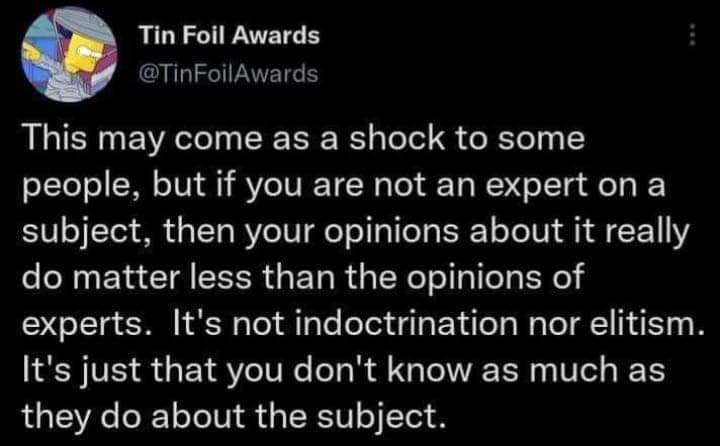
A plumber knows more about plumbing than you.
A pilot knows more about flying than you.
A scientist usually knows more about science than you.
That doesn’t make them automatically right.
But it does mean the burden of proof is on the person claiming thousands of experts got it wrong.
Science isn’t a democracy.
It’s not decided by likes, vibes, or confidence.
It’s decided by evidence.
And evidence doesn’t care who wins the argument.
There's a massive forest fire in Boborás in Galicia, north-west Spain.
It's only going to get worse!
Climate change is intensifying the natural fire cycle and stretching it over longer periods, which is why recent years have seen more intense and more unpredictable wildfire seasons, and why scientists expect that trend to continue.
Stammtisch: „Stundenlang an der Ladesäule stehen? Dann schaff ich ja nichts am Tag!“
Praxis: Während meiner 45 min Pflichtpause den Lkw mit Strom versorgt. Ein Nickerchen gemacht, Kaffee geholt und in Ruhe gefrühstückt.
Zeitverlust: 0 Minuten.
Praxis schlägt Stammtisch.
#Elektromobilität
#Verkehrswende
#eTruck #Logistik #lkw #eLkw #spedition #NannoJanssen
Another major environmental catastrophe that impacts on climate and world trade, but it is not on the radar.
The following link is a good video of the Sargassum problem, a pelagic seaweed floating on the surface of the ocean.
When we sailed across the Atlantic Ocean, we got stuck three times in giant mats of Sargassum. The video gives a good explanation of what happens in the Caribbean when it washes ashore, but it misses the major environmental and economic implications that have a profound impact on world trade and marine life in an entire ocean.
The Sargassum starts off from the coast of Brazil; it picks up nutrients from the Amazon and grows at an accelerated rate. It can double in biomass every 10 days. The weed crosses the South Atlantic to Africa and flows up the west coast, picking up more nutrients from the Congo and Gambia as well as agricultural run-off. By the time it reaches North Africa, Cape Verde, it takes a left turn and starts heading back across the Atlantic to the Caribbean.
There should only be 1 million tonnes of the weed in the Atlantic, but there are now 40 million, and it is expanding year on year. Sargassum is a plant, and like all plants, it requires nutrients such as phosphate. However, the massive amount of weed uses up all the phosphate and then biochemically defaults to absorbing arsenic, which sits below phosphate in the periodic table.
The Equatorial Atlantic is now devoid of phosphate, which means there is almost no phytoplankton, zooplankton or fish. When we conducted our citizen science project, 5000 samples were collected by 25 yachts at around 15 deg. North, and the results all confirmed that the Equatorial Atlantic was effectively dead.
The results were not ignored by the academics; instead, they attacked the Citizen Science project, this has become the subject of a reports by https://t.co/agIIEMzAfR.
Given the phytoplankton, such as coccolithophores and diatoms, have exhibited a regime shift, it also means the SML oil surfactant layer is gone, which means evaporation across the air-water interface has increased and aerosol/cloud formation has decreased.
Satellite.
Imagery confirms a 10%+ increase in humidity and a 10%+ decrease in cloud formation and rain.
This is climate change TICC, the consequences.
Impact on Central America, the survival of the tropical rainforests, mangroves, coral reefs, 25% of all marine life in the Atlantic and water supply for the Panama Canal. 6% of world trade and 40% of USA trade pass through the canal, and it has been totally missed as a major economic and environmental catastrophe.
GOES centre for marine research:
https://t.co/pu9QswXI3r
The video below was taken in the middle of the Atlantic Ocean from our sailing vessel Copepod. Via Howard Dryden
@fiatphoenix Die Arbeit ist viel mehr und viel stressiger geworden in meinem Büro Job. Immer weniger Personen müssen die Arbeit erledigen. Ich bin 58 und fühle mich ausgebrannt. Irgendwie schaffe ich noch die ihr täglich, dafür bin ich abends ko.
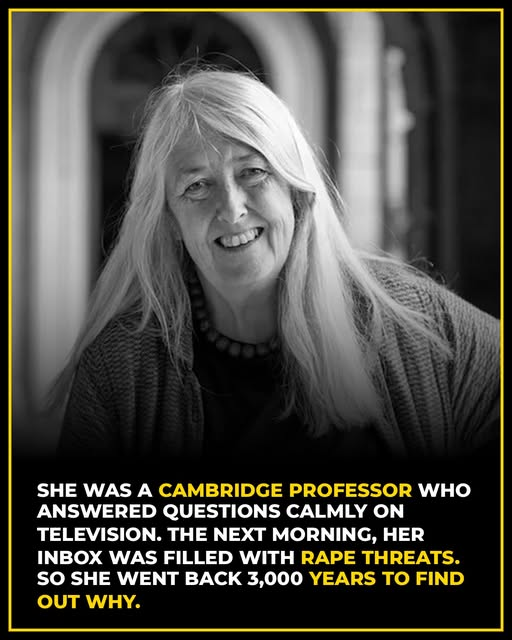
She was 57 years old.
White hair. No carefully managed image. No media training designed to make her more palatable. Just thirty years of accumulated knowledge and the calm, unhurried authority of a woman who had spent her life mastering her subject.
She sat on a BBC panel, answered questions about immigration and politics, cited evidence, made arguments — and then went home.
The next morning, her inbox looked like a crime scene.
Her name is Mary Beard — Cambridge professor, classicist, one of the most respected scholars of ancient Rome and Western civilisation alive. And the internet had decided that a woman speaking with quiet authority on television needed to be punished for it.
The messages were not criticism. They were not debate. They were rape threats. Death threats. Coordinated campaigns of personal destruction targeting her appearance, her age, her voice — anything that could be used to remind her that spaces like the one she had just occupied were not meant for her.
Most people would have gone quiet.
Mary Beard went further in.
She did what scholars do when they find a pattern that disturbs them: she followed it backward. Through decades. Through centuries. Through millennia. All the way back to some of the oldest texts in Western civilisation.
And she found it had always been there.
In Homer's Odyssey — one of the foundational works of Western literature, nearly three thousand years old — there is a scene that most readers pass over without registering its quiet violence. Penelope comes downstairs and asks the poet to sing a different song. Her own son, Telemachus, cuts her off. He orders her back to her room and tells her plainly: speech is the business of men.
She goes.
Mary Beard read that scene and recognized it immediately.
Not as ancient history. As a pattern.
In ancient Rome, women who dared to speak in public were not described as orators or thinkers. They were described as noise — disorderly sound, something that did not deserve to be called language or argument. Their voices were not speech. Their thoughts were not thoughts.
In the medieval world, women who claimed public authority were labeled as witches.
Elizabeth I — Queen of England, ruler of a nation — had to rhetorically reshape herself into something masculine just to be taken seriously as the leader of her own country.
The silencing of women who speak with authority was not invented by social media. It was not a modern pathology or a cultural accident. It was built deliberately, over centuries, into the very foundations of how Western civilisation defined who gets to speak, what authority sounds like, and who is allowed to take up space in public life.
Mary Beard had found something important.
In 2017, she published Women & Power: A Manifesto — short enough to read in an afternoon, substantial enough to reframe everything you thought you understood about why this keeps happening.
Her argument was precise and devastating.
The problem is not that women lack the ability to lead. The problem is that the model of leadership itself — the template for what public authority looks, sounds, and feels like — was built by men over centuries and has never been redesigned. When a woman enters public life and doesn't fit that template, she is not failing. The template was never built for her. It was built specifically to exclude her, and it has been doing exactly that, efficiently and continuously, for three thousand years.
The solution, Beard argued, is not to teach women to perform power the way men have always performed it. The solution is to dismantle and rebuild the very concept of what power is allowed to look like.
She kept teaching. She kept writing. She kept appearing on television — white-haired, unhurried, carrying her decades of authority without performing it, without packaging it for comfort, without apologizing for it.
The threats continued.
But other messages began arriving too. Letters from women and girls who had spent their entire lives feeling that every door was slightly too narrow, every table slightly too high, every room slightly reluctant to make space for them. Women who had spent years wondering what was wrong with them — why they couldn't quite fit, couldn't quite belong, couldn't quite be taken seriously no matter how much they knew or how hard they worked.
They read the book and understood, perhaps for the first time, that nothing had ever been wrong with them.
The room had been designed without them in mind.
That is not a personal failing.
That is a three-thousand-year-old architectural decision.
And one Cambridge professor with white hair and a calm voice — who refused to go quiet when the internet told her to — spent her career documenting it, naming it, and handing that knowledge to everyone who needed to hear it.
Telemachus told Penelope that speech was the business of men.
He was wrong then.
He is still wrong now.
And Mary Beard has three thousand years of evidence to prove it.
via The Inspireist
#FeministFriday #HERstory
Der Abstand zwischen Sozialhilfe und Arbeitseinkommen sollte hoch genug sein, so Hierländer (Presse).
#pressestunde
Dazu kann ich nur sagen:
Nicht die Sozialhilfe ist zu hoch, sondern die Löhne sind zu niedrig.
The hardest working person in the world likely lives in poverty. Hard work almost never translates to wealth. But exploitation of labor often does. The hard work myth needs to dıė
"We are losing biodiversity at a rate unparalleled in human history." Global wildlife populations have sunk over 60% since 1970.
We are destroying ourselves and taking nature with us.
Time to protect people and the planet.
#ActOnClimate#climate#biodiversity#nature
Women have been saying for years that there is a growing backlash against gender equality, and every time the conversation comes up we’re told we’re imagining it.
Now the United Nations is saying it.
According to a UN report, nearly 1 in 4 countries reported setbacks in women’s rights and gender equality. Hundreds of millions of women and girls are living in conflict zones, violence against women remains widespread, and UN officials are warning about a growing backlash against women’s rights worldwide.
The part that stands out to me isn’t even the statistics. It’s that women have been raising concerns about misogyny, online hostility toward women, violence, and attacks on reproductive rights for years, only to be dismissed as overreacting.
If the UN Secretary-General is warning about the “mainstreaming of misogyny,” maybe it’s time to stop pretending these concerns came out of nowhere.
Do you think women’s rights are genuinely facing setbacks, or do you think organizations like the UN are exaggerating the problem?
WM ist wenn Politiker die ihr Leben lang keinen Ball getreten haben plötzlich Fußballfan sind und Spieler die man gestern noch remigrieren wollte plötzlich unsere Burschen sind?
„Und jetzt, wo die Sonne wieder draußen ist, vielleicht ein kleiner reimender: Ihr Rock ist nicht zu kurz. Ihr Outfit ist nicht zu schlampig. Und wenn man das anders sieht, dann ist man vielleicht ein perverser Sack.“
Kathrin Gebel