Why are stablecoins not stable?
The primary purpose of a stablecoin, as understood by every market participant, is to hold a stable value pegged to the value of another asset, usually a fiat currency, thereby creating a safe haven from market volatility.
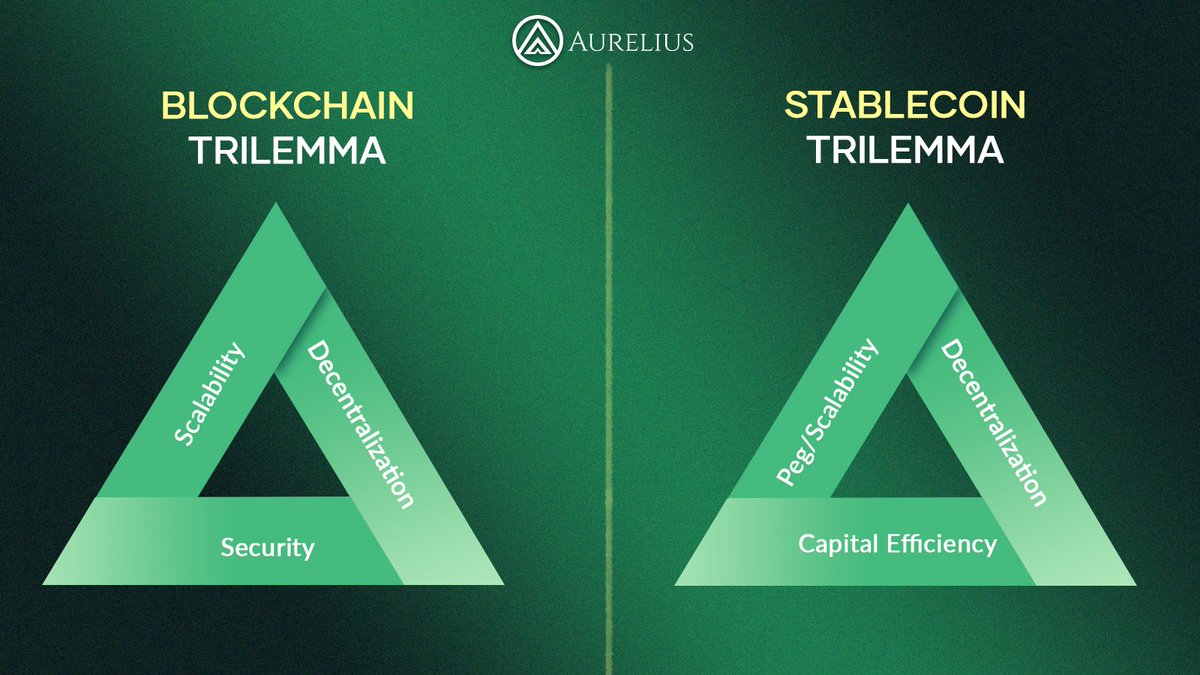
However, in most stablecoin designs, the goal of achieving this price stability comes with a tradeoff in either the decentralization of the system or its capital efficiency
Much like “The Blockchain Trilemma,” where networks have to sacrifice either one of decentralization, security, or scalability,
In the same manner, Stablecoins must trade either stability, capital efficiency, or decentralization
In other words, issuers face critical decisions in determining:
➛Collateral management; establishing token issuance mechanisms (decentralization)
➛Ensuring a 1:1 peg (stability)
➛Capital required for minting $1 worth of a token, with a focus on enhancing capital efficiency
Since these characteristics cannot be found in one stablecoin, issuers have to make tradeoffs
Here's a general overview of these characteristics:
1) Decentralization
- As the name implies, these are stablecoins whose system of issuance has little or no reliance on any central authority or organization but managed via smart contracts
- Stables under this category are usually CDPs meaning they're overcollaterised in order to account for the volatility of underlying collateral, essentially sacrificing capital efficiency for decentralization. Ex: Dai ($DAI) and Magic Internet Money ($MIM).
- On the other hand, centralized stables like $USDT and $USDC offer more stability and capital efficiency but with existing counter-party risk, regulatory risk, and other forms of censorships
Regardless of the trade-offs, centralized stablecoins remain the dominant leader.
2) Stability
- This is the primary purpose of a stablecoin, to peg its value against a real-world currency and maintain said peg in other to create a no-volatility zone.
- A stablecoin’s level of stability is determined by the type of collateralization backing the minting process
For highly stable systems, the ideal collateralization method is the 1:1 stable-to-reserve ratio as there are limited concerns for a depeg. However, this level of stability comes at the expense of decentralisation.
In overcollaterised systems, even though collateral is in surplus of minted stables, the system remains susceptible to black swan events and wild price volatility of underlying assets which could result in a death spiral
Below is a chart showing the deviation of $DAI depeg in its early stages.
Undercollaterised systems are the most susceptible to depegs as reserves do not meet up with minted stables.
While they enjoy capital efficiency, they carry a significant risk of depeg which could lead to a loss of consumer confidence and potentially a death spiral.
An example of this is the infamous UST crash
3) Capital efficiency
- This describes the smallest amount of capital (in the form of collateral) required to mint $1 worth of stables.
- In this case, undercollateralized stablecoins are the most capital-efficient, as they rely more on programmed mechanisms than fully collateralized reserves. ($1 issued again 90 cents)
- Fiat-collateralised stablecoins with a 1:1 collateralization ratio return $1 stablecoin for every dollar in reserve, making it less capital efficient but more stable, however centralised
- On the other hand, Overcollaterised systems require more than $1 in reserve to mint $1 worth of tokens sometimes up to 150% collateral making the system non-efficient, for the sake of stability and decentralisation
Innovation comes from challenges, and the stablecoin trilemma is one such challenge.
Hope you enjoyed reading this explainer post and learnt something from it soldier!⚔️
Aurelius marches to Mantle! 🚀
We're excited to share that Aurelius is a proud recipient of the @0xMantle Ecosystem grant!
We'll be going full speed ahead to bring the power of rehypothecation to Mantle, seeding and nurturing the cheapest integrated lending borrowing economy within the #DeFi ecosystem.
#BuildOnMantle
Another skilled builder on Mantle has joined forces with Aurelius!⚔️🤝
@stratumexchange is a community owned DEX which utilizes the ‘vote escrow’ NFT (veNFT) model, to deliver a protocol on which the projects building on Mantle derive sustainable liquidity for their tokens and enable users to transact in a cost effective and frictionless manner.
We're excited to be co-hosting events, spaces, AMAs etc. and most important of all building the @0xMantle ecosystem together!🫡
Prepare yourself for battle soldier! ⚔️
Complete these glorious missions to bring honor to our kingdom. QUESTS NOW LIVE ON ZEALY! 📢
https://t.co/wFecWvOwX5
We're teaming up with @0xMantle to showcase the immense potential of @OATHFoundation technology by engineering the best lending and borrowing experience in the industry.
Read the post below to learn more and follow us to stay up-to-date on $AU, $AUSD, and the future of Aurelius.
𝐓𝐡𝐞 𝐛𝐮𝐥𝐥 𝐦𝐚𝐫𝐤𝐞𝐭 𝐢𝐬 𝐰𝐡𝐞𝐫𝐞 𝐲𝐨𝐮 𝐜𝐚𝐧 𝐜𝐫𝐞𝐚𝐭𝐞 𝐥𝐢𝐟𝐞-𝐜𝐡𝐚𝐧𝐠𝐢𝐧𝐠 𝐰𝐞𝐚𝐥𝐭𝐡.
RIP those stuck with the bear market brain.
The pirate community have given their expertise.
𝐇𝐞𝐫𝐞’𝐬 𝐲𝐨𝐮𝐫 𝐆𝐎 𝐓𝐎 𝐛𝐮𝐥𝐥 𝐦𝐚𝐫𝐤𝐞𝐭 𝐠𝐮𝐢𝐝𝐞: 👇
Seeking a vacation with a touch of blockchain innovation?
@BocasDao delivers just that!
Their NFTs backed by RWA provide a secure, inflation-proof escape to Panama's stunning paradise. 🌅
#BocasDAO#NFTs#CaribbeanEscape