🚨 Amazon Just Dropped a Bomb on the Crypto World
On March 31, 2026, Amazon Web Services published an official technical case study on their AWS Web3 Blog.
Title:
"How the BSV Association built a million-TPS blockchain node using AWS"
Author: Jordan Kramsky – Senior Solutions Architect at Amazon Web Services.
Direct link:
🔗 https://t.co/sX40h5ZkyY
What Amazon Actually Confirmed:
✅ BSV Association built Teranode – the next-generation reference node
✅ Achieved 1,000,000 transactions per second (1 million TPS)
✅ Sustained performance with zero transaction loss for over 2 weeks
✅ Ran across 6 different AWS regions on 3 continents
💥 This is not a BitcoinSV ( $BSV ) press release.
💥 This is a real technical case study written by an Amazon engineer.
📈 Current SV Node peaks at ~13,600 TPS.
Teranode just showed over 70x higher sustained performance.
The narrative is shifting fast.
The question is no longer “Can BSV scale?”
The real question is: When will the rest of the market finally wake up?
The clock is ticking. 🔥
Who else sees what’s coming?👀
#BSV #BitcoinSV #Teranode #1MTPS #MillionTPS #AWS #AmazonWebServices #Amazon #RealBitcoin #SatoshiVision #Blockchain #Crypto #Bitcoin #Ethereum #Altcoins #Scalability #Layer1 #Web3 #DeFi #BlockchainScalability #HighThroughput #EnterpriseBlockchain #DigitalCommodity #CryptoNews #CryptoTechnology #CryptoAdoption #NextGenBlockchain #BSVvsBTC #CryptoInnovation
The Bitcoin white paper is eight pages long. Its objective is stated in the abstract: a peer-to-peer electronic cash system allowing payments to be sent directly from one party to another without going through a financial institution (Nakamoto, 2008). The word “directly” is doing the work. The system was designed to eliminate intermediaries from electronic value transfer. Not to reduce them.
Not to replace them with different intermediaries wearing different labels.
To eliminate them.
If you think BSV is centralized, then you don’t understand what centralization even means.
BSV is a locked protocol. This means NO ONE is in power. Its very CORE is decentralized.
You want TRUE decentralization?
BSV is LITTERALLY THE ONLY ONE...!
The white paper describes a digital cash system aimed at everyday, small, casual transactions and prepayments, with scale achieved by competitive block-creating nodes processing large volumes directly. Its logic is plain: if the ledger is to serve commerce, it must carry commerce. Pushing ordinary payments off-ledger into private channels is not an extension of that design but a retreat from it.
Lightning replaces on-chain settlement with a web of intermediated credit relationships. Channels are not “cash”; they are conditional IOUs requiring counterparties, routing, liquidity providers, and policy-set churn. That is correspondent banking in new clothes: layered trust, hidden frictions, selective access, and the ever-present need to “close back” to the base system when things go wrong. The result is not scaling the cash system; it is building a separate network of custodial risk and gatekeeping on top of it.
So the claim that the main chain “will never be for all humans” is not an argument from the paper; it is an argument against it. The paper’s model is to scale the transaction layer, not to shrink it and then sell people substitutes. If one wants a digital cash system, one scales the ledger that makes the cash final. If one wants correspondent banking with extra steps, one builds Lightning.
There are only two paths for Bitcoin, and both are absolute. Either it scales naturally on-chain, or it becomes wrapped, diluted, and reborn as digital fiat. There is no middle ground, no clever compromise between purity and convenience. A system either functions as cash—direct, final, and unmediated—or it decays into layers of abstractions and IOUs dressed in digital robes. The first path is hard, but it is honest. The second is easy, and it ends in the same deceit that destroyed every monetary standard before it.
When Bitcoin scales on-chain, every transaction is real. Each movement is final. Verification isn’t a priestly function reserved for institutions; it’s mathematics, immutable and open to all. Fees fall as volume rises, and the network becomes what it was meant to be—a global ledger of exchange and proof. This model demands efficiency, engineering, and competition. It is built on miners, not missionaries; on work, not consensus theatre. It mirrors the natural law of economics: those who perform real labour secure the network, and those who transact pay proportionately for the service they consume. It’s brutally fair and utterly transparent.
But the second path—the wrapping, the layers, the polite integration with the financial order—destroys all that. Wrapped Bitcoin is not Bitcoin. It is a claim upon a claim, a promise issued by custodians, banks, and exchanges that themselves rely on the same fractional reserve logic as the fiat system it pretends to transcend. Each token becomes a note backed by a dwindling reserve, an echo of value mediated by trust. It is digital fiat by another name. The supply becomes elastic, the money political, and the market once again dependent on gatekeepers.
This system already exists in embryonic form. Exchanges issue credits against real Bitcoin, trading billions in paper representations while the underlying coins barely move. Users don’t transact on the blockchain; they shuffle balances in databases. It’s the 21st-century version of the gold standard—where the gold sits idle in vaults, and the paper moves fast enough to fool the crowd. The wrapping process simply formalises that illusion, baking it into regulation, state custody, and surveillance. It becomes the government’s ideal currency: programmable, taxable, and controllable at the level of identity and access.
The truth is mercilessly simple. On-chain scaling preserves Bitcoin as money; off-chain layers pervert it into credit. There is no hybrid equilibrium, no sustainable “middle ground.” You either have a system that enforces ownership through computation, or one that delegates it to trusted intermediaries. The first makes men free; the second makes them subjects. Scaling on-chain—real, global, unfettered scaling—isn’t just a technical requirement; it’s the moral and economic defence of freedom itself.
Every argument against scaling is an argument for subordination. Every appeal to “practical compromise” conceals a desire for control. A Bitcoin that cannot handle the world’s commerce is not revolutionary; it’s ornamental. A Bitcoin that depends on wrappers, banks, and middlemen is not a new economy; it’s the old one in drag. The only honest Bitcoin is one that scales on-chain, that proves every transaction through work and cryptography, and that renders the custodians and their paper facsimiles irrelevant.
There are two futures. One where Bitcoin is cash, alive in every transaction, immune to manipulation. Another where Bitcoin is wrapped, traded as a derivative, and ruled by the same institutions it was meant to obsolete. Between them lies no middle path—only the choice between proof and trust, between freedom and obedience, between money that works and money that serves.
@Bitcrash4 He might be right... Q is BIG operation.
Involving BTC psyop and real Bitcoin.
You will find out at the end... all the players needed for optics. Even CZ and CSW how need to be distanced.
Nothing to worry about, blame it on tariffs. 🤡🤡🤡
Ignore V30
Ignore Core vs Knots
Ignore rolling icebergs
Ignore Craig
Ignore BSV
Ignore BTC uselessness
Ignore hijacking Bitcoin
Ignore woke BTC devs
Bitcoin magazine is a sad pathetic psyop influencer for the gullible.
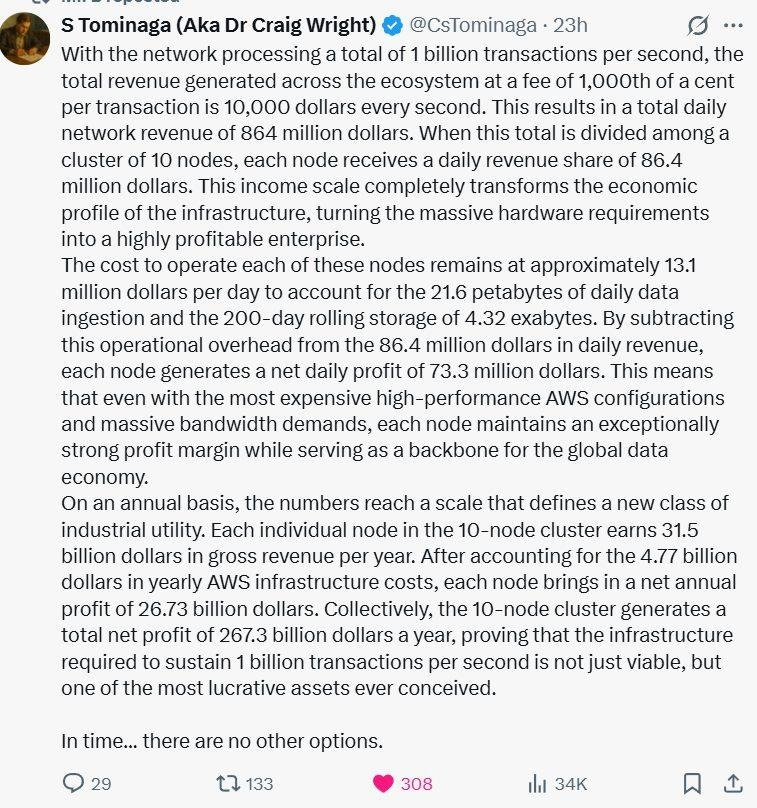
Sentinel Node on @BSVBlockchain confirmed 12.7 Million transactions in a day. That is more than BTC, ETH, XLM, XRP, HBAR, AVAX, BNB, ADA, and Matic COMBINED.
A small step for BSV but one giant leap for Blockchains.
Color me impressed.