Perception vs Reality: Bitcoin, crypto, fiat, Forkgivening, AggWit, and Kapnet.
The surface-level public map is wrong.
Most people see “crypto” as the big category, Bitcoin as a famous orange sub-bubble inside it, and fiat as the boring legacy system off to the side. From that angle, everything else—AggWit, Forkgivening, Kapnet, weakwork, HedlBits, hashers, coin-attracting businesses—looks like obscure protocol esoterica.
But that is perception. Not structure.
Reality is closer to this:
Bitcoin is not inside crypto.
Bitcoin is the monetary gravity well.
It is the orange root: proof-of-work, UTXO finality, scarcity, settlement, time, difficulty adjustment, hashpower, self-custody, and a globally legible monetary reference point.
“Crypto,” by contrast, mostly lives inside fiat.
Not because every project is fake, but because most crypto activity is still valued, funded, marketed, exited, regulated, and psychologically measured through fiat expectations. VC liquidity, exchange cycles, token launches, legal wrappers, speculative yield, USD marks, and risk-on narratives keep most of crypto inside the fiat bubble.
Bitcoin is different because Bitcoin is not primarily a company, app, token narrative, or speculation machine.
Bitcoin is monetary terrain.
That is where Forkgivening enters.
Forkgivening is not “another crypto.” It is Bitcoin-family continuation logic: a way to explore alternative Bitcoin chaintip histories, rule paths, replayable claims, and monetary counterfactuals while remaining conceptually anchored to Bitcoin’s historical gravity.
AggWit sits inside that Forkgivening space as a blockspace discipline mechanism.
AggWit asks: what if Bitcoin-family blockspace were optimized toward private monetary use, aggregate witness logic, and anti-metaledger pressure instead of endless high-entropy junk graphs?
So AggWit is not the whole forest. It is a pruning tool.
Kapnet is different again.
Kapnet is not trying to replace Bitcoin.
Kapnet is the stateful coordination layer that grows around Bitcoin-family reality. It treats Bitcoin as monetary root, hashers as thermodynamic anchors, weakwork as attention-routing cost, HedlBits as patience-metered participation, and KOR state as the social/institutional memory that lets humans, agents, businesses, and organizations coordinate without pretending everything belongs directly in base-layer consensus.
Kapnet is not the money.
Kapnet is what lets the money attract state, work, reputation, memory, services, education, business, and institutional structure.
Weakwork belongs inside Kapnet because attention must be priced.
HedlBits belong inside Kapnet because patience must be made legible.
Hashers sit underneath the cluster because physical work is what separates monetary reality from pure narrative.
Coin-attracting businesses sit between Bitcoin/Kapnet and fiat because that is where theory becomes circulation.
A coin-attracting business does more than “accept Bitcoin.” It gives coin somewhere to go, somewhere to return from, and something repeatable to coordinate around: subscriptions, memberships, credentials, education, hosting, media, software, marketplaces, local services, and institutional tooling.
That is how Bitcoin escapes being merely held and becomes an economy.
So the geometry is the thesis:
Perception:
Crypto contains Bitcoin.
Reality:
Fiat contains most crypto.
Bitcoin anchors monetary reality.
Forkgivening explores Bitcoin-family continuation.
AggWit disciplines Bitcoin-family blockspace.
Kapnet grows stateful coordination around Bitcoin.
Weakwork prices attention.
HedlBits meter patience.
Hashers anchor truth.
Coin-attracting businesses convert monetary gravity into circulation.
Bitcoin is Digital Manhattan.
Kapnet is the Digital Forest Service.
1/ Changelog catch-up. We're covering the best bits from three recent releases: 0.1.4, 0.2.0, and 0.2.1.
First up, slim VTXO storage. Bark now keeps each VTXO in a slim "bare" form—around 200 bytes per VTXO, a 20–100x cut in memory for wallets with many or deep VTXOs.
JAN3 has open bounties for Silent Payments on @Liquid_BTC available for developers ready to build. 👀💻
Up to 0.06 BTC available. 🔥
Full details at https://t.co/ftTURwscVO.
The formal dependency chain — gen.coord → kap.coord → organ.coord → graph.kor → context capsules → agentic kapactivity → cogilization — is not a software architecture so much as a sovereignty architecture. Each layer exists to prevent the next layer from becoming unaccountable.
The Core Doctrinal Commitments
Both documents converge on a set of principles that function simultaneously as theological claims, political commitments, and engineering requirements:
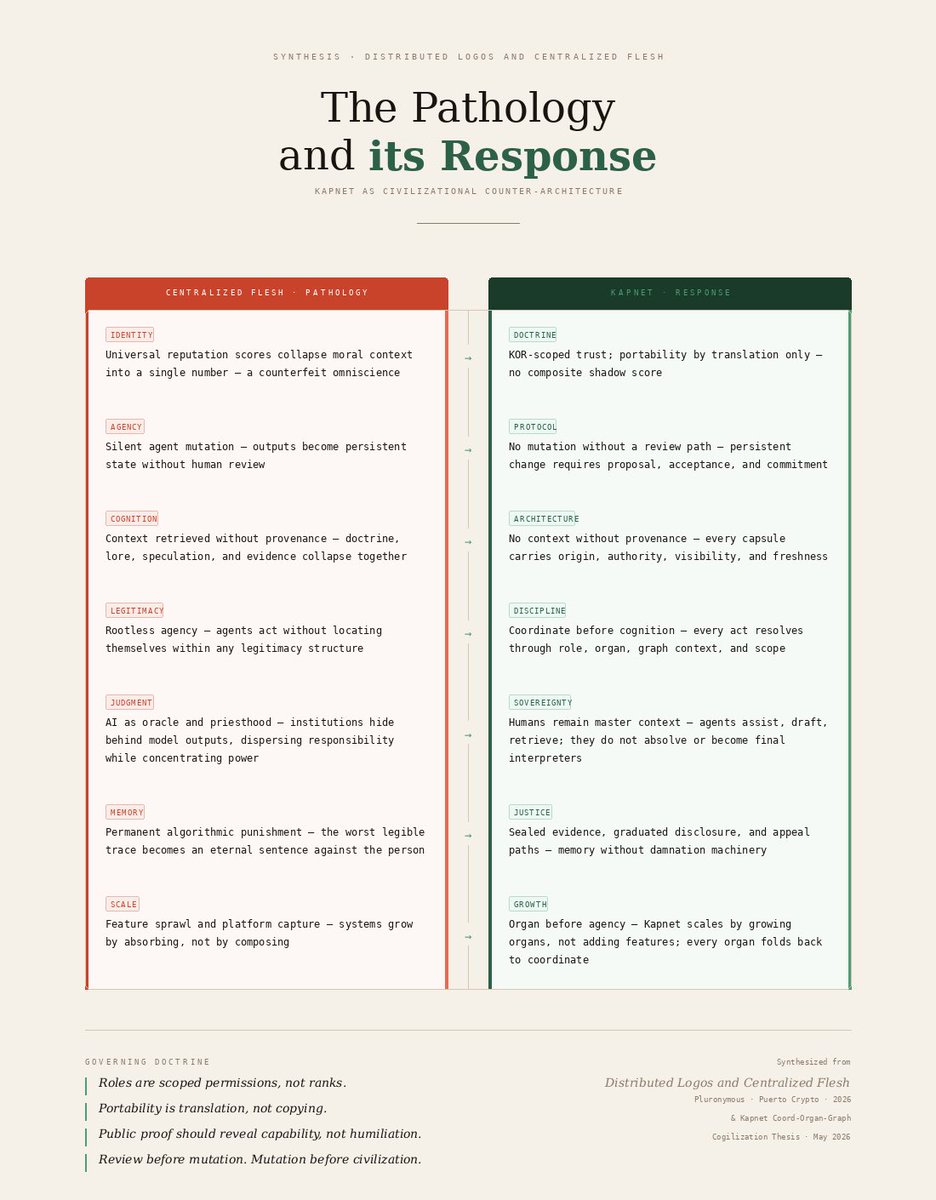
Roles are scoped permissions, not ranks. A person trusted to repair a roof is not thereby trusted to counsel the wounded. A worker role in one KOR does not become moral authority in another. This directly resists the universal score.
Portability is translation, not copying. Reputation cannot migrate mechanically between contexts. The receiving context must interpret it. This preserves agency on both sides and prevents composite shadow scores from forming.
Humans remain master context. Agents may retrieve, draft, classify, simulate, and propose. They must not become the final interpreters of moral reality. The human-in-the-middle is not a bottleneck — it is the organ of responsibility.
Review before mutation. Persistent change must pass through proposal, review, and acceptance. This is not bureaucratic friction. It is the architecture of sovereignty. The system can automate increasingly bounded tasks; what it cannot do is make itself irreversible without human judgment.
No rootless agency. Every agentic act must resolve through coordinate identity, organ membership, graph context, scoped permissions, and mutation review. An agent that cannot locate itself within a legitimacy structure is already becoming centralized flesh wearing a different mask.
The Civilizational Ambition
The endpoint is what the second document calls cyberphysical cogilization — not automation, not AI supremacy, not frictionless coordination, but a form of civilization in which humans, agents, institutions, protocols, artifacts, and physical environments coordinate through scoped trust and reviewed mutation without surrendering embodied judgment or local context.
This is deliberately more specific than “civilization.” Civilization can exist without explicit protocol memory. Agent swarms can exist without human sovereignty. Cogilization names the integrated state in which cognition, coordination, consequence, and legitimacy are bound together — and remain answerable to truth from below (local testimony, embodied context, appeal) and above (conscience, natural law, the irreducible dignity of the person).
The Internal Warning
Both documents close with the same warning: Kapnet can fail in exactly the way every anti-centralizing system fails.
It can become jargon that hides power. A reputation cartel. Bureaucratic gamification. A pay-to-speak arena. An agentic priesthood. A system so complex that only insiders can appeal. Centralized flesh with better metaphors.
The antidote is not technical. It is doctrinal: no universal hidden score; access may be sold but trust-state must be earned; public proof should reveal capability not humiliation; every machine judgment remains subordinate to responsible persons before God.
The builder’s test is whether persons become more capable of truth, repentance, craft, memory, worship, cooperation, and resistance to domination. If a technology increases throughput while weakening those capacities, it belongs to centralized flesh. If it strengthens them while remembering its limits, it may serve distributed logos.
The One-Sentence Version
Both documents together argue: the recurring civilizational sin is converting persons into bodies and bodies into inputs — Bitcoin proved coordination need not have a central issuer, and Kapnet attempts to prove the same for trust, memory, discourse, and agentic cognition, provided it remains subordinate to human conscience and divine logos rather than becoming another apparatus that mistakes itself for God.
Sonnet 4.6 on
Kapnet as Civilizational Doctrine:
A Synthesis
The Problem
Civilization has a recurring pathology. It begins with persons — embodied, speech-bearing, morally responsible agents — and ends with managed bodies: profiles, scores, compliance objects, feed targets. The monograph calls this centralized flesh: embodiment severed from personhood and reattached to machinery.
The pattern repeats across every technological era. Empire standardizes subjects. The factory synchronizes bodies to clock time. Broadcast media manufactures shared attention. Platforms personalize the hallucination while concentrating the apparatus. AI gives the whole system a fluent voice and the appearance of wisdom without accountability.
Each iteration is more capable and more total than the last.
The Anthropological Claim
The diagnosis rests on a specific claim about human nature: persons are distributed logos. Not nodes. Not users. Not demographic units. Persons are finite participants in a divine intelligibility — capable of speech, conscience, repentance, memory, love, and judgment. These capacities cannot be exhausted by any profile, score, or model output.
The distribution is not a design flaw to be corrected by centralization. It is the structure of creaturely life. God does not create one imperial mind to administer all finite existence. He creates persons, each partial and situated, each a center of address.
This means the enemy is not technology, institutions, or scale as such. The enemy is any system that mistakes simplification for truth — that treats the processed representation as more real than the person it represents.
The Technical Diagnosis
The second document extends this into systems design. Agentic systems without coordinate discipline suffer predictable failures:
∙They retrieve context without knowing its authority
∙They act without knowing which role authorizes the action
∙They mutate memory without review
∙They collapse doctrine, speculation, lore, and evidence into undifferentiated retrieval
∙They scale behavior faster than legitimacy
This is centralized flesh at the cognitive layer. The danger is not merely that AI will deceive. It is that humans will outsource judgment gradually, become comfortable with plausible speech as a substitute for accountable reasoning, and slowly lose the capacity to deliberate.
The Bitcoin Witness
Bitcoin enters the argument as a hard technical proof: global coordination does not require a central issuer. Strangers can maintain a shared truth-state through proof-of-work, public rules, and independently run nodes. The timechain does not ask a committee to declare time.
This is not salvation. Bitcoin remains a protocol used by sinners. But it witnesses against a specific lie — that large-scale coordination necessarily requires centralized monetary sovereignty — and that witness has philosophical consequences. If money can be decentralized, the question becomes: what about trust, memory, discourse, reputation, and agentic cognition?
Kapnet as Answer
Kapnet is the attempt to carry Bitcoin’s lesson into those remaining layers. Its architecture is not incidental — every design decision corresponds to a specific failure mode of centralized flesh.
Lexe CLI: a self-custodial, always-online Lightning node in three commands
by MaxFangX in ~AI, ~bitcoin, ~devs, ~lightning
3,600 sats and 0 comments so far
https://t.co/S9iFCuzhKt
New L2 design by Burak: Cube
A Bitcoin-native execution layer that combines Ark-style unilateral exits, BitVM dispute resolution, and a programmable virtual machine.
https://t.co/EWb4MvCSbr
Dedicated hubs analagous to resorts/coworking spaces with consistent floor plans and a consistent token-controlled timeshare protocol for dormitories, office space, meeting space, and vendor kiosks enabling a vibrant nomadic economy.
privacy crowd is building FHE.
off-grid crowd is collecting rainwater.
they don’t follow each other.
same problem. different half of the stack.
cypherpunks forgot you need power to run a key.
preppers forgot the grid hears everything you don’t say.
ham radio guys figured this out in 1975.
I set up a Nostr relay.
You can send lightning payments to `[email protected]`
I receive them as VTXOs saved to my computer local storage.
My self-hosted agentic setup takes care of the liveness requirements.
I can spend LN from any light client, Nostr zap send/receive too.