@InQuisitive138@brian_trollz Only one making a fool of himself is you - three years of a shitload of articles and still you remain blind.
Confirmation bias, Cognitive dissonance much?
This is a breakdown of the Mempool in general. Just how it works, and how different kinds of users make use of it. i.e. what is it doing for them in their use of Bitcoin: https://t.co/HKZooqJrOi
A NASA fellow claims 5 equations explain 99 percent of the physics that actually runs your world. Understand them deeply and you are set for life. His words.
And the way he does it is what makes the video worth it.
He does not teach the five as a list. He tells them as one story, where each equation is born from the one before it. F equals ma leads into gravity. Gravity rhymes with the law of electric charge, the exact same shape. That connects to magnetism. Magnetism folds into the wave. And the wave quietly opens the door to relativity and quantum physics.
By the end, all of physics feels like a single sentence written by one hand, not a pile of formulas you were forced to memorize.
The move that stays with you comes first. He says F equals ma is written the wrong way around, and rewrites it. One tiny flip, and the most famous equation on Earth suddenly means something school never told you.
His point for why this matters now: in the age of AI, the people who understand reality itself stay in demand. Everyone else is just memorizing.
Five equations. One thread. It is in the video.
I went to the Tour de France last week and it feels like a perfect microcosm of how Capitalism and Socialism differ (and why America is diverging economically and stagnating socially).
As an American I couldn't believe how poorly they monetized the event. You have millions of people watching and 99% of them watch for free.
The result - the median rider in the event is earning $250K a year, but the public has an event that is loved and accessible by all. The broader result is you don't get the private (and public) investment that coincides with such events in the USA because it's not being monetized well. That is, the teams earn less, the riders earn less and municipalities hosting earn less. So the aggregate result is everyone is poorer, on average, in the long-run because they don't capture the economic value of the event well.
BUT, the Europeans love their bikes. Boy do they love their bikes. And you see the happiness and social value of making this a public good instead of a private profit maximizing endeavor. So there's social value in NOT monetizing the event that **arguably** makes it a better overall social value than the Capitalist model.
In short, the American model creates a wealthier, more capitalized industry, while the European model sacrifices financial maximization to generate a widely distributed, unpriced public good. Which is better? Most certainly a mix. The hard part is getting the balance right.
A SpaceX engineer once described receiving an email from Elon Musk at 1:47am.
The email was one sentence long. Just a question about a valve pressure reading from a test that had happened nine hours earlier.
The engineer responded at 7am when he woke up. By the time he opened his inbox Elon had already sent two follow up emails. One with a proposed solution. One asking why no one had responded yet. It was 3:12am when the second email was sent.
The engineer said what disturbed him wasn't the hour. It was the specificity. Elon had referenced a data point buried on page 47 of a 200 page test report that had been distributed to the team that afternoon. He had not only read the entire report. He had found an anomaly in the data that the team who wrote the report had missed.
He said the running joke at SpaceX is that Elon doesn't sleep. The less funny version is that he sleeps but his brain doesn't stop processing. Engineers describe receiving emails that reference conversations from weeks ago, data from months ago, and connections between projects that nobody else had linked. As if his mind runs a background process 24/7 that never powers down.
The scariest part isn't the late hours. It's the precision. A CEO of six companies remembering a valve pressure reading from page 47 of one report among hundreds he receives weekly. That's not dedication. That's a different kind of brain. And the people who work for him either find it inspiring or terrifying. Usually both at the same time.
> Nobody voted for this. The OP_RETURN data limit sat at 83 bytes for years.
Bitcoin is not a democracy. Learn this.
> Four to one against.
There was only 1 person with any actual commits to bitcoin core that NACKed it and that was Luke, it had overwhelming technical consensus that it was the right thing to do and so it was released in v30 as harm reduction as many people have explained ad nauseum to pro 110 folks.
> "For the record, this pull-req wasn't my idea. I was asked to open it by an active Core dev because entities like Citrea are using unprunable outputs instead of OP_Return, due to the size limits."
Yes that's the whole point as I just said, the limit was causing harm by incentivizing centralizing blockspace through direct pay to miner channels like slipstream, so the limit was increased, and this is a relay plicy setting can be configured by any node runner if they wish for it to be lower. Core explained this in their blog post which you probably didn't even read.
> @hodlonaut documents that Core development runs on roughly ten to fourteen million dollars a year, from Chaincode, Brink and Spiral, and that Brink alone funds three maintainers.
Yes this is criminally small to spend on the development of a $1-2 trillion dollar network.
> And now a corporate Consortium offers to look after ₿itcoin's security.
Yes because current funding is tiny compared to anything else in the tech space as I just mentioned above.
> Do not take my word for any of it. Every number here is public.
@ctdl21 published the whole investigation.
Yes and it was pure narrative spun from public data, ridiculous with no substance whatsoever.
> Satoshi built this to get us out from under that money system. Not to sell it a seat at the table. ₿itcoin was the exit. They are turning it into another wing of the same building.
False accusation making no sense.
> BIP-110 is the plebs refusing,
No BIP-110 is the plebs failing to understand fundamental and basic technical reasons for the change and the fact that the change can be configured by any node runner, that's why it has ~1% signaling.
> because Plebs want Bitcoin to be Bitcoin as Satoshi Nakamoto described it in his White Paper.
You sound exactly like a bcasher as this was their favorite line to recite over and over again during the last fork war.
Georgia ranked 137th in the world for ease of doing business.
3 years later it was 11th and had overtaken Germany and France, while everyone was still calling it a failed post-Soviet state.
A businessman named Kakha Bendukidze took the economy ministry after the Rose Revolution in 2003 and tore the system apart.
He cut the tax code from 21 taxes to 6, slammed in a flat 12% income tax, and wiped out most of the licenses and permits choking every business.
Then he fired the entire corrupt traffic police overnight and built a new force from scratch.
GDP grew 7.5% a year and foreign investment went from almost nothing to $2.1 billion.
No country has ever climbed the rankings that fast.
Back in clown world, Western governments keep adding rules and agencies while growth stalls because real reform would destroy the parasites they protect.
What’s the risk of cannibalism?
Isolated without hope of rescue sends men mad. What could possibly go wrong with this plan?
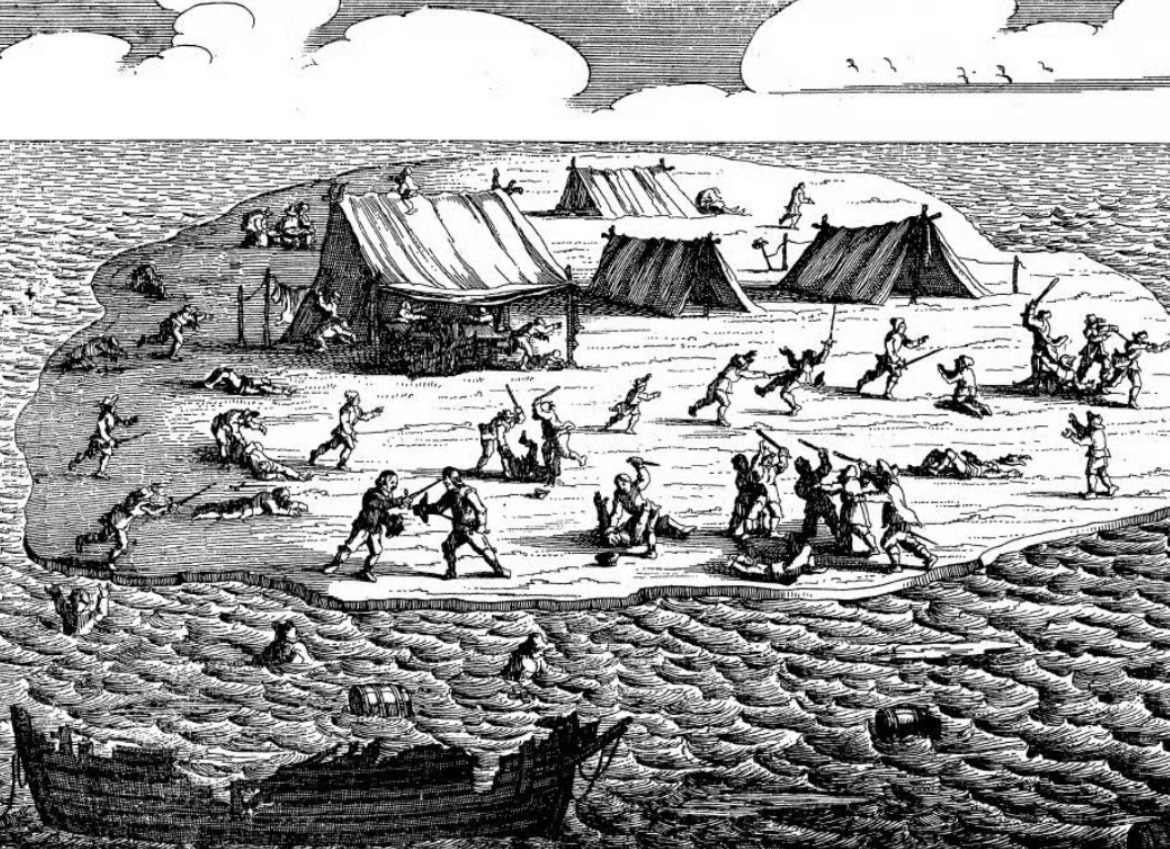
Jeronimus Cornelisz, apothecary on the ill fated Dutch East Indiaman, VOC Batavia, dragged Lucretia van der Mijlen by her feet half naked through excrement, in an old fashion seafaring public humiliation, courtship ritual, and henceforth obliged her to sleep beside him as his wife.
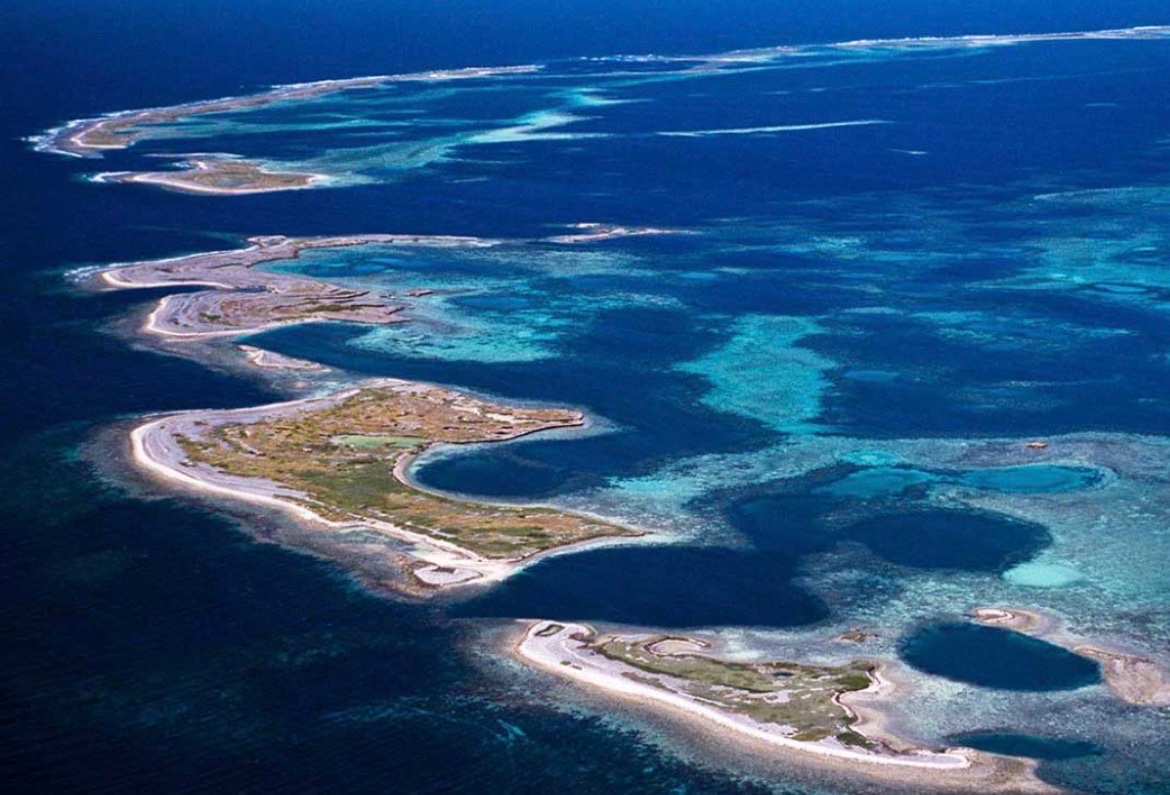
Brutalised beneath salvaged sail cloth, mockery her makeshift home, erected on a coral cay, Morning Reef, Houtman Abrolhos Islands, Western Australia, for 100 days stranded, after their ship ran foul, 4th June 1629.
She’d taken the attention of the ship’s officers, earlier rejecting the unwanted advances of Skipper Ariaen Jacobszb.
Ill fated she now lay, without ceremony or class comfort, beside a lamentably betrothed mutineer, as his band of murderous misfits scuttled the ship for her cargo of Spanish silver.
Driven insane with guilt and fear of starvation, isolated so far from civilisation, Jeronimus eyed off the competition for scarce resources, and from his matrimonial repose, plotted to save himself from privation.
Night after night armed with mace and Swedish fid, they crept into the tents of the remaining passengers, and stove in their heads, one by one, 125 men, women, and children.
Commander Pelsaert returned with a ship just in time to rescue 70 remaining of 250 pax.
Whence-forth the band of mutineers were put on trial and executed in situ. With both hands cut off, Jeronimus was hanged by the neck until dead.
Another returned to Batavia to be broken on the wheel, a preferred Dutch execution style of the day.
Lucretia’s husband, with whom she had expected to ren des vous in Java, had since died. She eventually returned to the Netherlands and remarried.
Imagine what could happen on Mars, so far away. Too ghastly to imagine @elonmusk
A man who designed nuclear weapons for 45 years gave one public lecture about his work. He opened it with a warning: this is an unauthorized reminiscence.
Then he started talking.
About the officer who crawled into the bomb bay mid flight to arm the Hiroshima bomb by hand. And what would have happened if that plane crashed. Not what the history books imply.
About the day in 1957 when an American bomber accidentally dropped a nuclear weapon on its own country. What saved the city is one sentence in this lecture, said almost as a joke.
About the first hydrogen bomb, built on an island because it was too heavy to move. After the test the island was not there anymore.
He took part in over 40 nuclear tests. The lecture is his life. His talk starts at 2:42, skip the intro.
Watch it before someone decides it really was unauthorized.
@john_giovanni_@DylanLeClair@hodlonaut@stephanlivera SegWit & Taproot aren't mistakes - they fixed key issues & enabled scaling/privacy. Complaints are mostly about user data abuse, not the upgrades. Minor consensus changes still carry risks & aren't hypocrisy - different consistent visions for Bitcoin as sound money vs data ledger
I think you're insinuating here that a central authority (which Bitcoin culture rejects) is the only way to handle the filtering. It's not.
However, it is an authority based adjudication. The people who participate in protocol development self-organize and defer to each other's judgement all the time in an ever shifting landscape of technical expertise and perception thereof, where that perception is itself mediated by the perceivers own technical expertise.
The question I pose to every proponent of bip110 is this:
How well do you think you really know Bitcoin?
Did you game this out yourself over painstaking thought?
Or did you defer to someone else who seems to have greater judgement?
Did the person you deferred to have a history of measured, precise evaluation of arguments or do they have a propensity to point fingers and blame others?
Are the claims of conspiracy substantiated or is the evidence circumstantial?
Have you really looked?
Are you willing to bet your future on it?
This set of questions, among others, is what plays out in the heads of devs all the time when they engage in protocol development. Why? Because the decisions carry weight. And in a world with no central authority, you have to either build your own authority by doing the work so you can trust yourself, or evaluate the legitimacy of others' authority by evaluating the quality of their output over a long period of time.
Appeals to emotion, especially that of unjust power dynamics are very effective when it comes to agitating crowds who can depose leaders with force. This is not possible in Bitcoin, so it is not really a strategy that works here, especially now that the network is capitalized at upwards of $1 Trillion dollars. The stakes are higher than they've ever been and so people would do well to exercise the commensurate level of restraint.
BIP110 supporters are saying that Core blew open OP_RETURN.
They didn't. They just removed a sign.
Bitcoin's real OP_RETURN limit isn't 83 bytes or even 100KB. Those are policy. You can think of them as speed-limit signs each node chooses to post.
The real limit is ~1MB. That's the law of nature, or consensus rules.
Think of it as the speed of light, 299,792,458 m/s. A fixed constant. No dev, no miner, no config flag moves it.
OP_RETURN data is non-witness data, 4 weight units per byte. Fill a whole block with it: 4,000,000 ÷ 4 = ~1,000,000 bytes. That's the real limit. It was the limit before v30 too.
This means the 83-byte cap was never Bitcoin's limit. It was a sign posted in front of a road that was always ~1MB wide.
And miners were already driving past it, accepting big non-standard transactions directly, bypassing the mempool entirely.
All v30 did was take the sign down. Default datacarrier size went from 83 to 100,000 bytes.
Should they have taken the sign down? That's debatable, but it also isn't relevant (outside of angering some people).
However, there were zero consensus changes. Not a soft-fork. Not a hard-fork. The set of valid blocks is identical before and after.
So when someone says "Core changed Bitcoin," ask them: which consensus rule changed?
If you hear a Pro-BIP110 Bitcoin-er.
That’s a Bitcoin communist.
Simple as that.
As Adam Back said, you can’t stop spam by modifying TCP/IP.
These people want to be Dictator’s, they are “The Bitcoiners”, you must Bitcoin how they approve.
They are not really authentic to Bitcoin’s primary message of Freedom & in their hysteria they have believed a story by a bunch of Bitcoin mental health psych ward patients.
I do not believe in use-case discrimination by a bunch of communists.
@SpaceX The top of the page above the title 'Starship's Thirteenth Flight Test' is showing 01:45 SAST, which is one hour out. It should be showing 00:45 SAST, the conversion from Texas launch time (5:45 p.m. CT).
I'm a cardiologist. Everyone is sharing this study as a skin story. They're burying the part that matters.
Scientists took the aorta of a 75-year-old donor, applied a single engineered enzyme, and stripped away more than 70% of the molecular damage — bringing it down to the levels you'd see in a 30-year-old artery.
Published five days ago in Nature Communications. Revel Pharmaceuticals, with Calico and the University of Colorado.
Here's what they erased.
Sugar reacts with proteins in your body the same way heat browns bread — slowly, over a lifetime. It leaves behind a residue called CML, the most abundant advanced glycation end product in aging tissue. It welds itself onto collagen and elastin in your skin, your eye lens, and your arterial walls.
Two things follow. Your arteries stiffen. And CML latches onto a receptor called RAGE, which drives chronic inflammation — the exact fire I've been writing about for months as the engine of heart disease.
Since the 1980s this damage was considered permanent. Your body has no enzyme to remove it. Every existing approach only slows new damage from forming. Nothing touched what was already there.
So they built an enzyme that doesn't exist in nature. They screened 45,000 protein structures, then ran five rounds of directed evolution across more than 500 million variants until they had CMLase — a molecular lawnmower that oxidizes the CML off the protein and restores the original, healthy lysine underneath.
Not patched. Reversed.
Over 70% cleared from elderly arterial tissue. Over 55% from elderly skin — below the levels found in 31-year-old skin. 45-78% in lens proteins. The CEO said they expected 20% and were floored.
Arterial stiffness drives systolic hypertension, heart failure, and stroke, and I have no drug that reverses it. I can slow the process. I cannot undo it. This paper says undoing it may be possible.
The caveats are real and I won't skip them. This was done on donated tissue in a dish, not in a living person. No functional data yet — we don't know if that artery got measurably more elastic. Delivering a large enzyme deep into human tissue is a hard, unsolved problem. Clinical trials are years away.
But something considered permanent for forty years just came off human tissue.
We spent a century learning to slow aging. Someone finally figured out how to erase it.
Thank you @theallinpod@friedberg@chamath@pesottas
Richard Feynman stood at a Cornell blackboard in 1964 and explained the problem every AI lab is fighting in 2026. The BBC filmed it. Almost nobody watches it.
The lecture is about why nature only answers in mathematics. Every team forcing language models to reason is hitting the wall he mapped 62 years ago.
He was 46. The Nobel Prize came 11 months later. The footage survived on film reels and now sits free on YouTube with fewer views than a keyboard unboxing.
Watch the blackboard section near the middle. He takes 1 of Kepler's laws and rebuilds it from nothing, with notation a 12-year-old can follow.
No slides. No jargon. 1 piece of chalk.
An ML engineer I know paused it 4 times and made his whole team watch it before standup.
You're 62 years late. The lecture is still free.