Hear that? It's the Global Money Printer on turbo.
Critical thinking & leveraging socioeconomic networks is what makes us the intelligent life form. #Bitcoin
NEW: @NEARProtocol and @HyperliquidX are taking different approaches to token supply.
• near:native : Annual inflation set to decline from 2.5% to 1.6% over 24 months. NEAR Intents has generated $60M+ in fees, with $8.3M used for buybacks. Tokens are held in treasury, not burned.
• hyperliquid:native : 99% of protocol fees go to the Assistance Fund for buybacks, while 50.68M HYPE has reportedly been permanently burned.
Lower inflation isn't deflation, and buybacks aren't necessarily burns.
What matters is net supply after issuance, unlocks, and actual burns.
Here is why this matters:
1. Nvidia invests in neoclouds
2. Neoclouds buy Nvidia GPUs
3. Lenders like $APO accept those GPUs as collateral
4. Nvidia even guarantees to rent unused capacity
Now: Take Nvidia out and the collateral loses its backstop. Everything collapses and the whole chain reprices.
The S&P 500 Loses Its 200 Day Average As Monetary And Credit Warning Signs Build
The S&P 500 fell to 7,339 on November 17, slipping beneath its 200 day moving average at 7,355. The breach is only 0.22% and occurred intraday, so a closing breakdown is not yet confirmed. But the deterioration began weeks ago.
The Breakdown Started Before Today
Since its October 6 peak near 7,844, the index has declined 6.4%. It trades 3.8% below its 100 day average and 4.1% below its 50 day average. Rebounds have struggled while shorter averages have flattened and turned lower.
Historically, the dangerous signal is not the first break. During the 2000, 2008 and 2022 bear markets, failed attempts to reclaim longer term averages preceded deeper losses. Yet the October 2023 correction and March 2026 recovery show that breaks can reverse. The next rebound matters more than the initial crossing.
M2 Is Growing, But Velocity Is Losing Momentum
September M2 reached $23.414 trillion, up 5.7% from a year earlier. Yet M2 velocity declined from 1.420 in Q2 to 1.417 in Q3, interrupting its recovery. During Q3, average M2 expanded at roughly a 6.6% annualized pace while nominal GDP grew around 5.6%.
Money supply is growing faster than nominal economic activity. That alone does not establish a recession or a liquidity crisis. But a continued decline in velocity alongside weaker lending demand would indicate that monetary growth is not translating into a comparable expansion in spending.
Where The Credit Is Going
Federal Reserve data show bank lending to nondepository financial institutions, or NDFIs, reaching approximately $2.11 trillion in October, up 20% from a year earlier. Lending to other borrowers grew about 6%. NDFIs accounted for roughly one third of the increase in bank loans despite representing less than one sixth of outstanding loans.
Yet lending momentum is weakening in both categories. NDFI loan growth slowed from roughly 35% annualized in Q1 to 13% in Q3, while lending to other borrowers slowed from about 6.8% in Q2 to 5.3% in Q3.
The Fed’s latest lending survey found weaker business loan demand, partly reflecting reduced plant and equipment investment. Meanwhile, banks reported stronger demand from some NDFIs for liquidity, refinancing and financial investment, even as they tightened standards across NDFI categories.
NDFI lending can still finance productive activity. The warning is the divergence between strong financing of intermediaries and weaker demand for direct business investment.
Why The Market Break Matters
The 10 year Treasury yield remains near 5.1%, volatility has jumped into the mid 20s, and refinancing remains expensive. If earnings weaken while borrowing costs stay elevated, equity valuations and corporate profits can deteriorate together.
Reclaiming 7,355 would reduce the immediate technical warning. Recovering the 7,629 to 7,655 area would indicate stronger trend repair. A failed rebound followed by lower lows, widening credit spreads and continued velocity weakness would be considerably more serious.
The warning is not simply that stocks slipped beneath a moving average. It is that M2 is expanding, velocity has turned lower, credit growth is increasingly uneven and the cost of capital remains restrictive. If technical weakness converges with deteriorating credit quality, the consequences could extend well beyond an ordinary market correction
Hyperliquid has reached a new all-time high in active perpetual futures traders.
355,001 active perp traders, with 2,260 new traders added in the last 24 hours (+0.64%).
The growth trend has been particularly strong since September, with active traders continuing to climb to record levels.
What stands out to me is the consistency. Hyperliquid isn't just attracting attention during major market events. Its trading ecosystem continues to expand.
More traders, deeper participation, and a growing network effect.
$HYPE is building momentum heading into 2027.
#Hyperliquid #HYPE #DeFi
Hyperliquid just burned $3 billion worth of HYPE.
50.59 million tokens. 5.06% of max supply. all funded by $1.42 billion in protocol revenue since launch.
47,700 HYPE went into the fire in the last 24 hours alone. that's $3.17 million burned at a $66.37 VWAP, in one day.
the mechanism: 97% of all protocol revenue comes from perps. volume feeds revenue, revenue feeds the burn, the burn tightens the supply.
while ETH rollups argue about revenue capture, Hyperliquid is capturing it, burning it, and compounding it, on the main chain.
Ansem's framework is already live here. the thesis isn't a bet anymore. it's running.
the volume is real. the revenue is real. 5% of HYPE is already gone.
Jeff Yan’s first prediction market attracted roughly 100 users before he returned more than half the capital raised. Eight years later, HIP-4 arrives on Hyperliquid, with a massive perp market and an existing base of traders to build around.
Already 108 of 109 live price contracts settle against Hyperliquid perp prices, and 64% of wallets trading them also traded perps in the past month. Sports still accounts for 87% of HIP-4 volume.
Our latest research draws on a conversation with @Outcomexyz Co-founder and CEO @OutcomeAhmed to examine what it will take to grow financial activity on HIP-4, from settlement rules and margin offsets to listing capacity and market-maker incentives.
Full piece here:
https://t.co/JO7gk2ND0h
Bond king Jeffrey Gundlach just said it out loud.
$ORCL is probably a zero. The credit market is losing confidence that some of this AI debt is worth anything at all.
It’s the credit side of AI bonds that’s scaring investors.
This debt is slowly becoming a joke.
Institutional exposure to the Hyperliquid ecosystem is attracting serious attention.
A reported institutional ownership table shows major financial firms holding substantial positions:
BlackRock — $182.2M (10.28%)
Goldman Sachs — $148.7M (8.39%)
Morgan Stanley — $132.1M (7.46%)
State Street — $123.1M (6.95%)
Invesco — $87.3M (4.93%)
Citadel Advisors — $37.2M (3.28%)
Duquesne Family Office — $36.1M (2.04%)
Healthcare of Ontario Pension Plan — $35.3M (1.99%)
Several institutions are also increasing their positions, with Goldman Sachs reporting a 290.75% increase in shares and BlackRock adding more than 4.7 million shares.
These figures appear to represent institutional equity holdings rather than direct ownership of $PURR or $HYPE tokens.
The bigger picture is worth watching: traditional financial institutions are gaining exposure to companies connected to the Hyperliquid ecosystem.
$HYPE $PURR #Hyperliquid #InstitutionalAdoption #Crypto
$HYPE IS BLEEDING. BUT HYPERLIQUID IS PLAYING A MUCH BIGGER GAME THAN THE PRICE CHART.
While everyone of us are watching our portfolios turn red, Hyperliquid is making moves that could change the size of its addressable market entirely.
Yesterday, CFTC Chairman @ChairmanSelig announced that the commission had approved blockchain-based exchange and clearinghouse registrations for derivatives trading and settlement.
This is bigger than it might initially sound.
The US is beginning to establish a regulated pathway for financial markets built on blockchain infrastructure.
And Hyperliquid wants a seat at that table.
The existing Hyperliquid derivatives platform is unavailable to US traders. An entire market of American traders and institutions cannot access what has become one of the most important onchain trading ecosystems.
But the moves towards a US presence are already happening.
Hyperliquid Strategies is pursuing a Futures Commission Merchant registration to help bring permissioned markets deployed on HIP-3 to American customers.
Now imagine that actually happens we’ll have New users, New capital, More institutional participation, A much bigger market for Hyperliquid’s infrastructure.
And perhaps even more importantly, Americans who have never traded on Hyperliquid finally get the opportunity to experience it.
But what if it doesn’t happen?
Hyperliquid can continue growing internationally, but it leaves a massive market opportunity on the table while regulated competitors fight for that same audience.
That’s why this US expansion is a game
Hyperliquid. 🇺🇸
CYBERSECURITY EXPERT JAMESON LOPP WARNS A QUANTUM ATTACK COULD WIPE OUT 95% OF THE MOST VULNERABLE #BITCOIN IN JUST 1 HOUR
“I ESTIMATED IT WOULD TAKE ABOUT 6 BLOCKS TO SWEEP THE BTC”
“NOBODY WOULD KNOW THIS IS HAPPENING”
THEN "MASSIVE VOLUMES OF ON-CHAIN TRANSACTIONS WOULD HIT FOR SEVERAL HOURS TO A DAY"
“THAT WOULD JUST BE PHASE ONE”
THE ATTACKER COULD EVEN “TRY TO KILL BITCOIN” 👀
JUST IN: Nvidia said on 17th November it could owe up to $118 billion if partners it backs default on data center and equipment deals, up from $108.5 billion in August. It has paid nothing on them so far.
A year ago, in a memo rebutting Michael Burry, it told Wall Street analysts it had one such promise, capped at $860 million.
A guarantee here is a promise to pay a lender or landlord if a partner cannot. The biggest one, $105 billion, backs 20-year leases to OpenAI at an Ohio data center campus built for Nvidia hardware. It switches on building by building, with the first expected in Nvidia's 2029 financial year, and it shrinks as OpenAI pays its rent, per commentary from Colette Kress, Nvidia's interim chief executive and finance chief.
New this quarter is a $9.5 billion guarantee on power and computer systems financing. The commentary does not say who it covers.
Nvidia's other promises grew too. Its commitments to buy memory, parts and factory capacity rose to $390 billion from $279 billion at the end of July. Its cloud contracts and signed data center leases that have not started reached $102 billion, up from $74 billion.
Customers owed Nvidia $81 billion on 25th October. It now waits 64 days on average to be paid, up from 60, partly because of "extended payment terms" for some large customers with strong credit ratings, the commentary says.
It keeps buying stakes in other companies as well. It spent $15.7 billion on them in the quarter, and its stakes in private firms were carried at $61.7 billion. It wrote down $1.8 billion of those private stakes.
Sales hit $115.8 billion in the quarter, which Nvidia called a record, up 103 percent from a year earlier. Data center sales were $107.6 billion.
The full quarterly report to the US Securities and Exchange Commission, with the detailed notes behind these figures, will follow "in the coming weeks," Nvidia said.
Steve Eisman says Jensen Huang built a virtual vertical holding company around Nvidia, and the neoclouds inside it are about to get ejected
"I think the other major issue is that Jensen Huang created what I call a virtual vertical holding company. And it's unwinding."
"I think the neo clouds are all in big trouble, though, because they're part of that vertical holding company. And I think they're about to get ejected."
[ The latest Commerce Department stuff, that would affect the neo clouds, you might think, right? ]
"It affects everything."
"But like I said, this whole structure that Jensen Huang created is going to unwind. It's going to be painful."
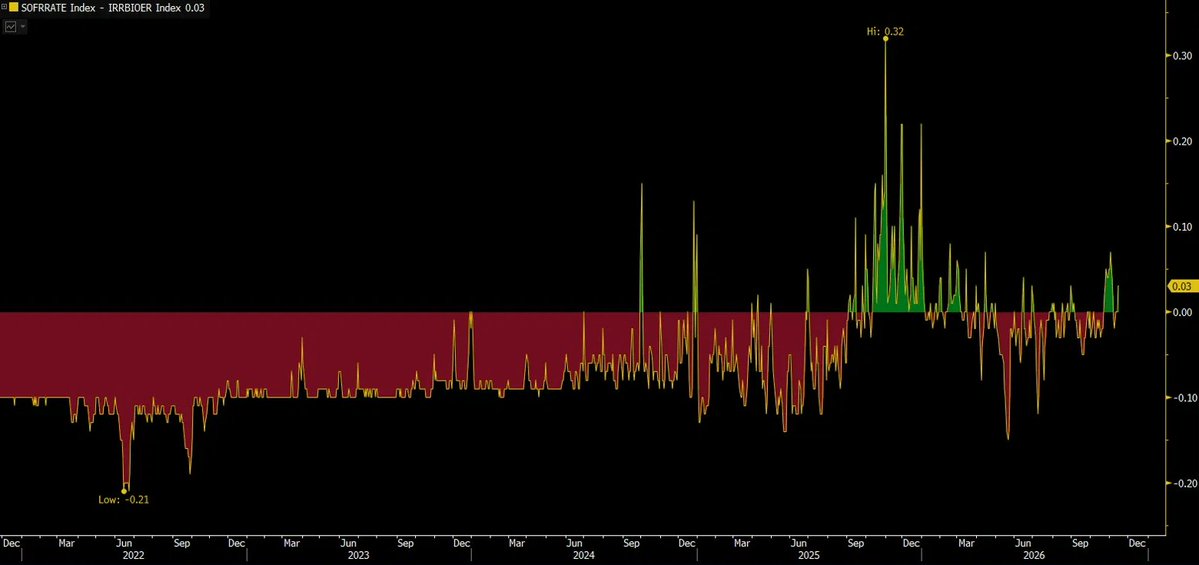
Just like in Q4 2025, we're seeing strain in the market plumbing again🚨
SOFR is trading above IORB, as the banking system struggles to absorb bond issuance.
Last November, the Fed stepped in with Tbills purchases. This time however, it announced last Friday that it will conduct zero purchases over the coming month.
Stress in the AI sector is expected to exacerbate the shortage of collateral and liquidity in the market🥶
#repo #liquidity
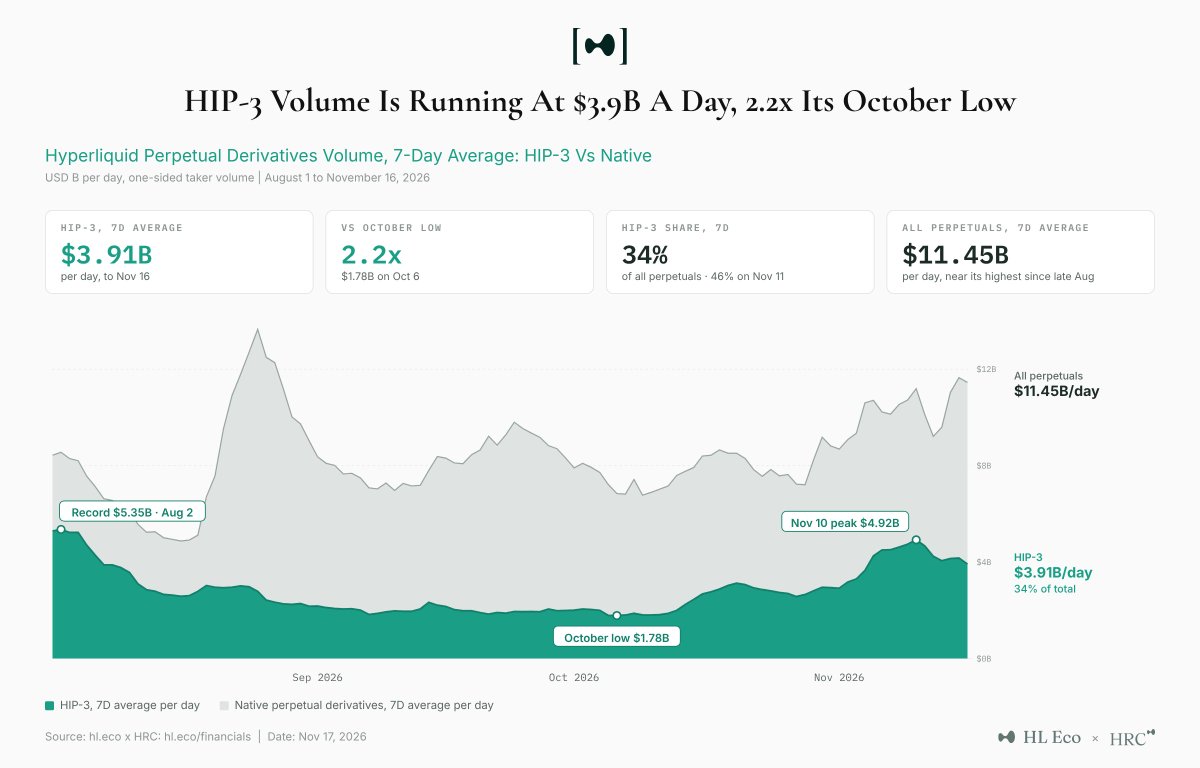
HIP-3 volume on Hyperliquid is running at $3.9B a day on a 7-day average, 2.2x its October low of $1.8B. It peaked at $4.9B on Nov 10.
HIP-3 is now 34% of all Hyperliquid perpetual derivatives volume, which is itself running at $11.45B a day, near its highest 7-day average since late August.
Nvidia has been the driver, with the board investigation and Jensen Huang’s resignation bringing a lot of volatility. xyz:NVDA traded $2.9B last week and a record $4.2B so far this week, over 4x its weekly record before November, and now makes up 20% of all HIP-3 volume, with $476M of open interest.
Nvidia reports after the close tonight and Anthropic IPO on Thursday, so we can expect more volatility across equities and the broader market.
Hyperliquid is open for both. 24/7.
This is the LARGEST 2-week drop in the all-in pr barrel price of oil ever..
Cracks, insurance, shipping, raw oil. Everything is down, and we are now talking almost 40 USDs in 2 weeks just (and waay more than 50 usds in a month)
Gosh inflation will be soft the next months..
"파티 끝났다, 은행 문 닫았음" 마틴 슈크렐리, 엔비디아 $NVDA 실적에 찬물 끼얹음 🥶📉
약값 5,000% 인상하고 감옥까지 갔다 온 월가 대표 어그로꾼 마틴 슈크렐리가 내일 새벽(한국시간 18일) 발표될 엔비디아 3분기 실적에 대해 역대급 초를 쳤음.
어그로만 끄는 관종 같아 보여도 반도체 실적 모델링 하나는 귀신같이 맞춰서 월가에서도 은근히 신경 쓰는 양반이라 더 찜찜한 상황임 ㅋㅋ
• 슈크렐리 핵심 발언 요약
"엔비디아 이번 실적 결과 안 좋을 거라 본다. 다른 이유보다 가이던스(실적 전망치)를 엄청 보수적으로 잡을 것 같기 때문이다."
"은행 문은 닫혔다, 친구야(The bank is closed, my friend)." -> 한마디로 그동안 매 분기 어닝 서프라이즈에 가이던스 상향으로 쭉쭉 빨아먹던 돈 복사기 파티는 끝났다는 소리임 🤡
• 왜 지금 이 타이밍에 '보수적 가이던스' 얘기가 나올까?
그동안 엔비디아 주가 공식은 단순했음. 실적 잘 나오고, 다음 분기 가이던스 더 높게 부르고, 주가 떡상하는 무한 루프였음.
근데 하필 실적 발표 직전 젠슨 황이 스캔들로 전격 사임하면서 회사가 CFO 콜레트 크레스 임시 CEO 체제로 급변했음.
리더십 공백에 대외 불확실성까지 겹친 판국에 임시 CEO가 무리해서 장밋빛 가이던스를 던질 이유가 1도 없음. 오히려 눈높이를 팍 낮춰서 매를 먼저 맞고 가는 게 경영진 입장에선 안전한 선택임.
• 투자자 입장에서 봐야 할 핵심 포인트
시장 기대치는 이미 하늘을 찌르고 있는데, 정작 성적표 뚜껑 열었을 때 숫자가 아무리 잘 나와도 가이던스가 보수적으로 찍히면 주가는 바로 뚝배기 깨질 수 있음.
빅테크들의 AI 케펙스(CAPEX) 지속 가능성에 대한 의구심도 슬슬 고개를 드는 중이라, 이번 가이던스 한마디가 반도체 섹터 전체의 단기 방향성을 가를 분수령이 될 전망임 ㅎㄷㄷ
결국 이번 실적의 핵심은 지난 분기 숫자가 아니라 임시 CEO 입에서 나올 '다음 분기 가이던스'임. 슈크렐리의 저주가 또 적중할지, 아니면 엔비디아가 또 한 번 비관론자들 뚝배기를 깨버릴지 내일 새벽 관전 포인트 제대로 잡혔음 🍿🔥
⚠️ 특정 종목 매수/매도 추천이나 투자자문 아님! Not Financial Advice 🚫
Look at this chart. Nasdaq dumps, BTC dumps. Nasdaq bounces, BTC bounces. Same shape, almost to the minute. For years we said $BTC was digital gold and a hedge against the system. Rn it trades like a leveraged Nasdaq ETF that's also open on weekends.
So yeah, if you're trading crypto this week, you're basically trading the Nvidia earnings tonight and the Anthropic IPO tomorrow. Whether you like it or not.
🦔The IMF says circular AI deals, where companies fund the customers who buy from them, now top $1 trillion. About two-thirds of that money is borrowed. Kristalina Georgieva, who runs the IMF, told CNBC the world economy is “standing on one leg on the AI leg,” though she called the recent market swings orderly.
My Take
Every time Nvidia funds a customer and that customer buys Nvidia chips, the purchase shows up in the GDP numbers as business investment. Harvard economist Jason Furman figured tech spending like this made up 92% of U.S. growth in the first half of last year (he thinks other parts of the economy would have filled in maybe half of that without the AI boom). So if the news says the economy is humming while your paycheck and grocery bill say otherwise, part of the difference is AI companies passing money around in a circle.
That leaves governments in an awkward spot. Finance ministers want the growth number, and regulators have a reason to look away until something breaks. The other leg was supposed to be wages and everyday spending, and I would definitely feel a lot better if growth came from that one again.
Hedgie🤗