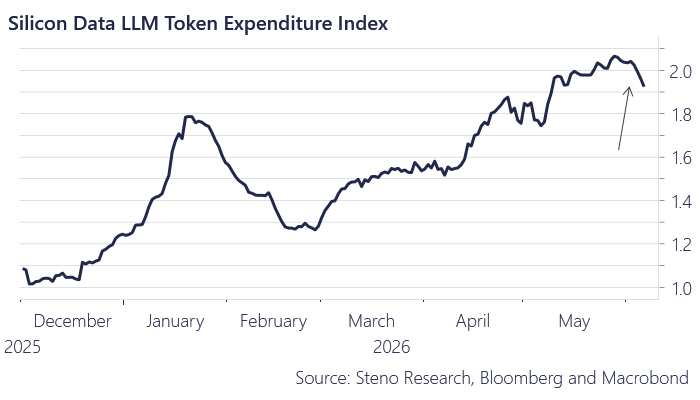
This is the chart that everyone should be watching.
If the Token Pricing rolls over, everything from the memory trade to the broader hard-ware and data-centre trade is over for this cycle imho.
The whole setup depends on this..
A very thoughtful post. And perhaps true on AI.
But it is perhaps overstated in other areas. If free market dynamism were all that mattered, what would explain the catch-up of the East Asian economies? How did China go from an economic backwater in 1980 into an industrial superpower in only forty years. My view is that learning from China doesn't mean becoming China. Are there no lessons for the United States, which is now falling behind in key industrial sectors, in the success of others?
The reason a free market at home does not always produce prosperity and progress is because the economy is global. The actions of other countries, and their state-driven distortions, affect the incentives we face at home, including those of our capital allocators and businesses.
There's wisdom in the market. But there's also foolishness. The "efficient" path can be a disaster if other countries de facto shape the global terrain of efficiency and "hack" our incentives.
Indeed, this is what happened to the United States. Deindustrialization is partly the result of operating on free market assumptions and keeping an open economy in a world where other states practice industrial policy. With no state-led correction to those distortions, the result was hollowing out.
Perhaps AI will spur reindustrialization. But I doubt it will be enough. Even today, the very companies hinted at below are facing unbelievable headwinds from Chinese industrialists, who will also apply AI. There is no magic button for reindustrialization. It will take policy. I actually think the Trump Administration, in its own way, also understands this.
The simple fact is we have experienced a catastrophic loss of jobs, process knowledge, and industrial capacity -- a national tragedy -- that is as much the result of our own free-market ideology and interest group capture as it is foreign mercantilism.
Research has consistently shown a strong inverse relationship between police presence and crime rates. That makes the widespread decline in crime since 2019 even more striking given it occurred alongside a reduction in police across most large cities.
Ultra High Net Worth Individuals (UHNWI) do own yachts for tax reasons, but not because they are a modern replacement for palaces.
Most of the world runs residency-based taxation. As in, if you stay over 183 days somewhere you become a taxable base. The US is the outlier, as it taxes you regardless of where you live, based on citizenship.
That difference produces two entirely distinct wealth architectures.
European UHNWI have a structural incentive to stay mobile. Not being in one place too long is itself a tax strategy. Yachts happen to serve that lifestyle perfectly - flag-registered in favourable jurisdictions, moving between anchorages, never accumulating residency days (and benefiting from things like Cypriot 2 month stay non-dom status). The tax regime does not cause yacht ownership, but it makes yachts a remarkably efficient asset class for people whose wealth depends on being nowhere in particular.
This is why European UHNWI do a yearly circuit - Wimbledon one week, Cannes another, the WEF, the Biennale. The social calendar is not separate from the tax strategy. They are the same thing. This also mirrors the itinerant courts of the past, where the aristocracy would move around from one part of the kingdom to another throughout the year, according to king's mood.
American UHNWI face the opposite constraint. Citizenship-based taxation means mobility cannot solve the problem. So they optimise differently - dynasty trusts, LLCs, state domicile arbitrage. They are not less sophisticated. The same economic incentive just produces a completely different behavioural output when the underlying regime changes.
The DPP has released a short policy brief attacking KMT head Cheng Li-Wun, currently touring the United States. They highlight a question I wish more Americans would push her more directly on
This highlights a few under-appreciated aspects of AI and growth. 1) an increase from 2 to 2.5% growth has HUGE economic implications (and I think it’ll be higher). It may seem like a small number but given the size of an advanced economy like the US, this will lead to large and visible changes to well being. 2) disruptive technology shocks are *necessary* to sustain growth. Without disruptive shocks, growth doesn’t stay steady, there is sclerosis in the economy and it will stagnate and eventually shrink. Unlike what some folks like to argue, this would be a *very bad thing*—most of our social programs and public goods depend on sustained or increasing growth.
Earlier this year, I was very skeptical of the claim that smartphones reduced birthrates, because fertility declined so, so long before the arrival of smartphones.
But @JesusFerna7026 changed my mind, and studies like this have confirmed that my mind should stay changed.
The way I think about now is something like this:
One set of factors best describes why birthrates declined toward 2 around the world in the last few decades—modernization, contraception, women's education and social freedom, etc.
But another set of factors seems to better describe why birthrates have fallen toward 1 and below one in many places and among many groups. And smartphones belong in the second category.
I'm not surprised the oil market could handle 100 days of the Strait being closed without significant disruption.
I am very surprised the oil market would remain so complacent after 100 days and with zero visibility on reopening.
Everyone is talking about how bad the ideas in this Piketty proposal are, and it's true: They're very bad.
But what's also notable is how *out of date* they feel. A one-world government to fight climate change? Seriously? Even Greta Thunberg has moved on to Palestine activism.
The new class of GLP-1 + glucagon drugs has, once again, shown that it can obliterate liver fat.
Fatty liver disease might be a thing of the past when these things hit the market.
Consider this earlier result for Retatrutide, where they saw 80% reductions in 24 weeks:
SF housing taking off like a rocket is making me wonder how long it’ll take for there to be spillover elsewhere — metros and neighborhoods have been pretty stagnant since 2022 but that probably starts to change soon.
Good take
My guess is
- demand for intelligence is near infinite
- but 80% of workloads will be running on 99% cheaper models within 12-18 months
- 20% of workloads will still run on latest gen models where IQ maxing is important (scientific breakthroughs, higher level ochestrator agents?)
- rough analogy might be what % of macbooks or gaming PCs sold have the maxed out specs for CPU/GPU, prices are falling much faster than Moore's law here though
- this leads me to think the limiting factor will be energy and compute, not better models
At Coinbase we're working hard on routing prompts to cheaper models where appropriate, and in some cases have been able to keep costs roughly flat, while token usage continues to grow exponentially.
The SpaceX Shock for Hong Kong’s Wealthy
As a Hong Kong passport holder, I’m fully aware of how its meaning has changed over the past decade.
It is no longer treated as the distinct identity it once was. Increasingly, it is viewed as simply another form of Chinese passport.
I understand and support that assessment.
But for wealthy Hong Kongers, the SpaceX IPO exclusion will still come as a shock. The message is blunt: a Hong Kong identity can now be enough to exclude someone from parts of the global financial system, because that identity is increasingly synchronized with China.
Inside Hong Kong, there have long been two broadly understood identities: old Hong Kongers and new Hong Kongers.
Old Hong Kongers are those who lived in Hong Kong before the 1997 handover. They generally see themselves as distinct from mainland China — more international, more connected to the open world, and more identify with democracy and capitalism.
New Hong Kongers are the mainland Chinese who have moved to Hong Kong since 1997, which amounts to 3 million or more than a third of Hong Kong population. Beijing has steered this migration as part of a familiar political strategy: diluting a local identity by reshaping the population. In Chinese, this is called 渗沙子 — mixing sand into the soil. The CCP has used versions of this strategy in Xinjiang, Tibet, and other regions with strong local identities.
Many in this newer group do not speak Cantonese, and keep to their mandarin. Their cultural and political reference points are mainland Chinese. They may live in Hong Kong, but they often identify first and foremost with China.
That is why this SpaceX IPO episode matters. It shows that the financial world is also no longer making fine distinctions between Hong Kong and China.
It is sad to watch Hong Kong lose its unique identity. But this is what becoming part of China means.
https://t.co/KD9laxwnoq
There's a very happy ending to this tweet, and it's a reminder that for all its buffoonery and corruption and incompetence, the Trump administration actually does some good from time to time.
One of the reasons I think the tech is getting better so much faster in plastic surgery than elsewhere is that plastic surgeons tend to be among the smartest doctors.
Every year, this repeats: the tests keep showing that derms and plastics are the smartest cookies.
"Why Solar Power Is Booming Under Trump" 😲 https://t.co/GzB5vVeKri
"The conceptualization of the United States, and not Europe, as the cradle of clean energy growth is rich in irony due to the divergent and counterintuitive stances of Washington and Brussels"
Counterpoint:
Xi Jinping (2012): “We differ completely from Western countries in social system, ideology & other aspects. This determines that our struggle and contest with Western countries is irreconcilable and therefore inevitably long-term, complex, and sometimes very acute”