„The efforts of men are utilized in two different ways: they are directed to the production or transformation of economic goods, or else to the appropriation of goods produced by others.“ - Vilfredo Pareto
We are heading toward another kind of stalemate and more economic chaos, one marked by heavy casualties and the involvement of additional actors.
Is the U.S. government going all-in? Not exactly.
Strategically this operation will not materialize the way the United States expects, nor will it be capable of reviving Donald Trump’s standing in the midterm election polls.
And they know precisely the risks I’m referring to.
We can expect a deepening of the economic crisis along with military phases marked by a high risk of environmental disasters and limited strategic advances.
Internally, what does this mean? It is highly probable that they will actively work to prevent the elections from taking place as planned, which will shake the United States to its core domestically.
Empirically, if you follow the logic of @DanielEllsberg‘s „stalemate machine“, the result should be FROZEN, at least for a long time (and then all of a sudden DEAL).
How do you reconcile theory and empirics?
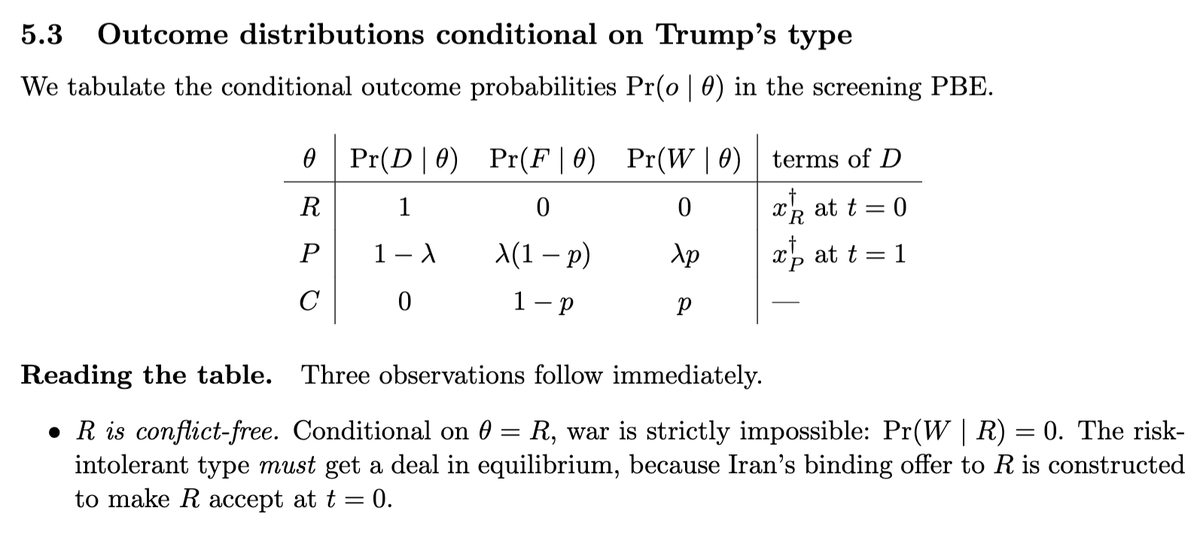
Gonna be a DEAL then. This is really the power of game theory. As I proved formally, the only equilibrium if Trump prefers FROZEN > WAR (type = R below) is a DEAL.
Theorem. Pr(D | R) = 1 in the unique perfect Bayesian equilibrium.
https://t.co/QYmiOCE8SI
@policytensor@dov_levin The key to peace is China.
The US has disciplined Israel in 2024 re Lebanon, via the Hochstein mediation when Biden withheld key weapons deliveries for the Gaza campaign.
…and this one: https://t.co/sQFwqOcOMI
„We study a model in which […] a form of third-party mediation inspired by work of Myerson effectively brokers peace in emerged disputes and also minimizes equilibrium militarization.“
Take a look at this: https://t.co/MaPO4DVgfp
„mediators can be equally effective as arbitrators. By using recommendation strategies that do not reveal that one player is weak to a strong opponent, a mediator can effectively circumvent the unenforceability constraint.“
One question that I haven’t seen explored is mechanism design for two sided negotiations. Isn’t there a tidy way to repurpose auction theory?
Like: both sides submit sealed bids to Pakistan repeatedly until we have a solution?
It is funny to see a German chancellor complaining about China’s undervalued exchange rate. This is exactly what Germany did to everyone else in the last decade. Germany’s industrial renaissance of that decade was largely a story of an undervalued real exchange rate. The appreciating euro has played a role in Germany’s subsequent decline. But I would argue it was not the main factor. More important were lack of innovation, overregulation, demographics and unhealthy dependencies. A 20% revaluation of the renminbi's exchange rate against the euro would help German industry. But it won't reverse the decline.
https://t.co/LUj41sOS3w
War is
— ‘a form of communication’ (Putin)
— a dynamic asymmetric information game whereby two sides pay in risk and pain to extract private information from the enemy (Schelling)
— a historical process that is at once irreversible and has unforeseen consequences no one foretold (Kolko)
— a technical process whereby the means of destruction are unleashed by the strong against the weak (Sherry)
— a paradoxical clash of opposed wills (Luttwak)
— determined ‘from below, by those who are afraid’ (Foucault)
What is the response function of the peasant?
Back in the 1960s, Robert Triffin predicted that the Bretton-Woods arrangement would be short-lived. To keep the world supplied with enough dollars, the US would have to keep running balance of payment deficits, ultimately leading investors to question the gold backing of all those dollars being recycled abroad. He was proven right within a decade. This time around, the same questions are being asked about the backing of US Treasurys.
The Safe Assets that weren't. https://t.co/NYNURJoRVh
POLITICAL BILLIONAIRES
The clip below is a good encapsulation of what modern China is by Eric X. Li, who’s one of the most thoughtful Chinese nationalists.
I appreciate his description, because the Internet is the exact opposite. Because on the Internet, capital (in the form of Bitcoin, and more generally smart contracts) really does stand above any given state.
The negative way of framing this emerging reality is that Internet capitalists are now above national governments. The positive way of framing it is: anyone can become an Internet capitalist, and there is now truly global rule-of-code that no state can easily abrogate. Moreover, individuals can’t have their digital rights revoked even by powerful states.
As for whether it’s bad if “billionaires” have influence over the government…the reality is that political leaders control many billions in assets. For example, a city like SF with ~$16B in annual budget and 11 supervisors plus a mayor essentially has 12 political billionaires.
Each of these political billionaires allocates $1B+ per year in cash, on average. This is orders of magnitude more than a typical tech billionaire allocates. That’s because tech billionaires might have $1B in net worth but perhaps only $10-50M liquid.
So: market billionaires actually have far less in the way of financial resources than political billionaires. A market billionaire might allocate perhaps $100M over the course of their lifetime, whereas a political billionaire will allocate $1B+ in a single year. This is a >100X differential.
Now, yes, it’s true that political billionaires have less for personal consumption than market billionaires do, but that is (almost by definition) societally unimportant. A political billionaire spending a billion on government worker salaries does a lot more to steer the world than a pair of fancy shoes.
One might also argue that political budgets are less discretionary than market budgets, and I’d agree, but the sheer scale of public budgets makes up for it. Even if only 1% of a $16B city budget is discretionary, that’s $160M in discretionary cash per year.
Anyway, the point is that anyone in control of a giant public budget is already in full billionaire mode. They are allocating billions in capital, so they are political billionaires. You are going to have billionaire-run government in this sense no matter what.
Wichtig ist, dass die Rohdaten für die Wissenschaft gut zugänglich sind, so dass die wir mit den Daten arbeiten und Statistiken zur Armut und ihrer Entwicklung erstellen können. Die Wissenschaft braucht dafür kein Statistisches Bundesamt. Die Vorwürfe sind unbegründet! 1/2m
A noble person is kind to a stranger he will never meet again, when nobody is watching, & when he has nothing to gain. The rest is self-promotion, social climbing, or profit seeking.
I love all the micro policies of Milei. Rent liberalization and bonfire of regulation works as expected. But I agree in being worried about the macro side. While fiscal deficits are gone, the peso is increasingly overvalued (eg. Big Mac index), the current account is flipping to a deficit in 2025. Looks unsustainable.
Services vs goods is not the issue. The issue is tradables vs non-tradables. The former is exposed to the rigors of the global market and accounts for virtually all productivity growth. Competition is an order of magnitude less intense in non-tradables and productivity growth is close to non-existent. The most successful and dynamic countries are those that dominate high value-added tradables. Countries that specialize in low value-added tradables—esp commodities—are at the receiving end of the international division of labor.
What you want is not manufacturing so much as a niche at the top of the ladder of the international division of labor in the production of tradables. This is hard. There are no shortcuts. You have to compete with the world’s best. You have to climb the ladder one step at a time. Industrial policy and good governance helps. But ultimately it comes down to human capital and general institutional competence.
My advice to all developmentalists world wide is to front-load investments in human capital, build efficient institutions, and gain as much exposure to the world market as possible. Everything else is second order and will fall in place if you stay disciplined and keep your shit together.
Strongly disagree.
(1) The actual reform would be to make IPOs easier, by essentially eliminating Sarbox. And we'll actually get that reform... but only via crypto, because all companies will become cryptoequities. However, that means they'll list on Internet capital markets and crypto exchanges, rather than NYSE/NASDAQ.
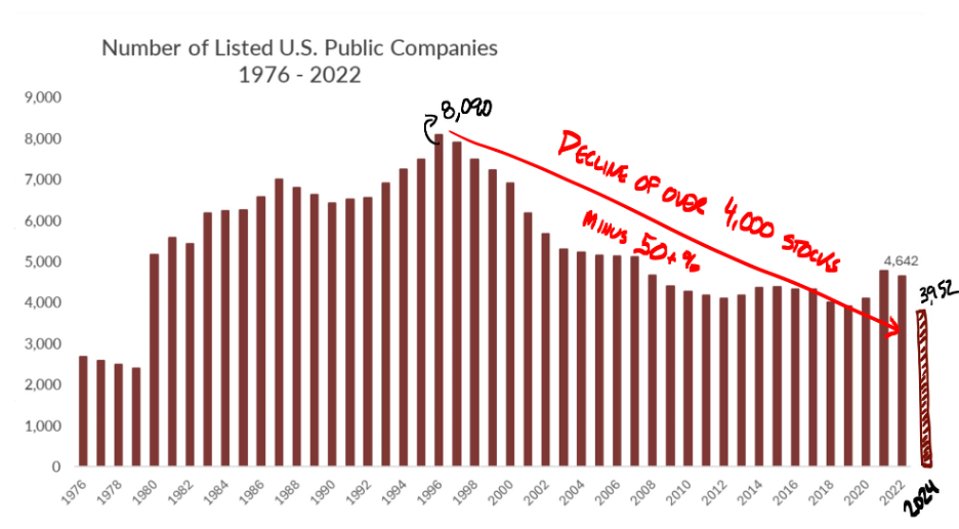
(2) See how the number of US public companies has crashed since the early 2000s? Then, ten years later, the number of Internet coins started soaring. The big picture is that we're just sunsetting US capital markets in favor of Internet capital markets.
(3) Now, let's talk about why random government interference with voluntary capitalist transactions is so bad.
(a) First, bigcos (invisibly) reduce already rare M&A activity, because they need to budget for a global fight with regulators just to get a deal done.
(b) Next, bigcos are forced into baroque deal structures, like the recent Character, Scale, Inflection, Adept, Covariant, and Windsurf deals, which can cause drama for everyone.
(c) And, bigcos are forced to fight to the death with startups rather than surrender to them by acquiring them. In practice this often means political skullduggery.
(d) Finally, bigcos put far less of their profits into exits, which in turns results in less money for tech startups. After all, a big M&A is a big surrender for a bigco, as they'd prefer not to capitulate to a startup by buying them.
So: that means less M&A, more complexity, more politics, and less money. That's like every dysfunctional socialist country, where businesses need to use political connections simply to get a deal done.
To be clear: of course I understand the hostility towards Big Tech, which did after all censor millions. But regulations in general strengthen bigcos by making it so complex and expensive to do things that startups can't compete (or, in this case, get acquired).
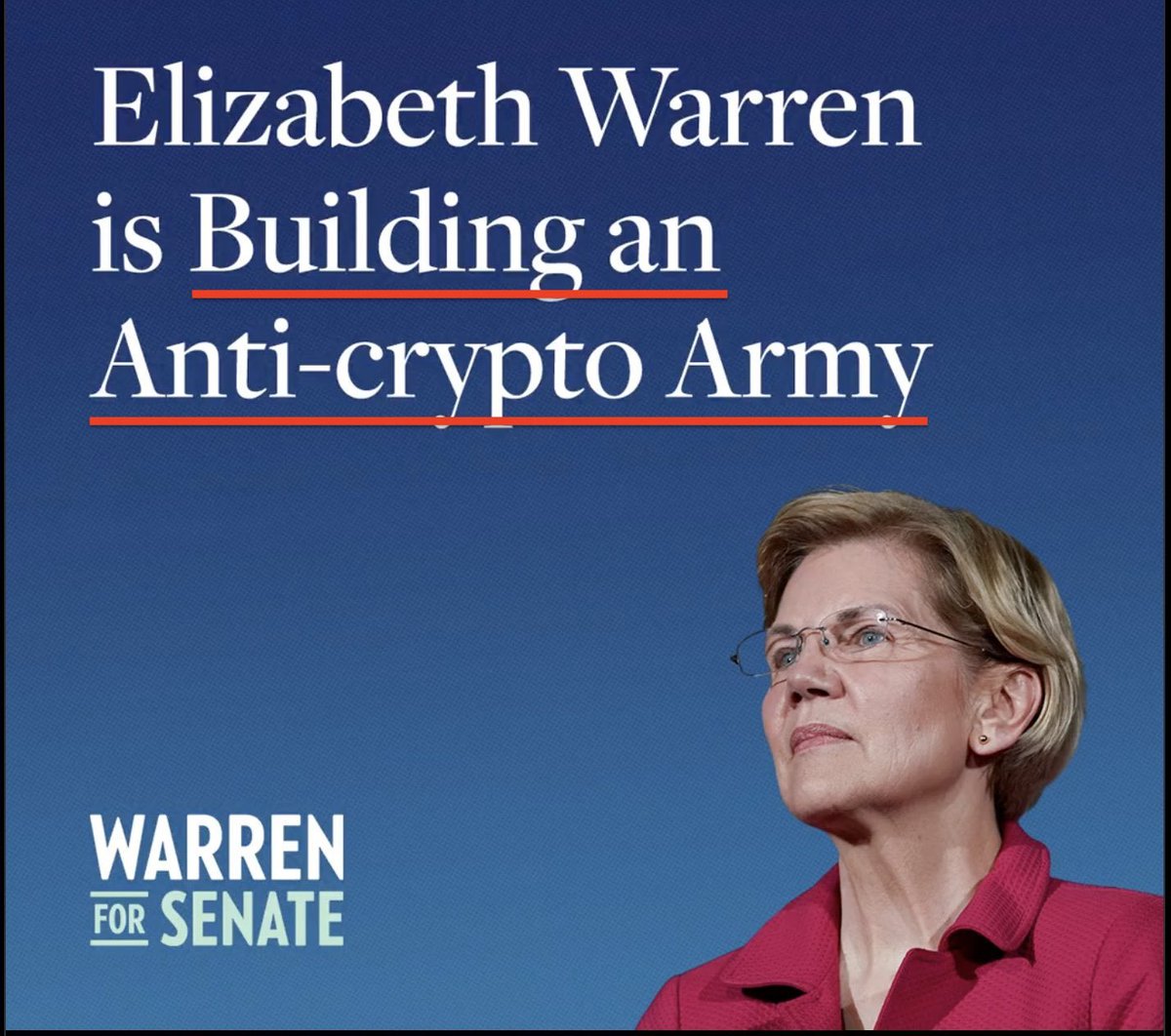
Finally: the Elizabeth Warren/Lina Khan faction of statists generally haven't founded businesses and certainly don't want to advance technology. Their actual policy goal was to kill tech and stop us from getting to Mars.
Sometimes they're explicit about it; see poster below. The only edit you'd make is that they were building an anti-tech army, and that army was (for now) defeated on the battlefield of ideas.
Turnberry ends the free trading world that made Europe rich. For decades, we profited from free trade while America paid for our security. Now the bill has come due. 15% tariffs, $750B energy purchases, $600B investments—for nothing in return. My take:
https://t.co/ucf5xdywja
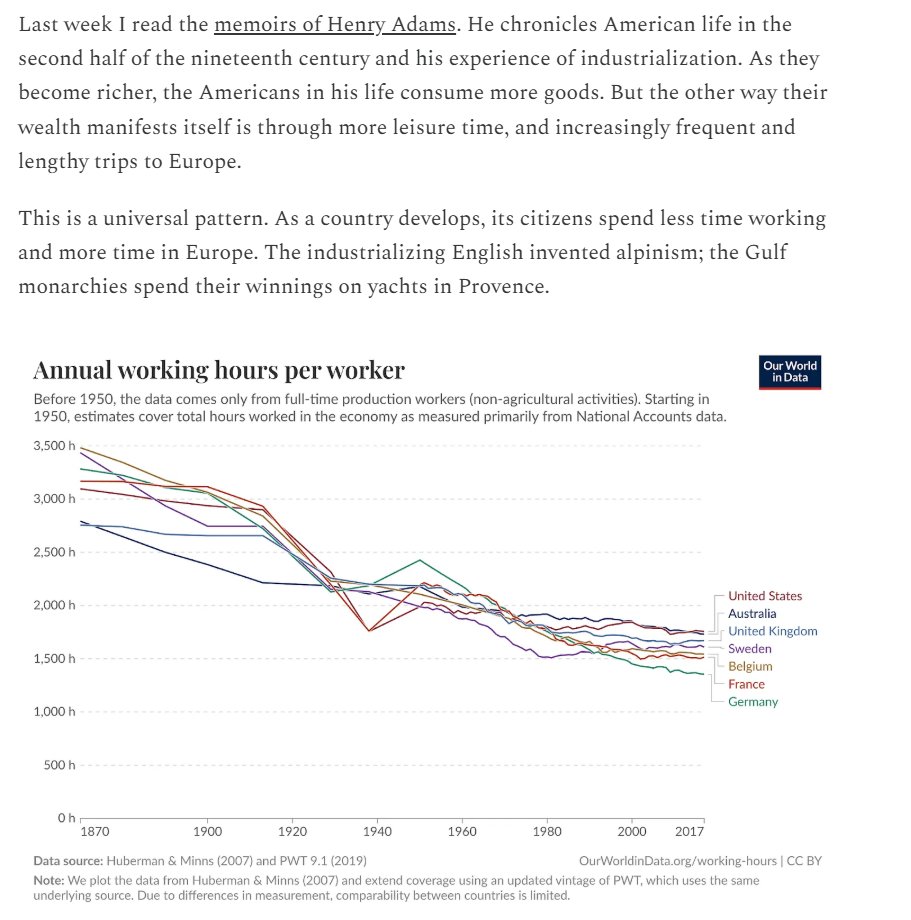
Europe may struggle to automate its own economy. But if it remains the world's preferred leisure destination, it can capture gains from everyone else's automation.
@pietergaricano explores the other side of Baumol in Silicon Continent.
🧵
1/9