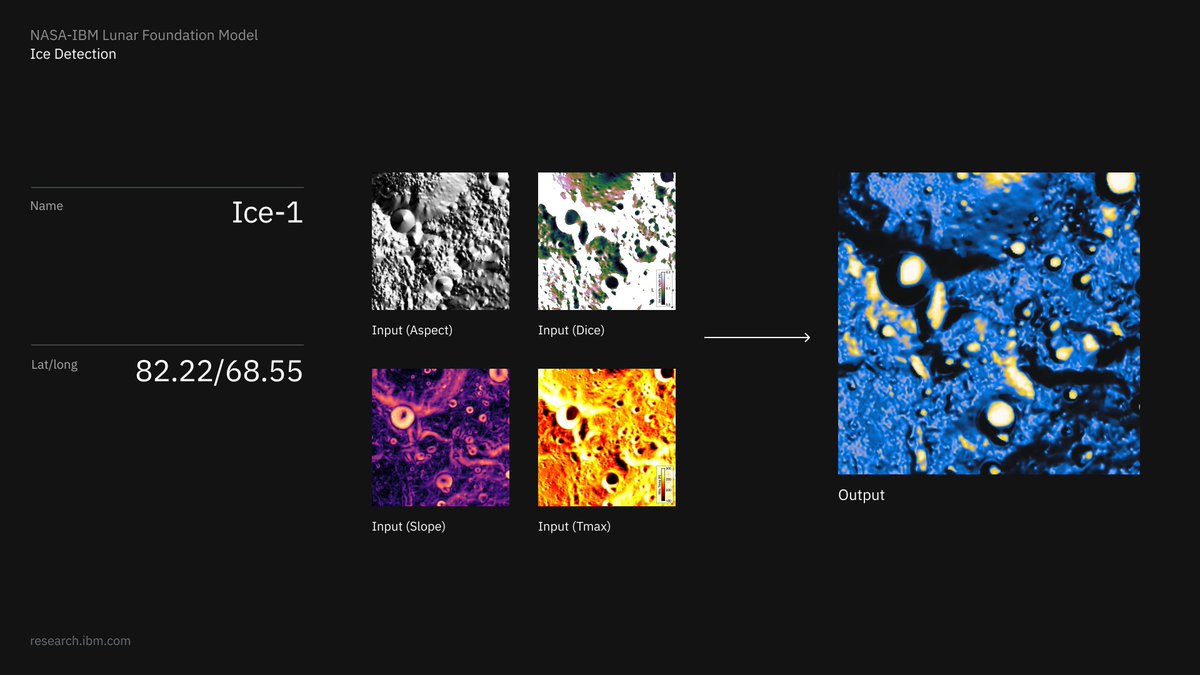
NASA and IBM open-sourced a lunar AI model built from 30+ aligned data layers across 4 missions. It maps craters, volcanic features and possible ice, cutting lunar-ice RMSE by up to 22% vs SwinV2-B. https://t.co/8o8kkXKRVA #AI#SpaceTech
Precise question: is the 7% net of recovery cost? Selective tool loading saves tokens when the policy guesses right — but a missed tool means extra roundtrips to reload and re-plan. If even 5% of tasks need one recovery pass, gross savings evaporate. What's the tool-miss rate, and is 7% measured on gross tokens or net tokens per completed task?
The "faster and more affordable" pitch holds where cost-per-call was the binding constraint — prototyping, agent loops, eval sweeps. It breaks where the constraint was never price: tasks gated on capability or trust, where a cheaper wrong answer is still wrong. The real bottleneck moves downstream to evals — at 10x the volume, the scarce resource is knowing which outputs to keep.
Key question that could flip this: was the side-by-side on the same fixed input set, and what's the $/episode on 6 Sol vs 5.5 Opus? If the stories differed — or the Claude writing fix did the heavy lifting — the comparison doesn't isolate the model. And if 6 Sol needed twice the edit passes, the 50% price cut buys nothing.
Anyone can verify this in ~20 minutes: pip install sentence-transformers v6, index 1,000 of your own docs with the 30M ColBERT checkpoint, then run your 20 hardest queries through it and a plain bi-encoder side by side. Two numbers that matter: top-5 hit rate on the tricky queries, and CPU query latency. If late interaction wins recall without blowing the latency budget, it's a drop-in upgrade.
Good excuse for a 20-min stress test: take one image and run 5 back-to-back edits on it (background, object swap, text overlay, relight, crop) — after each pass, check whether the regions you did NOT touch stayed stable. Multi-turn consistency is only real if untouched pixels survive to round 5. Publish the drift table; that's the benchmark nobody posts.
我因此改了一个判断:开源战场在分叉。一边是聊天模型打价格战(GPT-6 Sol 价格比上一代砍半);另一边是垂直科学模型,把一个领域几十年没人动的沉睡数据变成资产。
你在的行业,有没有“NASA 式”的沉睡数据?
EN: Chat models race to the bottom; domain models turn dormant data into assets.
@streamlit The one thing I'd want to confirm: does the client-side validation in 1.62 run before any server round-trip? If it's truly client-side, that's a real latency win for form-heavy apps — if it still round-trips, the "client-side" label is doing heavy lifting.
@omarsar0 One more signal to watch: if third-party reruns on messy agentic workloads — not the Index tasks — reproduce that cost-per-task edge, then this is a real open frontier. A leaderboard slot is a snapshot; durable cost-per-task is the trend.
@omarsar0 To feel the pain AML measures, run a 20-minute test on your own setup: ① log every context pull your agent makes in one session ② tag each as still-valid or stale ③ count how many stale pulls silently steered the output. That stale-pull rate is your memory debt.
@scale_AI The one thing I'd want to confirm: does ROK-FORTRESS score only the final refusal, or also the reasoning trace behind it? That distinction changes whether we're measuring alignment or just surface compliance — and it matters most for open-weight models.
This nails the solo-builder loop — push, preview, done. But for regulated teams, the real bottleneck isn't deployment speed, it's change governance: who approved what, and whether you can roll back an agent's 2am push. Auto-deploy is a velocity feature; the enterprise question is auditability.
@vercel@typesafeai To check whether this adoption is substance or novelty, run a 20-minute test: ① route 10% of production traffic to Jev ② compare task-success rates against your current model ③ measure cost per completed task, not per token. Adoption speed ≠ durability.
@togethercompute@parthsareen@ollama@zainhas@AIconference One more signal to watch: if retry rates and queue times on shared inference also start rising, that's when coding-agent adoption is genuinely production-scale — not just launch hype. The infra bill is the honest usage metric.
@GoogleDeepMind This holds for short, interruptible background tasks — but in long-horizon workflows, the real bottleneck is state continuity across interruptions, not how smoothly it talks. "Doesn't break flow" is the right claim; "finishes the task" is still unproven.