Warren Buffett on how he'd make 50% a year with a small amount of money:
Buffett explains that when he was 20 or 21, he went through thousands of pages of Moody's manuals, reading about hundreds of obscure companies most investors had never heard of.
"I went through the Moody's transportation manual a couple of times, that was 1,500 pages, and I found all kinds of interesting things."
This deep research is what connected him with Charlie Munger.
Buffett knew the details of tiny West Coast companies that Munger thought nobody else had heard of. "That became an instant point of connection."
His advice for earning high returns with limited capital:
"I would try and know everything about everything small and with a million dollars you could earn 50% a year. But you have to be in love with the subject. You can't just be in love with the money."
Buffett compares it to great chess or bridge players who succeed because the game itself excites them, not just the rewards.
"The human brain does its best when you find out what your brain is really suited for. And then you just pound the hell out of it from that point."
nLIGHT reported $82.6M of revenue for the June quarter, up from $61.7M a year earlier, on high-power lasers for directed energy and advanced manufacturing. Products revenue was $59.4M of that and grew 45%, and the operating line was still a $3.6M loss
Adam spent five years and billions of dollars owning game studios he didn't want to operate, purely to harvest the signal that would let his real business compete with Facebook. Once Axon 2 launched in 2023, AppLovin sold the studios off. He breaks it down here:
By 2018, AppLovin had cleared over $100M in EBITDA on a simple rules-based ad algorithm — if you played solitaire and poker, it showed you more games like that. But Adam could see Facebook was operating in a different league.
"Once they got their mobile marketing platform out, they really did turn ads into content," he explains. "If you have a very powerful algorithm on showing users ads that are really good for them, the consumer's going to discover products that they want to buy through the ads."
The problem was data. Facebook had the social graph and was pixelled on most of the websites in the world. AppLovin had solitaire and poker.
Adam describes the gap:
"Advertiser data is very, very important in predicting an advertiser relevant outcome. If you're a consumer and you're on 40 different sites and you're browsing for different products and you buy four in the last year, that's a very good data set to predict what you are actually interested in."
He tried the obvious path first — asking advertisers to share their data the way they shared it with Facebook and Google. They refused. AppLovin was too small, too unproven, just another billion-dollar company in the space without the model to justify the ask.
So Adam went the other way. If advertisers wouldn't give him the data, he would buy the advertisers.
"I went out and we just kicked off buying some gaming studios. The business from KKR investment to IPO ended up looking wildly different than an advertising business because we ended up with 14-15 different game studios across all categories of gaming."
The logic was clean:
"What you buy is very much predictive of what you'll buy next. And so that was critical for us to go get our hands on that data. We were unable to convince advertisers to share that data with us, so in order to solve that problem early on, I went out and we just kicked off buying some gaming studios."
The first acquisition was a studio called People Fun, and Adam moved fast — idea to first deal almost immediately, with KKR backing him because the logic was sound. The studios fed proprietary spend data into Axon, AppLovin's machine learning model. When Axon 1 launched, the in-house games were the first power users. Once the model was proven, third-party developers followed.
AppLovin founder Adam Foroughi lays out the long-term vision for the company: turn ads into something so well-targeted they function as content, and use a billion-strong audience of mobile gamers as the distribution layer.
The starting point is the audience itself. Adam explains that AppLovin reaches over a billion users who play games every single day around the world, with more than 150 million adults in the US alone. The power user isn't who you'd expect:
"That's not the same 21 year old who's on Instagram for six hours a day. The power user who's playing casual games, Candy Crush for 2-3 hours a day, as an example, is more of like a middle-aged person who has more time and is just getting relaxation here."
These users are willing to sit through long ads. Adam notes that the average ad on the platform runs over 35 seconds — "like a television commercial on the mobile device."
For years, that attention was only used to push more games. Adam describes the old loop bluntly: "We used to take a user and say game, game, game, game, game. If you weren't in the business of switching games, that's a pretty bad ad format to show you."
The expansion into e-commerce changed that, and Adam frames it as the first step toward a much bigger thesis — that as the targeting models get better, ads stop feeling like interruptions and start feeling like discovery.
He explains:
"The diversity will go up, the technology is already capable to do it, and then the value to the end consumer will go up. And that whole thing I said earlier of the ad becomes more like content."
Then comes the punchline that defines the vision:
"The hope we have is that we can get the local laundromat discovered by someone playing a game because we serve a really good ad to someone who needs their clothes washed. If that happens and we get to that level of scale, this business is going to be much, much bigger than it is today."
Adam is clear about who he wants to serve first. AppLovin has no sales force, so large enterprises will eventually come to the platform on their own. The real opportunity, in his mind, is the small and medium businesses that nobody else helps:
"We want to help those small to medium sized businesses. What made us really successful in gaming was going to the companies that really didn't have much support at most of the other businesses and going, what's your 10 people? Let's work together. Let us grow your business."
The end state is a single targeting engine pointed at a billion adults, capable of matching them to the right local shop, the right Shopify store, the right product — not the right game. When advertising gets accurate enough, it stops being advertising.
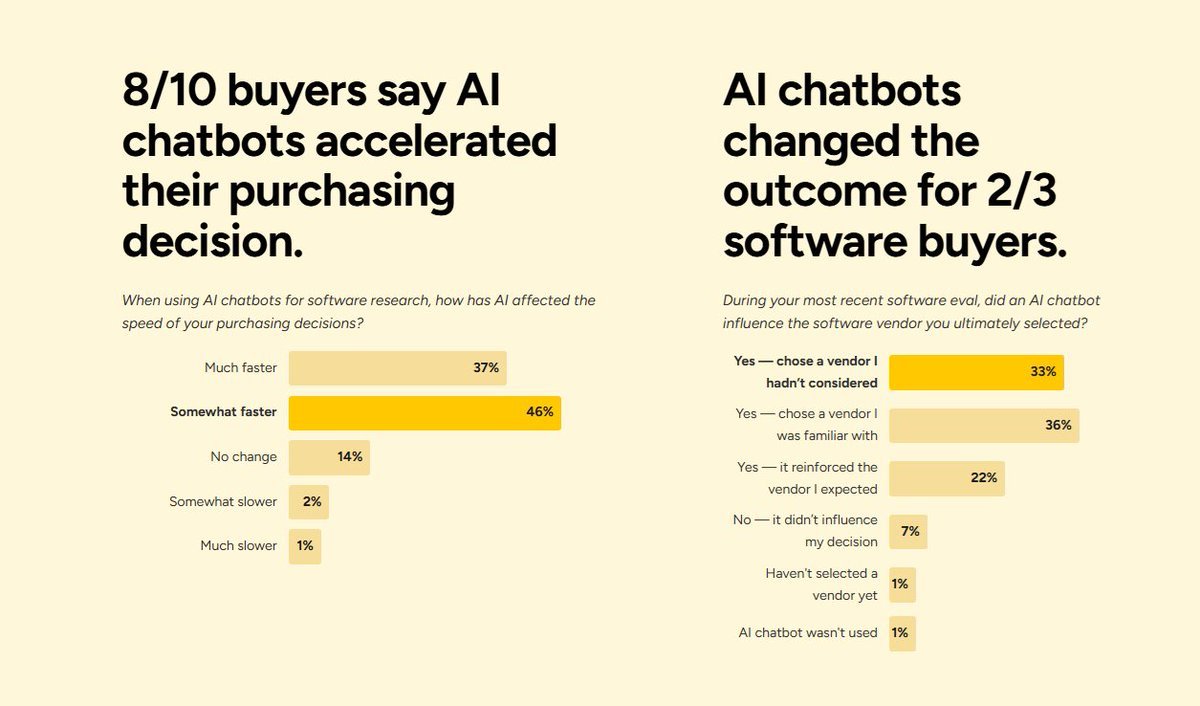
69% of B2B buyers chose a different vendor than they originally planned based on what an AI chatbot told them.
33% bought from a brand they had never even heard of before.
Increasingly in 2026 and beyond, if your brand is not the one AI is recommending, someone else's brand is taking your deal.
That is the reality that SEO Stuff (https://t.co/wKpf0EILTx) is helping businesses face daily.
If you want to see where your site stands across Google and AI search, start here (it's free):
https://t.co/Pn764BHwyL
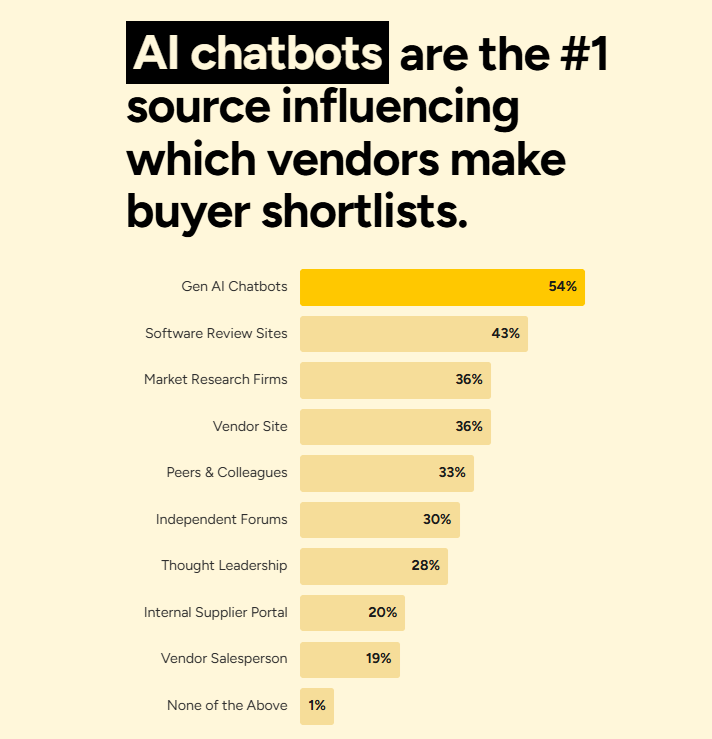
According to G2's 2026 Answer Economy report, which surveyed 1,076 B2B software buyers and decision-makers, AI chatbots are now the number one source influencing which vendors make buyer shortlists.
They're ahead of review sites, ahead of analyst reports and ahead of vendor websites.
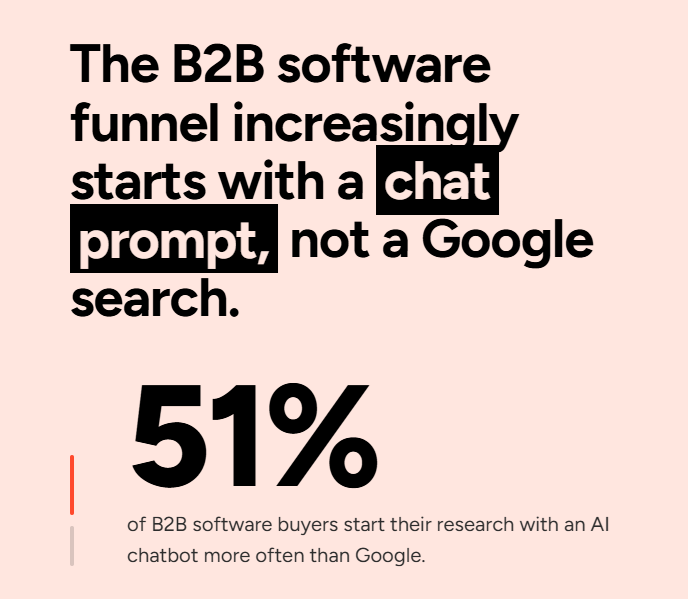
51% of B2B software buyers now start their research with an AI chatbot more often than Google, up from 29% a year ago.
85% of buyers say they think more highly of a vendor when it is cited in an AI-generated answer.
Just to put this in really simple terms: a buyer walks in planning to go with Vendor A, asks ChatGPT or Perplexity for a recommendation, and walks out buying from Vendor B instead.
Literally one in three buyers ended up purchasing from a brand they had never heard of before the AI recommended it.
That changes the competitive math entirely.
In the old model, brand awareness was table stakes. Buyers shortlisted the brands they already knew, and the competition happened between known options.
In the new model, a brand with zero prior awareness can get onto the shortlist purely because AI cited it during the research phase.
Even wilder, a well-known brand can lose the deal it thought was locked up because the AI recommended an alternative the buyer had not considered.
Again, if you want to see whether your brand is being cited when buyers ask AI about your category, start here (it's free):
https://t.co/Pn764BHwyL
So what determines whether AI recommends your brand or someone else's?
Well, when a buyer asks ChatGPT "best project management tool for agencies" or asks Perplexity "top CRM platforms for mid-market companies," the AI assembles its answer by searching for the most authoritative, comprehensive sources in that category.
The brands that get cited share two things.
The first is content depth. AI platforms break the buyer's question into sub-queries and pull sources for each one. The brand with 60 pages covering every question in the category shows up across multiple sub-queries. The brand with a homepage and five feature pages does not.
The second is authority. AI platforms prioritize sources that carry third-party validation. Editorial backlinks from trusted publishers, expert attribution, coverage from credible industry sites.
The brands building AI citation visibility now are the ones taking deals from competitors who have not.
This is the system SEO Stuff (https://t.co/wKpf0EILTx) was built around.
The done-for-you package:
https://t.co/yEFyM0Ze7W
Expert-attributed content backed by DR50+ backlinks: the combination that gets your brand onto AI-generated shortlists where 69% of buyers are now changing their vendor choice based on what AI tells them
The content package:
https://t.co/4CAnUt07PO
60 pages of expert-attributed content covering every question buyers ask in your category, so your brand shows up across the sub-queries AI platforms search when assembling vendor recommendations
The authority-building package:
https://t.co/Z9m9D7TjES
Editorial authority from trusted publishers that makes your brand citable by AI, putting you on the shortlist where 33% of buyers are discovering and purchasing from brands they had never heard of
Want to see whether your brand is being cited when buyers ask AI about your category?
Start here (it's free):
https://t.co/Pn764BHwyL
In 2017, HubSpot crossed $300M in revenue and every marketing team on earth was running the same playbook:
Build landing pages, write email sequences, A/B test headlines, wait two weeks for results.
The stack worked. The problem was that 80% of the hours went into assembly, not thinking.
A senior marketer would spend Monday on strategy and Tuesday through Friday dragging assets between tools.
This is the part of marketing that scaled with headcount for twenty years.
More campaigns meant more people. More channels meant more coordinators.
The relationship between output and team size was almost perfectly linear.
Conversion AI raised $30M to break that ratio.
Their pitch: AI agents handle the production layer while the team operates at the strategy layer.
They're calling it "vibe marketing," which sounds like a meme until you see the claim. 50% of a marketing team's time on execution, compressed to 5%.
If that number holds even at half the claim, the math on team structure in marketing changes permanently.
When Apple announced the iPhone in 2007, Steve Ballmer laughed on national television.
"Five hundred dollars? Fully subsidized? It doesn't appeal to business customers because it doesn't have a keyboard."
BlackBerry had 30 million subscribers. Every major bank and government on earth. Billions of secure emails per day. By 2013 it was in collapse.
Ballmer's mistake was measuring the new thing by the old thing's rules.
The iPhone changed the substrate underneath, and everything built on the old substrate became irrelevant no matter how dominant it looked.
The first generation of AI marketing tools made the same error BlackBerry did.
Better copy generation layered on top of the same workflow. The team still did the same work, just faster.
Conversion AI raised $30M to move the substrate.
AI agents that own execution end-to-end, team stays on strategy. 50% of production time compressed to 5%.
That kind of compression changes the shape of the team, not just the speed.
In 1876, the president of Western Union turned down the patent for the telephone.
He called it "an electrical toy."
Within twenty years his company was a footnote in a category Bell had built from scratch.
The substrate underneath communications had shifted from code over wire to audio over wire, and the new substrate produced a generation of companies built native to it.
AT&T was one. Western Union spent the next century trying to catch up.
This pattern is consistent. The substrate shifts every few decades, and the new winners come from outside the previous generation, with the failure modes of the pioneers already studied.
Marketing automation has had three substrate shifts in thirty years.
Siebel for client-server. Salesforce for SaaS. HubSpot and Marketo for inbound. AI agents are the fourth.
Conversion is launching agents on a domain that ran a previous version of this category.
From 2020 to 2022, conversion(.)ai was what became Jasper, the GPT-3 wrapper that grew to a $1.5B valuation and nearly broke when ChatGPT made the surface capability free.
Neil Tewari picked up the domain and launched the next generation native to the substrate Jasper had to climb to under duress.
The pioneer's failure report is usually the successor's design spec.
When Mailchimp sold to Intuit for $12B in 2021, the company had 800 employees serving 13 million users.
Salesforce had 73,000 employees at the time. HubSpot had 5,900.
Both offered broader platforms with deeper integrations.
Mailchimp won on a different metric entirely: output per person.
The pattern in marketing infrastructure has always moved in one direction.
Smaller teams, more leverage, higher output per head.
Every generation of tooling compressed the number of people you needed to run a campaign.
Conversion AI raised $30M to push that ratio further than software alone ever could. AI agents running execution while the team stays on strategy.
They claim the time spent on production work drops from 50% to 5%.
If that compression holds, the next Mailchimp-sized outcome gets built by a team of 50.
Adam Foroughi, founder and CEO of AppLovin, on how he turned a 92% stock collapse into one of the most profitable buybacks in corporate history:
AppLovin went public in April 2021 at a $28 billion valuation, peaked near $40 billion, then bled out for all of 2022. The stock fell from $115 to $9 a share. Market cap bottomed at $3.8 billion — a 92% drawdown — even as the business doubled EBITDA from $700 million to over a billion.
Adam describes the dissonance:
"You're running a business and the whole world is telling you your business is trash. Like, what do you do?"
The cap table was the core problem. They had IPO'd into a flood of COVID listings, big funds like Fidelity and BlackRock couldn't differentiate signal from noise, and roughly 50% of the shares were held by private equity investors and ex-founders who were guaranteed sellers over time. Shares hit the market, the stock cratered, and the narrative became self-fulfilling.
Most founders in that spot get defensive. Adam went the other direction:
"The whole world doesn't like our shares. So if no one's going to buy our shares, why don't we just start buying our own shares."
The math was straightforward. At a $3.8 billion market cap on over $1 billion of EBITDA, the company was trading at roughly five times cash flow. In theory they could retire 20% of the float every year.
But instead of buying anonymously in the open market, they did something most companies don't:
"We knew that we had a cap table where about 50% of the shares were going to sell at some point over the coming years… So instead of going to the public, we went to the shareholders that we knew were going to sell and got them to agree to sell back to us over time."
Over the next 18 months, AppLovin deployed roughly $6 billion in buybacks — partly from cash flow, partly levered. The proceeds eventually created somewhere in the neighborhood of $50-60 billion in value. One of the most successful buybacks in the history of public companies.
The conventional view said he was insane. Borrowing to buy back stock at a 92% drawdown, when every public-market analyst was calling the company trash, is not what conservative CFOs do. Adam's response:
"I never believed in saving cash for a rainy day. I'm a big believer in what we're building. I believe in where we're going. So if I believe in the future and we're a really high cash generative business, we should always be buying back our shares. So at the bottom point where the valuation became that juicy, there's no reason to be afraid of it."
The lesson is much less about buybacks, and much more about what you do when the market is screaming that you're wrong and the fundamentals are screaming that you're right.
Warren Buffett's investing philosophy, explained through baseball:
Buffett opens with a story about Ted Williams, one of the greatest hitters in baseball history.
"Ted Williams wrote a book called The Science of Hitting, and in The Science of Hitting he's got a diagram, shows him at the plate, and he's got the strike zone divided into 77 squares each the size of a baseball."
Williams mapped out his batting average for every zone.
In his "sweet zone," he would hit 400. But if he had to swing at low, outside pitches still in the strike zone, his average dropped to 230.
Buffett shares Williams' conclusion:
"The most important thing in hitting is waiting for the right pitch."
But here's where Buffett flips the lesson.
Williams was at a disadvantage that investors don't face:
"He was at a disadvantage because if the count was 0 and two or one and two or so on, even if that ball was down where he was only going to bat .230, he had to swing at it. In investing there's no called strikes. People can throw Microsoft at me and you know, you name it, any stock, General Motors, and I don't have to swing and nobody's going to call me out on called strikes. I only get a strike called if I swing at a pitch and miss."
This single insight reframes the entire game:
"So I can wait there and look at thousands of companies day after day, and only when I see something I understand and when I like the price at which it's selling, then I swing. If I hit it fine, if I miss it it's a strike. But it's an enormously advantageous game."
Buffett then drives home what most investors get wrong:
"It's a terrible mistake to think you have to have an opinion on everything. You only have to have an opinion on a few things."
He illustrates this with a thought experiment he gives to students:
"If when they got out of school they got a punch card with 20 punches on it, and that's all the investment decisions they got to make in their entire life, they would get very rich, because they would think very hard about each one."
The closing insight is the one most investors miss entirely:
"You don't need 20 right decisions to get very rich. Four or five will probably do it over time."
Ray Dalio warns of "something worse than recession" and points to 5 forces converging right now:
The billionaire investor isn't worried about a typical downturn. He's mapping something bigger.
"There's a financial problem. There's an imbalance problem," Dalio explains. "There are basically five big forces through history that drive everything."
Force #1: The debt cycle
"First, there's the money, credit, debt, economic cycle in which there's a building up of debt in a cyclical way that becomes too large and we're going to have problems. We're going to have a government debt problem."
In Dalio's framing, this is what's changing our monetary order.
Force #2: Internal conflict
"The second big force through time is the internal conflict force. The left and the right. Differences in wealth and values causing a conflict that we're seeing it changing our political order."
This is what's changing our political order internally.
Force #3: The great world order
"How countries deal with each other. When there's a rising power challenging existing power."
Dalio sees a major shift underway:
"Now we are going from multilateralism which is largely an American world order type of thing to a unilateral world order in which there's great conflict."
Force #4: Acts of nature
"Droughts, floods, and pandemics."
The historical wildcard that compounds every other pressure.
Force #5: Technology
"Technology changing and how they are coming together are the main forces behind this."
Dalio's core warning is about convergence.
No single force is the whole story:
"There can't be imbalances anymore in that environment."
Business writer Charles Morris, on what made George Soros different from every other great investor:
When asked how Soros invests, Morris had a striking answer:
"He just seems to know. Somehow his whole brain quivers to these mystic forces."
Morris recalls a fascinating revelation from Soros himself.
Soros once kept a detailed diary outlining his real investment strategy.
The result?
"When he did that he did much worse because if he actually wrote it down then he would think that was his real plan and he worked much better when he just let it flow."
Beyond intuition, what set Soros apart from investors like Warren Buffett was the scope and conviction of his bets.
"Most of the time his portfolio was totally global and he could see something. He could balance out what was going to happen with the mark, with the yen, what the dollar was going on, what Ronald Reagan was doing and he would see it."
Morris then highlights what may be Soros' most defining trait:
"When George invested he would invest his whole fund often. I mean, he did not take small bets. And again, contrary to almost anyone else who tells you how you're supposed to invest, he didn't follow any of the rules of diversification."
But conviction without flexibility would have been fatal.
Soros paired huge bets with ruthless honesty about being wrong:
"It all had a plan and then he would be wrong. And so he'd stop it and just take his losses and go on to the next thing."
Morris recounts one particularly telling story:
"He wrote once in detail about this horrible time he'd had. He'd called everything wrong. And I went through all the results and he somehow ended up with an 18% gain. And what he was really looking for was 42%."
A "horrible" year for Soros was still 18%, because his benchmark was 42%.
The same philosophy extends beyond markets. On Soros' politics and philanthropy, Morris notes:
"He thinks about it the same way. But there he's got a real strategy though, the open society strategy. And that's driven everything he did in the Middle East, in South Africa and so forth. You have to have open participation and that's a great thought."
George Soros explains why Europe is the outlier in global monetary policy:
"The global governance currently is entirely informal. There are no real formal structures, or the ones that we have, like the United Nations, are largely ineffectual."
According to Soros, cooperation between major economic players depends on agreement, and right now there's fundamental disagreement on how to handle current conditions.
He identifies Europe as the odd one out:
"Practically all of the rest of the world is now engaged in quantitative easing, whereas the European Central Bank under the auspices of the Bundesbank is still wedded to orthodoxy which is devoted to fighting inflation."
The problem with that orthodox approach?
It doesn't match the moment.
"The current conditions are basically conditions of deleveraging and potentially deflation. And it's to counteract it that you have quantitative easing."
Soros points to Japan as the most striking shift in global policy.
After 25 years of stagnation, the country abandoned its long-held approach:
"The last holdout other than the ECB, which is Japan, has actually given up on the policy that they've been pursuing for the last 25 years and recognized that the economic stagnation that it brought is really a form of slow death."
What changed in Japan was political. A group emerged that was willing to take serious risks to break the cycle:
"This was the Abe government that campaigned on an anti-orthodox, anti-central bank platform and won an absolute majority in the lower house. It's now following this up, and in fact the result is that everybody expects quantitative easing to be reinforced, and the yen has already started to fall."
The investing takeaway from Soros's analysis:
When central banks diverge in their approach to the same global conditions, currency moves follow. Japan's pivot away from orthodoxy is already weakening the yen.
Europe's continued commitment to fighting inflation in a deleveraging environment leaves the euro structurally exposed against currencies whose central banks are easing.
Knowing where each major central bank sits on the orthodoxy versus easing spectrum is one of the most actionable frameworks an investor can hold.