@AdamMancini4 Adam, You're seeing the trade from 7482, but wouldn't the recovery of 7540 signal that it has now become support and we could be moving up, recovering the breakdown of the last couple of days and continuing the run? I know you trade level by level. Just wondering your thoughts.
🇺🇸🇮🇷 Meet the four American influencers who attended Ayatollah Khamenei's funeral in Iran.
Can you guess what they all have in common?
4 of them are radical Leftists and 3 are openly communist.
They are all openly and fiercely against Western Civilization.
They have all dedicated their lives to advocating for Antifa, Palestine, Russia, and the Islamic Republic of Iran.
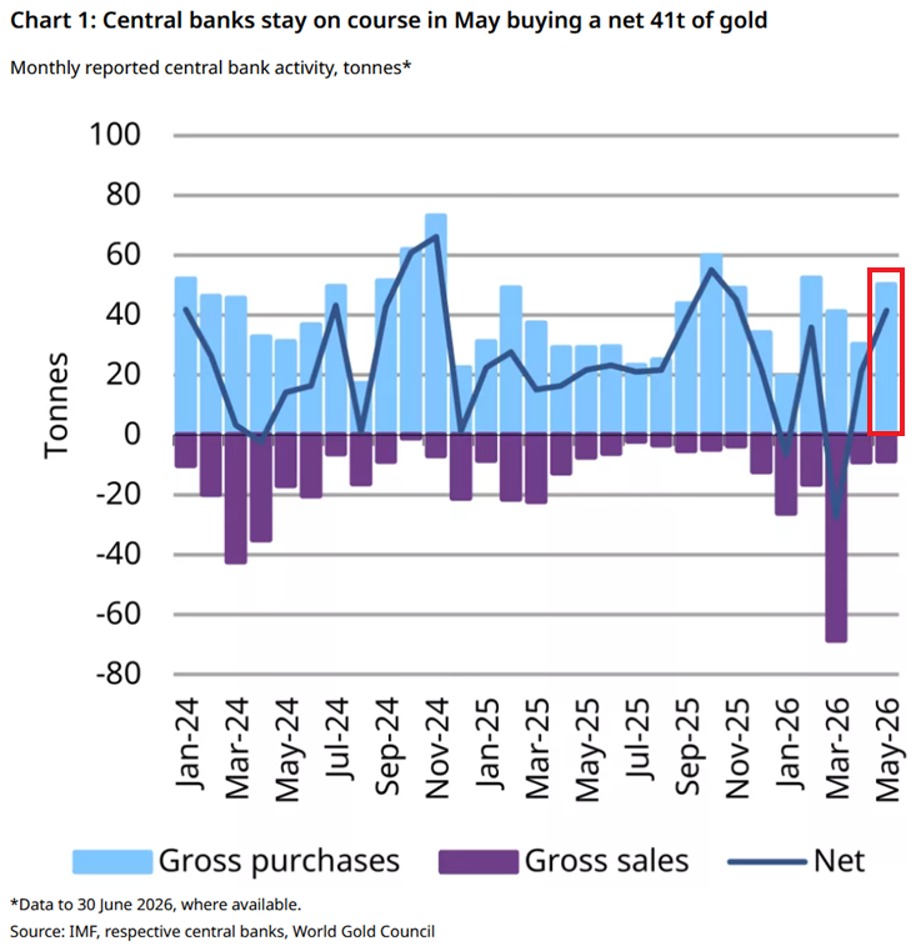
BREAKING: World central banks purchased +41 tonnes of gold in May, the largest monthly addition since November 2025.
This follows +17 tonnes acquired in April, and marks the 3rd monthly purchase this year.
Poland led for the 2nd consecutive month at +18 tonnes, bringing its year-to-date total to +64 tonnes, with gold reserves now at a record 614 tonnes.
China added +10 tonnes, the biggest monthly addition since December 2024, increasing its official gold reserves to a record 2,331 tonnes, also accounting for 9% of total FX reserves, near an all-time high.
This also marks the 20th consecutive monthly purchase by the Chinese central bank.
At the same time, Uzbekistan and Kazakhstan acquired +9 tonnes and +7 tonnes, respectively.
Central bank demand for gold is back.
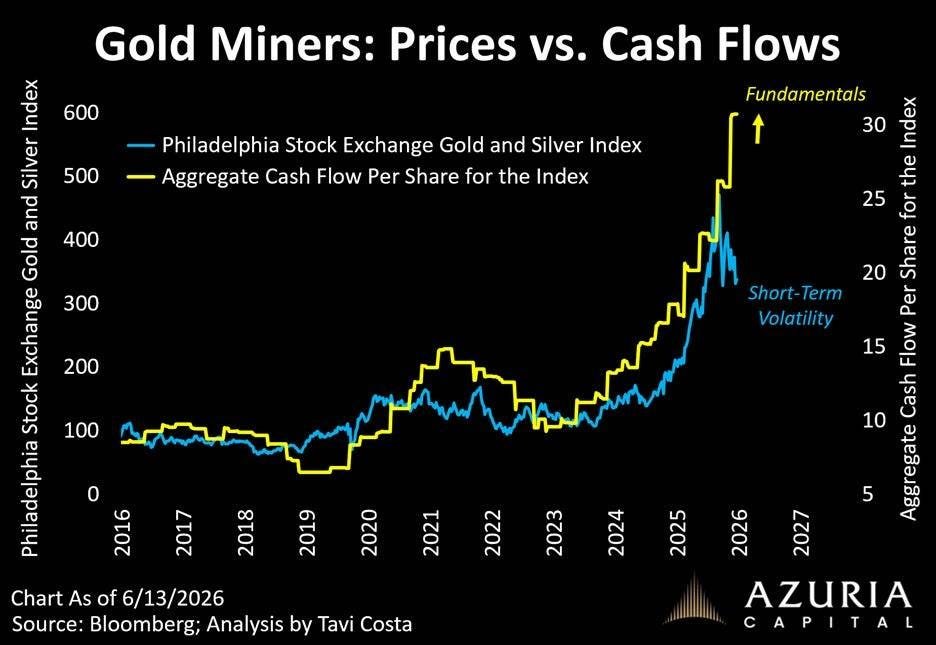
Today was a good reminder that despite the recent pullback in metal prices, miners continue to generate margins that would have seemed extraordinary just a few years ago.
Act accordingly.
https://t.co/LgqMHVxLkh
JUNE JOBS REPORT IN FOCUS
Markets expect the U.S. to have added 114,000 jobs in June, down from 172,000 in May, with unemployment seen at 4.3%.
A resilient labor market could keep the Fed cautious on rate cuts, while a weaker-than-expected report may boost easing hopes. Economists expect limited market reaction unless payrolls or wage growth significantly exceed forecasts.
BREAKING 🔴
Ships are again turning around in the Strait of Hormuz. The IRGC Navy continues to broadcast that the strait is closed, warning that only vessels with Iranian permission may pass and threatening consequences for noncompliance.
@_martinkelly_
China's central bank has now bought gold for 19 months straight, the largest official buyer on earth. And this week, as gold broke 4,000 dollars, China's biggest banks moved to push ordinary Chinese out of leveraged gold trading, with at least one warning it will liquidate any position not closed by month-end. Both are true at once, and together they explain what this crash really is.
Start with what is being banned, because the words matter. ICBC and a string of other banks are shutting down retail trading in what the Chinese themselves call paper gold, the margined, leveraged contracts where you bet on the price without ever owning a bar. Some banks lifted the margin requirement to 140 percent to choke the leverage off before closing the products outright. Physical gold, meanwhile, stays wide open. Coins, bars, savings plans, ETFs, all fine. It is only the paper, the leverage, the casino, that is being shut, the last step in a five-year retreat that the crash just finished.
Officially this is about protecting small investors, and that part is real. The same kind of leverage wiped out a wave of Chinese retail in a 2020 commodity blowup. But set the ban beside what the state is doing and something larger comes into view. While its citizens are pushed out of the paper, the People's Bank of China has spent those same 19 months buying the physical metal, more than two thousand three hundred tonnes of it now, accumulating straight through a 28 percent crash that scared everyone else out. Beijing is not trading gold. It is hoarding it.
That is the strategy in one frame. China looked at the two things both called gold, the paper bet and the physical bar, and made a choice no Western government would make. It is taking the metal for the state and closing the casino for everyone else.
The reason sits in a single date. 2022, when Russia's reserves were frozen with a keystroke. That taught every country outside the Western system one lesson: dollars in an account can be switched off, gold in your own vault cannot. So China is building its monetary independence out of the one asset nobody can freeze, and it does not want that foundation in the hands of leveraged traders who panic-sell in a crash, or priced by a paper market it does not control.
Watch this month and the two worlds split in real time. Western investors were forced out of their gold by margin calls and a rate scare. China's central bank bought that exact dip with both hands. One side treats gold as a trade. The other treats it as the floor under a currency.
The West is selling paper gold and calling it a crash. China is buying physical gold and calling it a foundation. In ten years, only one of them will look like it understood what gold was for. The metal is already moving to that side.
This 1 hour Yale lecture will teach you more about options trading & the exact models Hedge Funds use than most people learn in their entire careers on Wall Street.
Bookmark it and give it 1 hour today, no matter what.
Markets are clinging to a Federal Reserve that no longer exists.
Chair Kevin Warsh’s latest remarks have been parsed with the familiar Powell-era toolkit, every phrase treated as a breadcrumb toward the next rate decision. It is a reflex honed over a decade of hyper communicative central banking. It is also increasingly unfit for purpose.
Warsh is not offering incremental guidance within an inherited framework. He is challenging the framework itself.
The distinction is being missed. Investors appear eager to translate his comments into conventional signals on policy timing and terminal rates. In doing so, they risk overlooking what is more consequential: a chair who is signalling that the Fed’s operating model, its communication strategy, its institutional posture, perhaps even its implicit policy hierarchy, is up for revision.
Under Powell, forward guidance was elevated into a primary policy instrument. Markets learned to trade the Fed’s language as much as its actions. Don’t look at the data objectively just respond to the Fed we were told.
But that equilibrium depended on a central bank committed to transparency as a stabilising tool. A reform-minded Fed, by contrast, will place less weight on short-term signalling and more on reclaiming flexibility, discretion, and institutional credibility.
That shift does not lend itself to clean decoding. Indeed, it actively resists it. A generation of Wall St researchers need to go back to school.
The result is a growing mismatch between what markets think they are hearing and what is actually being said. Remarks that are being mined for near-term policy clues may instead be early markers of a broader institutional reset. The more investors force these signals into the old template, the greater the risk of mispricing the path ahead.
This will not be resolved in a single meeting. It may take several FOMC cycles, and likely a few policy surprises, before the market fully internalises that the reaction function itself is in flux.
Until then, the danger is clear: Wall Street is still trading Powell’s Fed, anchoring off of dot plots, while Warsh is busy building a different one.
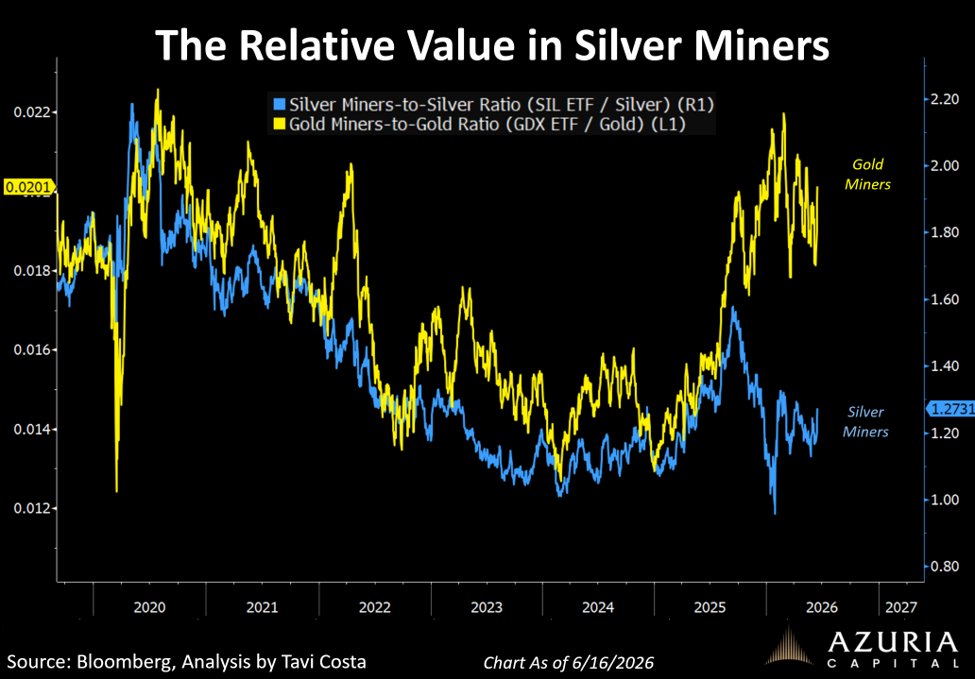
Silver just moved nearly $10 per ounce in four days.
That dramatically changes the economics of a mining business.
Margins expand. Cash flow surges. Yet valuations remain near historically depressed levels.
The market still does not appear to fully appreciate the operating leverage embedded in silver producers relative to the underlying metal price.
That disconnect won’t last forever.
https://t.co/vd0JBGwZHx
The Fed cannot be too hawkish because it would send the bond yields higher, and the federal government can't afford that.
Inflation may not be the problem as economic weakness works its way through the system.