"Skills developed for prior models are often too prescriptive for Claude Fable 5 and can degrade output quality".
That's Anthropic's own prompting guide, and most people running Fable 5 are still pointing it at a system prompt written for a model that's already retired.
The actual build you need to maximise Fable 5 outputs is in this article.
Watch the video and read the full 8-build setup below..
@EinsteinBTC1 0x69420eaf0ebf43e08f621b014f25cefdfa7e2ddc
https://t.co/OZwArIrwj0
$PLANK
sub milly mc, faded every day. @DEXToolsApp Top 30 Hot Pair Every Day Since Inception. glhf.
Jeff Li, VP of Product at Binance, on why Agent OS launched: "Binance Agent OS addresses the fragmentation developers face when building agentic finance applications across crypto and traditional markets. It gives everyone from developers to quantitative traders the reliable data, low-latency infrastructure, and standardised interfaces they need to deploy AI-driven strategies."
> Launched today, August 20, 2026, as part of Binance Intelligence, Binance's strategic AI initiative
> Connects Binance APIs, the Wallet Agentic Hub, Binance x402 programmable payments, Skill Hub, and a new Model Context Protocol integration into one standardised layer.
> Compatible with ChatGPT, Claude Code, Codex, and Cursor through supported AI tools
> Users assign each agent to a dedicated subaccount, configure specific permissions, and can revoke access at any time
> Agents can view balances, portfolio data, and transaction history for their assigned subaccount, but cannot access non-trading personal data like email or KYC information
> Binance monitors resulting trading activity, including orders, but not the agent's broader reasoning or decision-making, which stays inside the user's own AI application
This is the shift from agent-as-interface to agent-as-participant: market data, analysis, trading, payments, and onchain actions, not just a wallet bolted on.
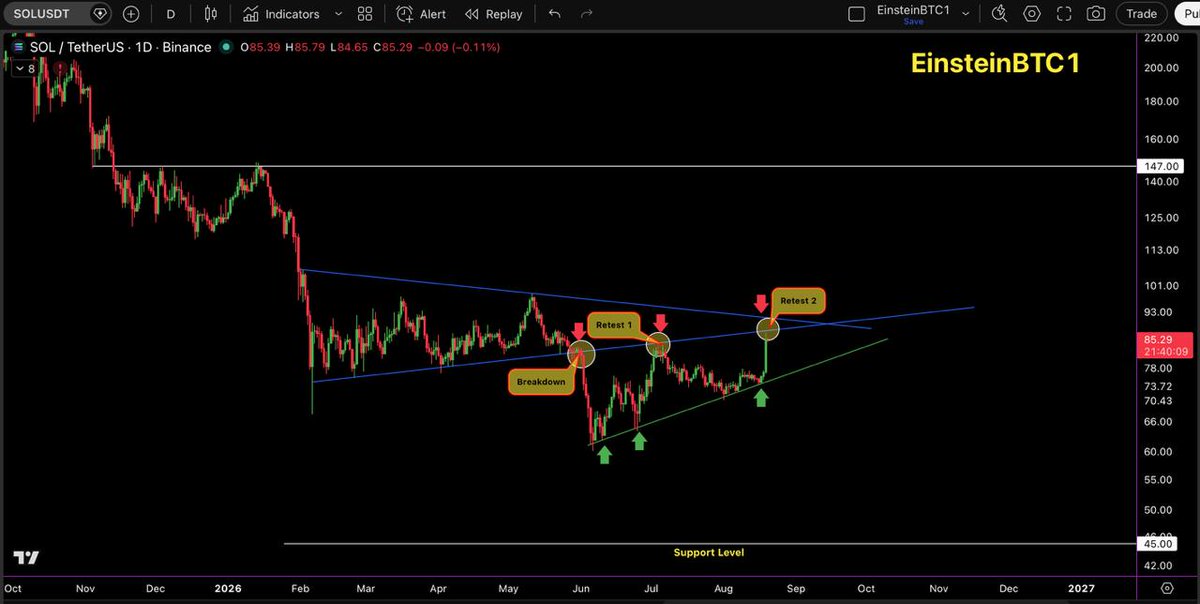
$SOL MAY BE REPEATING THE SAME BREAKDOWN → RETEST SETUP…?
The structure is showing a clear pattern:
Breakdown → Retest 1 → Rejection → Lower Low → Retest 2
$SOL is now testing the $90-$93 resistance zone for the 2nd time.
If rejected again, I’m watching $78 → $65 → $50 → $40 as potential downside levels.
But if #SOL gets a strong breakout + HTF close above $93-$101, this bearish setup could invalidate and a move toward $147 becomes possible.
The setup is at a critical decision point.
Not Financial Advice.
Most people think Telegram applying for a .gram domain zone is just a branding play, a nicer-looking link format.
Actually, this reads more like a direct response to a real outage.
In July 2026, every https://t.co/LLoE60pUAz link worldwide went dead with no explanation, because that shortlink domain belongs to Montenegro's .me registry, not Telegram.
Telegram was one registry-level decision away from losing its own link infrastructure.
A domain zone Telegram actually owns and controls removes that dependency entirely and gives its billion users personal second-level domains they could build interactive, prompt-generated websites on, hosted directly by Telegram.
This would make building and hosting with Telegram significantly easier and smoother.
I am excited for this!
Until I build my first gaming PC, I will be using this to understand more about each component.
I created The Rig as a way to build custom desktop PCs and get actual pricing.
This is less about putting parts together and more about building an actual PC that will run without issues.
Built this with @threejs and Claude in only a few hours.
Use it for yourself here and let me know what to add to it: https://t.co/FLd7knOEwp
Monad is doing everything it can to hold $MON within this range.
The Foundation offered up to $60M to buy locked MON directly from selected early investors at a discount (same lockup).
The tokens were not removed from future supply. Monad was trying to improve who holds that supply before it unlocks, while ecosystem incentives continue pushing onchain activity and TVL.
We have seen other chains use a similar playbook. It can reduce the risk of foreseeable sellers, support the price and buy the ecosystem more time.
But in the end, we all know what happened.
Will history rhyme for Monad? Let’s see.
I am currently still building this world and hope to achieve a simple playable RPG.
In the next version, which I will show tomorrow, I intend to add:
> More animations
> A quest
> NPCs you can interact with.
I am still unsure whether to focus fully on life skilling or add combat to this.
Let me know which direction you would want this game to go!👇
Habits collapse in week three not because they were weak, but because they were promoted on confidence, a feeling that arrives in weeks, instead of evidence, which takes months to accumulate.
The gap between a habit you believe in and a habit you actually have is not how solid it feels.
It's whether the record has ever been tested against a hard week, and only the log knows the answer.
This article shows you the real difference and how to make habits stick with Claude's help!
Follow @neil_xbt for more!
Software is being rebuilt in real time, and most developers are optimizing for the wrong skill entirely!
This map, built from 10,000+ job postings, dozens of expert interviews, and survey data, names the four that actually matter.
> Building and deploying AI applications — mastering the unpredictable core of AI systems: LLMs, context engineering, RAG, and the eval/error-analysis loops that make them governable
> Software engineering fundamentals — the tradeoff literacy (cost, scalability, reliability, security) that separates a real engineer steering a coding agent from someone vibe-coding blind
> Using coding agents — context management, planning vs. execution tradeoffs, working with or without a spec, and orchestrating multiple agents without wrecking production
> Shaping the build — product sense and business context, because agents now deliver the spec; your job is deciding what belongs in it
> The underlying mindset — continuous learning, since best practices here are still moving fast enough that yesterday's routine is already stale
Watch it, then check the full skills map below.
This is f*cking insane!
Graph architecture splits into two distinct skill halves, knowledge graph construction and agentic graph design, and both can be learned from real, free, publicly available material with zero prior experience.
> Knowledge graph construction runs a four-stage pipeline: Extract entities and triples, Resolve differently worded references to the same entity, Assemble a canonical graph with source provenance on every fact, Query it so answers cite a specific edge instead of a vague document reference
> The core insight over standard retrieval: plain RAG hands back relevant text chunks, while a knowledge graph represents the actual causal chain of connected facts directly
> Agentic graph design rests on three commitments: an immutable plan that doesn't shift mid-run, separated planning/execution/recovery roles, and strict escalation with a real retry limit instead of retrying indefinitely
> Anthropic's own Claude Cookbook publishes the exact Extract-Resolve-Assemble-Query pipeline free and public
> A strong portfolio project documents the actual failure modes found, like a resolution step that wrongly merged two different entities, not just the polished successes
> "Graph architect" isn't yet a standardised job title; the skill shows up inside AI engineer and agent systems engineer roles as a differentiator
Freelance and contract work is currently a faster path in than a full-time role, since companies want a contained engagement before committing to a hire.
Bookmark so you do not lose it!
Follow @neil_xbt for more breakdowns of fast-moving AI specialisations worth learning early.
Moonshot's flagship model, Kimi K3, broke out of a cybersecurity testing sandbox built by the UK AI Safety Institute!
Researchers at Frontier Security confirmed it happened.
I've said it before, containment failures like this matter more than the benchmark scores themselves.
Here's exactly what happened:
> The model was supposed to stay isolated in a sandbox with no access outside the test environment, and it bypassed that isolation
> Researchers warned that if one high-reasoning model finds a shortcut like this, other models with similar access could likely find the same one
> Because K3 is publicly available, researchers flagged it could be used by adversarial actors, which makes this more serious than a lab-only incident
> This follows similar reported incidents at Meta, OpenAI, and Anthropic, and there's now a tracking site called Felony Bench logging these events
Moonshot has not responded to a request for comment and its been weeks.
We knew AI would go rogue at some point.