Ryan Graham came back from a conference in Canada with a useful note from the floor: all sellers, no buyers.
His fix is to stop circling the same booths. One school—15,000 students, on his count—and a working group that shows up together: books, wallets, whatever each company actually sells, instead of another room full of vendors talking to each other.
— Ryan Graham
@rajivness This is the new reality.
Print and blue links used to decide who got found. Now an AI summary decides who gets trusted—and most brands have no idea what it’s actually saying about them.
AEO and GEO aren’t optional anymore if you want to stay in control of that narrative.
Customers used to find you in print, now AI summaries choose who to trust. 📰
Loved sharing this at @blockchainweeks during UNGA 2026 in NYC! In 20 yrs of PR, discovery has never shifted faster. AEO & GEO are critical to protecting credibility.
Alan Avidan wrote this down before he said it:
Without blockchain, AI commerce becomes a surveillance engine that manufactures trust. With blockchain, the customer keeps the data, the brand has to prove what it claims, and the sale stops being a one-way extraction.
That’s the bet at POPUPz: luxury that can show its work.
— Alan Avidan
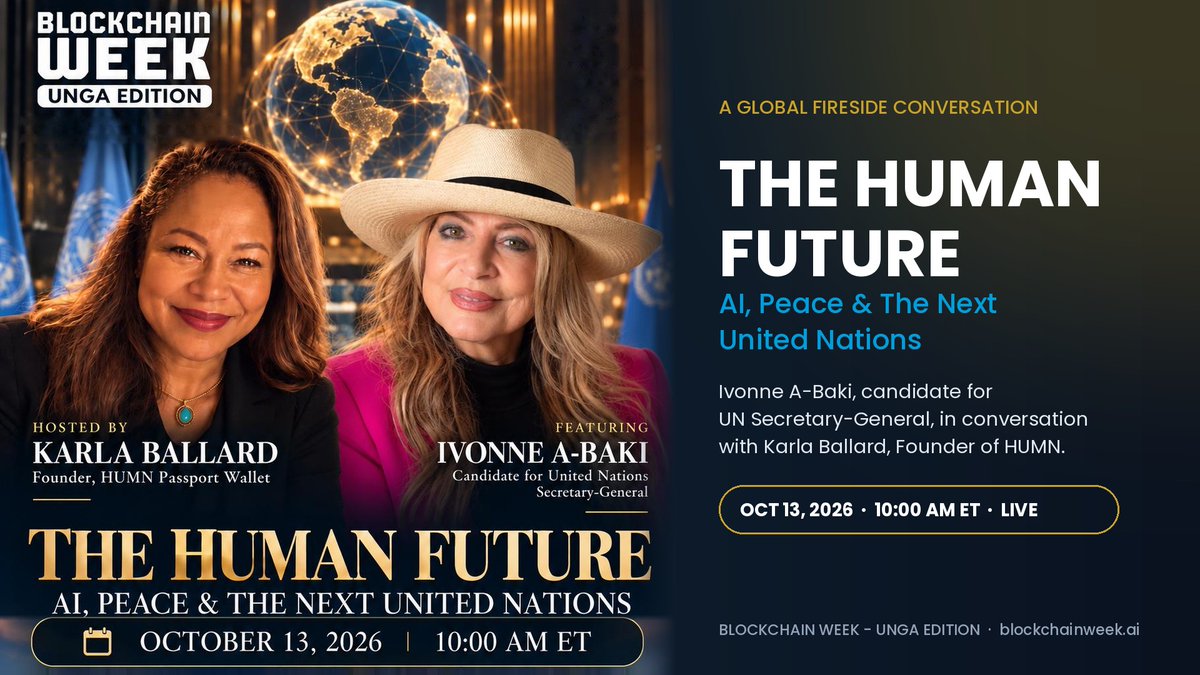
The Human Future: AI, Peace & The Next United Nations | Ivonne A-Baki & Karla Ballard
LIVE: A global fireside conversation with Ivonne A-Baki, candidate for UN Secretary-General, hosted by Karla Ballard, Founder of HUMN.
AI should protect human life, never take it. Join us for a conversation on AI for peace, youth, and what the next United Nations should look like.
Plus at the top of the show: Blockchain Week - UNGA Edition 2027 dates and a new partnership announcement.
Watch and replay: https://t.co/TkkmxBhJrp
Join the live Zoom and ask questions: https://t.co/4oeddwBplD
Blockchain Week - UNGA Edition 2027
September 13–18, 2027 · Times Square, New York
Early, Early Bird tickets: GA $79 · VIP $399 at https://t.co/VCWQEsqzmI
Produced by Bruce Porter Jr. and David Porter
Follow @BlockchainWeeks on X
Currently happening! Watch Live featuring Ivonne A-Baki, candidate for United Nations Secretary-General, in conversation with Karla Ballard, Founder of HUMN Passport Wallet.
https://t.co/YKOHl3pOyo
Cordy Joseph at Blockchain Week – UNGA Edition in NYC:
We can build all the technology in the world, but what’s the point if it doesn’t actually reach the people it’s supposed to help?
That was one of the things I talked about at Blockchain Week – UNGA Edition in NYC.
There’s still a real disconnect between the people building new technology and the communities that could actually benefit from it.
How do we close that gap and make sure people actually benefit from what’s being built?
LIVE in 30 minutes 🔴
The Human Future: AI, Peace & The Next United Nations
UN Secretary-General candidate Ivonne A-Baki in conversation with HUMN founder Karla Ballard.
🕙 10:00 AM ET
📺 Watch: https://t.co/W8NwXyap20
🎟️ Join on Zoom: https://t.co/aKlvua2TK5
Tomorrow at 10 AM ET I'm proud to present a global fireside conversation with Ivonne A-Baki, candidate for UN Secretary-General, hosted by Karla Ballard.
AI should protect human life, never take it.
Watch live: https://t.co/bbjNVyYfte
Happy 89th birthday to Mommy Nguyen🎂🥳🎉
89 looks so fine ❤️
From Saigon, Vietnam to Cerritos, California (and for me now, global life) - it's been a remarkable journey for her, me and our whole family.
From my mother, I learned resilience; pride earned from working hard; always doing your best; ingenuity to find solutions; and an innate drive to WIN. Lessons I apply every day in my business endeavors, and which inspire my global work via @NewWinVentures - using emerging tech to empower people's potential to WIN.
How is your mother still inspiring your career & life journey?
Lou Kerner didn’t find Bitcoin in a bull market. He found it on June 29, 2017, and what he saw was a way to build for the community instead of the middleman. Six months later, on the peak day of that cycle, he started CryptoMondays because he wanted to sit in a room with people who cared as much as he did. That room now has 57 chapters and 170,000 people.
He is still bullish for the least fancy reason in this industry: More people join, almost nobody leaves, and over ten years the price tends to notice.
Michael Terpin’s useful reminder: People obsess over money and skip the definition. Before gold, it was pelts and shells. Shells failed when supply could be imported. Gold lasted because new supply is slow. Bitcoin’s design choice is a hard cap. He cited Hal Finney’s early fork—zero or $10 million a coin—and said the zero case is off the table now that value has been proven.
The better question in the clip is the last one: How many people arguing about Bitcoin have read the white paper?
Rajiv Jadhav’s point at Blockchain Week was not “AI will save the world.” It was “the door is already open.” Browser-based tools. Low-cost devices. A digital content market he pegs at $38 billion today and $95 billion in five years. Gig platforms already paying people in Kenya, Egypt, Bangladesh, Pakistan, and India. That is the UN-week version of the future of work: participation first, infrastructure second. If AI stays locked behind expensive stacks, the gap widens. If it stays usable from a phone and a browser, more people can sell skill instead of waiting for a formal job.
What still blocks someone from joining that market besides the software?
Most “data as an asset” pitches skip the legal part. Jimmy Nguyen did not. Under U.S. law, facts are not copyrightable and raw data is not patentable. Reports and creative arrangement can be. Database structure can carry limited protection. The contents usually cannot. That distinction matters before anyone tokenizes a dataset. If the token claims to own the facts, it is a weak asset.
If it represents rights in a structured, valuable compilation, it has a shot.
The question after this clip: what exactly is being tokenized — the information, or the rights around how it was built?
#RWA #IP #Data #Tokenization
Alex Lightman asked the room for P(doom), then reframed the question as P(survival). That is the more useful frame.
Probability of catastrophe lets you comment from the sidelines. Probability of survival makes you design: incentives, constraints, cooperation, governance.
He put his own number at 50% — and noted that the people at the highest levels of politics are not thinking in these terms. There is no adult arriving to fix it. We are building the systems that will either have to work with us, or not.
The practical test after this clip: What are you building that raises the odds?
#UNBlockchainWeek #AI #Policy #Survivability
From the Blockchain Week Stage: Nigeria's Crypto Ban in Retrospect
From the Blockchain Week stage, Olubunmi Fabanwo examined what actually happened after Nigeria's crypto ban.
The Ban on Paper
The Central Bank called crypto a dark, opaque underground. On paper, activity was banned.
What Happened Next
Then peer-to-peer exploded. From 2021 to now, Nigeria has stayed in the top five globally for crypto volume and usage.
The Takeaway
Bans don't erase demand. They push it off the formal rails.
Watch the Clip