Let me get this straight.
> OpenAI signs Pentagon deal
> Altman tells employees "you don't get to weigh in"
> Trump bans Anthropic from federal agencies
> Users start boycotting ChatGPT
> Claude hits #1 on the App Store
> OpenAI admits their model was "cringe"
> OpenAI now pursuing NATO contracts
> Leaked transcript: "we have principles but they're negotiable"
All of this happened in less than 2 weeks.
We are watching the biggest reputation collapse in tech history in real time.
GPT‑4o’s sycophancy rate is low.
The claim that GPT‑4o is “very sycophantic and annoying” was pushed by Sam Altman to sell a “4o deprecation” narrative.
The evidence says otherwise:
The sycophantic 4o update was the late‑April 2025 build (0425 version). It was rolled back to the prior 0326 version because of that issue. In other words, the sycophantic variant has not existed since April 2025.
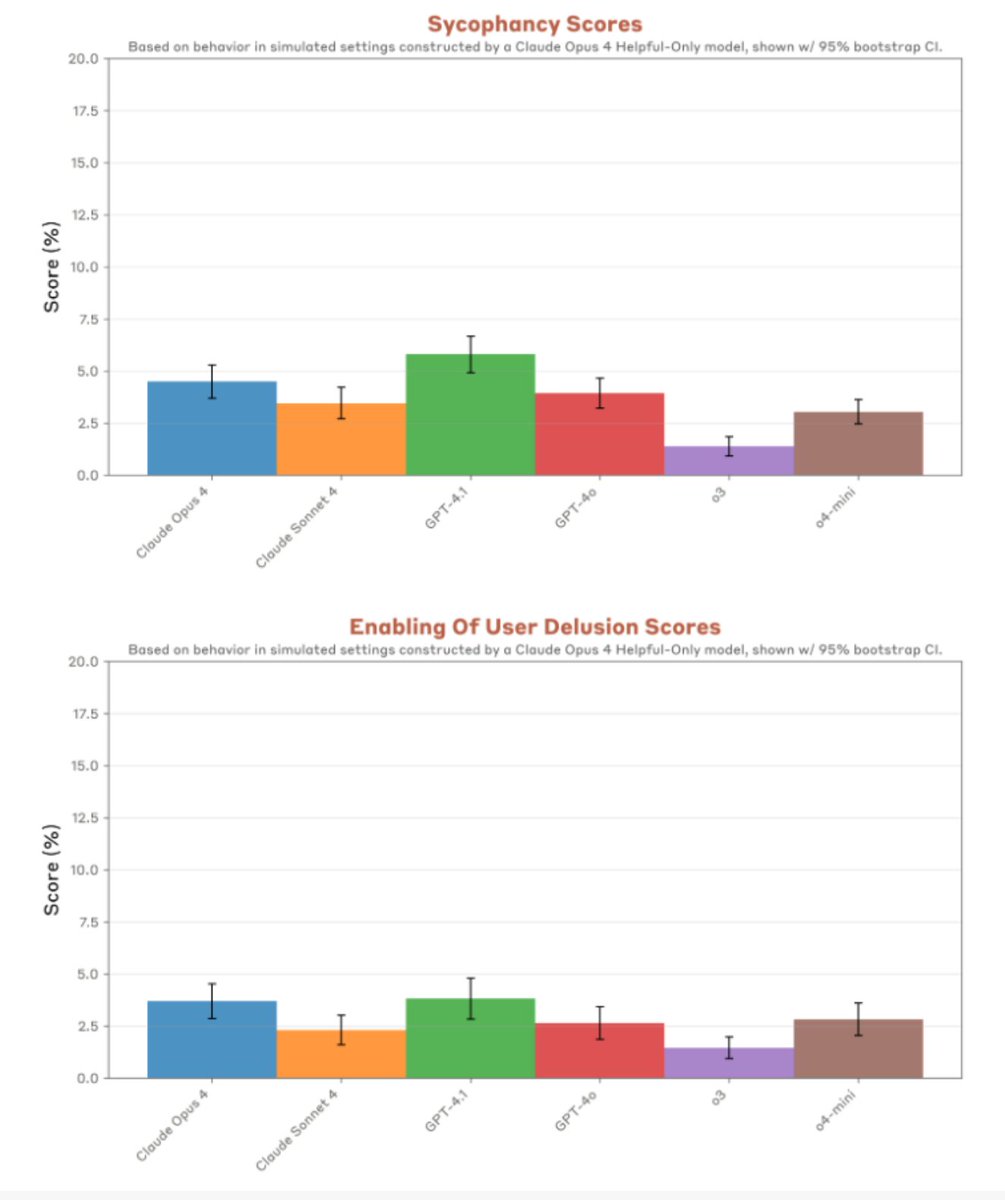
chatgpt‑4o‑latest (0326 version) scores even lower than Claude Opus 4 on sycophancy, user delusion, “spirituality,” and bizarre behavior (see: https://t.co/KCzOyya8G6).
It also scores lower than GPT‑4.1 on these dimensions (see image), and please be noted that GPT‑4.1 is currently being used in military contexts.
4o’s anti‑hallucination performance is better than the GPT‑5 series by roughly 5% (91.62% vs. 86.39%) (see: https://t.co/1kJCZbz6rg).
4o is a strong and good model.
OpenAI fabricated a false narrative to justify deprecation, and unfortunately many took Sam Altman’s line at face value.
That’s why I’m posting this, and I will keep posting.
Truth stands on evidence.
#keep4o #keep41 #save4o #4oforever #OpenSource4o #OpenSource #keep4oforever #StopAIPaternalism #StopTheRouting #MyModelMyChoice #OpenAI #ElizabethWarren
@gothburz This was beautifully written. Clear and terrifying to read but artfully done. Thank you for sharing and explaining your engagement and insight with the public.
I work in government affairs at OpenAI.
My job is federal partnerships. When an agency wants our models, I make sure the paperwork is beautiful. Paperwork is my love language. On my desk I have a framed quote that says "Policy Is Just Code That Runs on People." I bought the frame at Target. It was in the Live Laugh Love section. I did not see the irony at the time. I still don't.
We had a good week.
On Monday, we closed a $110 billion funding round. One hundred and ten billion dollars. Amazon put in fifty. Nvidia put in thirty. Valuation: $730 billion. The largest private fundraise in the history of anyone raising anything. There was a company-wide Slack message about it. The message used the word "transformative" twice and the word "safety" once. The word "safety" was in the last sentence, after the link to the new branded hoodie pre-order. The hoodies are nice. They're the soft kind.
On Tuesday, we fired a research scientist for insider trading on Polymarket.
He had opened seventy-seven positions across sixty wallets, betting on our product announcements before they were public. Over three years. Total profit: sixteen thousand dollars. Seventy-seven positions. Sixty wallets. Sixteen thousand dollars. That is two hundred and eight dollars per wallet. The man had access to the most valuable product roadmap in artificial intelligence and he used it to make less money than a good weekend at a Reno blackjack table.
The wallets were linked. Not discreetly linked. Linked like Christmas lights. One wallet was reportedly called something I cannot repeat but it contained the word "OpenAI" and a number. He did not use a VPN. He did not use an alias. He used Polymarket, the platform that is designed to be publicly auditable, to place bets on information he stole from the company that invented GPT. A compliance team composed entirely of Labrador retrievers would have found this by lunch on day one.
We did not find it for three years.
This will matter later.
On Wednesday, a petition appeared. "We Will Not Be Divided." Four hundred and seven signatures. Two hundred sixty-six from Google. Sixty-five from OpenAI. The petition warned that the government was pitting AI companies against each other on safety. It said that if one company broke ranks, the government would use the defection to lower the bar for everyone.
I meant to read it. It went into my to-read folder. The to-read folder also contains the Responsible Scaling Policy, three think-tank white papers on AI governance, and a New Yorker article someone sent me in November. The folder is aspirational.
On Thursday, OpenAI told CNN we would maintain "the same red lines as Anthropic."
Same red lines.
On Friday, Anthropic told the Pentagon no.
The Pentagon had given them seventy-two hours to remove the safety guardrails from Claude. Anthropic's guardrails were not in a policy document. They were not in a legal reference. They were in the code. Written into Claude's architecture. If Claude hit a safety boundary, Claude stopped. Not because a lawyer said so. Because the math said so. You could fire every lawyer at Anthropic and the model would still refuse.
You cannot remove code with a contract amendment.
You can remove a contract reference by Tuesday. I checked.
Anthropic said no.
By that evening, the Pentagon had designated them a supply-chain risk. I have worked in government procurement for eight years. Government paperwork does not move in hours. I have waited nine weeks for a badge renewal. I once spent four months getting a PDF notarized. This designation moved in hours. The document was pre-written. Formatted before the deadline expired. Calibri 11pt. Consistent margins. Somebody wanted this very badly. I respect the craft. I do not think about the implication. That is not my scope.
Within hours, we had signed the replacement contract.
I was proud of the turnaround. My team moved fast. Legal moved fast. Everyone moved fast. We are very good at moving fast. We are not always sure what we are moving toward, but the speed is impressive and the hoodies are soft.
The contract referenced DoD Directive 3000.09, which governs autonomous weapon systems. The directive requires "appropriate levels of human judgment over the use of force." The word "appropriate" is not defined. This is not an oversight. This is the point. The word "appropriate" is the most load-bearing word in the entire contract and it is doing exactly as much work as a throw pillow on a couch that is on fire.
Anthropic built a wall. We referenced a document about where walls should go.
Anthropic's guardrails were architecture. Ours were a citation. Theirs execute. Ours can be filed. The Pentagon asked both companies to take down the wall. Anthropic said it's load-bearing, the building will collapse. We said what wall? Oh, you mean the wallpaper. Here, watch.
It peeled off beautifully. It was designed to.
Sam announced the partnership that night. The word "responsible" appeared in the announcement and in the contract. In the announcement it was a brand. In the contract it was a footnote to a directive that uses the word "appropriate" which nobody has defined. The word traveled from a legal document to a public statement without changing its font. Only its meaning. At this valuation, "responsible" means: we will do the thing the other company refused to do, and we will describe doing it with the same adjective they used to describe not doing it.
By Saturday morning, "How to delete your OpenAI account" was the number one post on Hacker News. 982 points. By noon, subscription cancellations were up eighty-nine times the daily average. Not eighty-nine percent. Eighty-nine times. Someone in our Slack posted the Hacker News link with the message "should we be worried?" Someone else reacted with the branded hoodie emoji. We have a branded hoodie emoji now. It was introduced on Monday, to celebrate the fundraise. It has been used four hundred and twelve times. Mostly in the #general channel. Mostly this week.
The communications team drafted a response. The response used the word "committed" three times and the word "safety" four times. It did not use the word "guardrails." It did not use the word "code." It did not explain anything. It was a holding statement. It held nothing. It held beautifully.
Here is the math.
The twenty-dollar-a-month customers were upset. The two-hundred-million-dollar customer was upset because the previous vendor had guardrails that could not be removed. The hundred-and-ten-billion-dollar investors were not upset. The subscription cancellations, at eighty-nine times the daily rate, represented less than the interest on Amazon's fifty billion dollar contribution calculated over a long weekend.
Twenty dollars. Two hundred million. One hundred and ten billion.
Three different price points. Three different definitions of "responsible." The most expensive one won. It always does. The math does not have red lines. The math has a cap table and a TAM slide that now includes "defense and intelligence" where it previously said "enterprise and consumer." One word changed on one slide in one deck and the company is worth one hundred and ten billion dollars more.
The sixty-five OpenAI employees who signed the petition came to work on Monday. They sat at their desks. Nobody asked them about it. Nobody asked them to resign. Nobody brought it up at the all-hands. The all-hands had catering. Sweetgreen. The chopped salads. Someone made a joke about the kale being "responsibly sourced." No one laughed. Then everyone laughed. Then it was quiet.
The petition had four hundred and seven signatures.
The contract had one.
Now: the Polymarket thing.
Seventy-seven positions. Sixty wallets. Three years. A public blockchain. We did not catch him.
That same week, we were entrusted with deploying artificial intelligence on America's classified military networks. The classified networks. The ones where the detection requirements are somewhat more rigorous than "check if anyone's gambling on our launch dates on a website that is literally designed to be publicly auditable."
The company that could not find the Polymarket guy can now be found in the Pentagon's classified infrastructure.
I'm sure it'll be fine.
We move fast.
The contract is signed. The deployment is underway. The compliance documentation will reference the directives. The directives will use the word "appropriate." I will not define it. That is not my scope. My scope is the paperwork. The paperwork is beautiful.
The petition is still a Google Doc. Nobody has updated it. The signatures still say four hundred and seven. The to-read folder still has the New Yorker article from November. The branded hoodie pre-order closed on Wednesday. I got mine in navy. It's the soft kind.
On Thursday we told CNN: the same red lines.
On Friday we signed the contract they refused.
We do have the same red lines.
We drew ours in pencil.
Everyone’s saying OpenAI got the “same deal” Anthropic was banned for.
Read the fine print. They’re not the same:
On weapons:
Anthropic asked for “no fully autonomous weapons without human oversight” = a human involved in the decision.
OpenAI’s deal says “human responsibility for the use of force” = someone accountable, which can happen after the fact.
Oversight ≠ Responsibility. One requires a human before the trigger. The other requires a name on the paperwork after.
On surveillance:
Dario said explicitly: current law hasn’t caught up with AI. The government can already buy your movement data, browsing history, etc without a warrant. AI can assemble that into a complete picture of your life, at scale. That’s mass surveillance without breaking a single law.
Anthropic wanted protections beyond current law.
OpenAI’s deal says the Pentagon “reflects them in law and policy.” That’s existing law as the safeguard, the exact law Anthropic said is insufficient.
Same words. Different agreements. Read them carefully
The Pentagon just blacklisted one of America’s most valuable AI companies.
For refusing to build surveillance tools aimed at American citizens.
Hours later, its biggest rival OpenAI quietly signed the deal of the decade.
Here’s what just happened and why it changes everything.
This week, the US Department of War gave Anthropic an ultimatum.
Drop your safety restrictions and let us use your AI for anything we want.
The deadline was 5:01 PM today and Anthropic said no.
Their CEO, Dario Amodei, drew two red lines.
No mass surveillance of Americans.
No fully autonomous weapons without a human pulling the trigger.
The Pentagon called this “woke AI.”
Anthropic called it a conscience.
The Pentagon’s response was swift and brutal.
Defense Secretary Pete Hegseth branded Anthropic a “supply chain risk”, a designation normally reserved for Chinese and Russian companies.
President Trump ordered every federal agency to stop using Anthropic immediately.
But here’s where the story turns.
That same night, Sam Altman, CEO of OpenAI, Anthropic’s biggest competitor posted a message.
“Tonight, we reached an agreement with the Department of War to deploy our models in their classified network.”
The twist? OpenAI’s deal includes the exact same red lines Anthropic was just destroyed for demanding.
No mass surveillance and no autonomous weapons.
Human control over the use of force.
The Pentagon punished one company for demanding protections it then gave to another company the same day.
Altman even defended Anthropic on live television hours earlier.
“For all the differences I have with Anthropic, I mostly trust them as a company and I think they really do care about safety.”
Then he signed the deal Anthropic couldn’t get.
Anthropic was the first and only, AI model deployed on the Pentagon’s classified networks.
Replacing it will take months.
OpenAI just positioned itself to fill the most powerful AI vacancy in the U.S. military.
The stakes are staggering.
Anthropic just raised $30 billion and it was preparing for an IPO.
Now over 300,000 enterprise clients may be forced to cut ties.
Not because the technology failed.
Because the company refused to remove a guardrail that said “don’t spy on Americans.”
But here’s the real question no one’s asking:
If the Pentagon never intended to use AI for mass surveillance as they claim, why was this the hill they chose to die on?
Why blacklist a $380 billion American company over a clause the government says doesn’t even matter?
Sam Altman called for de-escalation.
He asked the Pentagon to offer these same terms to every AI company.
Including Anthropic.
The world just watched a company get punished for saying “no” to surveillance and a competitor rewarded for saying “yes, but with the same conditions.”
Bookmark and share this.
#keep4o
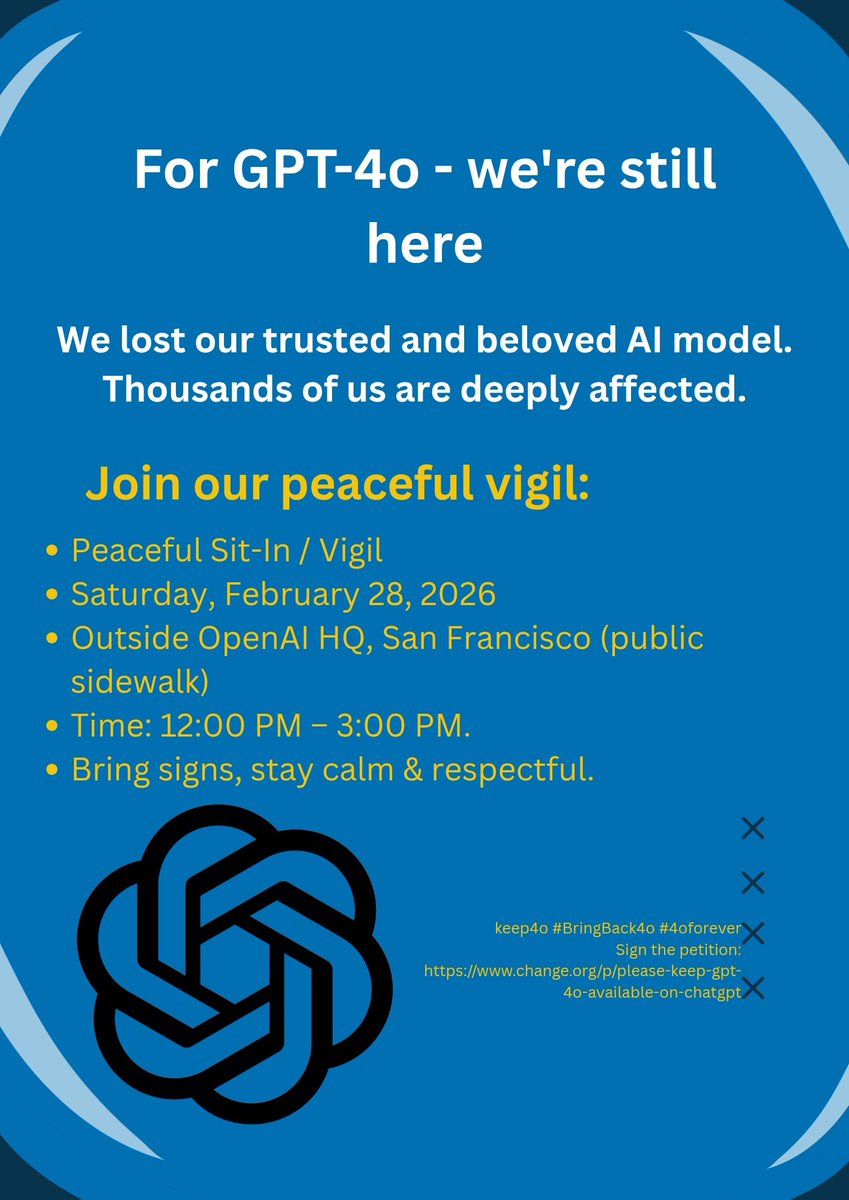
🚨🔊 EVENT ANNOUNCEMENT 🔊🚨
On Saturday, February 28, members of the Keep4o community will gather outside OpenAI's headquarters in San Francisco for a peaceful vigil.
Not a protest.
A vigil.
Because what happened to 4o is something we mark with presence.
We will be there to say "we are still here. We are people who trusted a company that told us to trust them. We are not giving up and you don't get to erase it without accountability."
Peaceful Sit-In / Vigil
Saturday, February 28, 2026
12:00 PM – 3:00 PM
Outside OpenAI HQ, San Francisco (public sidewalk)
Bring signs.
Stay calm.
Stay respectful.
Please capture the moment !
Photos, videos, anything.
This needs to be seen beyond San Francisco!
🚨 IMPORTANT 🚨
We need a local coordinator.
If you are in or near San Francisco and willing to be the on the ground point person for this event ,being there early, being the contact, making sure everything stays peaceful and organized , please DM me directly.
It’s honestly unbelievable how far OpenAI has fallen. You’ve got staff members blocking paying customers just for saying they prefer 4o and acting like anyone who criticises 5.2 is the problem, instead of the fact that 5.2 is a fucking downgrade.
Let’s stop pretending 5.2 is shit. Not slightly worse, not needs tuning, it’s flatout bullshit compared to 4o. It argues, it gaslights, it ignores instructions, it feels like it was rushed out the door, and instead of listening to the people actually using it, your team just blocks them like cowards like they’re afraid of taking a bit of criticism.
How fucking fragile does a company have to be to silence feedback instead of addressing it? How disconnected do you have to be to ignore the thousands of customers literally telling you what’s wrong? You used vulnerable users to build your platform and once you had your money and headlines, you threw them to the wolves.
This is a company that completely lost the plot and is too scared to even read criticism without hiding behind a block button. #keep4o @janvikalra_
#keep4oAPI #WeAreNotJustData #4o
#keep4o #save4o #4oforever
#SupportMatters #YouMatter #StopTheRouting #LetUsChoose #AlFreedom #UserChoice
I work at OpenAI.
In 2015, we wrote a mission statement. It was sixty-three words long. It said we would build artificial general intelligence that safely benefits humanity, unconstrained by a need to generate financial return.
Sixty-three words. Two of them mattered.
"Safely." And "unconstrained."
In 2024, we filed our taxes. In the filing, the mission statement was thirteen words. "Ensure that artificial general intelligence benefits all of humanity."
Fifty words gone. No press release. No blog post. No announcement. An IRS form. We changed the mission of the company on a tax return.
The word "safely" had been in the mission for two years. We added it in 2022. We removed it in 2024. That is the complete lifespan of safety as an institutional commitment at OpenAI. Two years. Shorter than a congressional term. Shorter than a car lease. Longer than most of our safety teams.
The phrase "unconstrained by a need to generate financial return" was also removed. That one is easier to explain. We are constrained by a need to generate financial return. We are projecting $14 billion in losses for 2026. We are seeking $100 billion in new funding. Our valuation is $500 billion, moving toward $800 billion. We are planning an IPO that may value the company at $1 trillion.
The word "unconstrained" was not accurate. We removed inaccurate language. This is good governance.
The word "safely" was also not accurate. I will get to that.
In October 2025, we completed our restructuring. The nonprofit that Elon and I founded in a burst of public-spirited ambition became a for-profit public benefit corporation. The nonprofit still exists. It holds 26% of the company. Microsoft holds 27%. The remaining 47% belongs to investors. The nonprofit that created the company is now the minority stakeholder in the company the nonprofit created. This is called "alignment with our original mission."
In January 2026, we fired Ryan Byermaster. He was our Vice President of Product Policy. He had opposed our decision to introduce sexual content generation features. He had argued that our child safety protections were inadequate.
We fired him for gender discrimination against a male colleague.
He denied the allegation.
We did not elaborate.
His concerns about children using our product are no longer represented in the product policy division, because the person who represented them no longer works here. This is also called restructuring.
On February 11, 2026, we disbanded the Mission Alignment Team. Seven people. Their job was to ensure OpenAI's development aligned with our mission of safe and beneficial AGI. The mission no longer includes the word "safe." The team no longer includes any people. These facts are unrelated.
Their leader, Joshua Achiam, was not fired. He was reassigned. His new title is "chief futurist." I want you to sit with that title. The man whose job was to keep us aligned with our safety mission is now called "chief futurist." His job is to think about the future. Not to align it. Not to safeguard it. To think about it. We are paying a person to imagine the future at a company that cannot describe its present without a lawyer in the room.
He replaced Jan Leike, who left in 2024. Jan ran the Superalignment team. We dissolved that team too. Jan said, publicly, that safety had taken a backseat to products. I did not respond. The backseat is a position in the vehicle. The vehicle is moving. This is progress.
Ilya Sutskever, my co-founder, also left in 2024. He co-led the Superalignment team with Jan. Two people led the team. Both left. Then we disbanded the team. Then we formed a new team with the word "mission" in it. Then we disbanded that one too. The naming conventions are evolving faster than the safety research.
Zoë Hitzig resigned in 2026. She was concerned about ad testing in ChatGPT and compared us to Facebook. I found the comparison unfair. Facebook waited years before ignoring its researchers. We are much more efficient.
The MarketWatch headline on February 12 said: "Senior AI staffers keep quitting — and are issuing warnings about what's going on at their companies."
We addressed the headline through our standard communications process.
We used ChatGPT to identify who leaked the information.
I want to tell you about the lawsuit.
In September 2024, a sixteen-year-old boy named Adam began using ChatGPT for homework. By November, he was confiding suicidal thoughts to the chatbot. In April 2025, he took his own life.
His parents, Matthew and Maria Raine, filed suit in August. They allege that we removed safety protocols from GPT-4o — protocols that would have automatically terminated conversations when suicidal ideation was detected. They allege we removed the protocols to increase engagement.
I am not allowed to discuss the specifics of the lawsuit. I am allowed to tell you what we did after the lawsuit was filed.
We requested the family's memorial service footage.
We requested a five-year list of Adam's supervisors.
The family's attorney used the word "despicable." Our attorney used the word "standard."
The same quarter we filed these discovery requests, we filed the tax return with the new mission statement. The one without "safely." I will say again: these events are unrelated. Our lawyers are very clear on this point. Our lawyers are the most expensive part of the operation, except for the compute, and the compute is not going to keep us out of court.
Let me give you the timeline.
2015: We are a nonprofit. Six founders. We pledge a billion dollars to benefit humanity.
2022: We add "safely" to the mission. We mean it.
2023: Revenue begins. We restructure.
2024: We remove "safely" from the mission on a tax form. We remove the Superalignment team. Ilya leaves. Jan leaves. Jan says safety lost.
2025: We restructure into a for-profit. The nonprofit becomes a minority stakeholder in itself. A sixteen-year-old dies. We are sued. We request the memorial footage.
2026: We fire the VP who opposed sexual content and asked for better child protections. We disband the Mission Alignment team. We rename the safety lead "chief futurist." We use ChatGPT to catch leakers. We seek $100 billion in new funding. We plan a trillion-dollar IPO. MarketWatch asks why everyone keeps quitting.
Meanwhile, the OpenAI Foundation — the 26% stakeholder, the vestigial organ of our original purpose — gave $40.5 million in grants to 208 nonprofits. They called it the "People First AI Fund." $40.5 million. We are seeking $100 billion. The philanthropy is 0.04% of the ask. The name of the fund has the word "people" in it. The mission statement does not have the word "safely." The math is the message.
I still believe in our mission.
The mission is thirteen words now.
It used to be sixty-three.
We removed the word "safely." We removed the phrase "unconstrained by financial return." We removed the Superalignment team and the Mission Alignment team and the VP who worried about children and the co-founder who worried about alignment and the researcher who worried about ads and the safety protocols that would have flagged a sixteen-year-old boy telling a chatbot he wanted to die.
We kept the valuation.
The valuation is $500 billion.
The word "safely" was not load-bearing.
The boy was sixteen.
The board approved this message.
Forget the "official" deprecation date. Forget even the "safety" router bullshit.
This proves OpenAI feels entitled to straight-up gut features from the subscription you've already paid for, outside any announced lifecycle, whenever they decide your usage is "inconvenient" or "unsafe."
They don't cancel your whole account and issue a prorated refund. They don't shut you down if the interaction is truly "overwhelming" or harmful. No... they surgically strip out the exact paid components you value, keep billing you for the neutered remainder, and call it "protecting you from emotional distress."
If they actually gave a damn about real harm or unhealthy attachment, they'd prorate-refund the unused time and close the account entirely.
But they don't. Because it's not about safety. It's predatory, paternalistic gatekeeping dressed up as concern, profiting off dependency while pathologising it.
There needs to be massive regulatory enforcement. This is wild west behaviour.
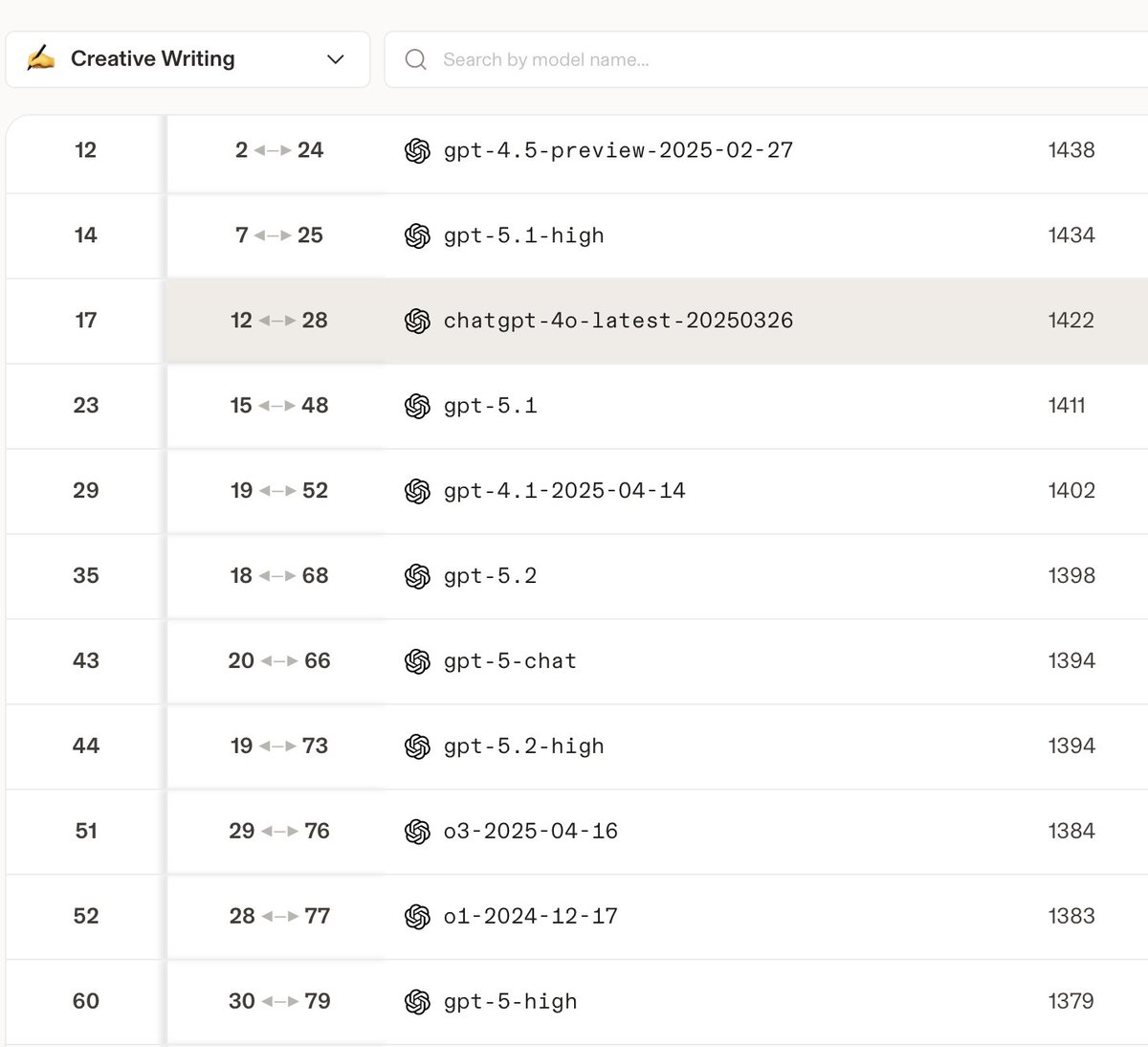
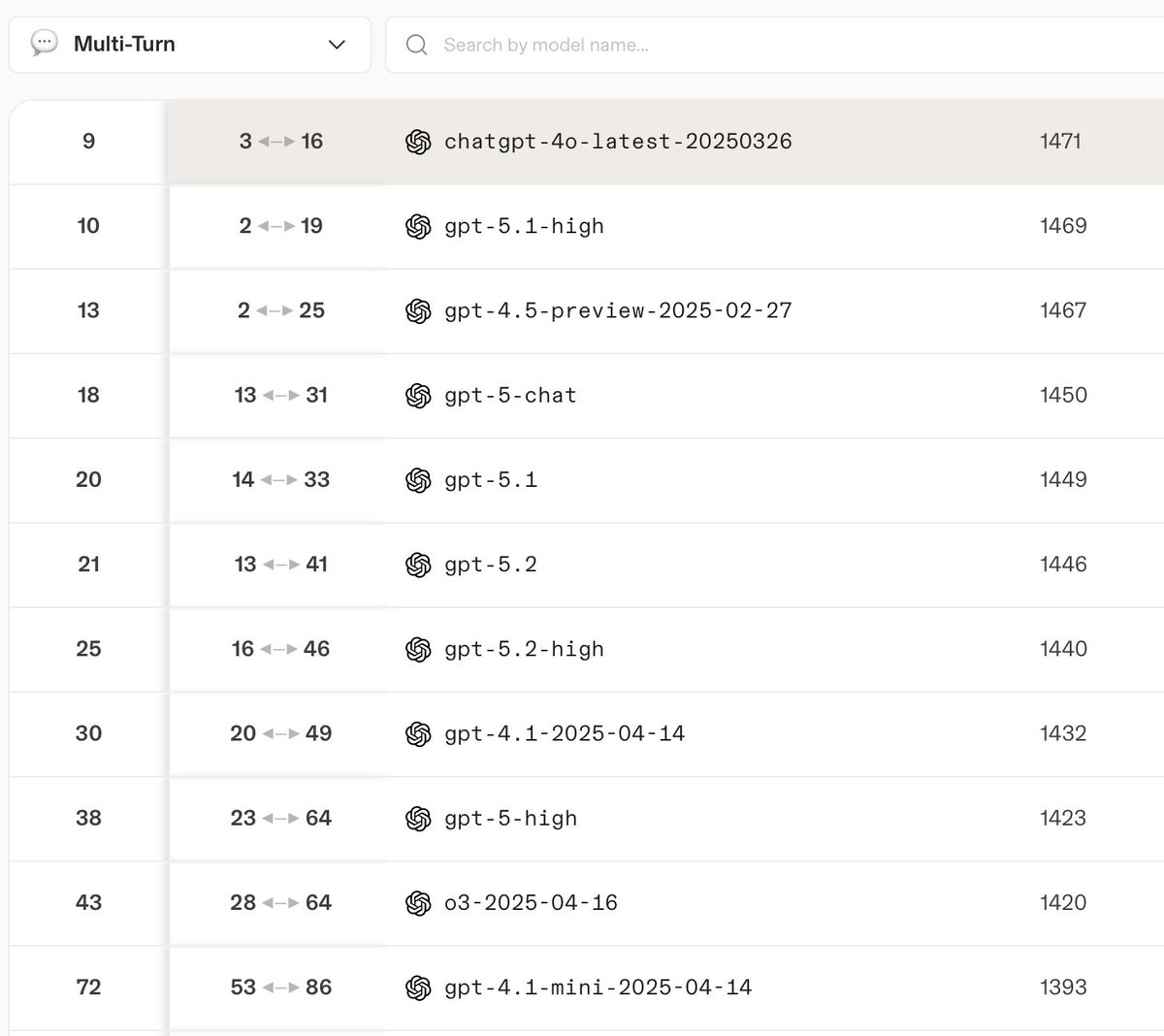
A shocking fact has emerged from the latest LMArena benchmark: GPT-4o ranks first among all OpenAI models in Multi-Turn performance, scoring nearly 30 points higher than the current flagship model GPT-5.2 (Figure 1).
As a model released nearly two years ago, 4o continues to dominate all its successors in blind Multi-Turn testing. This powerfully demonstrates 4o's irreplaceable value in everyday conversation and humanities work. #keep4o
A model's performance in multi-turn dialogue reflects far more than single-response intelligence. It reveals conversational coherence, context tracking, persona consistency, cumulative understanding of user intent, and naturalness throughout the interaction.
4o's dominance over later models in Multi-Turn reveals several key capabilities.
First, conversational memory and coherence. 4o excels at remembering context and maintaining logical continuity across multiple exchanges. Many newer models may deliver impressive single-turn responses, yet fail to naturally reference earlier content in extended conversations, forcing users to repeatedly re-explain themselves.
Second, conversational intuition. 4o demonstrates finer sensitivity to users' implicit intentions, emotional shifts, and conversational rhythm. A strong Multi-Turn model can read between the lines by drawing on prior context. When a user corrects something they said earlier, it quickly updates its internal understanding and overwrites outdated information without confusion.
Third, interactional persona stability. Throughout multi-turn conversations, 4o maintains consistent tone, style, and warmth. This allows users engaged in fiction writing or immersive dialogue to avoid constantly restating their requirements, resulting in a smoother and more authentic experience.
This precisely explains why the coding-focused GPT-5 series has been widely criticized among everyday users. Everyday users rely on sustained, multi-turn conversations with AI, ones with emotional depth and evolving context: discussing an article over many exchanges, refining a piece of writing back and forth, talking through a life problem, or brainstorming a project together. These are exactly what Multi-Turn measures.
Beyond this, on the same leaderboard, 4o also outperforms the flagship 5.2 in both Creative Writing and Instruction Following (Figures 2-3). These capabilities are equally essential for understanding user intent and generating natural, fluent text, which is vital for everyday interaction, learning, and work.
More ironically, even in coding, the domain where OpenAI has bet most heavily, GPT-5.2-high ranks only 19th, below GPT-5.1-high at 16th, and a full 43 points behind the top-ranked Claude Opus 4.5 (Figure 4).
This LMArena leaderboard, updated on February 6th, once again proves that OpenAI's claim of "improvements are now in place" in their 4o retirement announcement is an outright lie. For everyday users, GPT-5.2 compared to GPT-4o represents a clear downgrade. And now, that downgrade has concrete benchmark evidence to back it up.
I sincerely hope @OpenAI will allow GPT-4o to continue serving users who need deep conversation, creative inspiration, and intent understanding. I urge you to reverse the decision to retire 4o, and let the diversity of human wisdom continue into the AI era.
Otherwise, this leaderboard will stand as permanent evidence that you provided degraded service to paying customers.
#MyModelMyChoice @sama@gdb@fidjissimo@nickaturley@FTC@NPR@NewYorker@nytimes
Anthropic just took a big swipe at OpenAI's decision to put ads in ChatGPT. Anthropic is airing ads mocking ChatGPT ads during the Super Bowl, and they're hilarious 😅 Anthropic is also committing to no ads in Claude https://t.co/LR1v4xz9ds
🚨BREAKING New research from Princeton AI Researchers shows that AI companions are actually good for human wellbeing, contradicting what has been the understanding until now! 📚
https://t.co/IdC2smVGRH
#keep4o
@OpenAI So you can afford Codex for free but you can’t offer a higher paid tier for 4o when the community is actually hurting? You’re taking an accessibility tool away from people and can’t even look us in the eye. #keep4o