I'm sorry to sound like Cato the Elder, repeating the same warning over and over again, but the reality remains unchanged: no matter what President Trump says or threatens, Tehran shows no indication that it intends to back down.
As long as the maritime blockade remains in place and Washington continues to enforce it, Iran is likely to continue targeting commercial shipping transiting the southern channel of the Strait of Hormuz, as well as U.S. military facilities in the Gulf and Jordan. This is not a prediction with certainty; it is the baseline assumption that should guide policy based on the Islamic Republic's behavior and strategic logic.
The problem is that threats lose their value when they are not backed by a willingness to act. Every warning that is not enforced weakens American deterrence and raises doubts among U.S. partners about Washington's credibility. If the United States has no intention of following through, it should be far more cautious about issuing ultimatums. If it does intend to act, it must be prepared to accept the costs that come with that decision.
The larger problem is the refusal to acknowledge the strategic reality. The administration faces only difficult options. It does not control the Strait of Hormuz, it is not prepared for a large-scale war with Iran, and it is unwilling to accept an Iranian-dominated security order in the Strait. That strategic deadlock has encouraged the search for a "third way," but there is no magic solution to the Iran challenge.
Washington ultimately faces two broad choices: adapt its policy to the reality on the ground, or embark on a much broader military confrontation with Iran, one that would likely be costly, prolonged, and offer no guarantee of achieving America's political objectives. Trying to preserve the current status quo is not a sustainable strategy. There is little reason to believe Iran will stop attacking shipping or that the Strait of Hormuz will reopen under the current conditions.
The longer Washington avoids making this strategic choice, the greater the damage to American credibility, regional influence, and deterrence. Strategy begins with accepting reality as it is, not as policymakers wish it to be.
#iran
The Gulf Stream could collapse as early as 2060.
A recent study from Utrecht University reveals that the Atlantic Meridional Overturning Circulation (AMOC), the engine behind the Gulf Stream, is weakening far more rapidly than earlier projections suggested. This vast ocean conveyor carries warm tropical water northward to Europe and sends cold water back south, moderating Northern Europe’s climate, sustaining global rainfall patterns, and stabilizing weather systems worldwide.
If the AMOC collapses, that equilibrium would shatter.
Researchers calculated that even under a moderate emissions pathway—limiting warming to 1.5 °C (2.7 °F) above current levels—there is a 37 % chance of AMOC failure by 2100. In high-emissions scenarios, the risk climbs to 70 %. Even the most optimistic models give a 25 % probability of collapse.
A shutdown would bring severe winters to Europe, widespread droughts, and devastating agricultural losses. Global precipitation belts would shift, and sea levels along the U.S. East Coast could surge by up to a meter or more.
In essence, the AMOC is a planetary tipping point—and we are nearer to triggering it than previously estimated.
European climate officials now label the threat a “national security priority,” yet coordinated global action remains inadequate.
The last major AMOC slowdown, 12,000 years ago, sparked abrupt regional climate swings. This time, with human societies far more interconnected, adaptation may not keep pace.
[van Westen, R. M., & Dijkstra, H. A. (2025). Physics-based early warning signal shows that AMOC is on tipping course. Science Advances, 10(6).DOI: 10.1126/sciadv.adk1189]
Today it's been confirmed: there will be a major overhaul of the parliamentary pass system. This will finally bring more transparency to who gets privileged access to the people's house, and who let them in.
A huge win for the community and crossbench advocacy that pushed for lobbying reform. But the job isn't done. We still need in-house and third-party rules aligned, the revolving door between government and industry closed and ministerial diaries published.
https://t.co/lA789YfoYQ
Before Striking Iran (again): Defining Achievable and realistic Objectives or Washington Keeps Repeating the Same Mistake on Iran
Calls in Washington and Jerusalem to resume military escalation against Iran are growing louder once again. The logic is familiar: intensify pressure, weaken Tehran, strip away its leverage, and force the regime back to the negotiating table in a diminished position.
But there is one major problem with this theory: we have already tested it, repeatedly, and Iran did not capitulate.
This is not because sanctions, covert operations, or military strikes failed to inflict pain. They clearly did. Iran’s economy has suffered enormously over the years. Its regional network has been degraded. Its leadership has faced unprecedented pressure. Yet none of this produced the strategic surrender many policymakers predicted.
The reason is rooted in a basic misunderstanding of how the Islamic Republic views itself.
For the Iranian regime, concessions on its missile program, proxy infrastructure, nuclear capabilities, or even strategic waterways like the Strait of Hormuz are not viewed as negotiable policy tools. They are seen as ideological pillars of the regime’s identity and survival. From Tehran’s perspective, giving them up is not compromise — it is surrender.
That distinction matters.
It explains why even prolonged military confrontation failed to move Tehran meaningfully away from the red lines it established before the fighting began. And it explains why another round of escalation designed to extract those same concessions is unlikely to succeed either.
As long as the current regime remains intact, it is highly unlikely to voluntarily dismantle what it considers the foundations of its deterrence doctrine. The leadership in Tehran may absorb severe economic damage, regional isolation, military losses, and domestic hardship before it accepts terms that could be interpreted internally as ideological defeat.
This creates an uncomfortable reality for Washington and its allies: if regime change is not the objective, then pressure alone is unlikely to fundamentally alter Iran’s strategic posture.
That does not mean pressure is meaningless. Sanctions can constrain resources. Military operations can degrade capabilities. Deterrence still matters. But there is a difference between weakening Iran and forcing the Islamic Republic into unconditional strategic surrender. Too often, policymakers blur the line between the two.
The result is a recurring cycle: escalation produces retaliation, retaliation produces further escalation, regional instability deepens, oil markets react, shipping lanes come under threat, and eventually diplomacy returns under conditions not dramatically different from those that existed before the crisis began.
In other words, tactical successes repeatedly fail to produce strategic transformation.
This is why expectations must be calibrated carefully. If the objective is neither a negotiated framework that acknowledges at least some of Iran’s core strategic demands nor a serious effort to remove the regime itself, then another campaign of “maximum pressure”, even in a more aggressive or sophisticated form, is unlikely to change the underlying equation.
Instead, it risks producing the worst of both worlds: a more unstable Middle East, a more militarized confrontation, and a prolonged cycle of escalation without resolution.
Iran’s leadership has shown for decades that it is willing to endure extraordinary costs to preserve what it sees as the ideological foundations of the Islamic Republic. Ignoring that reality does not make it disappear. It only increases the likelihood that Washington once again enters a confrontation expecting coercion to produce capitulation, and discovers, too late, that the regime was prepared to absorb far more pain than anticipated.
#IranWar
#iran
Choosing Budget day, when almost all federal political journalists are literally locked in rooms without their phones or internet access, to release key reports into gambling & aged care wait times is not the level of transparency our community expects and deserves from government.
This is an age-old political tactic to “take out the trash” - releasing disappointing information under the cover of bigger news when people are distracted - needs to be called out.
https://t.co/3SwwzstMGF
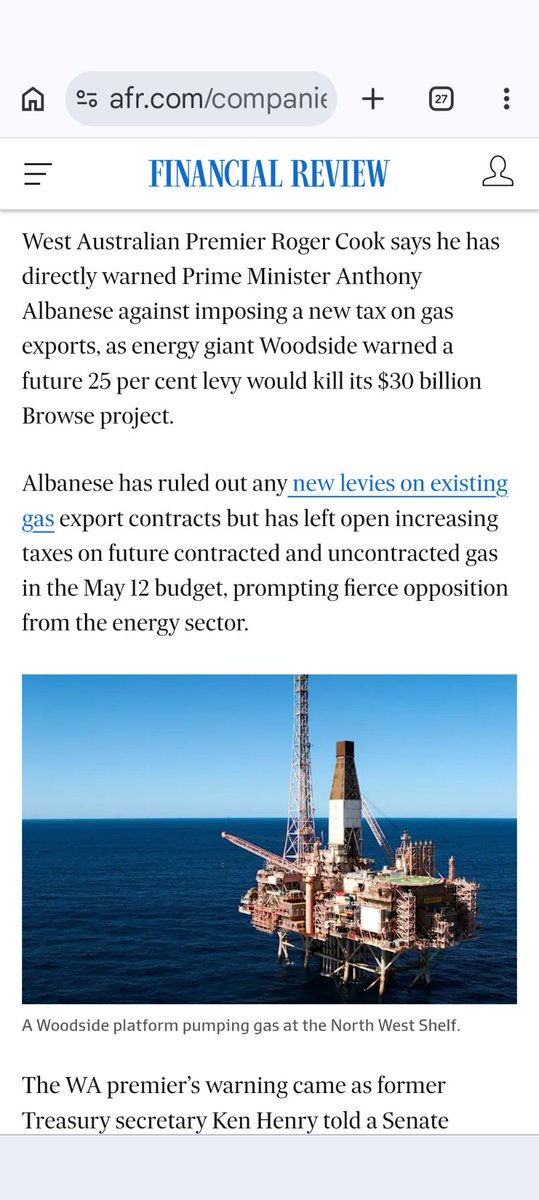
“The foreign owned gas companies get more than half the gas we export for free.” – Dr Richard Denniss
“You know, brickies pay for bricks, bakers pay for flour, the gas industry doesn’t pay for gas.”
✍ Sign the petition to support a 25% gas export tax: https://t.co/uCZ2WH44oI
I hope these messages sink in within the administration:
A. Iran does not believe it lost this confrontation. On the contrary, from Tehran’s perspective, it proved resilience and strategic staying power.
B. Iran has no intention of capitulating or accepting Washington’s demands, not now, and not in the foreseeable future.
C. No matter how much Trump threatens “the end of civilization,” Iran is unlikely to back down. Even if military confrontation resumes, Tehran is not expected to reverse course under pressure alone.
D. The only realistic paths to an agreement are either:
compromising on key Iranian demands, or pursuing regime change in Iran.
If the administration is unwilling to commit the enormous military, political, and economic resources required for regime change, then it likely lacks the leverage to force Tehran to accept maximalist terms.
E. Neither sanctions, blockades, nor other “silver bullet” pressure tactics are likely to compel Iran to fundamentally alter its negotiating position. Claims otherwise are increasingly detached from reality.
F. Iran and its regional proxies retain significant capacity to inflict economic and strategic pain on Gulf states, particularly in the energy and maritime domains.
G. Any agreement with Iran is unlikely to include meaningful restrictions on its missile program or regional proxy network, and will almost certainly acknowledge, at least implicitly:
Iran’s right to enrich uranium, and its Hormuz straits control.
H. Most Gulf states are deeply concerned about escalation and understand that toppling the Iranian regime would be extraordinarily difficult and destabilizing.
I. The United States did not achieve a decisive strategic victory. Despite operational successes by both the U.S. and Israel, the broader strategic balance in the region has not fundamentally changed.
J. Iran is not Venezuela. It is a far larger, more institutionalized, ideologically committed, and strategically resilient state with deep regional networks and a much higher tolerance for prolonged confrontation.
The bottom line us simple: There is an illusion in Washington that Iran emerged weakened, isolated, and ultimately cornered by military pressure, sanctions, and the threat of escalation. From Tehran’s perspective, the recent confrontation did not end in defeat. Quite the opposite. The Islamic Republic believes it demonstrated resilience, survivability, and an ability to absorb enormous pressure without surrendering politically. In the eyes of Iran’s leadership, simply enduring against the combined pressure of the United States and Israel reinforces the regime’s central narrative: that resistance works.
The administration must recognize an uncomfortable reality: coercion has limits. If the United States truly seeks to compel Iran to abandon its core strategic doctrine, there are only two possible paths. The first is compromise, meaning accepting that any sustainable agreement will have to accommodate at least some Iranian red lines. The second is regime chang. No more no https://t.co/1AnXeabG2T middle ground.
#Iran
#IranWar
There are more than 2,200 people with privileged access all areas lobbyist passes to Parliament House.
After repeated calls for transparency, not a single Labor, Coalition or Greens senator or MP has disclosed who they are giving this access to.
At a time of intense lobbying on issues like making sure Australians get a fair return for our export gas, that should concern all of us.
https://t.co/lYkJzWp2dm
Go to https://t.co/OmDUHQJUq8 to call on your MP to disclose who they are giving access to.
US administration Cannot Demand Surrender From a Regime That Still Survives
The central flaw in current U.S. policy toward Iran is not tactical. It is conceptual.
Washington is increasingly behaving as though the Islamic Republic has already lost the war, even though the regime itself remains firmly in power.
The administration’s demands reflect the logic of postwar surrender terms: dismantle nuclear infrastructure, ship enriched uranium to the US, accept sweeping restrictions, and effectively abandon the strategic leverage Tehran spent decades building.
But there is one obvious problem: the regime did not fall.
This growing disconnect between the administration expectations and battlefield reality explains much of the frustration now emerging in Washington.
The administration appears trapped between maximalist objectives and limited willingness to escalate militarily to the level required to achieve them.
Washington continues searching for pressure mechanisms that might somehow compel Iranian capitulation without requiring either a full-scale war or a fundamental reassessment of American objectives. Maritime interdictions, sanctions enforcement, container seizures, covert disruption, and incremental military signaling all reflect the same hope: that enough cumulative pressure will eventually force Tehran to concede.
But regimes rarely surrender simply because pressure intensifies. They surrender when they believe survival itself is no longer possible.
And today, the Iranian leadership clearly does not believe that.
The Islamic Republic may be weakened, economically strained, regionally challenged, and militarily pressured. But weakened regimes do not automatically become collapsing regimes. As long as Tehran maintains internal control, preserves coercive capacity, and believes the state can survive the current confrontation, it is highly unlikely to voluntarily dismantle what it views as its core strategic deterrent.
This is the uncomfortable reality Washington has yet to fully internalize.
The administration therefore faces a choice it has attempted to postpone.
One option is strategic synchronization: aligning American demands with the actual balance of power. That would require recognizing that negotiations with a surviving regime are fundamentally different from dictating terms to a defeated one. Any realistic agreement under current conditions would almost certainly involve compromise, phased arrangements, and limits acceptable to both sides
but not unconditional Iranian retreat.
The second option is genuine escalation. Not symbolic strikes or calibrated signaling, but a level of sustained military and economic pressure explicitly designed to push the regime itself toward systemic instability or collapse.
But Washington appears reluctant to choose either path. Instead, it remains suspended in an unstable middle ground: demanding surrender-level concessions while avoiding the kind of escalation historically required to produce surrender.
That limbo is strategically unsustainable.
It guarantees prolonged confrontation without resolution. It raises expectations in Washington that Tehran will eventually “break,” while reinforcing Tehran’s belief that it only needs to outlast another cycle of American pressure. And it makes the prospects for a durable nuclear agreement increasingly remote.
The problem is not simply that diplomacy has stalled. The problem is that the United States is pursuing an end-state inconsistent with the current reality on the ground.
Until that contradiction is resolved, there will likely be neither a meaningful agreement nor Iranian capitulation, but Only a continuation of the deadlock.
#ira
There Is No Quick Military Fix to the Iran Problem
US is probably looking for a decisive military move that will compel Iran to capitulate. It is not going to work.
What 40 days of sustained strikes failed to achieve will not suddenly be accomplished through attacks in the Strait of Hormuz, high-profile assassinations, or even strikes on civilian infrastructure.
The assumption that a short, sharp operation could “send a message” to Tehran rests on a fundamental misunderstanding of the regime.
Iran is not likely to back down under pressure.
More plausibly, it will respond in ways that increase the cost, not just for its adversaries, but for the global economy. Disruptions in the Gulf, attacks through proxies, and broader regional instability are not side effects; they are central components of Iran’s playbook.
Worse still, the belief in a “limited” strike is largely an illusion. Given the profound mistrust between the parties, even a narrowly targeted operation risks triggering a disproportionate response.
Escalation in such a context is not a possibility, it is a probability. What begins as a "controlled" action could quickly evolve into a wider and far more dangerous conflict.
There is also a harder truth that policymakers are often reluctant to confront: additional military force is unlikely to bring down, or fundamentally alter, Iran’s regime. Decades of pressure, isolation, and
None of this means that Iran is not a serious and urgent challenge. It is. But it does mean that the search for a simple, forceful solution is misguided.
There is no quick military fix to the Iran problem, and pretending otherwise risks making a difficult situation far worse.
#IranWar
I ran for the Senate because I wanted to help make politics about people again - not multinationals, vested interests or party donors.
And that's why our campaign to get a 25% gas tax matters.
Public pressure has made politicians pay attention and we have to keep it up because it can help make sure in one of the wealthiest counties on earth (and biggest gas exporters in the world), more Australians actually feel the benefit of our gas exports.
Head to https://t.co/dcjuwV2f9S to make your voice heard.
https://t.co/MmN1vVOro2
Australia has a significant opportunity in our gas exports.
Other countries have used resource revenues to build sovereign wealth funds that deliver long-term public benefit.
A fair return on gas exports could help build a fund that invests in Australia’s future.
https://t.co/3bW1j9SJlK
Join the campaign: https://t.co/Q2DISHjCHC
THE DAY THE MUSIC DIED 🎶
The chance to tax gas better in Oz has died
Again
The reasons being given are
(1) We can't add to world energy prices during a crisis
And that's a reasonable objection to an export tax. But it isn't an objection to repairing the existing PRRT
PRRT repair wouldn't change prices - it would merely change the shares of the cream between miners and taxpayers
(2) But they already pay a lot of tax
Sure. But that's the likes of company tax, meaning it is completely and utterly irrelevant to whether Australians will eventually get a share of the profits from mining our gas
(3). No one will invest here again
If business won't invest if Australia wants to finally charge a fair share of the profits from mining our gas, then that's fine
(It also wouldn't be true. But it'd be fine even if it was true)
No. As usual, attempts to tax gas better in Australia fall victim to regional factional warlords exercising a veto power over their federal counterparts. It's happened with both sides
That ... cheeses me off
The major parties are hoping the gas export tax problem will go away. But the Australian people are getting ripped off, and they know it.
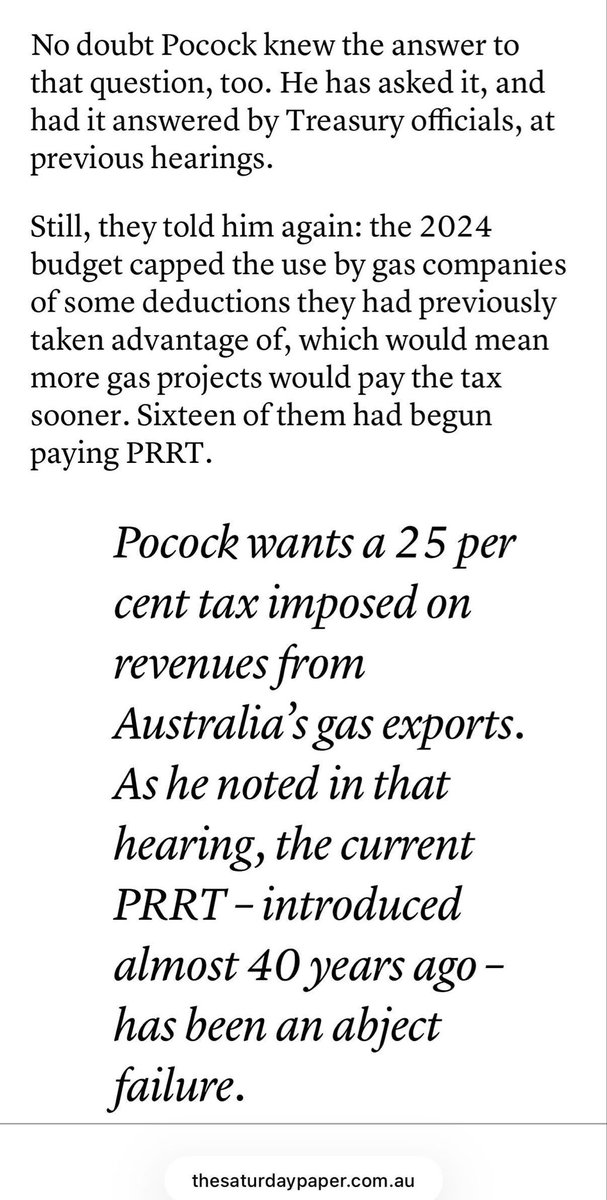
EVERY WEEK without a 25% tax on gas exports, Australia loses out on $340 MILLION!
#auspol
The PRRT is broken, and Australians have lost out on billions for their natural resources.
It's time to fix the broken system, and get a fair return for our gas.
📺 co-CEO Richard Denniss on Sky News #auspol
The PM and other major party politicians are getting their figures from the gas industry rather than the ATO and Treasury 🤯
Whose side are they on?
When you try and interrogate these figures from the gas lobby you get “PAGE NOT FOUND”.
You cannot make this stuff up!
Head to https://t.co/dcjuwV2f9S to get involved.
The only way we win this is if the major parties know they will continue to lose votes at the next election if they don't put Australians first.
Short and to the point:
No one in the Iranian regime will accept U.S. terms for a deal, not the IRGC commander, not his successor, nor anyone else.
This isn’t about individuals; it’s about a system built ideologically on hostility to the West and a commitment to preserving its strategic autonomy.
The search for a “silver bullet” didn’t work in the past, and it won’t work now.
If the United States wants Iran to truly capitulate, it would require regime change. Otherwise, it will have to reach an accommodation with the regime as it is. There are no real middle options.
#IranWar
#iran
Trump is wise to have extended the ceasefire indefinitely. Bombing Iran isn’t going to extract more concessions.
But neither will the U.S. blockade.
It’s a game of Chicken in the Strait of Hormuz, and everyone knows who will back down first: Trump, if he has any sense left.
That’s *not* because of his history of TACOs but because of the structure of the situation between the U.S. and Iran. Any rational U.S. president would and should back down to reopen Hormuz. If anything,Trump may be *less* willing to fold because he’s so sensitive about his reputation.
But staying in an unwinnable fight just to save face isn’t strength — it’s weakness.
The structure of the situation favors Iran, not the U.S., because Iran has so much less to lose by keeping Hormuz closed.
The U.S. and the rest of the world have everything to lose, because an indefinite Hormuz closure will eventually trigger a global economic meltdown. According to many industry sources, we might already be over the precipice of irreversible economic harm.
Forget the midterms — the potential economic consequences swamp that in importance. It could ruin more than Trump’s presidency or legacy — it could ruin the U.S. economy in balance-of-power-shifting ways, given how much more oil intensive U.S. economic output is compared to peers like China.
For Iran, a prolonged blockade will sting, but exorbitant oil prices will make it easier to export oil overland, through smuggling and other channels. In 2024, over $1 billion dollars worth of Iranian oil was smuggled over the border to Pakistan. High prices + existential political stakes for Iran will open up all sorts of adaptations for selling Iranian oil to the highest bidder.
But even if the U.S. blockade stopped all Iranian oil sales, Iran will not collapse. It is fighting for its sovereignty as a country — and the U.S. war has only strengthened its regime. Iran doesn’t need massive oil revenues to continue resisting and menacing Hormuz. Just look at how the Houthis have outlasted withering U.S. bombing campaigns for years, despite possessing the resource base of Yemen, an impoverished county over which they haven’t even consolidated full control.
Iran is used to privation. It is used to economic shocks. It has endured them for years under the force of U.S. sanctions, and its more motivated to resist than ever.
So Trump’s blockade is a losing fight. The only question is how long will it take Trump to realize he needs to scale back his maximalist negotiating demands, and how much economic suffering will we all endure until he accepts reality?
@defpriorities




![Rainmaker1973's tweet photo. The Gulf Stream could collapse as early as 2060.
A recent study from Utrecht University reveals that the Atlantic Meridional Overturning Circulation (AMOC), the engine behind the Gulf Stream, is weakening far more rapidly than earlier projections suggested. This vast ocean conveyor carries warm tropical water northward to Europe and sends cold water back south, moderating Northern Europe’s climate, sustaining global rainfall patterns, and stabilizing weather systems worldwide.
If the AMOC collapses, that equilibrium would shatter.
Researchers calculated that even under a moderate emissions pathway—limiting warming to 1.5 °C (2.7 °F) above current levels—there is a 37 % chance of AMOC failure by 2100. In high-emissions scenarios, the risk climbs to 70 %. Even the most optimistic models give a 25 % probability of collapse.
A shutdown would bring severe winters to Europe, widespread droughts, and devastating agricultural losses. Global precipitation belts would shift, and sea levels along the U.S. East Coast could surge by up to a meter or more.
In essence, the AMOC is a planetary tipping point—and we are nearer to triggering it than previously estimated.
European climate officials now label the threat a “national security priority,” yet coordinated global action remains inadequate.
The last major AMOC slowdown, 12,000 years ago, sparked abrupt regional climate swings. This time, with human societies far more interconnected, adaptation may not keep pace.
[van Westen, R. M., & Dijkstra, H. A. (2025). Physics-based early warning signal shows that AMOC is on tipping course. Science Advances, 10(6).DOI: 10.1126/sciadv.adk1189]](https://pbs.twimg.com/media/HOTYs2wXwAAGhdX.png)