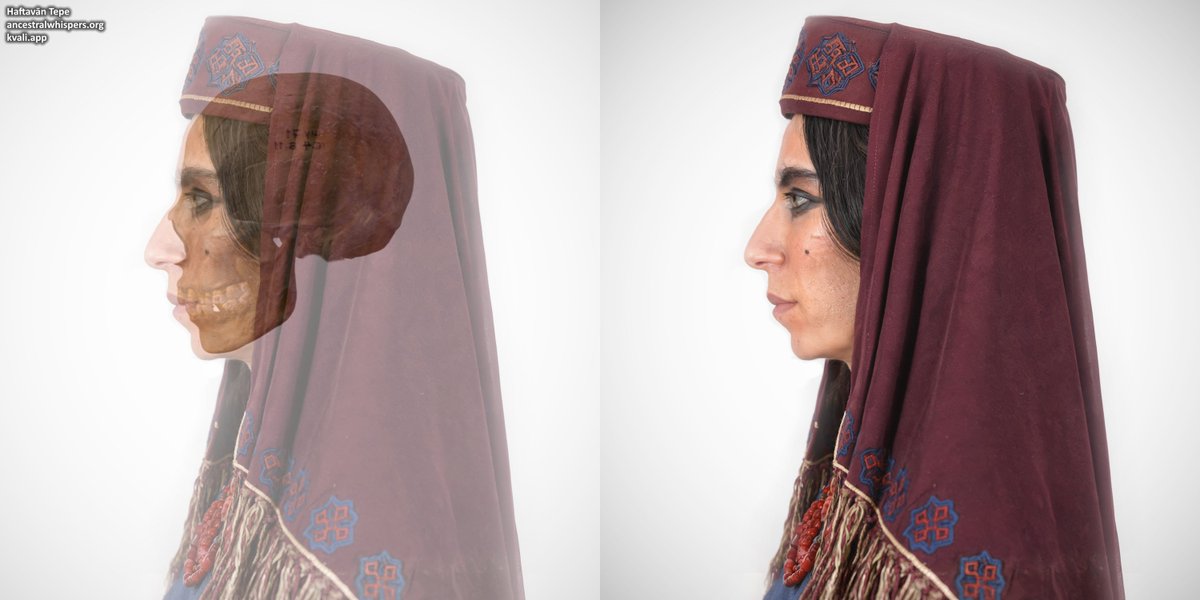
Facial reconstruction of a 2,750-year-old woman from Haftavān Tepe, Iran
Haftavān Tepe is one of the three largest settlement mounds in the Urmia Basin, Azarbaijan. Covering approximately 50 acres, it lies near the village of Haftavān, about two miles from Salmās. The multi-period settlement comprises eight main archaeological phases, numbered VIII to I from oldest to youngest, spanning roughly 3,000 years.
The woman lived during a period when the region was contested between the kingdoms of Urartu and Mannaea, both of which existed within a broader cultural sphere shaped by earlier Hurrian influences.
Haftavān VIII (c. 2600 BC). The earliest excavated phase revealed two successive layers of circular buildings, with pottery dating to the end of the Early Trans-Caucasian II/Kura-Araxes culture period, comparable to Yanik Tepe near Tabriz.
Haftavān VII (c. 2300 BC). Occupation was concentrated around the summit citadel, where massive mud-brick structures were uncovered. The relatively peaceful character of this phase is reflected in the limited archaeological material recovered.
Haftavān VI C–B (c. 2200-1450 BC). Following a period of abandonment, the settlement was sparsely reoccupied, mainly around the citadel. Painted Orange Ware provides parallels with Hasanlu VII.
Haftavān VIB (c. 1900-1450 BC). This phase comprised two prosperous sub-periods, Early and Late VIB, both ending in major destruction by fire. The settlement reached its greatest extent during Early VIB, when extensive buildings, including massive terraced structures, occupied much of the mound. Their timber-reinforced mud-brick walls and pottery, including black-on-red vessels, with strong Transcaucasian connection.
Late VIB is particularly notable for its painted Urmia Ware, depicting felines, equids, birds, human figures, and animal-drawn vehicles. Transcaucasian cultural connections appear to have weakened following the destruction of the earlier settlement.
Haftavān V (c. 1450-1100 BC). Corresponding to the Iron I period, this phase retained considerable continuity with Late VIB material culture, although a small proportion of distinctly Iron Age dark grey burnished pottery also appeared.
Haftavān IV (c. 1100-800 BC). Corresponding to the Iron II period, this appears to have been a relatively unimportant phase compared with contemporary Ḥasanlu. Excavations revealed poorly preserved but spacious buildings, alongside inhumation burials containing bronze and iron ornaments and numerous beads, mostly carnelian.
Haftavān III (c. 825-715 BC). This phase is associated with the incorporation of the Urmia Basin into the Kingdom of Urartu in the late 9th century BC. Excavations on the citadel uncovered a large building arranged around a central courtyard, with five column bases along its southeastern side. Its pottery included distinctive Urartian wares, particularly red-polished palace ware, found in the destruction debris of an upper storey.
The building was probably not a fortress but rather the residence of an Urartian governor. It was likely destroyed around 714 BC, during Sargon II's eighth campaign, either by the Assyrians or the Cimmerians. The pottery suggests an earlier Urartian occupation, dating approximately to 825–715 BC. Urartian settlement also extended beyond the citadel, after which the site was abandoned, possibly until the late 6th century BC.
Haftavān II (mid-1st millennium BC). Achaemenid period, characterized by defensive towers and perimeter walls.
Haftavān I (C-A, up to the mid-1st millennium AD). Sasanian period, featuring a perimeter wall, a cemetery, and numismatic finds, including coins of Shapur I
Reconstruction commissioned by @shoresh03
And also World Oldest Haplogroup J was found in Iran Mesolithic Hunter Gatherer 10-12 thousands years old and other ancient Haplogroup J was found in Balochistan Shahr e sokhta IVC site
Dzudzuana is native Caucasus Hunter Gatherer that was replaced by Middle Eastern Basaloid Iran HG J1,J2(CHG) invaders.even Anatolian Hunter Gatherer and Natufian are more related to Dzudzuana than CHG/Iran_HG. Keep dreaming Turkjeet muh slanted eyes noodljeet assimilated greek
We also confirmed through a sponsored Big Y-700 test that the royal Mohammadzai/Barakzai dynasty belongs to haplogroup L-BY18981. A tested descendant of a brother of Amir Dost Mohammad Khan (d. 1863) was found to be positive for this clade, proving that the Mohammadzai/Barakzai ruling lineage falls within L-BY18981.
I wonder what the haplogroup of Nawab Akbar Bugti was.Autosomally he falls within the Baloch range:higher Zagrosian ancestry and lower ANF + EHG + AASI. We don't have Bugti Tribesman DNA samples yet
Just a reminder! world oldest G2a1 belongs to Zagrosian Neolithic (Zagros Shanidar Iraq) with 0% CHG ancestry. Today you can find G2a1 dominance in Caucasus region ,G2a1 is Zagrosian Neolithic
This Turk is using the same flawed logic Pakistanis employ to challenge Baloch claims to Balochistan. He is telling Kurds that Balochistan is their ancestral homeland to undermine their claim to Kurdistan, much like Pakistanis calling Baloch as Kurd migrants.
The Geographic Distribution of Y-DNA Haplogroup G2b among Pashtuns
Heatmap showing the frequency of haplogroup G2b among Pashtun samples, based on the known locations of their earliest paternal ancestors.