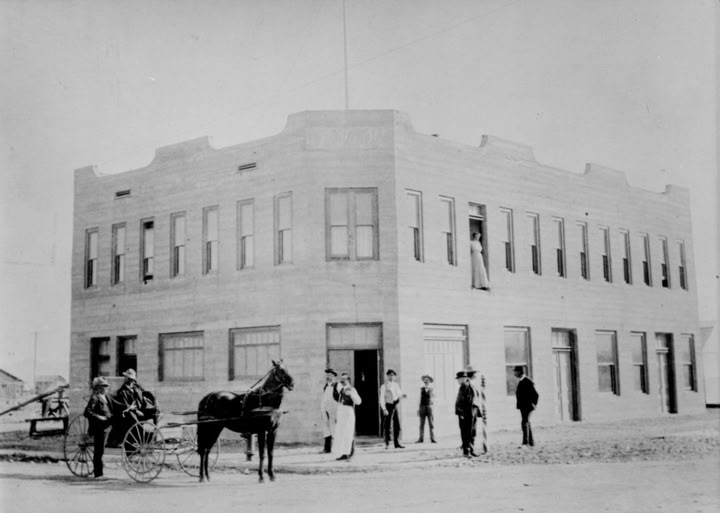
Before the Strip, before neon, and before millions of visitors, the Hotel Nevada helped connect Las Vegas to the world.
#OnThisDay in 1907, the city's first telephone was installed there, marking a milestone in Las Vegas history. Over time, the building and property expanded and evolved into today's Golden Gate Hotel & Casino, later earning another claim to fame as the birthplace of the iconic shrimp cocktail.
Photo courtesy of Vintage Vegas.
RETRO FOLLICLES UPDATE: Doing a special live remote broadcast on the legendary 1440 WROK in Rockford, Illinois. This was 1975. If only I’d harvested all that hair and put it to good charitable use.🤪 But this was “the look” then. #YoungTeenDJ#PumpinTheWattageIntoYourCottage 😎
Notice how Nithya Raman just completely disappeared after they blocked us out of the general election?
She's not campaigning at all. Like a pickpocket disappearing into the crowd. Just a ghost. I told you her campaign was a scam. Colluding with Bass from the start.
Use extra caution this time of year - the bison rut is beginning!
You may see mature male bison with their mouths open, tongues out, and upper lips pulled back. This is how bull bison sniff pheromones and determine whether a female is ready to breed. Bulls will also display their dominance by bellowing, wallowing, and engaging in fights with other bulls. The winners earn the right to mate with receptive females.
Bison are wild and unpredictable, no matter how docile they may appear to be. Be sure to always maintain a distance of at least 25 yards (23 meters) from them, and if a bison charges, retreat!
👉 Learn more about our safety tips at: https://t.co/IaHWB5JIFc
When Johnny Bench passed Yogi Berra as the catcher with the most home runs in history, the Yankees great sent his congratulations as only he could: “I always thought the record would stand until it was broken.” https://t.co/mecDd7Kc8U
A walk-off home run to end the All-Star Game had Ted Williams jumping for joy #OTD in 1941.
His storybook season would continue as the young @RedSox star set his sights on a .400 batting average. https://t.co/AWYz4HnBT7
❗CASE UPDATE ❗
Former San Diego County Sheriff’s Deputy Jeremiah Manuyag Flores was sentenced in federal court to 57 months in prison for violating the civil rights of a detainee by using excessive force, then lying in a report to cover up his illegal conduct.
#FBISanDiego worked closely with our partners at the @sdsheriff (Homicide Unit) to conduct a thorough investigation, resulting in today's outcome. #Justice
https://t.co/kmfl7IvO0b
LIGONIER, Pa. — George Washington, a 26-year-old officer at the time, said he was never in more “imminent danger” than on a November evening in 1758.
For nearly 264 years, the precise location of the battlefield Washington found himself in during the French and Indian War remained a mystery. It lay undisturbed at a farm field two miles from Fort Ligonier, a key British fort in western Pennsylvania where Washington was leading a Virginia regiment in a fierce battle through dense forest.
I take the reader to that battlefield and along the Forbes Trail--where you can walk the same military road that Washington forged today and even stay in the same places that he did! (gift link) https://t.co/dSYStSFk6P
U.S. farmers are intentionally flooding their fields to revive ancient "prairie potholes," creating temporary "pop-up" wetlands that deliver a huge boost to migratory birds while improving soil health.
In regions like California's Central Valley and the Mississippi Delta, innovative programs—most notably BirdReturns (launched by The Nature Conservancy in 2014)—pay farmers to strategically flood low-lying or post-harvest fields at precise times during bird migrations. These short-term wetlands mimic the natural prairie potholes and seasonal marshes that once dotted the landscape but were largely drained for agriculture.
By timing floods to align with peak migration periods (e.g., spring and fall for shorebirds, waterfowl, and sandhill cranes), farmers provide essential stopover habitat: shallow water, mudflats, and abundant food for millions of birds traveling along flyways like the Pacific Flyway. The approach has transformed tens of thousands of acres of working farmland into critical refueling stations, with studies showing dramatic increases in bird use and numbers—sometimes 3.5 times higher in these managed pop-up wetlands compared to standard fields.
Farmers also gain practical benefits. Seasonal flooding enhances soil structure, boosts nutrient cycling (as bird activity and water help break down residues), recharges groundwater, reduces erosion, and supports long-term land productivity—often without hurting crop yields in subsequent seasons.
This win-win model proves that modern agriculture and wildlife conservation can reinforce each other, turning productive farmland into flexible ecological assets that sustain both birds and resilient farming systems.
[The Nature Conservancy. BirdReturns: Creating Dynamic Habitat for Migratory Birds. The Nature Conservancy California]
John Quincy Adams, when he discovered that both his father, John Adams, and Thomas Jefferson had died on the 50th anniversary of independence on July 4, 1826, he believed it to be a palpable mark of divine grace.
“The time, the manner, the coincidence with the decease of Jefferson, are visible and palpable marks of divine favour, for which I would humble myself in grateful and silent adoration before the Ruler of the Universe—For myself all that I dare to ask is that I may live the remnant of my days in a manner worthy of him.”
In 1885, former President Ulysses S. Grant was dying of throat cancer and facing financial ruin. During his final months, he worked tirelessly to finish his memoirs, hoping the proceeds would provide for his family after his death. The book went on to become a massive bestseller.
4 July 1939: New York Yankee Lou Gehrig announces his retirement, giving his famous "Luckiest man on the face of the Earth" speech on Lou #Gehrig Appreciation Day. He was diagnosed with amyotrophic lateral sclerosis (ALS) on June 19, 1939, his 36th birthday. He died on June 2nd, 1941. #History #OTD #ALS #ad https://t.co/Uxv0ZTU0y4
@URDailyHistory Later that year, the officers of Army Base 30, gathered in front of the new Palace of Fine Arts to memorialze the unit, service in France, and it's decommisioning.
27 June 1944: Three weeks after D-Day, #German troops at Cherbourg, #France surrendered to U.S. troops. #Cherbourg was an important harbor that the Germans sabotaged before surrendering. Cherbourg is the first French port liberated by the Americans. On July 16, the first large ships were able to dock there. #WWII #WW2 #History #OTD #ad https://t.co/vqpXR4lEYp








![Rainmaker1973's tweet photo. U.S. farmers are intentionally flooding their fields to revive ancient "prairie potholes," creating temporary "pop-up" wetlands that deliver a huge boost to migratory birds while improving soil health.
In regions like California's Central Valley and the Mississippi Delta, innovative programs—most notably BirdReturns (launched by The Nature Conservancy in 2014)—pay farmers to strategically flood low-lying or post-harvest fields at precise times during bird migrations. These short-term wetlands mimic the natural prairie potholes and seasonal marshes that once dotted the landscape but were largely drained for agriculture.
By timing floods to align with peak migration periods (e.g., spring and fall for shorebirds, waterfowl, and sandhill cranes), farmers provide essential stopover habitat: shallow water, mudflats, and abundant food for millions of birds traveling along flyways like the Pacific Flyway. The approach has transformed tens of thousands of acres of working farmland into critical refueling stations, with studies showing dramatic increases in bird use and numbers—sometimes 3.5 times higher in these managed pop-up wetlands compared to standard fields.
Farmers also gain practical benefits. Seasonal flooding enhances soil structure, boosts nutrient cycling (as bird activity and water help break down residues), recharges groundwater, reduces erosion, and supports long-term land productivity—often without hurting crop yields in subsequent seasons.
This win-win model proves that modern agriculture and wildlife conservation can reinforce each other, turning productive farmland into flexible ecological assets that sustain both birds and resilient farming systems.
[The Nature Conservancy. BirdReturns: Creating Dynamic Habitat for Migratory Birds. The Nature Conservancy California]](https://pbs.twimg.com/media/HMc0HrdW8AA3WjV.jpg)


