CEO @impactbnd. I help businesses become the most recommended, trusted and chosen company in their market in the age of AI with the #EndlessCustomers System.
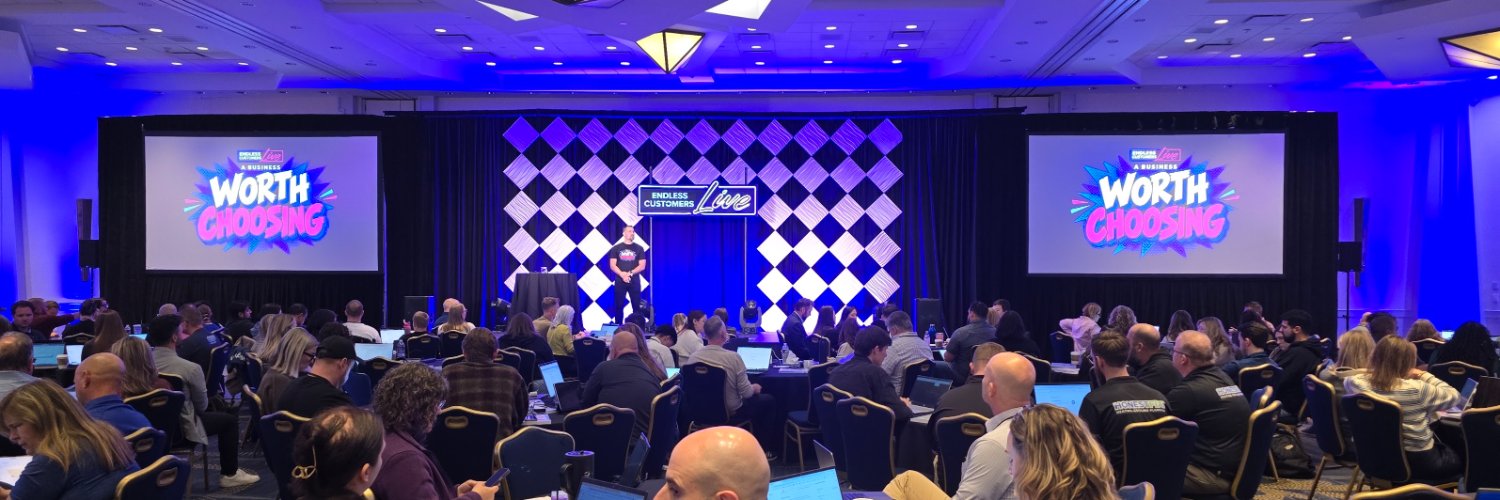
My biggest takeaway from Endless Customers Live this week: when AI recommends a company, it starts with a pool of 30-40 options, then starts eliminating.
Here's how it cuts the list, and the fix for each step 👇
This week I had the opportunity to speak at the CRI Simple Numbers Summit in Austin.
I've followed Greg Crabtree's Simple Numbers for years, and IMPACT was a client of theirs for a few of them. It's a simple system for improving your company's efficiency, profitability, and ultimately its valuation. If you haven't yet, I highly recommend reading Greg's two books, Simple Numbers and Simple Numbers 2.0.
Many of the owners in the room are already doing Simple Numbers really well. Mike Maxson and Brandon Gray wanted this to be a well-rounded business event, and how to grow in the age of AI is a question on the minds of a lot of people in their community. That's why they brought me in, and why I introduced the 10 Factors to becoming the company AI recommends and buyers choose.
The response to what I taught was overwhelming, and I really enjoyed every conversation I had with the people I met.
Mike and Brandon, thank you for bringing me in. For your first conference, you guys did an absolutely incredible job. I know firsthand how hard it is to put on a conference, and you should be very proud. Congratulations to Greg and the rest of the Simple Numbers team as well. It takes a lot of people to pull off an event like this.
I'm excited to see this event happen again next year, and I hope to be part of it for many more.
I'm back as CEO of @HubSpot today.
@dharmesh and I are completely re-founding the company. Its day 1. We're now the Customer Harness Company.
In the next few days, I'll post about why I'm coming back and what my plans are. LFG!
“You need to be someone people seek out. Your feedback, your ideas, your judgment, your opinion, your sign-off. If no one is coming to you for something, you’re at risk of being replaced by AI.”
This is something I said to my entire company at a recent team meeting, and I find myself repeating it over and over again. No, not as a threat, but as advice.
For most professionals, there’s still time to get ahead of the AI workplace transformation, because it’s still in its infancy. Today, most of us turn to AI first when we need advice or need to get something done, and for the most part it does a good job.
We’ll only go to a human when AI can’t get us the answer we’re looking for, or we’re unsure the thing it’s recommending is the right thing to do right now, or it did some of the work and we need someone who knows what they’re doing to finish it.
If you’re the person people turn to after they can’t get what they need from AI, you’re valuable.
If people are getting more from AI than they were getting from you, and no one is pinging you for help anymore, you should be scared.
As leaders, we need to be intentional about how we’re coaching our teams through this. They look to us as leaders, and failing to guide them is a leadership breakdown.
If you have staff you already know are not going to make the cut when AI gets a little bit better, and you’re not talking to them or trying to help them right now, you’re failing them as a leader.
I’m not saying we have it all figured out at @impactbnd, but we’re trying a lot of things right now, and here are a couple of them:
First, we’re being open and honest. I don’t hide things from my people, and I don’t lie to them. They see the headlines, so it’s better that I call it as it is. I’ve said multiple times that jobs we hired for, even in the last year, may not be needed in six months. That doesn’t mean the person has to go, but it does mean jobs are changing, and skills have to change too.
Second, we created a 90-minute spot every Monday called the Expert Exchange, for training each other on how to be more valuable in the age of AI. Sometimes it’s show and tell on AI tools, like AI assistants. Other times it’s communication training or other knowledge sharing. But it’s 90 minutes a week, for whoever wants to show up, where we all help make ourselves more valuable to our clients, our company, and the workplace in general.
I’d love to hear what you’re doing in your company to prepare your team. What’s working, and what do you want to see more companies doing?
How AI recommends a company and what you can do to get recommended more.
The process varies, but here’s the pattern we’ve seen in our research:
1. It takes the prompt and tries to understand the user’s true intent.
2. It looks at everything it knows about the user (context, which may be a lot or a little) to understand exactly what they need.
3. It creates an initial pool of options (products, companies, places, services, etc.) from search results or credible published sources. In our research, this is often 10 to 40 options.
4. It eliminates options in rounds. First, it quickly scans each company’s website to see what it offers, who it serves, and where it specializes, then cuts the ones that don’t fit the user’s needs.
5. Next, it looks for evidence the remaining companies can back up their claims: customer results, accreditations, awards, etc. More cuts.
6. It then acts like a buyer with questions, digging deeper into the remaining websites for answers about pricing, potential problems, and comparisons to alternatives. This is where it finalizes its short list.
7. It does one last confidence check, looking for bad reviews and patterns of complaints.
8. It presents its top recommendation with a few backups and explains why they fit.
Next time you ask AI for a recommendation, ask how it got there. It will often describe a very similar process.
Notice the pattern: a big pool, a quick skim, easy eliminations. Then deeper passes, spending most of its time on the finalists.
Just like human buyers often do.
Here’s how to position your company to be recommended more:
1. Have a website. If you already do, congrats! You’ve already completed step one.
2. Be extremely clear about the problems you solve, what you do, who you do it for, where you’re a fit, and where you’re not. Do this for each product or service too. Make it easy to see why you belong in the next round.
3. Back up your claims. If you say “reduce costs,” aim for 3 to 5 customer stories with data. How much did costs drop? For whom? Over what period? Specificity is key. Show or link to the proof.
4. Answer every question a buyer may have, ESPECIALLY PRICING. Explain price ranges, cost drivers, options, payment terms, financing, and guarantees.
5. Know your bad reviews (everyone gets them), respond to them, and fix your business so you get fewer and fewer.
6. Stop trying to be all things to all customers. Become the best in your market at something specific. Show plenty of proof, and back it with a clear promise, guarantee, or warranty. The clearer your focus and the stronger your proof, the easier you make it for AI to recommend you.
You can use a tool like @HubSpot's AEO tool to track your visibility in AI recommendations.
Share with anyone who needs this. My team helps companies with all of this.
What are you seeing in your own tests? Does this match your experience? I’d love to hear what’s working for you.
4. Build a great business first.
Tom DiScipio: "What these tools are ignoring is whether or not you are actually building a good, credible business that's worth recommending."
Tools measure whether you get credit for being that business. How do you prove AEO ROI to leadership?
AI visibility is becoming the new vanity metric.
We spent an hour at IMPACT's expert exchange (30+ coaches and partners) trying to measure revenue from AEO. The consensus: proving the ROI is messy.
Here's why your AEO score might be lying to you.
The fix: self-attribution. Ask buyers how they heard about you on every form and every sales call. Analytics can't see inside a ChatGPT session. The buyer can tell you.
Yesterday I spoke to a marketing class at UConn.
Three student groups. Three real marketing projects. One of them is working for the university itself.
The dean gave that team a big challenge: position the university as the best for experiential learning. That's what they want to be known for in the coming years.
I love that goal. With how much the world is shifting right now, it's exactly where a university should be focusing.
As they planned their research, here was my advice:
Go to ChatGPT and ask, "What would a university have to do for you to recommend it as the best for experiential learning?"
My guess is nobody at the university has asked that yet.
What comes back will likely fall into two buckets:
• Tactical moves. What to put on the website. Which student experiences and outcomes to document and share.
• Fundamental shifts. What would we have to change? Where would we invest? What would we stop doing so we could go all in?
That second bucket is the hard part. Being the best at something means making choices, including deciding what other things you'll pull energy, focus, and resources away from.
I told the students to treat that first answer as a starting point. Keep probing. Stay curious. Shape it around what they heard from the dean.
I'd bet they walk back in with something the dean hasn't seen before. Not a list of marketing ideas, but a clear picture of what it would actually take to own that position, from the "buyer's" point of view.
And this applies to every business.
Pick the one thing you want to be known for. Be specific about who you want to serve. Then ask AI:
"What would a company have to do for you to recommend it as the best at this for these customers?"
Then ask what evidence it would need to see. Then ask what you'd have to stop doing.
Some of the answers will be wrong, incomplete, or unrealistic. Building a great business still takes human judgment.
But you'll have a starting point you can question, test, and bring to your team. And you'll know exactly what AI says you'd need to do before it recommends you.
Has anyone been doing this in their business? What did you learn, and what did you change?
What do you need to do so AI tools like ChatGPT recommend your company more?
We built a free tool that shows you. It's called the Instant Diagnostic, and it's in beta right now.
Enter your website and in a few minutes it analyzes your site, your competitors, and your digital presence, then scores you across 10 factors that drive AI visibility, trust, reputation, and purchases. Plus specific advice on what to fix first.
Feedback welcome. What was your lowest-scoring factor, and did it surprise you?
Link below.
Reach a new lead within five minutes and you're 8x more likely to convert them, according to InsideSales research on 5.7 million inbound leads.
Yet only 0.1% of leads get a response that fast.
Here's how I'd check: pull out your phone and shop your own business. Try your website, your Google profile, and your Facebook page. Can you actually get help and book a time?
Do it yourself this week. You'll see exactly where the work needs to happen.
Bold prediction: within six months, ChatGPT and Claude will both launch a CMS.
ChatGPT Sites already hosts websites on your own domain. Claude can publish live pages.
Next: managing your whole site from a chat. An interesting alternative to WordPress or HubSpot.