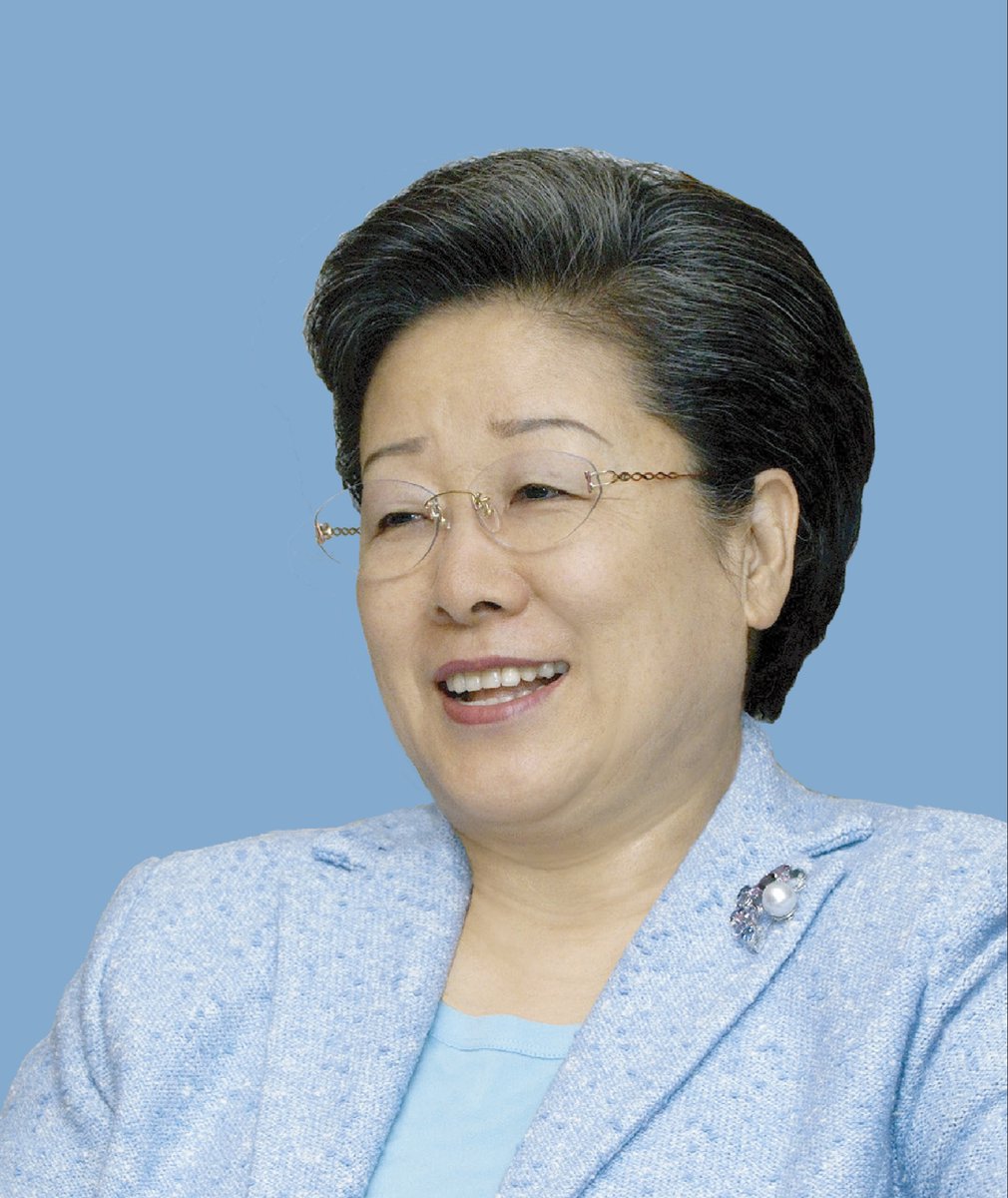
Nobel Peace Prize Nomination Submitted for Dr. Hak Ja Han
Dr. Jan Figel @janfigel, former EU Special Envoy for Freedom of Religion or Belief, has formally nominated Dr. Hak Ja Han of the Family Federation (FFWPU) for the 2026 Nobel Peace Prize.
In his nomination letter, Figel cited the following achievements:
1. Interfaith cooperation: Appointed thousands of Peace Ambassadors worldwide to bridge religious divides
2. Korean Peninsula peace: Organized Rally of Hope summits promoting peaceful reunification
3. Humanitarian recognition: Established the Sunhak Peace Prize, honoring global peace advocates
4. UN engagement: UPF and WFWP hold comprehensive consultative status with the UN Economic and Social Council (ECOSOC)
5. 38th Parallel Peace Initiative: A proposal to build an international peace park in the DMZ, aligned with Nobel's vision of abolishing armed conflict
6. Cultural diplomacy: Deployed the Little Angels performing arts troupe to carry peace messages worldwide
On Dr. Han's ongoing detention, Figel stated that many international observers regard it as politically motivated and intended to obstruct her global peace work.
He noted that U.S. Vice President J.D. Vance @JDVance raised her case directly with the South Korean Prime Minister during official talks, a sign that her detention has become a matter of urgent international concern.
Source: https://t.co/B3A29L2nta
@monarchreport25@janfigel Finally. Someone who get who she is! And her husband, Rev. Dr. Sun Myung Moon, is eminently worthy of receiving the Prize posthumously!
@Introvigne Excellent article! Reveals how the Tokyo High Court assumed the role of Inquisitor and judged the theological beliefs of the Unification Church.
https://t.co/1ksRRVE6kb Bitter Winter starts today publishing an in-depth analysis of the Tokyo High Court decision dissolving the Unification Church, in six parts.
@Introvigne This article is a great read! The Tokyo court's charge that the Unification Church commits "mental manipulation" is nothing more than the "persuasion" that all political and faith groups exercise.
Second article on the Tokyo High Court decision against the Unification Church: the key role of the pseudoscientific theory of mind control
https://t.co/KCNyC3X19o
@BitterWinterMag The Tokyo High Court decision on the Unification Church conceals a dangerous and monstrous bigotry that could be used to target other disfavored groups.
The Tokyo High Court Unification Church Decision. 2. The Ghost of “Brainwashing” https://t.co/cqdv3R1pJ6 A key theme of the decision is the discredited pseudo-scientific theory that “cults” victimize their members through “mental manipulation.”
@monarchreport25 How many times does the poor woman need to be hospitalized for the reality to penetrate the walls of the Seoul judiciary that Dr. Han requires constant, stress-free medical care?
#releasethemotherofpeace#religiousfreedom
A Seoul court today granted Dr. Hak-ja Han her third consecutive suspension of detention for medical treatment — temporarily releasing her until April 30.
The condition: she must remain at her treatment hospital and nowhere else.
November 2025
February 2026
March 2026
For six months, she has been held in a solitary cell without adequate care.
She has appealed for medical release repeatedly.
Each time, she was sent back to detention — still recovering from surgery.
The pattern raises a question the court has now answered three times over: can she physically remain in custody? The answer, apparently, is no.
International critics — including former Secretary of State Mike Pompeo and former House Speaker Newt Gingrich — have called her prosecution a religiously motivated purge.
The international community must know that she has repeatedly appealed for release due to deteriorating health — and been denied.
Source: https://t.co/grMCk7Uv1Z
@monarchreport25 Why? Why are Dr. Han and her church being targeted? Because a quasi-communist Korean president is scared of their robust anti-communist and pro-God message.
An 83-year-old woman has been sitting on the floor of a windowless cell for over 180 days. No bed. No chair. No formal charges brought against her.
That woman is Dr. Hak Ja Han, co-founder of the Unification Church and one of the most recognized religious figures in modern history. And according to those close to her, South Korea's government isn't just holding her — it's considering dismantling her organization entirely, following the same legal playbook Japan used to dissolve the Family Federation there.
What Mackay Holmes, a longtime church elder from Las Vegas, is asking is simple but urgent: why?
Every document was handed over. Her passport was surrendered. She can barely move. The United Nations has its own guidelines strongly discouraging this kind of confinement for anyone over 80. And yet here she is.
Holmes argues that the Moons spent their entire lives building bridges — between political rivals, world leaders, economists, scientists — creating spaces where people from opposite sides of every debate could sit in the same room and actually talk to each other. That legacy, he says, is not the profile of a criminal organization.
The deeper concern he raises is one that goes beyond religion. South Korea built its modern identity on democratic values borrowed in part from the United States — freedom of speech, freedom of association, freedom of religion.
If the government moves to seize the assets of a religious organization and detain its elderly leader without clear legal grounds, it signals something troubling about where that democracy is heading.
Is this justice — or is it something else dressed up to look like it?
@monarchreport25 The US's dominant Protestantism has led to past justifications of chattel slavery, antisemitism, and anti-Catholicism but, on balance, has been able to preserve One Nation Under God.
U.S. House Speaker Mike Johnson addressed the origins and meaning of the phrase “separation of church and state,” noting that it stems from Thomas Jefferson’s 1802 letter to the Danbury Baptist Association rather than the Constitution.
He emphasized that Jefferson sought to shield religious practice and conscience from government overreach, not to exclude faith from influencing public policy or civic life.
Johnson cited George Washington and John Adams to support his view that the founders regarded religion and moral virtue as indispensable foundations for a free republic, fostering self-discipline, civility, and respect for the rule of law.
This perspective enters a longstanding American debate over the role of religion in government, law, and public discourse. Johnson’s interpretation highlights the founders’ belief that faith strengthens democratic institutions by cultivating the personal and civic character essential for self-governance.
In an era of cultural and political polarization, when the boundaries between religious liberty and state neutrality remain sharply contested, statements from senior officials like the Speaker illuminate competing understandings of how faith and freedom should intersect in a pluralistic society.
When high-ranking leaders revisit core constitutional principles, it directly influences how citizens interpret the relationship between religion and governance.
Do you believe the founders intended religion to actively inform public policy and civic virtue, or should contemporary readings favor a stricter separation to safeguard diverse beliefs and prevent any one faith from dominating public life?