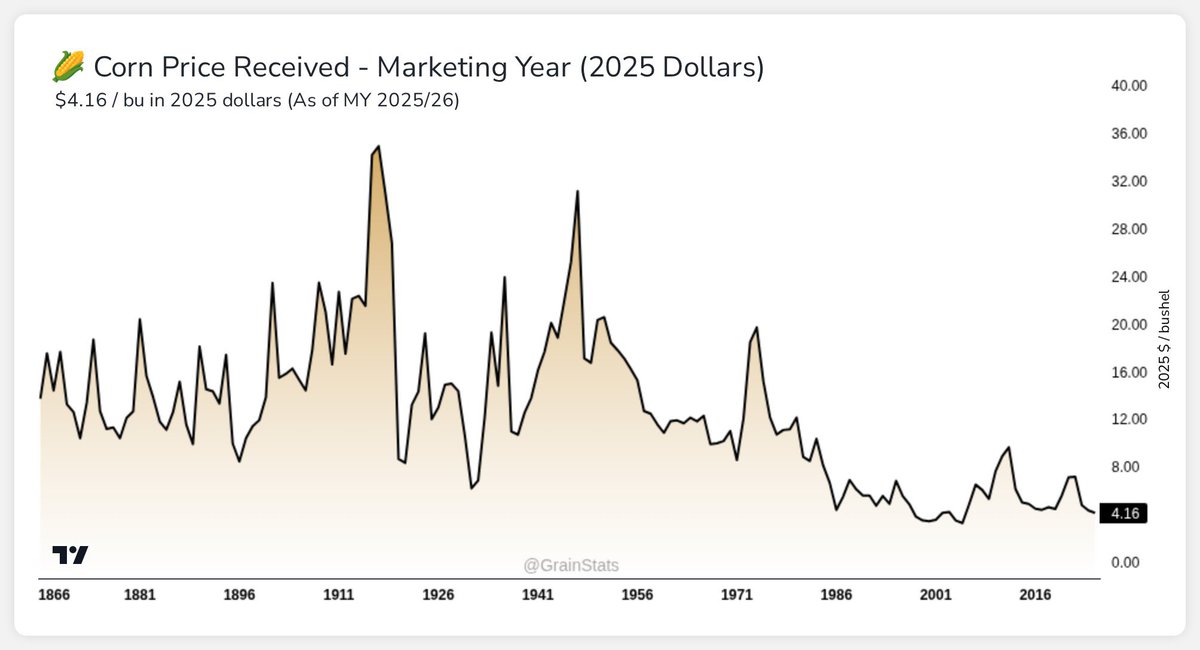
🌽 Corn's real price peaked over a century ago
The 2025/26 marketing year is $4.16/bushel, but in 2025 dollars the all-time high was $34.91 (1917), with a second peak at $31 (1947). Even 2012's $6.89 was just ~$9.66 today.
A Starlink subscriber has paid $85/month for satellite internet for 2 years.
He mounted the dish on his roof. He connected to the WiFi. He opened Netflix. That was his entire Starlink experience $85/month for WiFi from space. Fast enough. Reliable enough. Good enough.
His neighbor a network engineer who also runs Starlink told him something during a fence-line conversation that made him pull out his phone and open the Starlink app for the first time since installation.
“You’re running Starlink on default settings. The default router name is broadcasting to everyone within a mile that you have Starlink including the serial number. Your WiFi bands are merged meaning your devices are fighting between 2.4GHz and 5GHz instead of connecting to the optimal frequency. You’ve never opened the hidden debug page that shows real-time satellite connections, latency, and obstruction data that the app doesn’t display. Your security is on WPA2 when WPA3 is available. You don’t have a guest network every visitor who connects has access to your entire local network. You’ve never run the split speed test that tells you whether your slow speeds are caused by the satellite connection or your WiFi signal. You’ve never configured content filtering the free malware and adult content blocker built into the router. And you’ve never opened the obstruction tool that would have told you the tree on the south side is blocking your signal for 6 minutes every hour.”
He showed him 11 Starlink settings, diagnostics, and capabilities that optimize speed, improve security, reduce cost, and unlock features the dish has been capable of since the day it was mounted.
Here’s every hidden Starlink feature most subscribers never configure 🧵
Marry a farmer, they say.
He’s already got his own farmhouse, probably at the end of a muddy track with no phone signal, which is exactly where a husband should be kept.
He’s up at five and doesn’t come home until dark. No hanging around the kitchen asking what’s for dinner. No following anyone around TK Maxx looking like he’s been taken hostage.
And the food situation sounds bloody perfect.
A farmer isn’t going to lecture anyone about eating too much red meat. He spends half his life raising the stuff.
Nobody asking where the vegetables are because he knows perfectly well where they are. They’re in the field being eaten by the dinner.
Other men turn up with flowers and chocolates. A farmer turns up with half a cow.
Now that’s romance.
But then you discover what marrying a farmer actually involves.
Apparently there’s cooking for a man who works sixteen hours a day, washing overalls covered in cow shit and spending Sunday mornings standing in a muddy gateway waving your arms at forty fucking bullocks.
Sorry, WHAT?
Nobody mentioned agricultural duties in the marriage proposal.
And forget holidays.
Two weeks in Spain? Can’t. Silage.
Weekend away? Can’t. Lambing.
Christmas somewhere warm? Can’t. Cows.
Apparently the closest thing to a romantic getaway is an agricultural show where the highlight is a particularly impressive bull.
So you’ve married a man who’s never home, acquired a second full-time job, ruined three pairs of wellies and sacrificed your holiday to Tenerife.
All for a freezer full of beef.
Except the beef isn’t even free anymore, is it?
Meanwhile, the butcher sells ribeye, puts it in a bag and hands it over without expecting anyone to deliver a calf at three in the morning.
Single life wins again.
Although farmers who deliver steak without requiring agricultural duties may still apply.
Elon Musk was asked how he handles employees who disagree with him publicly.
His answer contradicts every leadership book written in the last 30 years.
"I'd rather have someone who argues with me and is right than someone who agrees with me and is wrong."
The room expected the diplomatic answer. That he values diverse perspectives. That healthy debate makes the team stronger. The standard CEO answer about psychological safety.
He went further. He said the most dangerous person in any company is the one who agrees with you to protect their job. Because that person will let you drive the company off a cliff rather than risk being fired for telling you the cliff is there. The yes-man isn't loyal. He's selfish. He's trading the company's survival for his own comfort.
He said SpaceX has a rule. If an engineer sees a problem and doesn't speak up, and the problem later causes a failure, the silence is treated as more serious than the mistake itself. The person who made the error was trying. The person who watched the error and said nothing was protecting themselves at the cost of the mission.
Think about what that inverts. In most companies, the person who stays quiet and avoids conflict is rewarded with job security. At SpaceX, silence is the fireable offense and disagreement is the job requirement.
Most leaders say they want honesty. Then they punish the first person who delivers it. He built a system where dishonesty through silence is the thing that gets punished. The culture didn't happen by accident. It was engineered to make agreement more dangerous than disagreement.
Holy shit!
Wing came down on a drill and right into the cab of semi hauling fuel around Hardisty.
The driver lived and the tank never exploded.
Wow.
Remember to lock out your hydraulics and ensure you are winged up all the way before transport. Pin them in for long hauls.
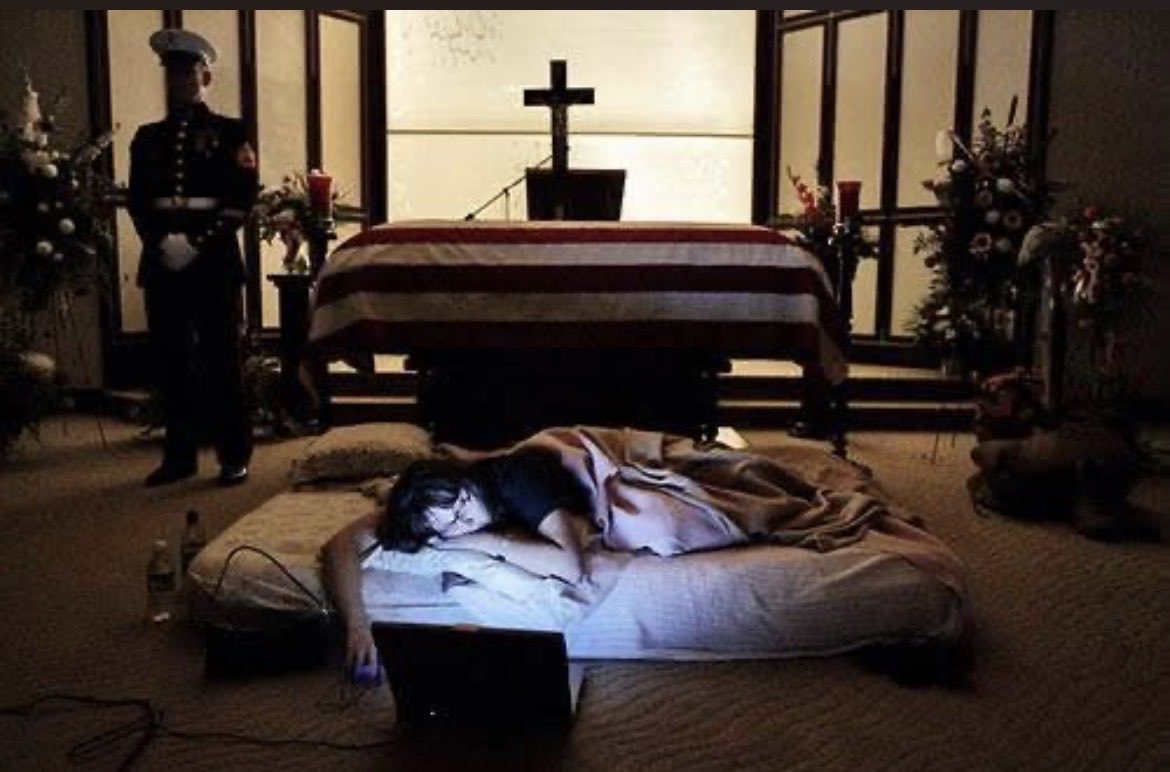
The image depicts Katherine Cathey, the pregnant widow of U.S. Marine 2nd Lt. James “Jim” Cathey, lying on an air mattress on the floor in front of her husband’s flag-draped casket the night before his burial. A Marine honor guard stands vigil in the background.
Jim Cathey was tragically killed in action in Iraq in August 2005. Overcome with grief, Katherine refused to leave her husband’s casket. She requested to spend one final night with him. Two Marines went to great lengths to provide her with a makeshift bed, using a mattress and pillows on the floor. One Marine stood guard over her and the casket throughout the night.
This powerful and Pulitzer Prize-winning photograph was captured by Todd Heisler in 2005 as part of his series “Jim Comes Home” for the Rocky Mountain News.