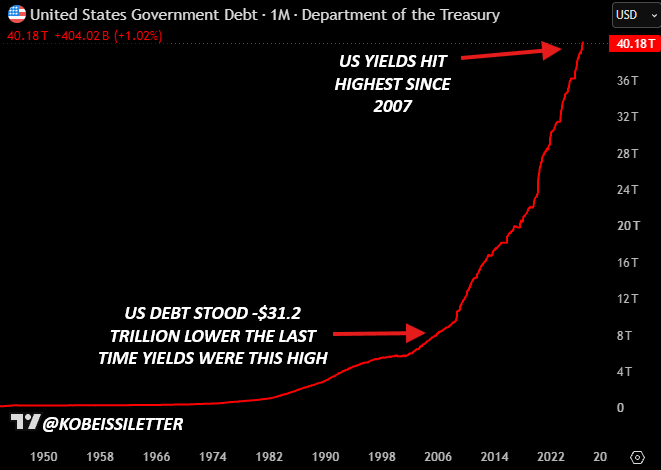
The last time US Treasury yields were this high, total US national debt stood at just $8.9 trillion.
Today, US debt stands at $40.1 trillion. That's +$31.2 trillion more, or over 4.5 TIMES higher.
This means every 1 percentage point in the average cost of servicing the debt now translates to ~$401 billion per year in interest expense.
In 2007, the same 1 percentage point translated to just ~$89 billion.
That’s an additional ~$312 BILLION in annual interest expense for every percentage point increase in borrowing cost.
This is a vastly different situation than it was 19 years ago.
The bond market matters more now than ever.
THIS IS REALLY CONCERNING.
Before the 2008 Financial Crisis:
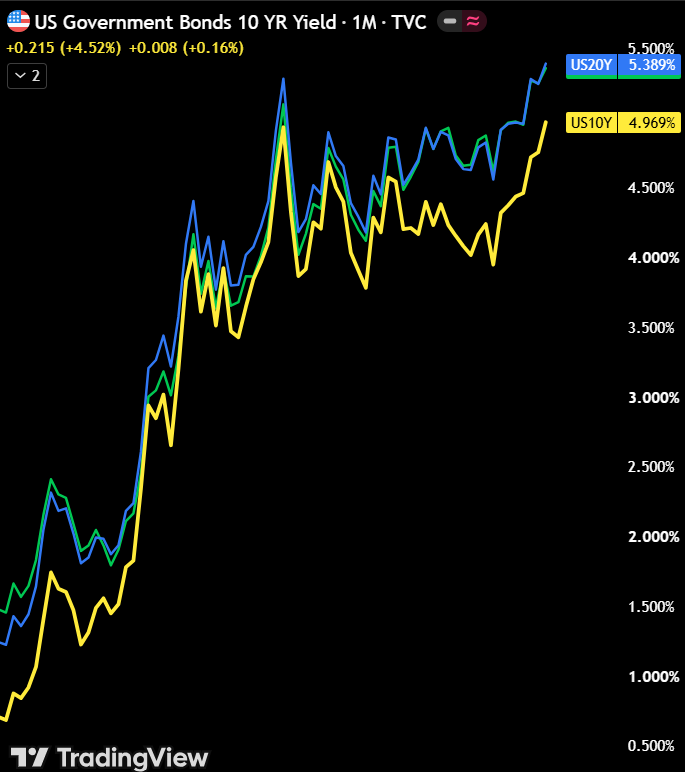
• The US 10-year yield was at 4.99%.
• The US 20-year yield was at 5.44%.
• The US 30-year yield was at 5.43%.
Today, US 10Y, 20Y, and 30Y yields are back at the same level, and the Fed rate hikes haven't even started.
On top of that, major economies are selling US treasuries, putting more upward pressure on the yields.
If combining Treasury's failed effort and US mounting debt, it's clear that investors want higher yield to hold US debt.
And history suggests when that happens, the economy often enters a recession and the stock market experiences a major crash.
The US economy is now dependent on AI spending:
AI investment now accounts for more than 25% of US GDP growth, the largest contribution on record.
This includes spending on software, IT equipment, R&D, and data centers.
In other words, for every $4 of US economic growth today, over $1 is coming from AI investment.
This comes as AI spending is up to a record ~8% of US GDP.
By comparison, spending on IT equipment, software, and R&D peaked at ~6.5% of GDP during the 2000 Dot-Com bubble.
US economic growth is now all about AI.
BREAKING: The EU and US are close to a trade deal setting 15% tariffs on European imports to avoid President Trump’s planned increase to 30% on August 1st, per FT.
FIRING POWELL WOULDN'T SAVE INTEREST COSTS: DEUTSCHE BANK
Markets briefly feared last week that Trump would fire Fed Chair Powell, giving economists a chance to gauge the impact. Deutsche Bank found short-term yields would likely fall while long-term yields would rise, steepening the curve. However, this shift would offer little savings on U.S. interest payments, Deutsche estimates.
This was, without a doubt, President Trump’s test to see how the market would react to firing Fed Chair Powell.
After an instantly negative market reaction, Trump now says in live comments:
“We are not planning on doing anything.”