Happy Black Friday.
Watch the shoppers today.
Fast feet. Locked jaw. Tunnel vision.
That's not greed. That's a body in hunt mode.
The eyes cannot see what the mind does not know.
Airports trained officers to spot risky passengers by their behavior.
The program cost about $900 million.
In 2013, government auditors said the evidence didn't show those behavior cues could pick out threats.
Watching isn't knowing.
Today someone will say "It's delicious!"
Too fast. Too bright.
You'll be sure they hate your stuffing.
Maybe. Or they're just being kind.
Spotting a cue is easy. Knowing what it means is the work.
https://t.co/DurDnRLpWT
"The eyes cannot see what the mind does not know."
That's why two people watch the same clip and see two different things.
I train the mind first. Then we watch.
https://t.co/DurDnRKS7l
"The eyes cannot see what the mind does not know."
That's why two people watch the same clip and see two different things.
I train the mind first. Then we watch.
https://t.co/DurDnRLpWT
Tomorrow at Thanksgiving, someone will go quiet at the table.
You'll decide they're upset.
They drove six hours. They're on their second plate. They're tired.
Silence isn't a signal until you know their normal.
He laughed when he heard the terrible news.
You called him heartless.
Nervous laughter is a common reaction to shock and stress.
Grief doesn't come with a costume.
More misreads, frame by frame:
https://t.co/DurDnRKS7l
Feet pointed at the door? Body language books say they want out.
Maybe.
Or the door is where the bathroom is. Or the kids. Or the cold draft.
A direction isn't a desire.
Read the person, not the floor plan.
Can you spot a deepfake call?
Stop trying to out-listen the AI.
In 2024 the FBI told families to set a secret word or phrase to verify each other.
The best detector isn't your ear.
It's a question only the real person can answer.
They copied your posture. Your tone. Your sip of coffee.
You felt a connection.
Mirroring builds rapport. That's why it's taught in sales.
A tell that can be learned is a tell that can be used on you.
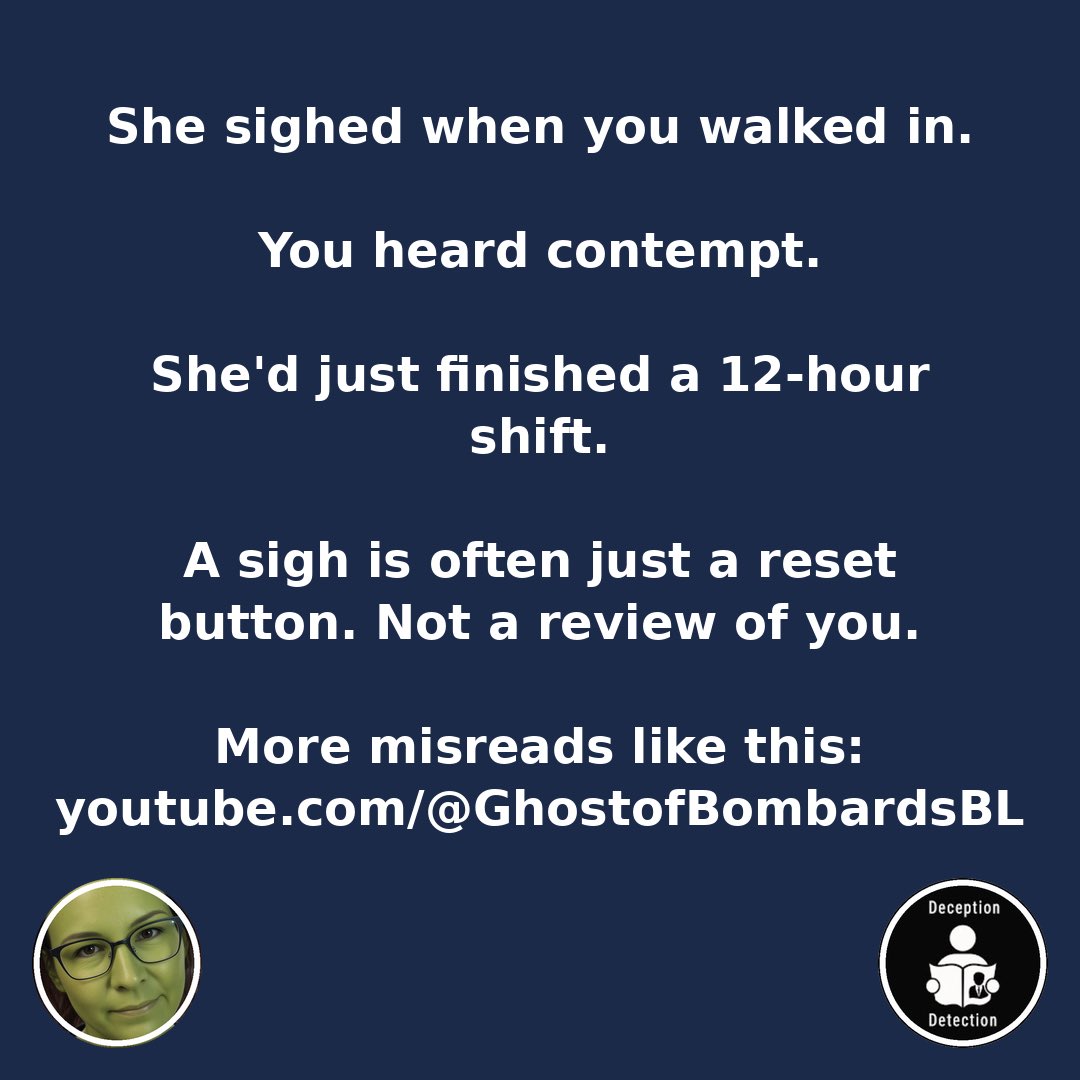
She sighed when you walked in.
You heard contempt.
She'd just finished a 12-hour shift.
A sigh is often just a reset button. Not a review of you.
More misreads like this:
https://t.co/OZEa2MgdzA
Can you spot a deepfake?
In a 2023 study, AI-made white faces were judged human 66% of the time. Real faces? 51%.
The fakes looked more real than real.
And the people fooled most were the most confident.
You can read a stranger.
No personal baseline? Use the human one: how people typically react to stress, surprise and pressure.
Human behavior is predictable.
But only to those who study it.
You judge a stranger's trustworthiness in a tenth of a second.
In a Princeton study, 100 ms with a face was enough. More time mostly made people more confident.
Fast isn't accurate.
Watch before you judge:
https://t.co/OZEa2MgLp8
Can you spot a deepfake?
Watch the mouth on M, B and P. Your lips have to close to say them.
In a 2020 study, lip-sync deepfakes often missed that.
That gap will close too. No trick lasts. A trained eye that keeps checking does.
Ask the world how to spot a liar.
In a study across 58 countries, the No. 1 answer was the same: they look away.
The research doesn't back it up.
The whole planet agrees on a tell that doesn't work.
Some honest people just look guilty.
Researcher Tim Levine found observers get swayed by demeanor: some people seem sincere even when lying, others seem shifty telling the truth.
You're reading a style, not a lie.
More on Patreon: https://t.co/lI5LPug02Z
Can you spot a deepfake?
You probably think so.
In a 2021 study, people couldn't reliably spot deepfake videos, yet overrated their own skill and leaned toward calling fakes real.
Confidence isn't detection.
Check the source, not just the face.