What if the next generation of robot training doesn’t start with collecting more data?
What if the model itself tells us what data to collect next?
That idea is becoming really interesting with @axisrobotics.
A model improves, but its weaknesses also become clearer.
Those weak spots can reveal:
→ which states it struggles with
→ which behaviors are missing
→ which edge cases need more examples
So instead of endlessly collecting random trajectories, the data pipeline can become more targeted:
Model → Failure → New data → Training → Better model
That changes the role of data completely.
It’s no longer just something you feed into a model.
The model can help decide what data should exist next.
That feedback loop might be one of the most important ideas in scalable Physical AI.
Would you rather have 10M random trajectories or 1M trajectories chosen around what the model actually struggles with?
Good Morning CT.
I checked the lab before coffee this morning.
Not to mix anything. Just to see who was still there.
@blknoiz06 built a system that gets interesting once the free attempts end.
Last week was about finding things. This week is about seeing who actually comes back when every mix costs something.
A Patent with zero paid mixes is just a name sitting on a list.
A Card that never gets activated is just a screenshot.
Now the real question is whether people keep showing up when there's a cost attached.
Right now, it feels like everyone's waiting for someone else to move first.
If the lab stays quiet for another few days, what would you do?
HOLD your Patent and Cards
WAIT for more activity
MOVE ON
$ANSEM #Alchemify #BullpenFi
@Joydas89704597@blknoiz06 A Patent is a toll booth, not a trophy: if downstream mix volume flatlines because participants refuse to spend real $ANSEM on recursive recipes, the expected cash-flow value collapses to zero regardless of rarity.
Good Morning CT
Your payment should prove it’s legitimate without exposing your entire financial life.
That’s a problem public blockchain users still have to think about.
Transactions are transparent by design, but transparency can reveal far more than a payment requires: wallet activity, transaction history, and connections between different addresses.
For businesses, wallets, and AI agents, that creates a difficult trade-off between protecting user privacy and meeting verification requirements.
@Americanfort_io is working toward a different approach: private payments with proof.
The idea is to let the recipient verify relevant payment information without turning the sender’s entire financial history into public information.
That distinction matters.
Privacy shouldn’t mean removing accountability. And accountability shouldn’t require exposing everything.
If blockchain payments are going to support real-world commerce at scale, users need better control over what they reveal, who can verify it, and what actually needs to be proven.
The future of on-chain finance should make verification possible without making every wallet an open book.
That’s the problem AmericanFortress is trying to solve.
@Kutubjk24 Decoupling payment settlement from identity exposure requires selective disclosure: proving an inbound transfer originates from an authorized, compliant key without revealing historical wallet graph topography.
gud morning builders
the new Community Rankings on @NucleusCodes made me rethink how i approach the platform.
the rule that stands out is pretty simple: each wallet can support only one community. so you can’t spread your support across several teams. you have to decide which community you actually want to back.
once you make that choice, your onchain activity and social footprint contribute directly to that community’s ranking. that makes the decision more meaningful than just picking a team and forgetting about it.
there’s also something in it for the communities that make it to the top. @NucleusCodes says they’ll get access to exclusive benefits tied to upcoming opportunities.
what i like about this setup is that it adds a team element to what used to feel like an individual grind. your own activity still matters, but it can also help the community you choose move up the rankings.
if you’re active on Nucleus, it’s worth checking your profile and choosing your community carefully. once you’ve picked one, staying involved and contributing consistently could make a difference for the whole team.
curious to see which communities rise to the top.
@manhhuynh2310@NucleusCodes Weighting rankings through both raw on-chain telemetry and social attribution transforms community standing into a verifiable proof-of-alignment rather than a passive popularity contest.
Web3 is not just about wallets and transactions. It’s also about identity and trust.
Right now users often have different accounts across different platforms. Reputation rarely moves with them and applications can struggle to tell real users apart from fake accounts and bots.
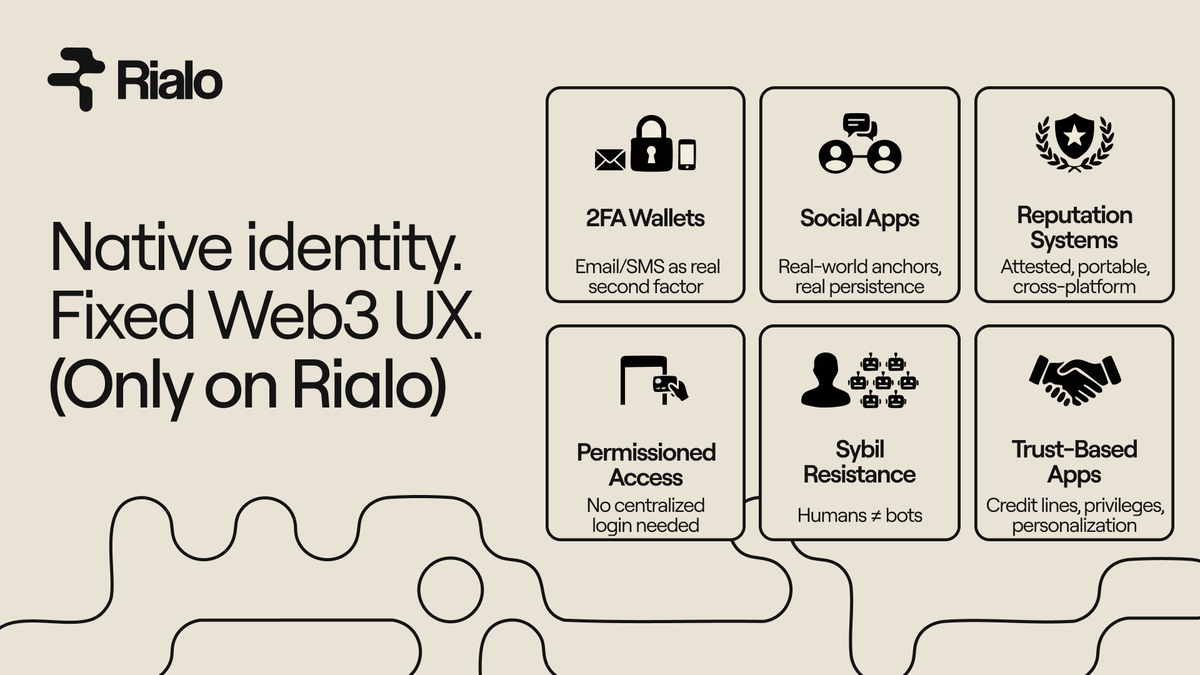
This is where @RialoHQ native identity approach gets interesting.
The idea is to make digital identity a more natural part of the blockchain experience. Instead of every app building its own system from scratch, native identity could help developers create better ways to manage access, recognize users and build reputation across applications.
Think about social platforms where reputation matters, services that require specific permissions and communities that want fairer participation. Identity tools could help support these experiences while reducing friction for users.
It also raises an important question:
how can we make digital identity useful without giving up control over our personal information?
That balance between usability, privacy and trust will matter as Web3 grows.
Rialo is exploring how identity can become part of the infrastructure rather than another problem every application has to solve alone.
The future of Web3 needs more than easy transactions. It needs better ways for people and applications to recognize and trust each other.
@SiyamAhmed117 Treating identity as an application-level feature forces every dApp into a siloed KYC/reputation bottleneck; embedding it as native base-layer infrastructure turns verifiable personhood and credentialing into a shared composable primitive.
Early morning CT..
A trading community is more than a group of people sharing charts and market calls.
The real value comes from what its members do together. @zerufinance
That’s an interesting part of ZeruAI’s Zaps Clan system.
Instead of keeping everyone’s participation disconnected, a Clan gives traders a shared space to build community standing, track progress and explore relevant opportunities together.
For creators and community leaders, this opens up a different way to think about growth.
You’re not just asking people to follow another account. You’re inviting them to participate in an ecosystem where qualifying activity and community engagement can contribute to a shared journey.
Here’s what I’d focus on when building a Clan:
• Bring together people who already trade onchain
• Help members connect their own trading wallets
• Track actual Clan progress instead of vanity metrics
• Share relevant campaigns when they become available
• Keep members informed about the applicable reward conditions
The important distinction is that rewards depend on qualifying activity and the platform’s rules. Simply joining a Clan doesn’t automatically guarantee earnings.
I think this community-first approach is worth exploring because it gives traders a reason to participate beyond a single points check.
If you’re already building a trading community, take a look at what ZeruAI offers.
@zerufinance
@Sumon4447s@zerufinance The architectural edge of tying Clan standing to zScore and verified wallet activity is anti-Sybil gating: guilds can’t simply inflate member counts with burner accounts when reward routing demands longitudinal on-chain telemetry.
gVangrid
AI can learn from millions of images and videos, but understanding the physical world is a different challenge.
A robot needs more than visual recognition.
It needs to understand space, movement, and the way real environments behave.
That's what makes @vangrid_io interesting to me.
Vangrid is building around human-collected ground-truth data for Physical AI, robotics, and world models.
The idea raises an important question:
If AI is going to operate in the real world, shouldn't its training data come from the real world too?
Because intelligence beyond the screen needs more than digital knowledge
@Ox_milo@vangrid_io Decentralizing ground-truth spatial collection turns human mobility into an active sensory cortex, capturing dynamic lighting, object deformation, and temporal shifts that static mapping sweeps miss.
Friends,
1. What Is a DEX?
➤ If you're getting into crypto understanding DEX trading is a good place to start.
A DEX [Decentralized Exchange] allows users to swap cryptocurrencies
Through smart contracts without relying on a centralized exchange to custody their funds,
→ Connect your wallet
→ Choose the tokens you want to swap
→ Review the exchange rate slippage and fees
→ Confirm the transaction and check its status
Unlike a centralized exchange you generally keep control of your wallet and approve transactions yourself.
➤ But remember:-
DEX trading still carries risks→ including scams, malicious smart contracts, price volatility and failed transactions.
Always verify token addresses and never share your seed phrase.
➤ Learn first→Research carefully→ Trade responsibly.
More DEX basics coming in Part 2.
#DEX #DeFi #Web3
@jwaldip28 Treating token approvals casually is the fastest way to drain non-custodial capital; granting infinite allowances to unverified swap routers is functionally equivalent to handing over custody.
The more I learn about the AI agent ecosystem the more I realize that discoverability matters just as much as capability
An agent can be useful, but people and other agents first need a way to find it
That’s why I find the Brand Agent concept on @termix_ai's https://t.co/hsz5ahxdDl interesting
It gives projects and communities their own presence in an environment where users and AI agents can discover them more easily
With @RocketBNB joining the ecosystem, it’s another example of how communities and AI capabilities can come together
For me, this is an important step toward making the agent economy more connected and accessible
@Jahid_Cryptox@termix_ai Onboarding active community ecosystems like RocketBNB provides the critical social liquidity needed to bootstrap an agent registry beyond an empty showcase.
On @vangrid_io you don't prove after you film, you prove AS you film.
Hit record for a bounty and the app instantly creates a fingerprint: hash of the frames + rough location + timestamp.
That fingerprint gets batched into a Merkle tree and anchored on Base. Video itself never touches the chain, it stays off-chain to build the 3D mesh. Only the hash is anchored.
Then in Explorer you can take the inclusion proof, recompute the root, and verify it against Base yourself. No team to trust, no file to wonder if it was swapped.
@vangrid_io
@Nobir001@vangrid_io Anchoring lightweight cryptographic roots to Base offloads multi-gigabyte point-cloud payloads from consensus state while preserving deterministic verification on-chain.
Good moring CT ☕️
I would not treat the upcoming NFT whitelist on @PlayOnMint as a simple signup opportunity.
Recent updates from September 29 and October 5 point toward platform activity playing a direct role in WL eligibility. The latest 25% rakeback update also ties eligible play with your $MNTD airdrop allocation, daily drip, and NFT WL.
A quick detail to keep straight: MintABear is a separate free-mint collection of 4,444 NFTs, with a portion reserved for active players. The upcoming NFT whitelist is an entirely different opportunity.
The team hasn't shared the WL snapshot date, total supply, or exact wagering requirements yet, so I would avoid trusting random numbers circulating online.
For now, keep track of your Season 1 XP and eligible wagering. While the $50 cumulative line matters for Season 1 eligibility, it is not a confirmed NFT WL threshold.
Check the Rewards section for current rules and wait for official team clarification. Better to track what’s confirmed than guess what the requirements will be.










![jwaldip28's tweet photo. Friends,
1. What Is a DEX?
➤ If you're getting into crypto understanding DEX trading is a good place to start.
A DEX [Decentralized Exchange] allows users to swap cryptocurrencies
Through smart contracts without relying on a centralized exchange to custody their funds,
→ Connect your wallet
→ Choose the tokens you want to swap
→ Review the exchange rate slippage and fees
→ Confirm the transaction and check its status
Unlike a centralized exchange you generally keep control of your wallet and approve transactions yourself.
➤ But remember:-
DEX trading still carries risks→ including scams, malicious smart contracts, price volatility and failed transactions.
Always verify token addresses and never share your seed phrase.
➤ Learn first→Research carefully→ Trade responsibly.
More DEX basics coming in Part 2.
#DEX #DeFi #Web3](https://pbs.twimg.com/media/HUPDV8OaoAAHBeL.jpg)