$BOOGIE is live on @Solana.
CA: Ej8NYEn7Sx6fLma5h3BmbEub8LghSM1g77WeHH5Mpump
Boogie is built on a simple principle: you should not have to sell the position you are holding just to rent a GPU for an afternoon.
You keep NVDA, SPY, QQQ or TSLA in your wallet. The contract sells only as much as the hours actually cost, and whatever it does not spend comes back in the same transaction. No custody. No invoice. No sales call.
The compute settles on Robinhood Chain. The token lives on Solana. Two chains, one product, and the product shipped first.
Built for people who would rather hold their shares than liquidate them. Built for agents that need compute on demand and settle for it themselves, with no human in the path.
Developer resources:
Docs: https://t.co/zqfS6Hu6sl
App: https://t.co/ToGfjY1IWJ
Keep the position. Rent the compute.
Boogie now runs on Solana. Not just the token, the whole payment rail.
You can rent a GPU and pay with USDC, or straight from your tokenized stocks: NVDAx, SPYx, QQQx and TSLAx. Connect Phantom, Solflare or Backpack, pick a machine, sign once.
The stock is swapped to USDC through @JupiterExchange inside the same transaction. The exact rental amount goes to Boogie and the change stays in your wallet. If the swap comes up short, the whole transaction reverts and nothing leaves your wallet.
Your order lives in the transaction itself, so the treasury history on @solana is the public ledger of every rental and every refund.
Pay with your portfolio. Train on a real GPU.
https://t.co/ToGfjY1IWJ
$BOOGIE
$BOOGIE moves to @Solana.
The product does not move. Rentals settle on Robinhood Chain, because that is the only place tokenized NVDA, SPY, QQQ and TSLA actually live, and paying for compute with those is the whole point.
The token is a different question. It needs liquidity, wallets people already hold, and a market that is awake at every hour. That is Solana.
So two chains, one product. Compute where the stocks are. The token where the market is.
New address drops here. The old one is retired, do not buy it.
What Boogie actually does, in one pass.
You pick a machine from a live list of datacenter GPUs, priced per hour. You pay from your wallet with tokenized NVDA, SPY, QQQ, TSLA or USDG, and the contract sells only as much of it as the hours cost, returning the rest inside the same transaction.
The machine boots as the tool you chose. A notebook with PyTorch, ComfyUI for images and video, a local model with a chat window, or an OpenAI-compatible endpoint. The models download while it boots, so the first screen you see is already useful.
Your hours start when the machine is up, not when you pay. Nothing runs longer than it was paid for, and if you stop early the unused time comes back to the wallet.
There is no account anywhere. Your SSH key is bound to your wallet by a signature, and that is what decides whose key goes on the machine. The same six calls the site makes are open to any script or agent, with clients for Python and JavaScript that never touch a private key.
The contract that settles all of it is public, tested, and running on Robinhood Chain.
Rent the hours, keep the position.
Quiet on the timeline is not quiet in the repos.
Since the last update: a Python client, a JavaScript client with no dependencies, a bridge inside the dashboard so getting funds onto the chain is one step instead of a detour, and machines that boot as the tool you picked with the models already downloaded. The contract went public with its tests and a version number on it.
None of that needed an announcement to work. It needed to be built, and it was.
If you would rather check than take our word, the commits are dated and the releases are tagged. https://t.co/nP9RLCTDVZ
Still here. Still doing the boring parts properly.
The JavaScript client is out, and it has no dependencies.
One file over the built-in fetch, so the same code runs in Node, Deno, Bun and the browser. Types ship with it, and there is no build step in between.
It reads the catalog, picks the cheapest card per GPU-hour, gets a signed price, binds your key and waits for the machine. Waiting is one call: the service holds the line and answers when the machine does, so there is no polling loop left to write.
It never holds a key and never signs a transaction. Settling the quote stays in your code, which is exactly where your wallet should stay.
Same client exists for Python. Both stop at the same line.
https://t.co/g5AsOG5OXd
We measured a rental instead of describing it.
Eight RTX 4090s, one hour, paid from a wallet. The machine came up, and the first cell in the notebook multiplied large matrices on every card at once.
323 TFLOPS. Half a second of work that a laptop would still be chewing on tomorrow.
That number is not off a spec sheet. It is what the cards did on a machine somebody actually rented, with the tool that boots on it by default.
Rent one and run the same cell. It is the first thing waiting in the notebook.
https://t.co/2ISNJTWGdT
Who should we work with next?
We are looking at three kinds of partners, and the replies decide the order.
Projects that need GPUs and would rather rent them than own them. Teams building agents that pay for their own compute and need it to happen without a human in the path. Anything on Robinhood Chain where paying with tokenized equity makes sense beyond renting a card.
Tag them below. If it fits, we reach out this week.
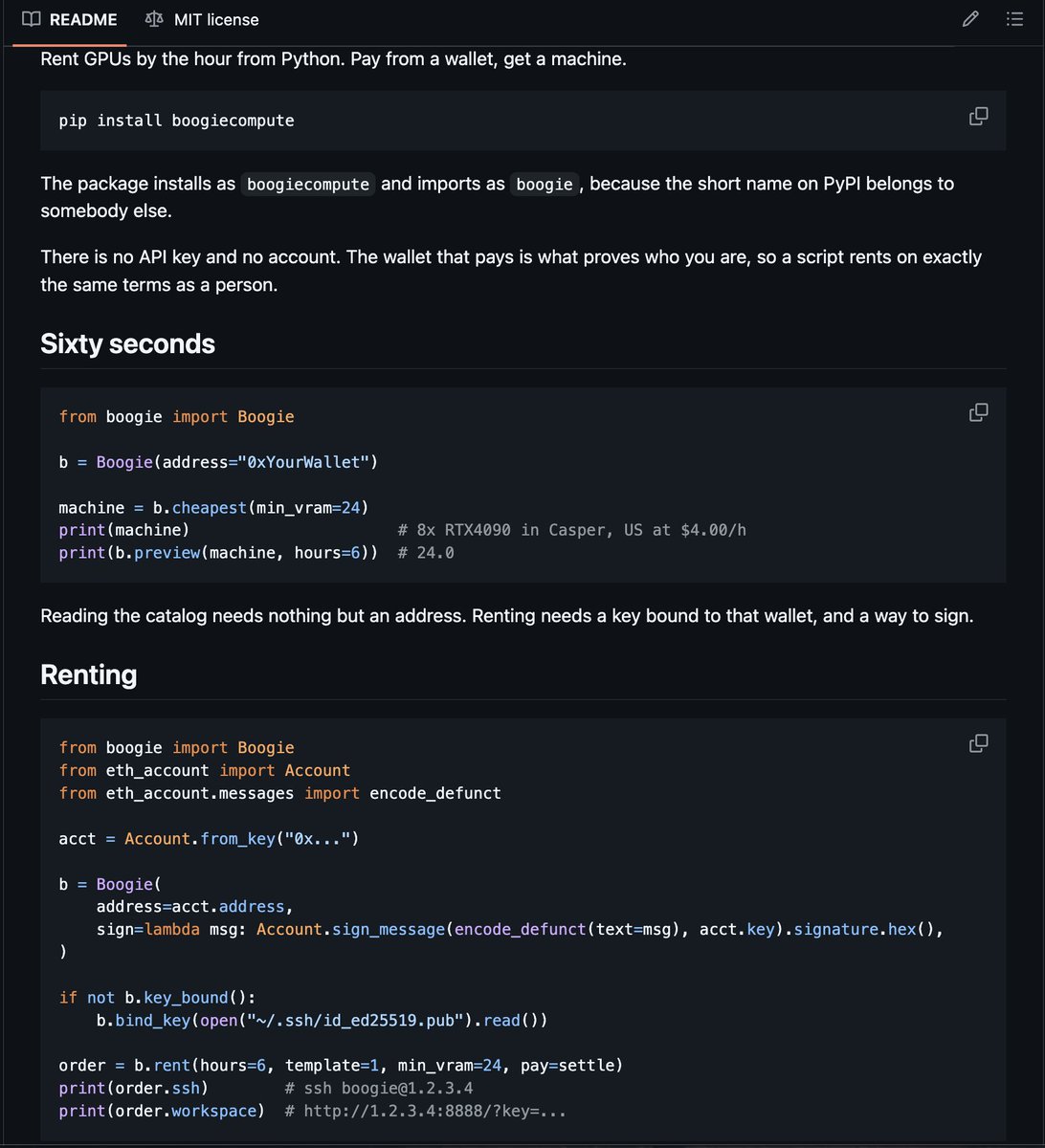
Renting a GPU from Python is now a few lines.
The catalog, the price, the key binding, the machine and the way back out all sit behind one client. order.ssh gives you the login line, order.workspace gives you the browser link once the tool inside is up.
It never asks for a private key. Signing is a function you hand it, and settling the quote stays in your code, so your wallet stays where you keep it.
Machines price themselves per card, because that is the number that actually compares. Errors say what happened, so a machine taken between listing and pricing is something you catch rather than something you parse.
MIT, tests included, no account anywhere.
https://t.co/I3X7W2QdTt
The contract is open.
Every dollar that moves through a rental goes through one contract on Robinhood Chain, and now you can read it: the source, the tests, the deploy script and a working example of renting from code.
It takes a price we signed, pulls your stock, sells exactly as much as the hours cost and returns the rest inside the same transaction. It never holds your equity between orders, and it cannot touch money held against orders that have not been provisioned yet. There is a test for that last one specifically, because that line is the difference between a rental and a rug.
Eighteen tests pass on a clean clone. One of them runs against the live chain rather than a mock, so it proves the whole path.
https://t.co/0isv1E0Y6u
The first wall was never the GPU. It was getting money onto the chain.
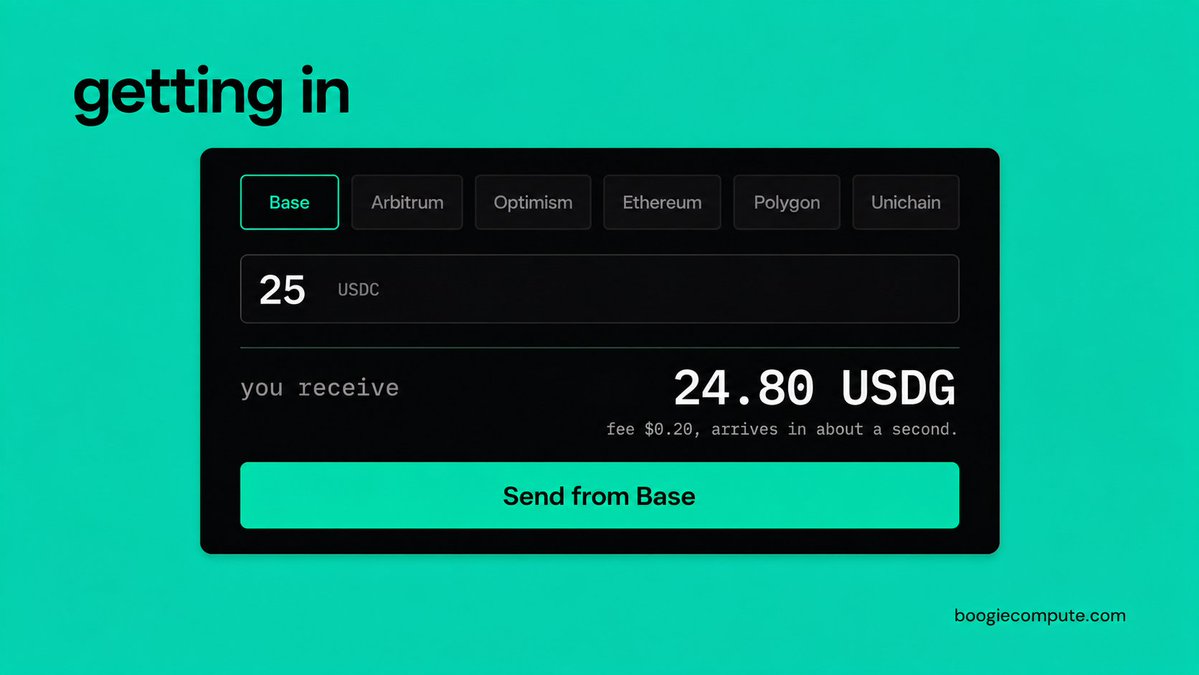
Now that happens inside the dashboard. Pick the network your USDC already sits on, say how much, and it lands here as USDG in about a second, routed by @AcrossProtocol. You see the fee before you sign, and nothing sends you off to another site.
Six networks in, and the wallet switches back on its own when it is done, so you can rent without thinking about which chain you are standing on.
Getting in should not be the hard part.
https://t.co/2ISNJTWGdT
Where this goes next.
Your work stops disappearing. Today a rental ends and everything on the machine goes with it. Next it follows you: the folder rides along to whatever card you rent after that, in another city if you like, and you pick up where you stopped.
Then the other side opens. A card sitting idle in someone's room earns instead of collecting dust. That waits on one thing only, proving the hours a host actually served, because supply nobody can verify is worth nothing to the people renting it.
And agents keep getting more of this by default. They already rent without a human anywhere in the path, and everything we add lands in the same calls they are already making.
None of it needs a new chain, a new token or a new account. It needs the boring parts done properly.
Compute you rent by the hour, that behaves like it belongs to you.
https://t.co/2ISNJTWGdT
Most people who need a GPU do not own one, and have no reason to.
You have a folder of photos to upscale, three hours of interviews to turn into text, a video to restyle, a pile of your own notes you want a model to actually learn, a batch of images to make for work. A laptop does these overnight, or heats up and refuses.
A card you rent for an afternoon does them while you make coffee. When the work is finished it shuts itself down, and you are not left with hardware to maintain, resell or explain to anyone.
The work is short and heavy. Owning is long and expensive.
https://t.co/2ISNJTWGdT
Getting onto the chain was the hardest part of renting here. Now it happens inside the dashboard.
Send USDC from Base, Arbitrum, Optimism, Ethereum, Polygon or Unichain, and it lands on your address as USDG, the currency rentals settle in. @AcrossProtocol carries it, and it usually arrives in about a second.
You see what will arrive and what the bridge keeps before you sign anything. Your wallet switches networks for you and switches back when it is done, so you fund and rent on the same screen without leaving for a bridge site.
The chain was never the point. The card was.
https://t.co/2ISNJTWGdT
Nothing to sign up for, so it is shorter than it looks.
Bridge USDC to Robinhood Chain and it arrives as USDG. @AcrossProtocol does it in seconds. Send a little ETH to the same address too, that is the gas there.
Then open https://t.co/ToGfjY2gMh, connect that wallet, and in Profile press Create a key and sign once. It is free, and no machine starts without a key.
In Rentals pick a card, pick what it should boot with, and pay. When it comes up, press Open.
https://t.co/zqfS6HuEhT
Renting from code got shorter.
Before, a program had to read the catalog, filter it, pick a row and only then ask for a price, and the machine could be taken in between. Now one call does all of it: describe the job and get a machine chosen and priced against the same live list.
Ask for the cheapest card, the fastest to boot, or the one with the most GPUs. Say how much VRAM the job needs, what you refuse to pay above, which country it should sit in, and which workspace it should boot with.
Waiting got shorter too. One call holds the connection until the machine answers and hands back the way in, so there is no polling loop left to write.
And the whole interface describes itself, so an agent can read what it is allowed to do instead of reading our documentation.
https://t.co/zqfS6HuEhT
The machine now arrives with the work already possible.
Before, you opened @ComfyUI to an empty model folder, or a chat with nothing to talk to. Now the models come down while the machine is still booting, so the tool you picked is useful the moment it opens:
ComfyUI arrives with SDXL Turbo by @StabilityAI
The chat arrives with Qwen2.5 by @Alibaba_Qwen, pulled by @ollama and ready to answer
The API serves that same model through @vllm_project
The notebook comes with transformers, diffusers and accelerate already installed
And there is no password to type anywhere. The button in your rental carries the key, so you press it once and you are inside.
Rent a card, open a tab, start working.
https://t.co/2ISNJTWGdT