If you're interested in
- early modern England
- the early English book trade
- social networks & histories
- gender & print culture
- labor history
- material culture
- early modern literature (esp. drama!)
- economic history
- &c.
then you'll want to give us a follow!
It's rare to find a #will that was written in its #testator's own hand, but Bartholomew Downes's (1637) is! He didn't want us crying over spilled #ink, so he left a #note: "the blot that is aboue I did it my selfe bee fore I sealled this my last will Bartholomew Downes"
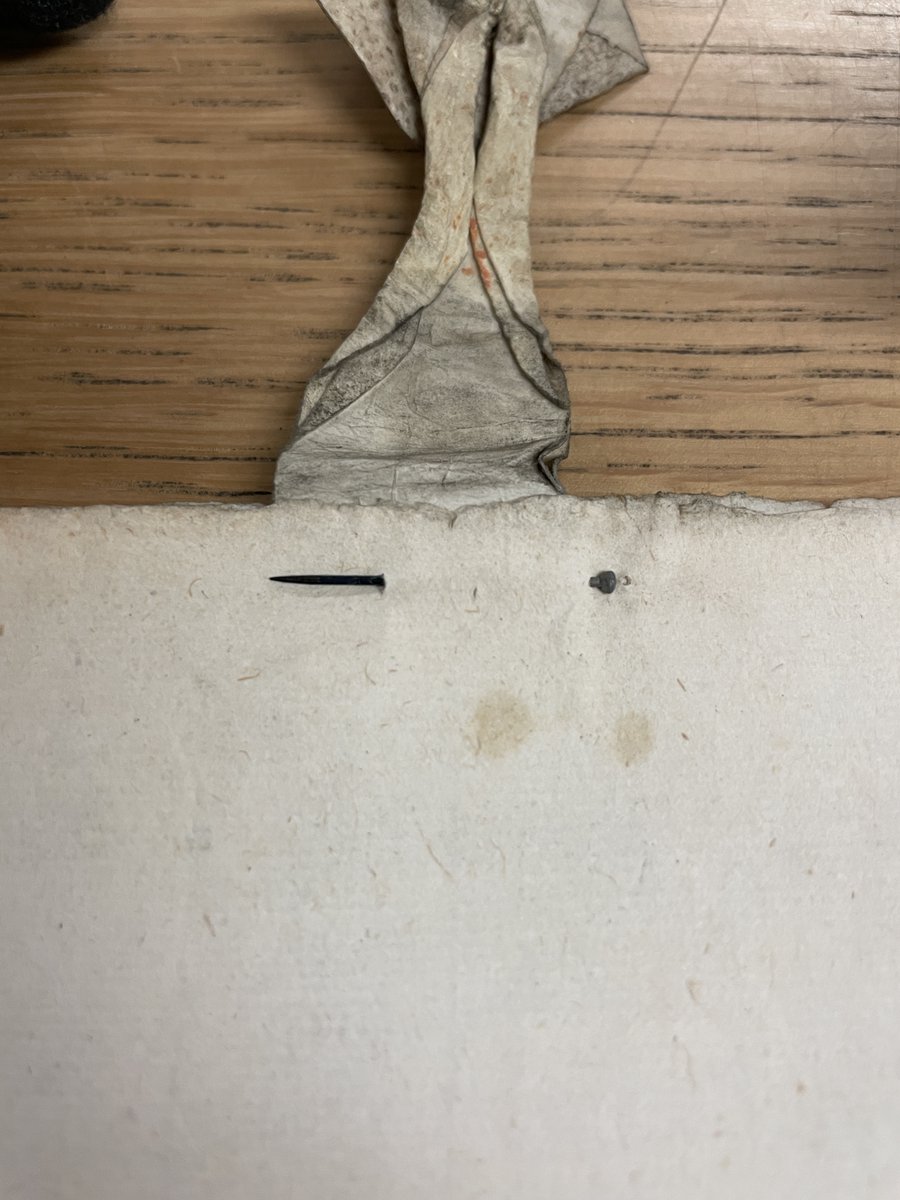
There are some material similarities in how wills were stored; even paper wills have vellum tags at times, and memoranda might be slipped between the folded pages. Other times, they used a pin to attach codicils and memoranda, like this! #MaterialCulture#BookHistory#Probate
My (@bre_weber's) current personal favorite: Thomas Nichols' (1641) skull & crossbones! (If anyone knows or can make out the motto around the outside I'm all ears, it looks like "tempus" and "venit" at least...).
Inventories take a lot of forms: some are on pieces of folded #vellum, but the majority have been vellum rolls. They're often one roll about an inch in diameter, but Luke Meredith's 1700 #inventory is gargantuan in comparison! #twitterstorians#archives#bookhistory#archives
Inventories tell us what a #stationer owned when they died & give us a sense of what their homes looked like. Maurice Atkins's 1688 #inventory details lots of items in his "coffee roome," including "copper potts," a #coffee iron & "some tin things" #twitterstorians#bookhistory
Hercules Francois's 1604 #will explains that while he's living in the city of #London at the time of writing, he was born in #Holland. This unusual comment at the top of the original will notes that it's *actually* a #translation "owte of frenche"! #bookhistory#earlymodern
Hi all! BTP is back on Twitter after a short hiatus, but it has definitely NOT been a hiatus from the project: in fact, we've been pretty busy in London over the past few weeks gathering hundreds more stationers' wills, inventories, administrations, & more for the database!
In case you're curious what this process looks like, it requires a LOT of lists and spreadsheets, microfilm, crumbly document sorting, stacks and stacks of book weights, patience, and no problem at all with grit because it leaves your hands looking like this: