Level up your C++ skills!
Sharpen your code with the latest from the Boost Libraries, powerful, peer-reviewed, and production-ready
New in Boost:
Bloom – High-performance Bloom filters → https://t.co/6RwXF9vxVi
Hash2 – Modern, flexible hashing library → https://t.co/AHvxeFSeQr
MQTT5 – Next-gen MQTT protocol support → https://t.co/jo1zzMKqiD
Explore all Boost libraries → https://t.co/JUOQnr8uhL
When a financial system is overloaded, a cancel order is not just another message.
Critical operations need to be protected even when the system can't process every request. Meanwhile, lower-priority work, such as internal analytics, may have to wait or be dropped.
Priority isn't a nice-to-have. It's part of the system's failure strategy.
Watch the short: https://t.co/M84IbDwrw9
#FinTech #SystemDesign #Concurrency #SoftwareReliability
What happens when a session stops while your pipeline is still running? 🤔
With structured concurrency, cancellation can be built into the design. Define clear scope boundaries, establish a proper cancellation policy, and make sure work stops when it should.
Because reliable systems need more than a way to start tasks. They need a predictable way to stop them, too.
▶️ https://t.co/6m98gTKXv5
#Cpp #StructuredConcurrency #SoftwareEngineering #Concurrency
Modern C++ gives developers powerful ways to describe what types can and can't do.
In this highlight from Using std::cpp 2026, Bjarne Stroustrup explores C++20 Concepts and the tricky rules around narrowing conversions.
🎥 Watch the short: https://t.co/1yk0Nq2Txk
#CPP #ModernCpp #GenericProgramming
Random UUIDv4 primary keys scatter inserts across your B-tree index, so once it outgrows memory nearly every insert lands on a cold page
RFC 9562 fixed that in 2024 with time-ordered UUIDv7. PostgreSQL 18 and Python 3.14 generate them. Standard C++ has no UUID type at all 🧵👇
Boost Blueprint 142: Boost.Uuid
time_generator_v7 produces RFC 9562 UUIDv7s: a 48 bit Unix millisecond timestamp, sub millisecond bits and a counter, then randomness. Generated in order, they sort in order, so new rows land at the end of the index instead of on a random page
time_point_v7() gives the creation time back, and v1, v4, v5 and v6 generators live in the same library
The uuid type is 16 bytes with no allocation, and each generator seeds itself from the OS once
Level up your C++ architecture. Follow @Boost_Libraries for the #BoostBlueprint series
#cpp
Think of CUDA C++ as having two worlds:
🖥️ Host — where your main program runs
⚡ Device — where GPU computations execute
Moving between them isn't implicit. GPU work must be explicitly launched, which is a key concept to understand before diving deeper into CUDA.
Learn the fundamentals with Bernhard Manfred Gruber:
🎥 https://t.co/OGvhY7sGBo
#CPP #CUDA #GPUProgramming #SoftwareDevelopment
Concurrency bugs are more than a performance problem when you're building financial systems.
Under bursty workloads, timing-sensitive issues can threaten the correctness and reliability of an application — precisely when the system is under the most pressure.
Writing concurrent code means thinking beyond the happy path.
Explore the short: https://t.co/8Mr6YWU9eY
#CPlusPlus #SoftwareReliability #Concurrency #Finance
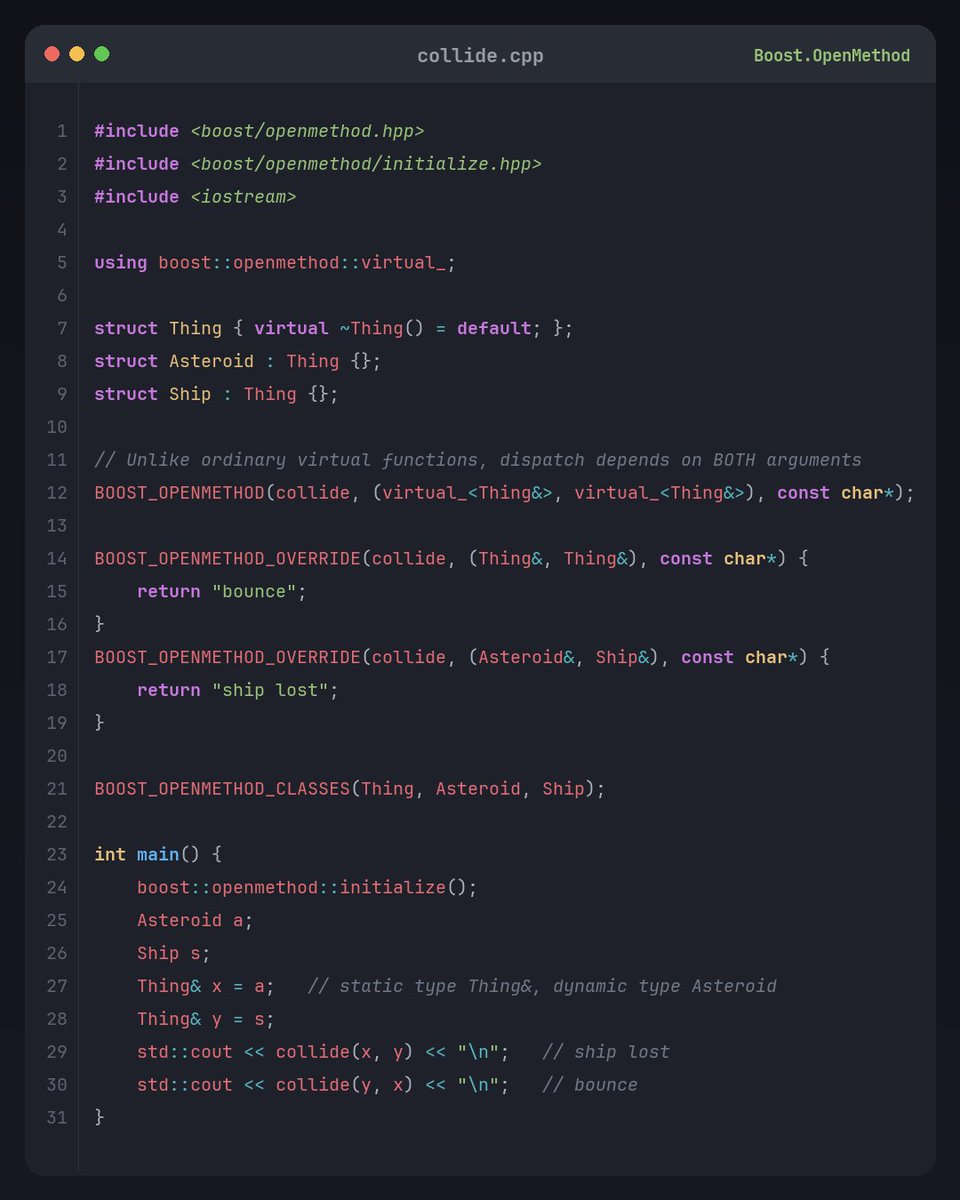
collide(asteroid, ship) needs to know what both objects really are at runtime
C++ virtual functions only check one. Julia and Common Lisp check all of them. Stroustrup co-wrote a 2007 proposal to bring this to C++ but it never got in 🧵👇
Boost Blueprint 141: Boost.OpenMethod
BOOST_OPENMETHOD lets you write a free function that acts virtual in as many arguments as you want. It checks the real type of every argument and calls the most specific match. A version written for the base class handles everything else
Methods live outside your classes. So you can add new behavior to a class hierarchy you don’t own, with no visitor and no changes to its code
Each call is a table lookup that takes constant time, just like a virtual call
Level up your C++ architecture. Follow @Boost_Libraries for the #BoostBlueprint series
#cpp
One function. Two references. One subtle C++ bug.
Passing a vector and a reference to one of its elements into the same function creates an aliasing hazard. If push_back() reallocates the vector, that element reference can become dangling.
The lesson? Always think about how your references interact with container operations.
▶️ https://t.co/VTtZPeLT7m
#Cpp #Aliasing #MemorySafety #SoftwareDevelopment
Still writing C++ like it's 1998? It might be time for an upgrade. 🚀
The language has evolved, and so should the way we write it. Instead of manually managing every step, modern techniques let you express transformations more directly and make code easier to read and maintain.
Less boilerplate. More intent.
▶️ https://t.co/X2JkcAyiEN
#CppProgramming #ModernCpp #CppCon #DeveloperTips
A std::vector can make your code look clean and modern — but references to its elements still have rules you need to understand.
If an operation reallocates the vector's storage, existing references and pointers to its elements can become invalid.
Small details like this can turn into serious bugs.
Watch the short: https://t.co/L4kqaejgkk
#CPlusPlus #STL #Cpp #Debugging
💡 Stop telling the compiler how to do something. Start expressing what you want.
Modern C++ lets you move beyond manual loops, iterators, and boilerplate mechanics toward clearer, more expressive code. Get the map, filter the values, collect the results. Focus on intent—not plumbing.
See how modern C++ changes the way we think about code.
▶️ https://t.co/X2JkcAyiEN
#Cpp #ModernCpp #CleanCode #SoftwareEngineering
std::hash<std::string>{}("hello") can produce different numbers on libstdc++, libc++ and MSVC. That’s allowed
More surprising: the standard doesn’t promise the same hash across runs of the same program. Persist it to disk or send it over the wire and you’ve shipped a bug 🧵👇
Boost Blueprint 140: Boost.Hash2
The interface was proposed to the C++ committee in N3980, “Types Don’t Know #.” Boost shipped it
Hash2 separates what you hash from how you hash it. Pick a specified algorithm (xxhash, FNV-1a, SipHash, SHA-2 and more) and feed it any type with hash_append
Use fixed-width integer types with a fixed byte order flavor and the same struct produces the same hash on every compiler, OS and CPU. Safe for cache keys, content addressing and on-disk indexes
SipHash with a random key adds hash flooding resistance, which std::hash never promised
Level up your C++ architecture. Follow @Boost_Libraries for the #BoostBlueprint series
#cpp
There's a lot of clever thinking behind something as familiar as:
std::sort(...)
Joaquín M. López explains how iterator concepts let algorithms express their requirements—and why the whole system is so powerful.
From Using std::cpp 2026 🎥 https://t.co/L4ZqocGPL4
#CPP#Coding #Programming