I’d like to return to this thread where I referred to the game industry as being a trash fire. Some corrected me to talk about record profits. How about record layoffs? I am fucking bereft at the state of it.
Filipa Pipiras only needed to show up to both her games on Day 5 to get the WGM title.
But she did more than that! In the first game, she faced GM Namig Guliyev (2481), higher-rated than anyone she ever defeated before, and she beat him! 🇵🇹😮
https://t.co/EVKCQiKEW7
📷: Baku
The Next Two Years of Software Engineering https://t.co/uIJSBJdzVa < these are five crazy-relevant questions to ask of yourself and your team. @addyosmani then offers strong recommendations to consider.
@kumarraviii The issue with the lost airplanes has very little to do with the conflict or the ability of the indian air force. The concern is that a number of Rafale fighters (NATO compatible platforms) were downed so easily by equivalent chinese weapon systems.
Lately, I've gotten a lot of flack suggesting that hand optimizing for speed is often a waste of time. Let's drill into that. Your job as a developer is to make your users' lives easier. You discover how to do that through conversations with them (without some intermediary—you don't want to be playing "telephone.") They'll tell you the problems that they're having, and you work together on solutions. They don't "demand" anything, but if you don't keep them happy, you won't have a viable business.
Technical stuff inside the solution is not a user's concern at all. The same applies to "stakeholders," who have no business dictating technical decisions. However, the devs can't just do what they feel like, and often, things that devs deem necessary and desperately want to do (because it's "better," whatever that means) have zero impact on user/customer satisfaction.
The speed issue is a case in point. Sure, if greater speed in certain parts of the program makes the users happier, work on that. If lack of speed has a direct impact on the business (measurable revenue decrease greater than the cost of doing the work), then work on that. Working on speed anywhere else tends to be waste.
It's a common anti-pattern for developers to get caught up in the tech without considering the users or the business. In fact, many developers deliberately distance themselves from both the customers and the business, saying, "It's not my job." Working on unnecessary technical "improvement" does active damage to the business's bottom line, however. Money is spent without a concomitant increase in revenue, and time is added to getting things out the door. Don't do that.
People seem to hate microservices with the same vehemence that they hate OO, and in both cases, what they hate is not the thing itself but bad realizations of the thing. (A microservice system is effectively an OO system—services are effectively objects communicating via messages.) Like all architectures, distributed ones make a great deal of sense when you can leverage their strengths and don't care as much about the downside. Netflix is made up of ~6,000+ microservices because that gives them the elasticity, fault tolerance, and absence of downtime that they need to service millions of customers simultaneously. The speed loss is less important to them, and they're willing to pay the cost of the additional hardware. The problem is the companies with 100 customers, an overly complex product idea, and they think they're Netflix.
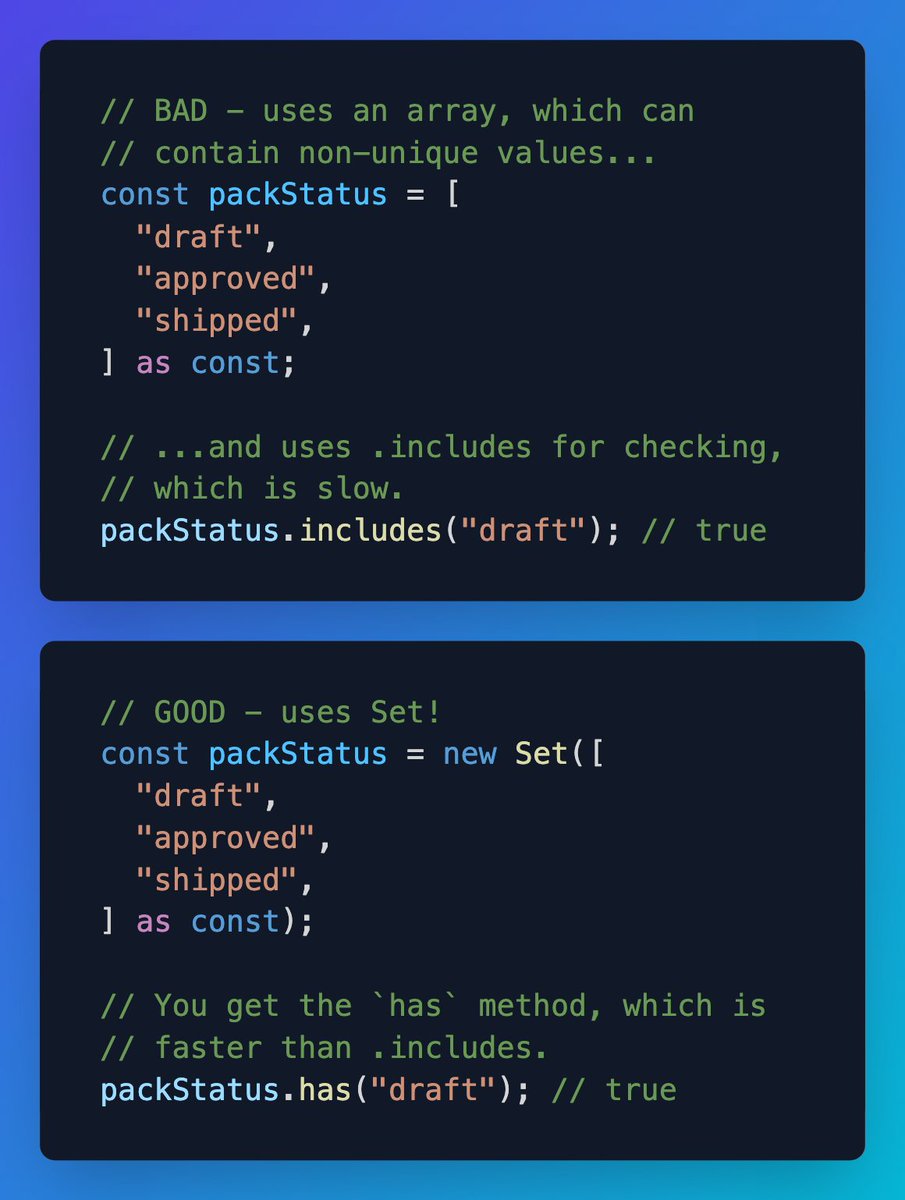
Let's start with a bit of context. I like enums. I like them a lot. I would really like JavaScript to have them.
But TypeScript's implementation of them is weird enough for me not to recommend them.
Here's the section on them in my book:
https://t.co/9Nkmi4PUjH
Don't ask "how long will it take." Instead, ask "can I make this smaller?" Very different questions with very different activities resulting from the answer.