Last day on X for me, the posts in here are getting more and more crazy. The amount of bots is insane at this time. Hope the alternatives will provide more of the old twitter spirit.
@BQPMalfoy Way too expensive, still shorter N50 than ONT and Pacbio and most likely still not closed genomes for most bacteria. I really dont see the potential within mircobiology at least.
@biorxiv_genomic Title sounded cool but very misleading comparisons in the manuskript hopefully the reviewers will make the effort the require improvements.
@mehio_rami@CatharineAquino@GenomicsCow@illumina Thanks Rami! If you send me a DM then I can send you my work e-mail and we can get you up to date. We had a good meeting with the Nordics team 2 weeks ago and forwarded them a rapport.
@environmicrobio @nanopore It’s most likely your sample extraction. The short estimated lengths will drop further after basecalling and the 4 kb are already not hmw. If this is the rapid kit then there are so few steps that it is unlikely to be the library prep steps that fragments it.
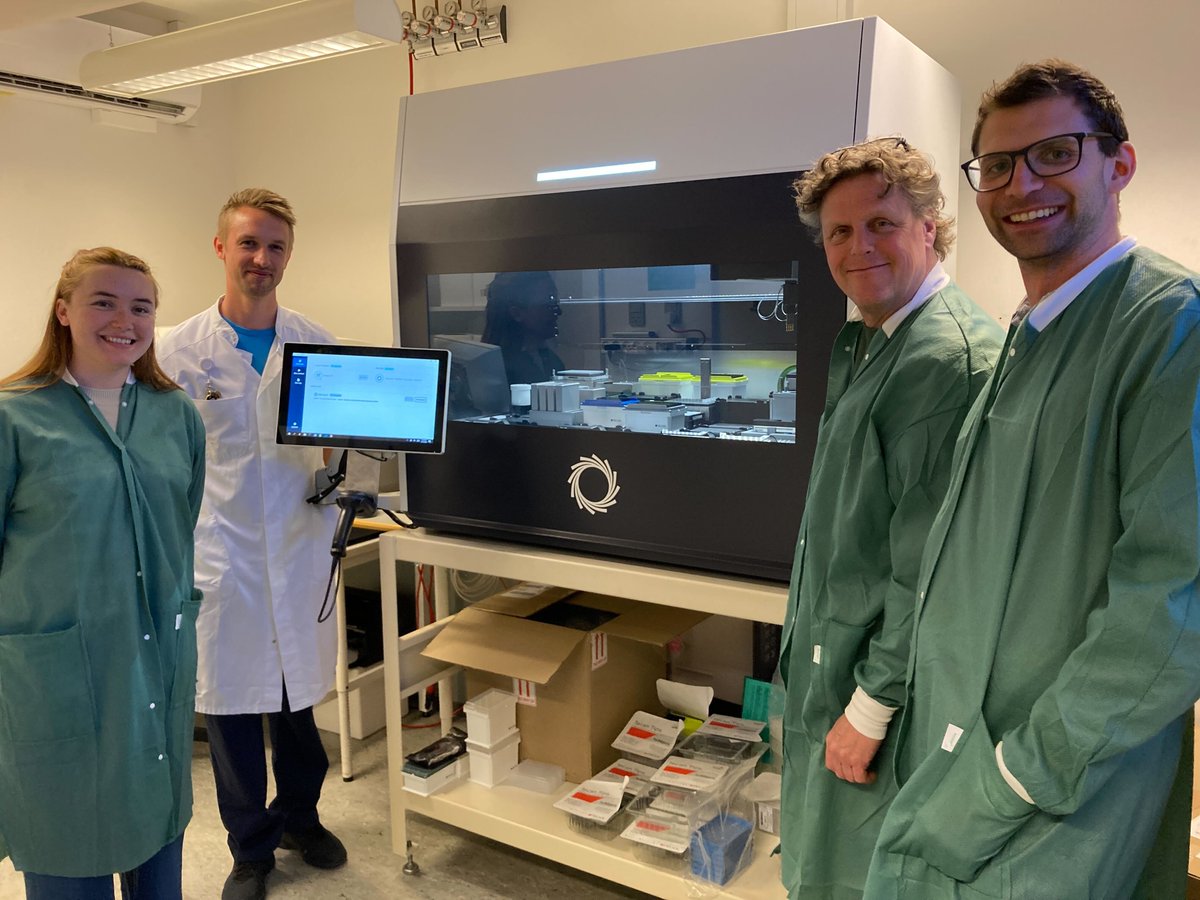
We are happy to test it out and see what the future brings! So far we are relieved to see it handle all the different species we throw at it. I’m super thankful for the ONT Nordic and implementation team, a smooth ride so far. @nanopore@Rigshospitalet#turbot
TurBOT's ready to go!
The team at @RegionH are leveraging the fully automated, cutting-edge device to enhance their microbial and clinical research capabilities.
Learn more about TurBOT: https://t.co/238ikl2iLP
More updates coming next week at #nanoporeconf. @Born2bewildtype
I don’t know if it ever will feel normal to place your samples on the machine and just go home 😀
It truly is walk away and come back next day and look at the sequencing report.
TurBOT's ready to go!
The team at @RegionH are leveraging the fully automated, cutting-edge device to enhance their microbial and clinical research capabilities.
Learn more about TurBOT: https://t.co/238ikl2iLP
More updates coming next week at #nanoporeconf. @Born2bewildtype
Kindly: please retweet if you see this important notice.
Today at @officialatcc, we announced a change to the access model for the ATCC Genome Portal (https://t.co/rykh2Qf2yH). In order to maintain its long term sustainability, we are transitioning to a Supporting Membership access model on May 1st, 2024.
Members, groups, or institutions who opt in to support the AGP will continue to have access to ALL our microbial genomics data, our REST-API, recieve quarterly updates as we release new authenticated genome references to the portal (~1,000 new genomes per year), and get access to new tools for assessing the quality and accuracy of existing genomics data and reference genomes. We have many such tools on the roadmap, the first of which will be Descrepency Report tool that will compare raw sequencing data provided by end-users against our reference genomes, and provide both an easy to interpret (human-readible) report (PDF) and a machine-readable JSON, BAM, BED, and VCF files. More tools, additional data types, phenotypic data, and extensive re-curation efforts are planned, but I would love to hear feedback about what sorts of things might be of most use to you. Finally, access to the entire database and tools we develop doesn't require purchasing physical materials from ATCC, only that you opt-in to be a supporting member.
For ATCC customers who decide not to opt-in for supporting the ATCC Genome Portal, we will still provide them with access to authenticated reference genome assemblies for the microbes they purchase from ATCC. So, if you purchased (for example) a bacterial strain from ATCC in the past, you will be able to still access the reference genome, annotations, and metadata for that strain directly from the ATCC Genome Portal. It's extremely important that we continue to provide customers with access to verified/authenticated reference genomes for the materials they obtain from us. These data is produced by our ISO-certified genomics lab (the ATCC Sequencing & Bioinformatics Center, my group ☺️), and is not found anywhere else.
The last three years has been a wild ride as we started sequencing the entire collection. About 30% of the microbes we've sequences have never been sequenced before by anyone anywhere in history. It's very cool when you think about it! ☺️ And - wow... my team has grown from 5 to 20 in that time, and both our sequencing and bioinformatics capabilities have increased by orders of magnitude. This has been, and continues to be, a major investment by ATCC into the authenticity of both our biological materials and the data associated with those organisms. I'm really looking forward to the next three years too - and beyond - as we continue to sequence all these interesting bugs. But do to this, we'll need the help of the community to continue supporting this extensive program.
I'm very happy to answer questions and take suggestions from the community as well - so please feel free to send me DM via Twitter or LinkedIn (see profile for link). And thanks again to everyone for their continued support 🥰🧬
-- Jonathan
#genomics #microbiology #bioinformatics #dataprovenance #science #reproducibility #bacteriology #virology #mycology https://t.co/rykh2Qf2yH
@bioinformer@kirk3gaard@nanopore Great observation for those doing hybrid assemblies, have you observed a need for lower amount of Illumina reads for polishing?
@kirk3gaard@nanopore I fear the pricing to be honest. But our hope is that it will allow us to take the afternoon samples and put them on the turbot before the lab closes and let it handle extraction, prep, loading, analysis and have the results ready the next morning for the clinicians.