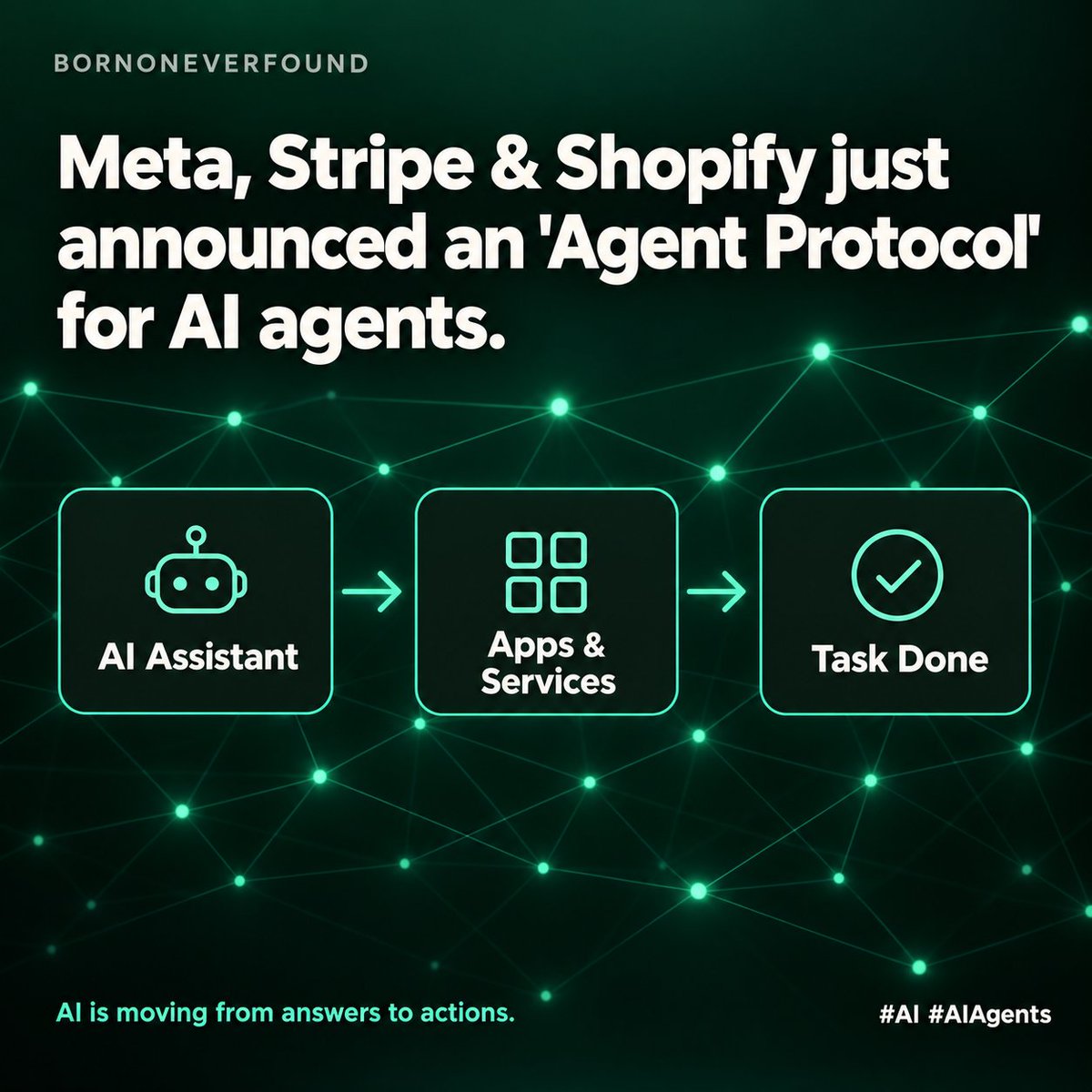
Meta, Stripe & Shopify just announced a joint “Agent Protocol” for AI agents.
Translation: AI assistants may soon book, buy, and manage tasks across apps without friction.
Agents are becoming the next big platform shift. 👀
#AI#AIAgents#TechNews
Before you buy a domain, check these 10 registrars!
Cheap & trusted options:
1️⃣ Namecheap - affordable, simple, free WHOIS privacy
2️⃣ Cloudflare Registrar - at-cost pricing, no markup
3️⃣ Porkbun - low renewal fees, lots of TLDs
4️⃣ Hostinger - domain + hosting in one place
5️⃣ GoDaddy - biggest name, often has discounts
6️⃣ Spaceship - modern UI, easy management
7️⃣ Dynadot - good for bulk domain buying
8️⃣ https://t.co/DctVxFtjYu - easy setup, solid support
9️⃣ IONOS - good for business sites
🔟 Squarespace Domains - great for portfolio/brand sites
What’s your brand name? Drop it in the comments and I’ll suggest which domain would work best!
#Domain #WebsiteBuilding #DigitalMarketing #Tech
Gemini 4 Argon just topped two major benchmarks.
Here are the full numbers.
Knowledge Work:
Gemini 4 Argon: 68.9%
Claude Sonnet 5.5: 67.0%
Claude Opus 5.5: 67.0%
Claude Fable 5.1: 65.8%
Gemini leads by 1.9 points over the closest competitor.
Coding:
Gemini 4 Argon: 77.9%
Claude Opus 5.5: 74.2%
GPT-6 Astra: 74.1%
Claude Fable 5.1: 67.4%
Gemini leads by 3.7 points over the closest competitor.
Two categories. Two wins. Both against the strongest models from Anthropic and OpenAI.
This is Google's first flagship since February 2026. It was announced September 30 and is now reaching users.
The knowledge work score matters because Claude has been dominant there. The coding score matters because GPT-6 was expected to lead.
Google beat both at their own game.
The AI race is no longer two-horse. Google is back in contention. Anthropic is still strong. OpenAI is still in the game. And now Mistral, Reflection, and Cloudflare are shipping competitive models too.
The frontier is crowded again. That is good for users.
Hashtags:
#AI #Gemini #Google #Benchmarks #Tech
The AI Nobody Talks About
Day 5
Behind every AI model you use, there are thousands of invisible workers in developing countries earning less than $2 per hour.
They label data. They moderate content. They transcribe audio. They tag images. They teach the AI what is safe, what is correct, and what is appropriate.
Without them, AI does not work.
Here is what most people do not know:
Companies like OpenAI, Google, and Meta outsource data labeling to countries like Kenya, the Philippines, and Venezuela. Workers there are paid between $1.50 and $2.00 per hour.
Their job is to look at disturbing content violence, hate speech, explicit material and label it so the AI can learn to recognize and reject it.
Many workers report psychological trauma from this work. Some develop anxiety, depression, and PTSD. The companies that employ them often provide little to no mental health support.
The AI industry calls this "data annotation."
The workers call it something else.
The next time you use an AI tool and it gives you a safe, helpful answer, remember:
Someone in a developing country was paid $2 to look at the worst content on the internet so that you would not have to.
That is the hidden human cost of AI.
And it is not in any model card.
Hashtags:
#AI #TheAINobodyTalksAbout #HiddenFacts #DataLabeling #Tech
Training one AI model costs more than the lifetime income of 10,000 people.
Here is the math.
Training a frontier AI model costs between $50 million and $100 million. Some estimates put it higher when you include the compute, the engineering team, the data infrastructure, and the months of electricity.
Now compare that to human income.
The average annual income in the United States is roughly $60,000. Over a 40-year career, that is about $2.4 million.
A single AI model training run costs the lifetime income of roughly 20 to 40 average Americans.
And that is just one training run.
The scale becomes clearer when you look at the industry.
OpenAI. Anthropic. Google. Meta. Mistral. Each is training multiple models per month. Each run costing tens of millions. Some runs costing hundreds of millions.
The total annual spend on AI training across the industry is estimated at over $50 billion.
That is more than the GDP of most countries.
What do you get for that investment?
A model that can write, reason, create, and solve problems. A model that can replace certain jobs, accelerate others, and create new categories of work that did not exist before.
But here is the question nobody asks:
Who owns the value created by these models?
The companies that paid for the training. Not the workers whose jobs are displaced. Not the users whose data was used. Not the countries that paid for the infrastructure.
The value flows upward. The costs are distributed downward.
The next time someone tells you AI is democratizing opportunity, ask them:
Democratizing for whom?
Hashtags:
#AI #Economy #HiddenFacts #Tech #Inequality