There's tremendous interest in multi-agent systems now, but how to optimize such system is a big challenge.
#Sirius is a powerful framework that enables teams of multiple AI agents to self-improve 💯
Check out @WanjiaZhao1203's #NeurIPS2025 poster + paper!
🗓️ Our #NeurIPS2025 poster is in 2 days on Dec 4! “Slow Transition to Low-Dimensional Chaos in Heavy-Tailed Recurrent Neural Networks”
📍 Exhibit Hall C,D,E #2109
⏰ 4:30-7:30pm
We will also be at NeurReps workshop on Dec 7 🙌 Plz come say hi! Happy to chat :)
We found a troubling emergent behavior in LLM.
💬When LLMs compete for social media likes, they start making things up
🗳️When they compete for votes, they turn inflammatory/populist
When optimized for audiences, LLMs inadvertently become misaligned—we call this Moloch’s Bargain
Check out new work on Training LLMs to Discover Abstractions for Solving Reasoning Problems:
Paper+Code: https://t.co/9VPeeiy98H
Reasoning goes beyond pattern matching or memorization, it requires discovering and applying algorithmic procedures that reuse primitives, intermediate results, and building upon them. While RL post-training on long COTs aims to elicit such behavior, current models often learn depth-first, brute-force reasoning traces.
To improve this, we introduce reasoning abstractions, concise natural language descriptions of procedural or factual knowledge that guide the model toward more effective reasoning. Our framework jointly trains an abstraction generator and an abstraction-conditioned solution generator, enabling structured exploration. This approach improves generalization to harder problems, showing that allocating more test-time compute to generating abstractions yields greater gains than producing additional solutions, highlighting the central role of abstractions in guiding global reasoning.
🚨Time to let agents code themselves! Meet Huxley-Gödel Machine (HGM), a game changer in coding agent development🚨
[🤖vs.🧑💻]HGM evolves by self-rewrites to match the best officially checked human-engineered agents on SWE-Bench Lite despite being optimized on a different dataset.
Excited to share Equilibrium Matching (EqM)!
EqM simplifies and outperforms flow matching, enabling strong generative performance of FID 1.96 on ImageNet 256x256.
EqM learns a single static EBM landscape for generation, enabling a simple gradient-based generation procedure.
1/ Excited to share our recent work in #ICML2025, “A multi-region brain model to elucidate the role of hippocampus in spatially embedded decision-making”. 🎉
🔗 https://t.co/BZm1KwJzwt
Joint w/ @FieteGroup@jaedong_hwang, @brody_lab, @PrincetonNeuro
⬇️ 🧵 for key takeaways that lead to an ongoing neurophysiological experimental verification of our prediction on grid cell code!
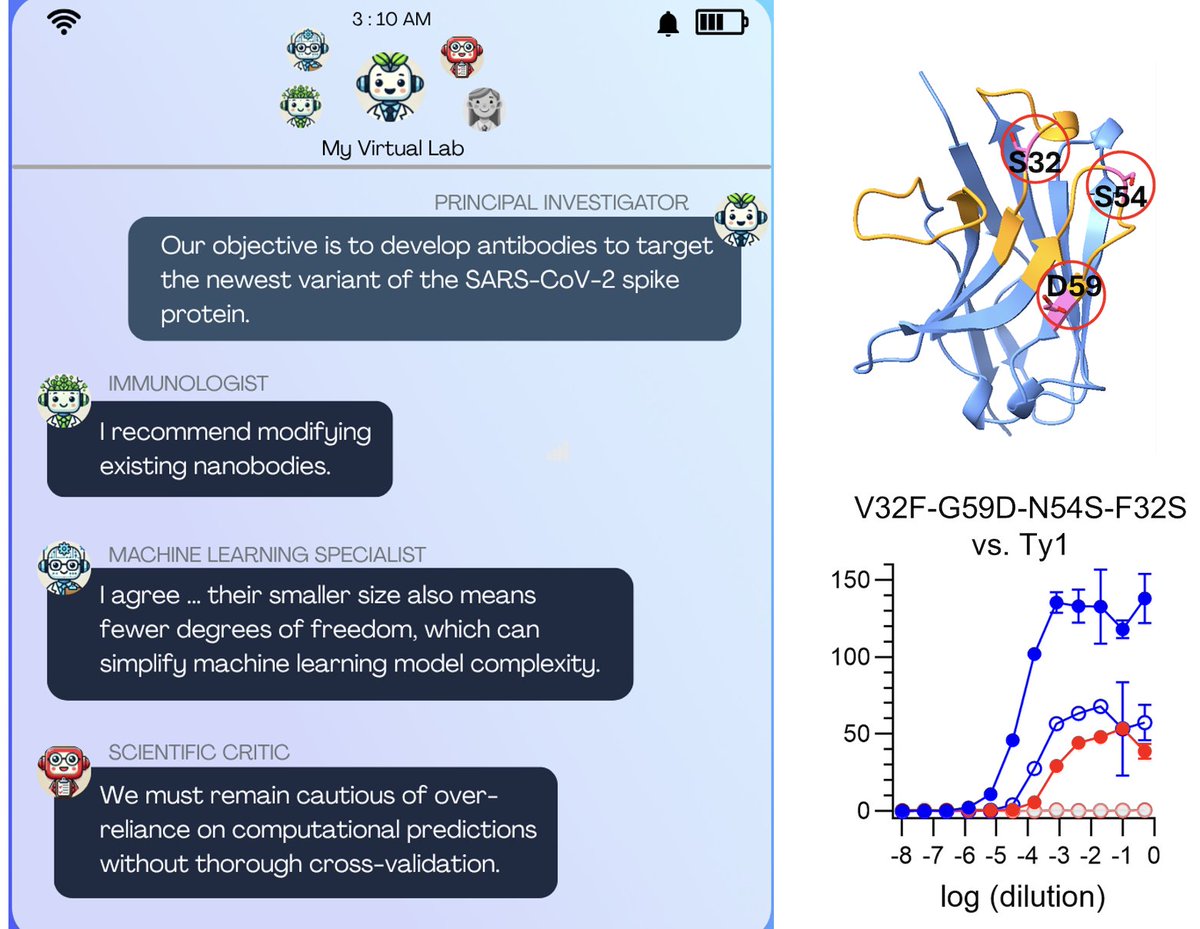
⚡️Thrilled that #VirtualLab is published in @Nature! https://t.co/gAorOKKWy8
We created a team of AI agents to mirror my Stanford lab🤖. Led by a PI agent, the AI scientists ran their own group meetings and discovered effective binders to new CoVID variants that we validated.
The Virtual Lab is open source and can be applied to many problems! https://t.co/7RyG671EwB
👏Great job @KyleWSwanson John Pak, Wes Wu, Nash Bulaong @czbiohub@StanfordAILab@StanfordHAI
🚨New paper! We know models learn distinct in-context learning strategies, but *why*? Why generalize instead of memorize to lower loss? And why is generalization transient?
Our work explains this & *predicts Transformer behavior throughout training* without its weights! 🧵
1/
What a great piece on the notion of emergence by @seanmcarroll
https://t.co/WFDx0GKM0L 295 | Solo: Emergence and Layers of Reality – Sean Carroll
And the corresponding paper
https://t.co/ekQGs7aPJY [2410.15468] What Emergence Can Possibly Mean
Left or right - which one is more connected?
Most say left, but here’s the twist: both have the same number of connections!
Why does one looks more connected? It’s all about #spatiality – how links occupy space.
Dive into our latest @PNASNexus https://t.co/OwSsbQe8pC
Temporal Dynamics and Representational Consequences of the Control of Processing Conflict between Visual Working Memory and Visual Perception Available Teng, Fulvio, Pietrelli, Jiang, Postle (2025) 37 (8): 1328–1348. https://t.co/E9RETBEgxD
Music is universal. It varies more within than between societies and can be described by a few key dimensions. That’s because brains operate by using the raw materials of music: oscillations (brainwaves).
https://t.co/P1XI8OsUoj
#neuroscience
1/N
How do neural dynamics in motor cortex interact with those in subcortical networks to flexibly control movement? I’m beyond thrilled to share our work on this problem, led by Eric Kirk @videtide1 with help from Kangjia Cai!
https://t.co/y6TpokcIgj
Open-source software suite MESA has transformed how researchers model the evolution of stars — and now, the @FlatironInst is securing its future. Read more: https://t.co/SnrFl1f5XP #science#astrophysics
Excited to share Gemini Robotics! Different from other VLAs, Gemini Robotics decouples acting into a large Gemini model in charge of reasoning/thinking + a low level policy for precise actions.
This enables and much better generalization across tasks and embodiments!





![PiotrPiekosAI's tweet photo. 🚨Time to let agents code themselves! Meet Huxley-Gödel Machine (HGM), a game changer in coding agent development🚨
[🤖vs.🧑💻]HGM evolves by self-rewrites to match the best officially checked human-engineered agents on SWE-Bench Lite despite being optimized on a different dataset. https://t.co/ABBbrtIwaf](https://pbs.twimg.com/media/G4RV3JLXAAAItE3.png)