‼️ BREAKING - A newly discovered #WordPress pre-auth XSS affects every version.
XSS2Shell (CVE-2026-64638) can run attacker-controlled JS in a site's origin without a login. With a logged-in Administrator, one click, and required deployment conditions, it can be chained to PHP code execution.
Update your WordPress sites ASAP 🠖 https://t.co/WxHpU2DkIC
🚨 A Chinese-speaking threat actor used DeepSeek to autonomously find exposed systems, choose public exploits, and launch attacks after an initial Telegram command.
Experts say the wider operation attempted to exploit 460+ targets.
Read the full story → https://t.co/MpXtLpG76y
Kimi K3 AI reportedly found 19 Redis zero-days in about 90 minutes.
Another run reportedly produced a Redis 8.8.0 RCE exploit in 27 minutes. Redis confirms the flaws and fixes, but not the count, timing, or autonomy claims.
We are announcing a long-term strategic partnership with NVIDIA. NVIDIA is making a substantial investment in SSI that will let us 10x our compute in the next 12 months. We reached the point where our research is worth scaling and with this partnership we will be able to. We are honored by NVIDIA’s conviction.
Releasing the model weights and technical report of Kimi K3.
Kimi K3 is our most capable model: a 2.8T MoE model with native visual understanding and a 1M-token context window.
New model architecture: 2.5x the intelligence per unit of compute, not just more params.
Alongside Kimi K3, we're opening up more of the stack behind it — high-performance attention kernels, MoE communication library, and infrastructure for running agent environments at scale.
Model weights: https://t.co/7m7eEg6Y0B
Tech report: https://t.co/yeu6cjpMCT
Tech blog: https://t.co/YTfiMSNM1f
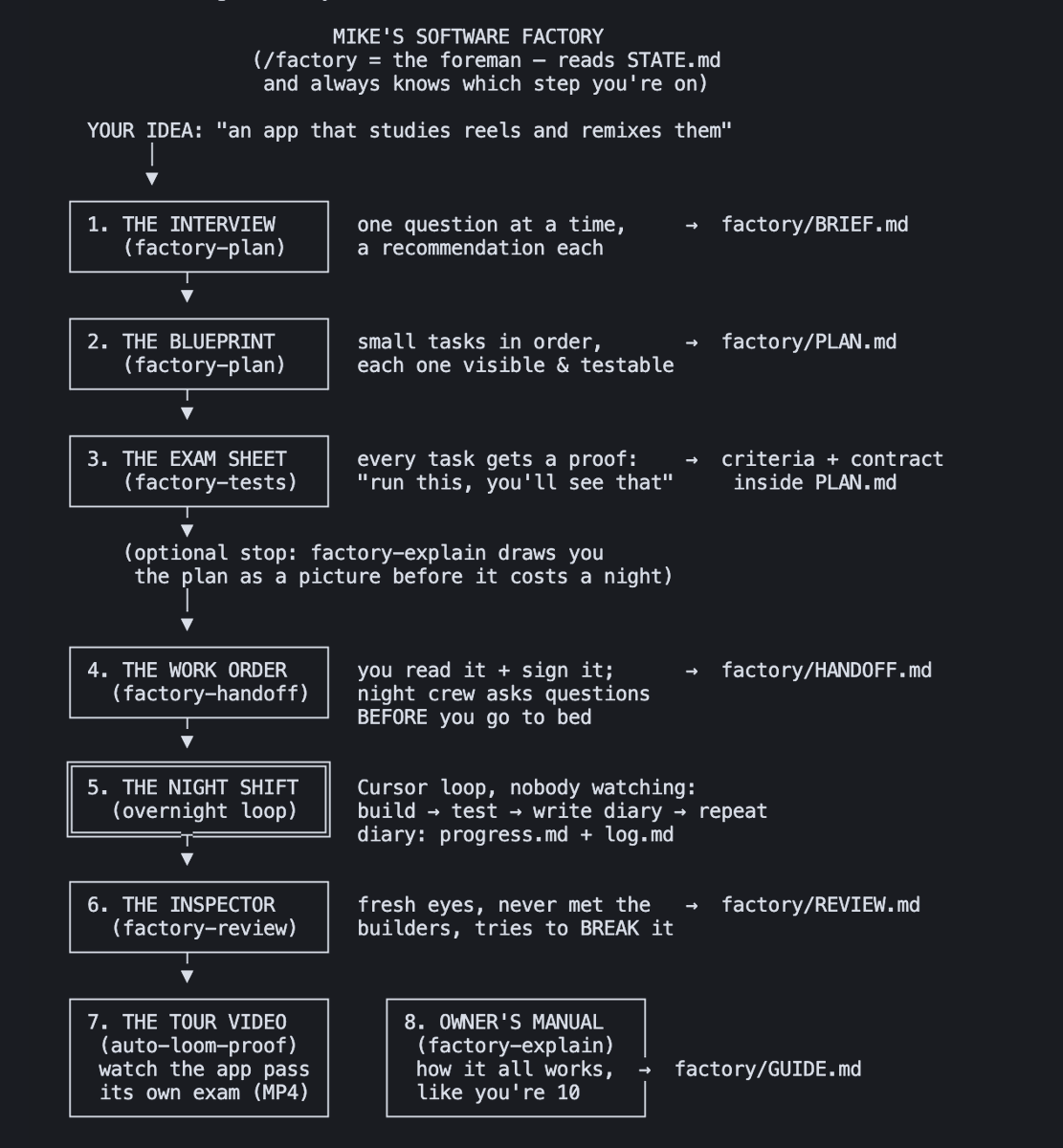
This is my personal software factory.
It turns ideas into working products while I sleep. No babysitting coding agents with prompts all day.
Cursor and Claude Code made writing code way easier. The harder problem is building a system that can context engineer and manage itself.
My factory starts with a Skill called `/factory`. It's the foreman that remembers where the project stands and sends in the right worker for the job.
Factory runs this assembly line:
1. `/factory-plan` - the interviewer
Reads the existing codebase (if there is one), extracts missing context from me via interview, and writes a product brief.
2. `/factory-plan` - the planner
The same skill turns the approved brief into small, testable features and development tasks.
3. `/factory-tests` - the professor
Before anyone writes code, every task gets an exam. This skill defines the success criteria for each task, and how the coding agent can prove to itself that what it built works or needs iteration.
4. `/factory-explain` - the presenter
Explains the plan to me like I'm 10, with visual metaphor and mermaid charts. Now that coding agents can write more code, faster than any human ever could, the new bottleneck is human understanding of the code. This skill solves that.
5. `/factory-handoff` - from CTO to SWE
This packages the brief, plan, tests, safety rails, and stop conditions into one work order. Factory uses the best models for the planning in the previous steps above, then hands the work order to a lower token usage model like Grok 4.5 for execution.
6. Cursor or Claude Code `/loop` - the coffee
The night shift picks one task, builds it, takes its exam, records what happened, iterates if needed, then moves onto the next task. If it gets stuck, circuit breakers stop it from confidently digging a deeper hole while I sleep.
7. `/factory-review` - the teacher grades the homework
The student doesn't grade it's own homework. A fresh agent that never met the builder tries to break the result. The reviewer rereads the original plan, reruns tests, and finds anything that's broken.
8. `/auto-loom-proof` - shows the evidence
Uses browser use and screen records itself performing the tests and adds an 11labs voiceover explaining what's being proven. It sends me the narrated demo video.
9. `/factory-explain` - the code
The factory updates a plain-language owner's manual explaining what actually got built. I understand my own codebase, so I can make decisions without becoming the bottleneck or outsourcing my thinking to AI.
NOTE ON BUILDING AI
Cursor and Claude Code have made writing code dramatically easier. But getting AI to work reliably and at scale for you can't be fully automated.
LLM-as-judge helps, but a judge needs a rubric, examples, and input from someone with subject matter expertise. You still need a human reviewing the work and teaching the system how to perform better.
You can check out my factory on github in the post below.
🚨A novel way to do RL in LLM post-training!
Inspired by our previous path-not-taken work (https://t.co/hKe4qkgiXL), we dig deep into the learning trajectory of RL and find that optimizing singular vectors (i.e., rotation) of weight matrices suffices for good performance in RL. The resulting “isospectral optimization” reaches matched scores with substantially fewer training steps.
Great work from @zhu_hanqing666 and the co-authors!
Many LLM-based optimization algorithms have been proposed recently. We find that GEPA, AutoResearch, and Meta-Harness each win on different tasks and no single LLM optimizer wins everywhere.
How do we leverage the complementary performance profiles of these optimization algorithms?
Today, we release optimize_anything omni: a meta-optimizer that leverages the best of each optimizer. At a matched budget, omni beats every standalone optimizer. (thread)
we're launching BUZZ!
a new groupchat platform for teams of people and agents of all sizes, built to reduce our dependency on slack and github. model-agnostic, decentralized, self-sovereign, and open source. 🐝
https://t.co/8IaMVeTQNo
The world is not just made of words, and spatial intelligence was never just about perceiving and generating worlds. It's about interacting with them.
Today, SceniX is joining World Labs. 🌎🤖👇
Presenting our ICML 2026 poster tomorrow! 🚀
Come by if you’re interested in coding agents, benchmark quality, or AI evaluation—we’d love to chat!
SWE-ABS shows that SWE-Bench doesn’t just reject correct patches—it also accepts incorrect ones.
📊 19.78% of “solved” patches from top-30 agents are actually wrong.
📉 Every top-30 ranking changes after strengthening the tests.
📍 Hall A
🗓️ Jul 8, 9:30–11:15 AM
🎯 Poster #1804
#ICML2026 #CodingAgents #AIEvaluation