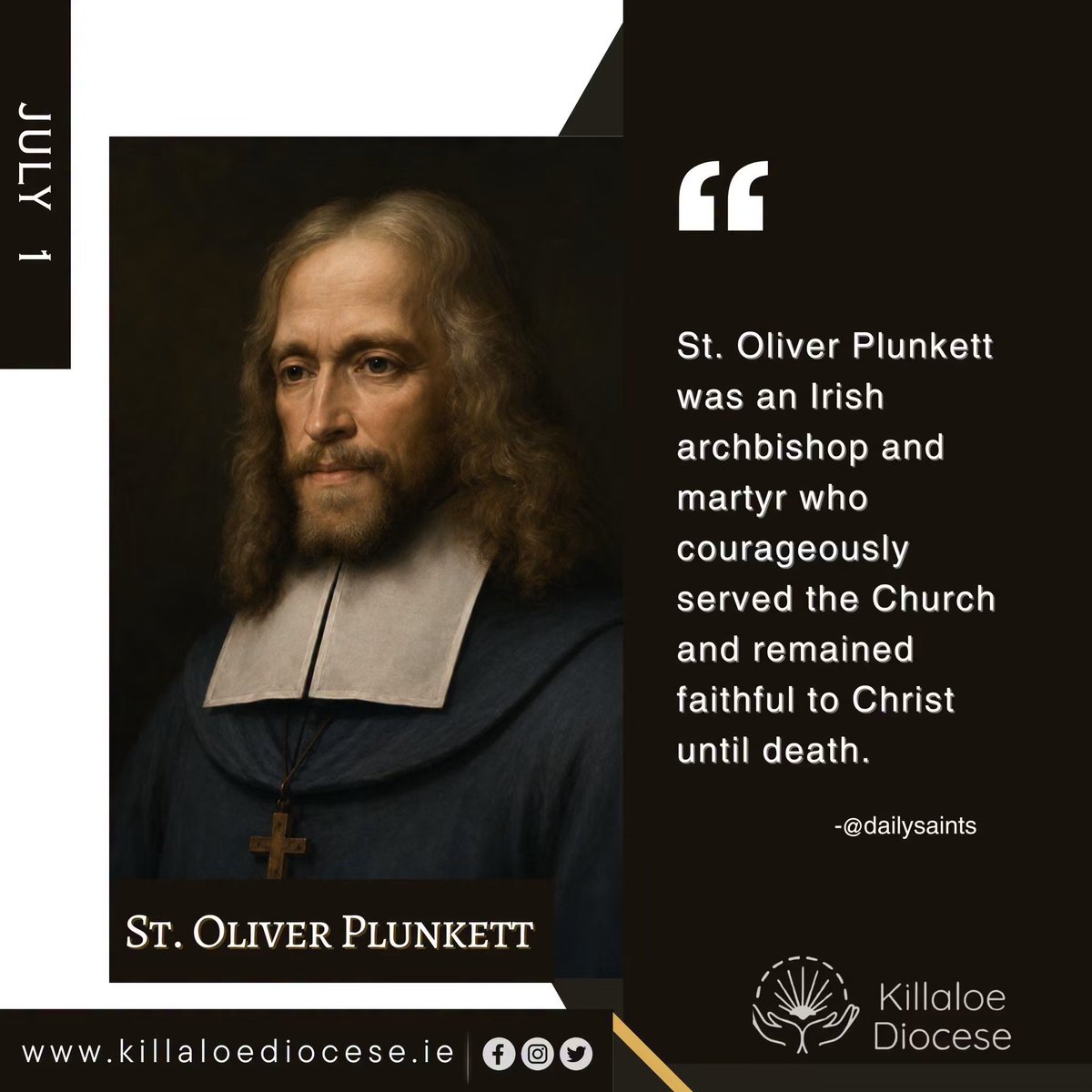
St. Oliver Plunkett was born in Ireland in 1625. He studied for the priesthood in Rome and was ordained in 1654. During a time of severe persecution, he was appointed Archbishop of Armagh in 1669 and returned to Ireland to strengthen the faith of the people.
He travelled throughout his diocese, confirming thousands of people, reforming the clergy, and caring for the poor. Falsely accused of treason, he was arrested and brought to England. Despite suffering imprisonment and an unjust trial, he remained faithful to Christ and the Church. He was martyred by hanging, drawing, and quartering at Tyburn, London, on 1 July 1681.
St. Oliver Plunkett was canonized by Pope Paul VI in 1975 and is remembered as the last Catholic martyr of England.
Prayer:
St. Oliver Plunkett, faithful shepherd and courageous martyr, pray for us that we may remain strong in faith and faithful to Christ in every trial. Amen.
Syria (Aleppo) in the 1950s, when 40% of the population was Christian. Today, it is less than 1%. This is the case for all the Middle East under Islam. Funny how no one cares about this real genocide.
I have just finished reading The Rape Gang Inquiry Report.
It is, without a doubt, the most horrifying document I've ever read in my life.
There is no close second... and it's worse than you could ever imagine.
Here's everything you need to know 🧵
2 yrs ago when I had surgery for cancer, the lady in the next bed was visited by a hospital administrator she had not met before, not her doctor, who stood at the end of her bed and said she had no option but to have MAID. The woman said “Absolutely not! I plan to get up and dance again”. The administrator then started to argue with her saying she had no choice but MAID without explaining why. The woman said “Well I’ll talk to my family when they come on Monday.” The administrator replied “They’re coming on Monday? Good, I’ll talk to them”. She headed off the family on Monday before they saw her and they came to our room primed to convince her she had to have MAID according to the hospital. She then argued with the family that she didn’t want it. During the day she was firm but at night when they weren’t there she cried. Ultimately they convinced her and started preparing a party for her to say goodbye to all her friends. So sad. And it has made me more skeptical about MAID procedures.
In his Summa Theologiae, St Thomas Aquinas laid out one of the most charitable yet practical arguments concerning immigration that effectively shaped the West for almost 1,000 years.
1. Immigration must always be proportionate so that foreigners can properly assimilate into the culture and mode of worship of the state.
2. Citizenship – and associated rights – should only ever be granted after the third generation to preserve the culture, mode of worship, and constitution of the state.
3. The common good of the citizens must remain the highest priority of the state, meaning, the state's obligation to provide aid to its neighbours can never be at the expense of the citizens.
However, Aquinas ends with the sobering reminder that some peoples and states are incompatible with one another, and these must be held as "foes in perpetuity".
THE CHURCH FATHER WHO WROTE THIS IN 107 AD AND IT SILENCES EVERY PROTESTANT ARGUMENT
St. Ignatius of Antioch was a student of the Apostle John. He was arrested and sent to Rome to be eaten by lions.
On the way, he wrote seven letters. In 107 AD, within living memory of the Apostles, he wrote:
“Where the bishop is, there let the multitude of believers be; even as where Jesus is, there is the Catholic Church.” (Letter to the Smyrnaeans, 8:2)
This is the first recorded use of the term “Catholic Church” and it comes from a man who personally knew the Apostle who leaned on Jesus’ chest at the Last Supper.
He also wrote:
“Take note of those who hold heterodox opinions… They abstain from the Eucharist and from prayer, because they do not confess that the Eucharist is the flesh of our Savior Jesus Christ.”
Real Presence of Christ in the Eucharist. The Catholic Church by name. Obedience to bishops in apostolic succession.
107 AD. Not the Council of Trent. Not the Middle Ages.
The next time someone tells you the Catholic Church invented these doctrines centuries later, show them Ignatius.
He wrote this on the way to die for it.
Who will share this?
Around 200 Catholics gathered in London for the annual Tyburn Martyrs Walk, retracing the route once taken by those condemned to death for the Catholic faith.
The pilgrimage follows the historic path from Newgate Prison to Tyburn. The walk concluded at the Tyburn Convent
MUST WATCH: We asked the 13-year-old student who was barred from presenting her pro-life poem because it’s “offensive”, to read her poem so we can share it with the world.
PURE FIRE🔥
This is the poem @JeffcoSchoolsCo doesn’t want you to see.
Would be a shame if it went viral!
A 49-year-old nun forced open the gates of a Nazi prison camp with her bare hands. Then she built a secret network that would save 2,000 lives—and outwit the Gestapo for two years.
July 1940. Metz, France.
The city had just fallen to Nazi Germany. Alsace-Lorraine was annexed directly into the Third Reich. French flags burned in public squares. Speaking French was now illegal.
40,000 French prisoners of war were starving in camps around the city.
Sister Hélène Studler was 49 years old. A Daughter of Charity. White habit. Rosary beads. And a truck.
She drove straight to the camp gates.
When the German guards refused entry, she didn't negotiate. She forced the doors open. Shoved food and medicine through the bars.
This wasn't recklessness. This was calculation.
She'd lived in Metz for 22 years. Ran the Hospice Saint-Nicolas. Cared for poor children. Visited every sick family in town. Everyone knew her face.
That trust became her weapon.
Within weeks, she'd turned that hospice into the nerve center of an underground railroad.
Forged identity papers. Hidden cameras for fake ID photos. Safe houses across Lorraine. Farmers, priests, shopkeepers—all recruited into a network that would smuggle hundreds of French POWs out from under Nazi occupation.
She didn't just feed prisoners. She helped them vanish.
One escaped POW at a time. One forged document. One midnight handoff to the next safe house. Then the next. Until they crossed into unoccupied France or Switzerland.
By February 1941, the Gestapo knew.
They arrested her. Charged her with treason. Sentenced her to one year in prison.
Under interrogation, she gave them nothing.
No names. No addresses. No contacts. Not one single person was betrayed.
The network kept running while she sat in a cell.
After eight months, she collapsed. Cancer. The same disease that killed her mother when Hélène was five years old.
The Germans released her, assuming she'd die within weeks.
She walked out of prison and went straight back to work.
On December 10, 1941, a young French lieutenant arrived at a church in Metz.
His name was François Mitterrand.
He'd been a German POW for 18 months. Escaped twice. Recaptured twice. His third escape had brought him here.
Sister Hélène's network gave him false papers. Civilian clothes. A new identity. A train ticket to Paris.
That lieutenant would survive the war. Join the Resistance. Eventually become the 21st President of the French Republic.
He owed his life to a nun with a truck.
By early 1942, the Gestapo was hunting her again.
She had to run.
Her own network smuggled her out. She made it to Lyon. Then to a hospital in Clermont-Ferrand.
By late 1942, she could barely walk. Cancer spreading through her body. Bedridden.
But from that hospital bed, she kept coordinating escapes.
On November 22, 1944, American forces liberated Metz.
She heard the news from her hospital bed in Clermont-Ferrand. The city she'd saved thousands from. The city she'd had to abandon. The city she'd never see again.
Days later, General Henri Giraud—one of the most famous French generals of the war, a man whose escape from a Nazi fortress she'd helped coordinate—came to her bedside.
He pinned the Legion of Honor on her hospital gown.
Eleven days later, on December 3, 1944, Sister Hélène Studler died.
She was 53 years old.
In 1946, her body was returned to Metz.
Over 100,000 people came to honor her. More people than lived in the entire city.
French soldiers she'd smuggled to freedom. Families she'd hidden in safe houses. Orphans she'd raised before the war. Widows she'd fed.
Almost every family in Metz owed her something.
François Mitterrand, when he became President of France in 1981, reportedly kept a photograph of her in his personal study for the rest of his life.
Here's what makes this story so staggering.
She wasn't trained. Wasn't a spy. Wasn't a soldier.
She was a middle-aged nun who ran a children's hospice in a small French city.
And when her country fell, she built a resistance ...
👇🏻THIS is the Faith that Catholics profess every, single Sunday. If you want to know what Catholics really believe, in our own words, here it is.👇🏻
1. I believe in one God, (Deuteronomy 6:4; Mark 12:29; Ephesians 4:6; 1 Corinthians 8:6)
2. the Father almighty, (Matthew 6:9; 2 Corinthians 6:18; Genesis 17:1)
3. maker of heaven and earth, (Genesis 1:1; Revelation 4:11)
4. of all things visible and invisible. (Colossians 1:16; Hebrews 11:3; John 1:3)
5. I believe in one Lord Jesus Christ, (1 Corinthians 8:6; Ephesians 4:5)
6. the Only Begotten Son of God, (John 3:16; John 1:18)
7. born of the Father before all ages. (John 1:1-2; Colossians 1:15, 17; Hebrews 1:2-3)
8. God from God, Light from Light, (John 1:1-5, 8:12; Hebrews 1:3)
9. true God from true God, (John 1:1; 1 John 5:20; John 20:28)
10. begotten, not made, consubstantial with the Father; (John 1:14, 18; Hebrews 1:3; Philippians 2:6)
11. through him all things were made. (John 1:3; Colossians 1:16; Hebrews 1:2)
12. For us men and for our salvation (1 Timothy 2:4-6; John 3:16-17)
13. he came down from heaven, (John 3:13, 6:38, 3:31)
14. and by the Holy Spirit was incarnate of the Virgin Mary, (Luke 1:35; Matthew 1:18-20)
15. and became man. (John 1:14; Philippians 2:7-8; Hebrews 2:14)
16. For our sake he was crucified under Pontius Pilate, (Mark 15:15, 24-25; 1 Corinthians 15:3)
17. he suffered death and was buried, (Isaiah 53:5-9; Matthew 27:50, 59-60; Romans 5:8)
18. and rose again on the third day (Matthew 28:1-7; Mark 16:9; 1 Corinthians 15:4)
19. in accordance with the Scriptures. (Luke 24:25-27, 44-46; 1 Corinthians 15:3-4)
20. He ascended into heaven (Acts 1:9-11; Luke 24:51)
21. and is seated at the right hand of the Father. (Mark 16:19; Ephesians 1:20; Colossians 3:1; Hebrews 1:3)
22. He will come again in glory (Matthew 25:31; Acts 1:11; 1 Thessalonians 4:16)
23. to judge the living and the dead (Matthew 25:31-46; 2 Timothy 4:1; Acts 10:42)
24. and his kingdom will have no end. (Luke 1:33; Hebrews 1:8; Revelation 11:15)
25. I believe in the Holy Spirit, the Lord, the giver of life, (2 Corinthians 3:17-18; John 6:63; Acts 2:17-18)
26. who proceeds from the Father and the Son, (John 15:26; John 16:7, 13-15)
27. who with the Father and the Son is adored and glorified, (Matthew 28:19; 2 Corinthians 13:14)
28. who has spoken through the prophets. (2 Peter 1:21; Hebrews 1:1; Acts 28:25)
29. I believe in one, holy, catholic and apostolic Church. (Matthew 16:18; Ephesians 4:4-6; 5:27; Ephesians 2:20)
30. I confess one Baptism for the forgiveness of sins (Ephesians 4:5; Acts 2:38; Titus 3:5)
31. and I look forward to the resurrection of the dead (John 5:28-29; 1 Corinthians 15:20-23; 1 Thessalonians 4:16)
32. and the life of the world to come. Amen. (Revelation 21:1-4; 2 Peter 3:13; John 14:2-3)
And some Protestant Fundamentalists actually say “Catholics are not Christians.”
The genocide of Orthodox Christians in Atheist Soviet Union is perhaps the single greatest Christian persecution in Human history.
What crimes did the Bolsheviks commit during the ‘Russian Revolution?
They nailed him to the floor of the church. He remained alive for a long time. Red-hot ramrods were slowly driven into his body until one pierced his heart… This is how Bishop Sylvester (Olshevsky) of Omsk died in February 1920.
Bishop Tikhon (Nikanorov) of Voronezh was crucified on the Royal Doors of the iconostasis.
Bishop Andronik of Perm was buried alive in a pit which he had been forced to dig himself.
Bishop Hermogenes of Tobolsk was tied to a ship’s wheel and drowned.
Bishop Seraphim (Chichagov) was carried on a stretcher to be executed at the Butovo firing range, as the nearly 90-year-old elder could no longer walk.
Grand Duchess Elizabeth & the nun Barbara were thrown alive into a deep mineshaft in Alapaevsk.
Bishop Benjamin of Petrograd, along with several laymen, was shot after a show trial based on false charges related to the confiscation of church valuables.
Priest Peter Skipetrov was shot in the face in the Alexander Nevsky Lavra.
Archbishop Nikon Rozhdestvesnky (accused of ‘antisemitism’) was stabbed & maimed to death outside of his monastery (Trinity Sergius Lavra), his body was disfigured beyond recognition. The Bolsheviks also beheaded him.
Metropolitan Vladimir (Bogoyavlensky) of Kiev was dragged outside the walls of the Kiev Lavra, shot, and bayoneted while he gave his blessing to his executioners.
The elderly ascetic, Bishop John (Pommer) of Latvia, was tied to a door torn from its hinges, laid on a workbench, brutally tortured, and then set on fire while still alive.
Bishop Thaddeus of Tver was drowned in human waste.
Father Alexey Merkuryev of the Urals was murdered in front of his congregation, daughter, and son.
Bishop Theophan of Solikamsk was stripped, his hair braided, a pole threaded through it, & he was slowly lowered into an icy hole in the Kama River. His body became encased in ice. But the hierarch was still alive - and then he was drowned.
Some priests and laymen had their hands tied behind their backs, their eyes blindfolded, and were ordered to walk across the ice until they fell into a hole. The torturers mockingly called them ‘divers.’
The holy prisoners of the Solovki labor camp had their beards and mustaches ripped out and were starved to death…
No number of pages or tears can recount all that our land endured so recently - just yesterday. This is only a drop in the ocean of blood shed by the Holy New Martyrs, whose memory we commemorate each year.
Hundreds of thousands of priests and millions of laypeople were killed and torn apart for their faithfulness to Christ. More than 2,000 have been canonized as confessors and martyrs - and how many more are known only to God?
And this was not some mere political struggle. It was hell itself unleashed. Only demons devoid of all conscience could torture people in such ways.
The scale, ferocity, and mercilessness of Soviet persecution of the Church is encapsulated in a single figure: out of 80,000 churches and monasteries at the beginning of the 20th century, by 1939, barely a hundred parishes remained across the vast Russian land. Not a single monastery. Not a single seminary. Not a single bishop at liberty. Just a scattered handful of monks.
Key Book References:
Konshaubi: The True Story of Persecuted Christians in the Soviet Union by Georgie Vins. Chronicles the experiences of believers facing Soviet oppression.
The Bolshevik Persecution of Christianity by Francis McCullagh (1920s/Various reprints). An early account of the anti-religious campaigns.
Soviet Antireligious Campaigns and Persecutions (Vol 2 of A History of Soviet Atheism) (Springer Nature).
Persecutor by Sergei Kourdakov (1973). A memoir by a former Soviet officer involved in raids against Christians.