Daily Education #3 📚 How to Buy and Sell Dips
Learning how to buy and sell dips is simple, and it’s one of the easiest ways to build strong positions safely.
You don’t need to be a pro or know complex analysis. You just need to understand where a pullback is healthy and where it’s losing strength.
That difference alone can completely change how you trade.
WHEN TO BUY DIPS ✅
You want to add when price pulls back to retest a previous breakout level and successfully holds it as support.
This confirms that buyers are stepping in to defend the structure, showing that the pullback is part of a healthy trend and not the start of a reversal. It’s usually where new liquidity enters before the next move higher.
WHEN TO SELL DIPS ❌
If the same level fails to hold and price closes convincingly below it, that’s a signal that bullish momentum has weakened.
This usually means the market is transitioning from accumulation into distribution, and a deeper correction is likely incoming.
That’s the level you want to derisk and protect your profits. Not because you’re bearish, but because the probability of continuation up has shifted out of your favour.
If the support is later recaptured (as shown by the dotted line), it confirms that bears failed to sustain control, giving you a new re-entry opportunity on the potential move back up.
That's it. This approach doesn’t need advanced TA. It’s mechanical, emotion-free, and brutally effective for compounding over time.
It’s how professional traders grow their winners aggressively and cut their losers fast.
$ASTER lost critical support and flushed to ~$1.07, as we expected. An easy short if you were able to catch it.
Now finding solace around ~$1.08, a decent cushion above the local bottom of ~$1.02.
Price lost all moving average and structural support in the consolidation range, and now bulls need to push price back to $1.10 to mitigate any real damage to the chart.
Since price rebounded strongly the first time it visited the local bottom, there isn't much recent support to try and be confident about apart from the absolute low of ~$1.02.
If bulls can't break through resistance, they certainly need to build some support levels here to prevent a harder flush down.
Daily Education #2 📚 Trading the "Spring" Setup
One of the most potent breakout setups in trading is the "Spring", one of the methods from Wyckoff's accumulation theory; but most traders misunderstand when to enter.
During accumulation, price chops between clear horizontal levels (support and resistance).
Eventually, it dips below support (spring/downthrust); a fake breakdown designed to trap shorts, flush weak longs, and engineer more liquidity before the real breakout phase begins.
From here, you’ve got two entry options:
1) Recapture of support after the spring. You buy once price reclaims the range, with a stop just below the low of the downthrust candle.
2) Breakout retest of the top of the range after the move up. You buy the retest, with a stop just inside the prior consolidation range.
Both setups work. The first catches the move early, while the second gives you confirmation of the breakout.
Either way, never buy the breakdown itself, wait for the recapture. That’s the difference between getting trapped and catching the real move.
Wowzers, lots of interest in this!
Will drop some bite sized educational tweets every day, starting today.
Excited to help create the next generation of legendary traders on the timeline.
And charts on our favourite projects coming shortly!
One of the biggest mistakes traders make is trying to time the exact top of a cycle to start offloading their portfolio.
But you don’t need to know the price Bitcoin or alts will reach.
You just need to understand the timing of the cycle.
Because Bitcoin doesn’t peak at a price. It peaks in a specific phase of the cycle.
For example: instead of waiting for $150K to sell Bitcoin, recognize that it has historically topped between October and November in most cycles. Alt seasons typically follow 4–6 weeks later as capital rotates.
You now have a timeframe to completely offload your portfolio.
Use timing to rotate your portfolio, not price targets, and you’ll consistently outperform.
Even the best traders rarely catch the exact top. Most hold too long and give back their gains.
Thinking of dropping some bite-sized educational Tweets on here daily –– some quick lessons to help you sharpen your trading sword.
Would you guys be interested in that?
Lemme know in the comments so I can gauge if it's worth rolling out!
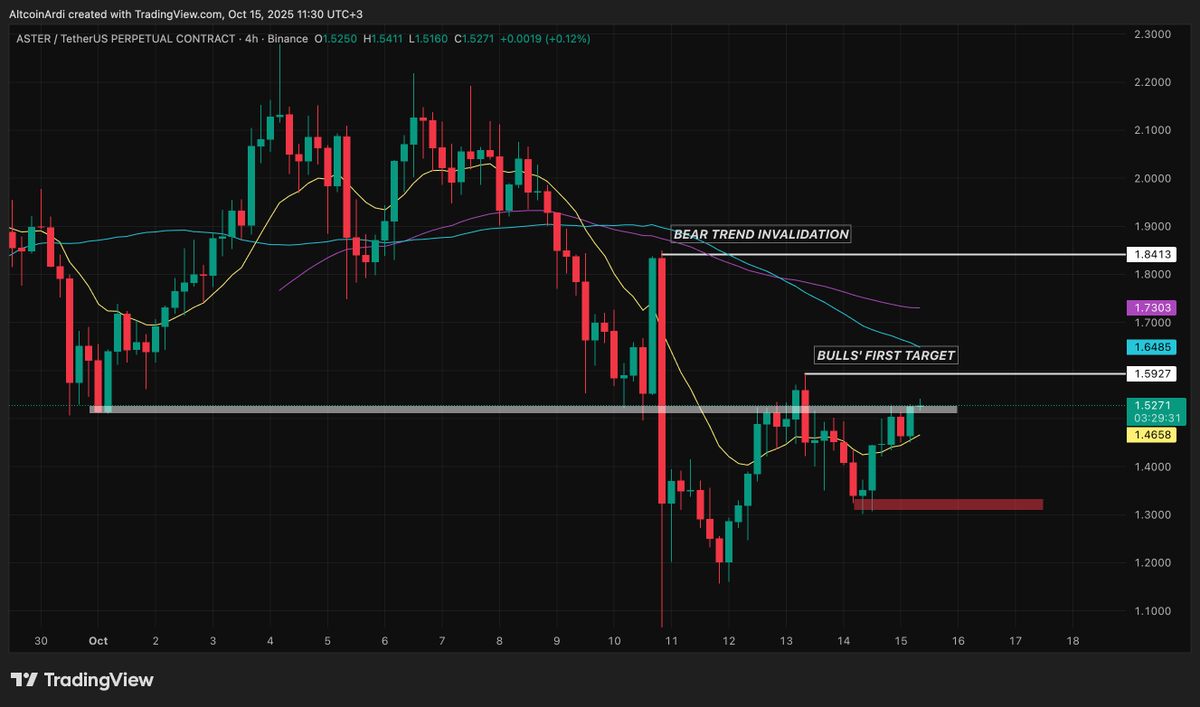
$ASTER attempting to break upward toward the bulls’ first target, but currently stalling around the $1.53 resistance – the same level that acted as key support earlier in October.
If it convincingly breaks out here, price would almost certainly be on its way to meet its first major objective at ~$1.59..
Important for the bulls’ confidence to secure a breakout here, otherwise price likely ranges and retests the local range lows.
-- 1x 1,000$ GIVEAWAY ---
🔥 Like & RT this post
🔥 Follow my new IG Account
IG: https://t.co/sxz6sF640K
NAME IS: @YourPlugAbu
That's all.
Winner will be chosen in 24hrs from now.
GOOD LUCK
$ASTER this might be unpopular, but there’s a valid case to be made that despite the liquidation, Aster’s still forming another lower high while bulls try to regain momentum.
The rejection around $1.53 lines up pretty nicely with both the top of the descending channel and the 100 SMA (purple) which it failed to reclaim, along with the loss of the 13 EMA (yellow).
Still too early to call a direction with conviction, but since people have been asking for entries and setups, it’s at least worth being tactical here. At minimum, I'd wait for a confirmed break above the channel and a recapture of the 100 SMA before going in with confidence.
If price loses ~$1.41, odds favor a continuation down the channel.
$ASTER DAILY MARKET UPDATE 📢
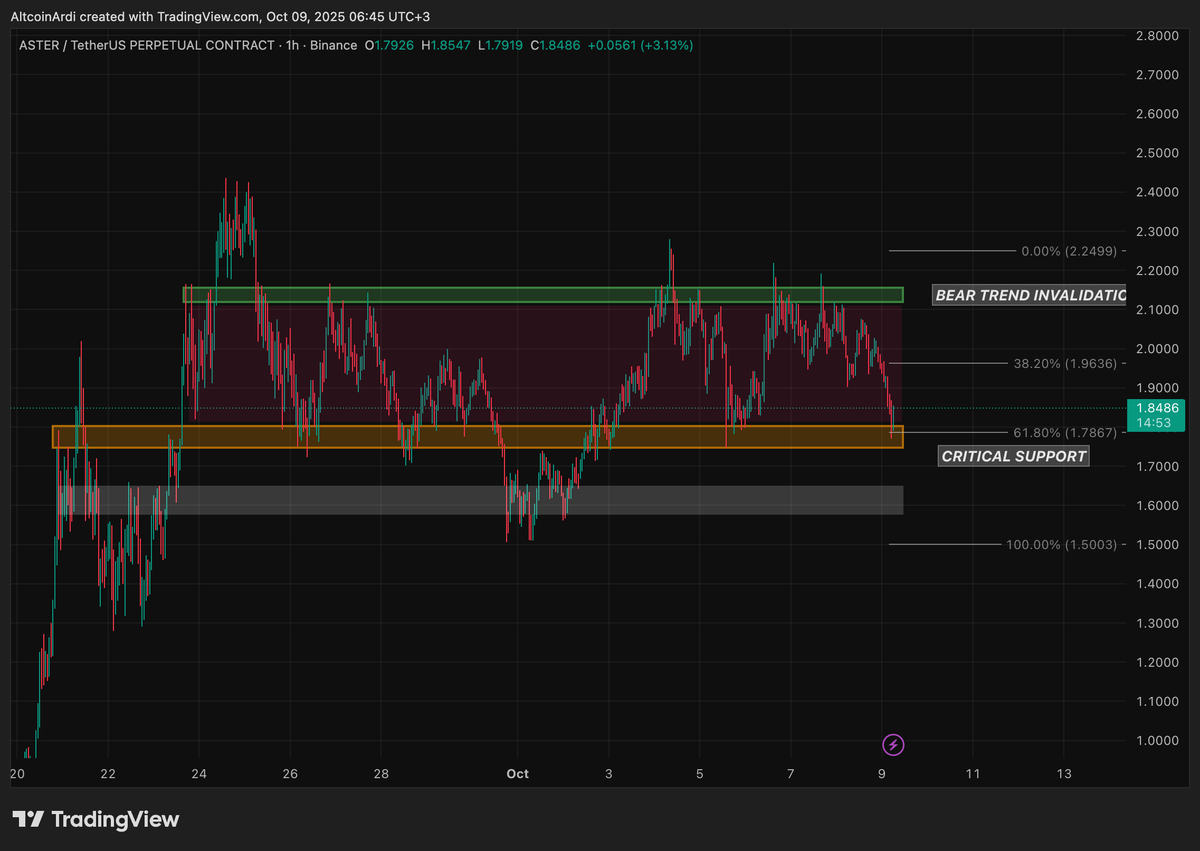
Aster dipped into our critical support zone around ~$1.75 after losing both its ascending trendline and the local ~$1.90 support range we've been tracking.
The drop tagged the 61.8% Fibonacci retracement of the $1.50 → $2.27 leg; still considered a healthy pullback structure rather than outright weakness.
So long as the chart holds above this Fib level, the overall mid-term structure remains constructive. However, multiple closes below 61.8% Fib would shift probability toward a deeper retrace into the next major liquidity pocket in the ~$1.57–$1.63 region.
For bulls, the focus now shifts to reclaiming former support zones and turning them back into support, as they failed to push through the sturdy $2.11 resistance (bear trend invalidation).
Interestingly, nearly 95% of price action over the past 16 days has occurred between $1.80–$2.10 (red zone); a clear equilibrium range where bulls and bears continue to wrestle for control.
And as I said before, the chart already prices in all the headlines and token unlock noise well before it happens. Hope you guys are slowly seeing what I mean!
Current Key Levels:
- Resistance: $1.90 (prior support flip)
- Critical support: $1.74 (61.8% Fib)
- Target support: $1.57–$1.63 (if critical is lost)
There are a few reasons I use X more than Binance Square.
I like to stay logged out on https://t.co/9rMMAmczvH when not making a transaction, as a security policy. I go on for months without logging in.
I like to reach non Binance community.
But maybe I will switch back there
Excited to formally announce OpenVPP Retail Product's ecosystem provider: Base! It takes a lot to bring any migration together, this was no different, there is so much behind the scenes, but working with their team has been a joy.
What does it mean for OpenVPP and our product though?
Tokenizing real world energy assets requires high throughput and a blockchain capable of handling millions of transactions tied to thousands and eventually millions of energy devices. This capability is exactly what Base delivers, while still staying within the trusted EVM ecosystem.
Excited for the next steps ahead, and glad I can sleep a little better now knowing Base is setup behind the scenes.
Excited for the next steps ahead!
$OVPP The Internet of Energy.
All Team Boost data has been updated.
Based on community feedback, we’ve made improvements:
1. From Epoch 4, boosts activate within 8 hours after joining a team.
2. Points affected by the earlier misunderstanding have been re-credited.
Please refer to the screenshot below to find your corrected points. If you still notice anything unusual after this, please don’t hesitate to reach out to us on Discord. Thank you for your patience and support.