Rare disease delivered another August catalyst for $REGN with FDA approval of Pasatru on August 19th for adults with FOP.
Meanwhile, $SNY partnered Dupixent remains the main growth engine as $AMGN and other biosimilars increase pressure on legacy EYLEA.
Cemdisiran is the next major regulatory event, with Priority Review in anti-AChR-positive gMG (and a November 2026 FDA target action date).
Here's what comes next for Regeneron across rare disease, cancer, and obesity:
https://t.co/MaR91HQhON
I am predicting that NLRP3 inhibitors will be vindicated in the clinic and that this is a good buying opportunity for NLRP3-related stocks because they're all down dramatically as a knock-on effect from the ZEUS trial failure, which is IMO way too downstream of NLRP3.
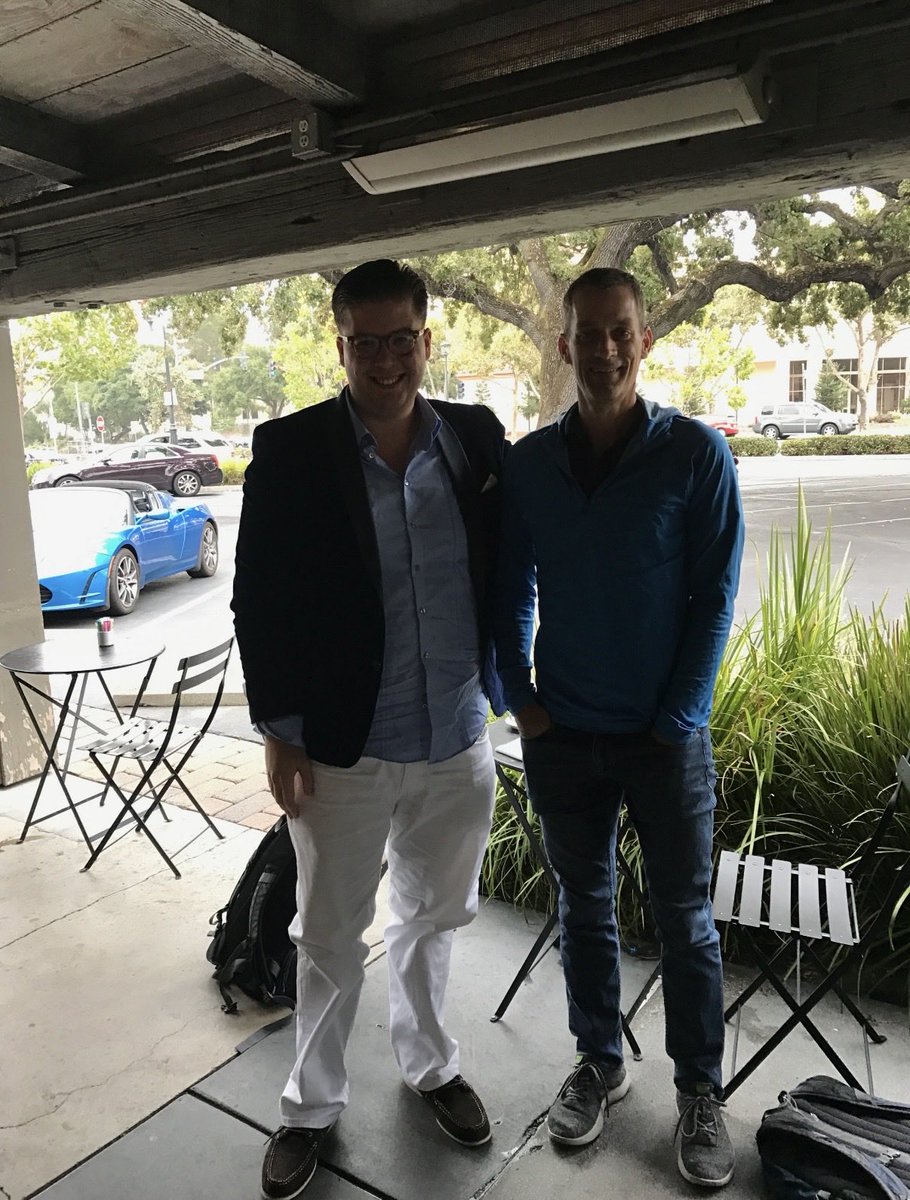
The rumors are indeed true. Here is @JeffDean and me shootin the shit @CoupaCafe in 2017 when I first started my @Stanford biology dept postdoc. I was a fucking nobody freshly-minted PhD graduate at the time so imagine my starstruckedness when he agreed to take an IN-PERSON meeting with me and even bought me breakfast. Dude's a @Google legend and I wish him all the best at @DiscoLoopAI
Learning biotech part 2:
Once you understand process of finding drugs, you should study the incentives that drive decisions.
Why does someone choose to launch the 200th EGFR program? Inevitably there's a set of incentives, and often data-driven risk analysis, motivating these seemingly silly decisions.
While new biotechs often challenge existing assumptions, understanding Chesterton's fence is the smartest way to decide where and why you deviate.
I would start by reading AstraZeneca's retrospective on why their programs won or lost:
“Lessons learned from the fate of AstraZeneca’s drug pipeline: a five-dimensional framework.” https://t.co/8fPq5HAeNu
The '5Rs' they identified are a good representation of the risks pharma prioritizes: right target, right tissue, right safety, right patient, and right commercial potential.
YC tells their companies to talk to users. But who is the 'user' for biotech?
- Ultimately, we make medicines for patients to enjoy healthy lives.
- The FDA judges whether it works.
- But doctors decide what to prescribe.
- And insurance and medicare actually pay for the treatment.
This makes the situation more confusing for new biotechs. But your product needs to work for all four of those user.
(even if you plan to sell to pharma before approval, they have the same users, so you just have one more user to please)
I recommend the book 📚 "Her-2" about Genentech's mega-successful drug Herceptin, which includes decisions about which diseases and trials they tried it for first. If those decisions had been wrong, the drug might have died.
I'd also recommend (any and all) episodes of 🎧 "Hard Drugs" from @salonium and @JacobTref, especially for examples where the science incentives are stronger than financial ones.
https://t.co/uVXhWUtv8U
After that, try deconstructing decisions you see in the news, like Genentech choosing to exit cancer immunology two years ago or everyone buying 'radiopharmaceutical' biotechs. What got derisked, or saw added risk?
One source of 'irrational behavior' might be classic short-term performance goals among executives at public companies. At any given time, pharma's revenue come from a small number of patent-protected drugs. When patents expire on a top product revenue plummets, so you often see acquisitions of mature companies that might get a new big approval before the cliff.
Basics of patent cliffs here: https://t.co/HjdNuTh6fw
and this episode of @alexkesin and Matthew Pech's 🎧 Approved goes deep on that drug, including at ~90m how Merck sought to protect its profits: https://t.co/mvnZQWcUbR
Ultimately, incentives all come back to 1) a desire to improve humanity's conditions by scientists who go into biomedicine, and 2) free market competition.
When you see something that seems cool (like PCSK9 gene therapy) but isn't super hot, check the incentive stack to understand why (in this case, strong competition with lower risk).
And when you see an opportunity nobody is filling, at least find out why.
More good content on this topic includes:
@alexkesin’s ✍️ “Pharmacopoeia” broadly covers how biopharma behaves, for example in “Pharma Is Hollywood, Roughly”:
https://t.co/8Vt3nWzNBH
@ElliotHershberg’s ✍️ “The Century of Biology” has a series on platform companies, like BridgeBio, that dissects incentives:
https://t.co/3NdCYjqT6n
Finally, 📚 “The Great American Drug Deal” by @PeterKolchinsky is relevant as big picture context on how healthcare works and how the medicines it pays for flows back into the next generation of drugs. You can also get the short version on this website: https://t.co/CZ9kzQLhKG
I don't think people appreciate how significant this data is.
Healthy individuals eGFR decreases by 1 mL/min/1.73m^2 per year after 30-40
In this trial with patients with kidney disease has increase of 1.3 after 2 years!!
I would not be surprised if this makes it into some microdosing longevity regimen in the future.
Safely cutting sleep from 8 hours to 4 could give us nearly a decade of extra waking life.
I wrote an article explaining how we might get there without sacrificing our health in process.
Hint: we already have proof of concept.