the creativity and pace of the community has been astounding. my favourite so far is `neorex`, a plugin for neovim which gives it Rex-native splits and floating windows.
https://t.co/b8Xh1jFIlr
I've got an agent in a loop optimizing a renderer with the goal to minimize frame times (and tests to measure). It got times down from 88ms to 2ms and allocations down from ~150K to 500. Sounds good, right? Wrong. This is exactly why agent psychosis is a big fucking problem.
As an experiment, I rewrote the Ghostty core render state in Go, with access to identically laid out data structures as Ghostty and the exact same validation tests. I made a purposely naive renderer (simple, correct, but slow). 88ms per frame with 150,000 allocations (horrendous, lol)!
I then kickstarted a Ralph loop to bring the frame times down. I told it it can't modify input data structures or the public API or tests (they're correct), but it can do anything else it wants. It got to work.
It has worked for about 4 hours. I've spent around $350 on this experiment so far. The results?
88ms => 1.5ms
150K allocs => ~500 allocs
Incredible right? Nope.
My hand-written renderer I ported has frame times (same benchmark) of ~20us (0.020ms) and 0 allocations in the update path.
This is the problem with psychosis and lacking systems understanding. If you don't understand the system, you're going to accept that this is an incredible result. If you understand the system, you'll see better solutions immediately and can do roughly 75x better on throughput.
The people who blindly trust agent output are in the former camp. They're sheeple, overdrinking from a fountain of mediocrity.
Standard disclaimer: I use AI all the time. I like AI. The point I'm making is to not blindly accept results. Think. Analyze. Learn.
Next version of Omarchy will have a delightfully configured Tmux setup out of the box. Many terminals, including Ghostty, have panes and tabs built-in, but let me show you why I've still come to prefer Tmux.
"...it would be a shame to think of it simply as time to rest-up for more work. Sadly, this is the mindset for many us caught up in a world of pressure, productivity, and, well... more, More, MORE! We've got it wrong if we think of vacations (or even weekends) as a way to recharge for work. To put it another way, we shouldn't be resting so we can work. Work is necessary. Work is important. Meaningful even. Being effective at work matters. But we work so that we may rest. Rest is where the most important things live: families, friends, hobbies, play. The things that feed our souls. Fill yourself with those things and, somehow, you'll also be better at work."
https://t.co/YeJXDPrdtR
https://t.co/zczCRqh6sA
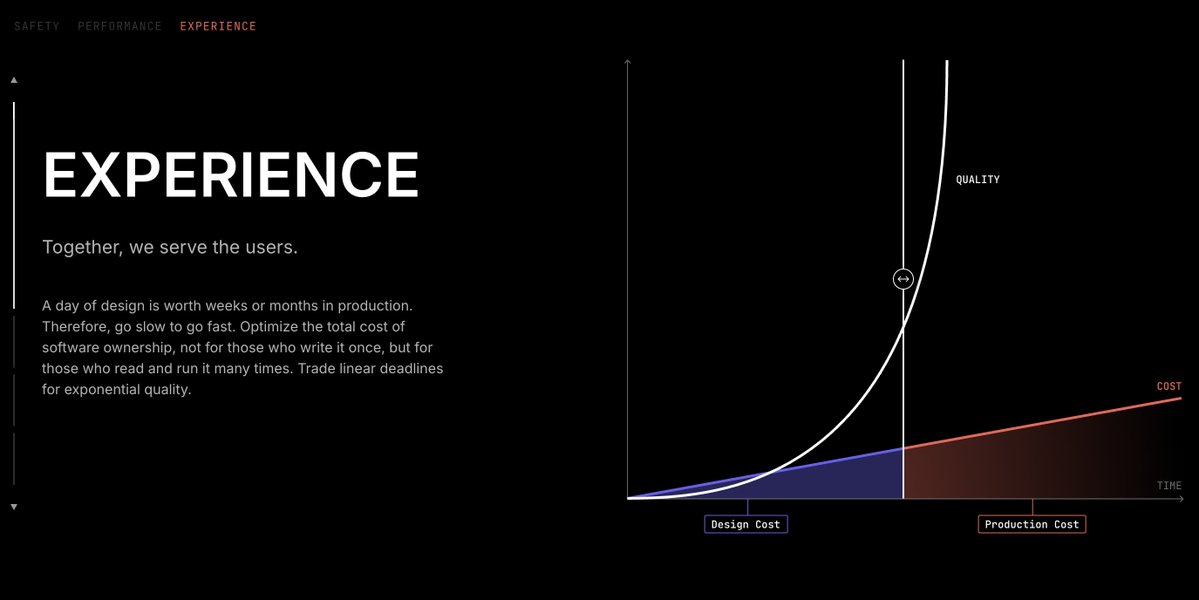
A new, visual home for TigerStyle -- the software engineering methodology developed by TigerBeetle to produce safer, faster software in less time.
"Do the hard thing today to make tomorrow easy."
"If you want to be remembered, be remarkable."
"The hard part is no longer writing code it's reviewing code."
This is just telling on oneself that one never cared about CI/CD, testing, or documentation before AI.
ship something shitty fast and fix it later culture just does not produce anything great
there's mountains of rationale as to why you should do that but i've never seen it work and it always turns the company into a painful place to work
nothing going on right now changes this
i am convinced that software devs have a speed problem
they think the #1 issues is writing code faster... its not. its fixing the code that is already there to stop being utter garbage (as a garbage code connoisseur)
quality is really lacking these days, yet quantity has never been higher
Zig tip: `errdefer comptime unreachable;` will ensure at compile time that from that point forward nothing can fail. This is an extremely important pattern since `errdefer` (cleanup on error) often depends on a particular state of the world and this asserts it.
Example use case: I'm working on a piece of functionality that receives some data, sets up a bunch of buffers, and then swaps the buffers. I have a bunch of `errdefer` sprinkled about to clean up the new buffer being built.
But after I swap the buffers, those `errdefers` are now WRONG. They'd result in an eventual double-free.
So, right when I swap buffers, I put a `errdefer comptime unreachable` and a comment explaining why its important errors can't happen after that.
If I ever need errors after that, it'll force me to revisit how I do error cleanup. Very good!
Well, it has happened. Ghostty on macOS now has search. This is now in tip releases, I'm certain there's a bunch of polish and bugs to work through over the next months, but more than enough time for it to be rock solid for 1.3 next year. GTK to follow soon. Gobble, gobble. 🦃🦃