🧬 Excited to share our new work in @NatureBiotech!
Paper: https://t.co/7bc59q8p7O Research Briefing: https://t.co/o5wKM3RQBr
Large gene editors require large mRNAs, but LNPs are typically discovered using much smaller reporter RNAs. We asked: does RNA size matter when discovering delivery lipids?
Using a large base-editor mRNA for high-throughput screening, we identified LC-1, an ionizable lipid that enabled efficient gene editing in the liver, lung, and brain via different administration routes in mice, with up to 4× higher Cas9 editing than benchmark LNPs. LC-1 also efficiently delivered base editors for disease-relevant targets in hypercholesterolemia, cystic fibrosis, and Angelman syndrome.
Why does LC-1 work so well? Cryo-EM and X-ray scattering revealed that LC-1 LNPs form an ordered, inverted-hexagonal structure that persists with large RNA cargo. This membrane-fusing structure helps RNA escape from endosomes, the compartments that can trap it inside cells. In cell studies, LC-1 released roughly twice as much large mRNA into the cytosol as the benchmark formulations. We show that LC-1's key design features also apply to ionizable lipids made through other synthetic routes.
These findings show that accounting for RNA size from the start can change which lipids we discover and improve delivery of large gene editors. This could help expand the delivery options available for future gene-editing medicines.
Thank you to all our co-authors, collaborators and funders @CIHR_IRSC@NSERC_CRSNG@UofTPharmacy@LisaDolovich@PMResearch_UHN@bradwouters #LipidNanoparticles #GeneEditing #RNATherapeutics
Excited to share our new work published today in @ScienceMagazine! 🧬 We engineered chemically modified suppressor tRNAs and tailored lipid nanoparticles to rescue disease-causing nonsense mutations in cystic fibrosis 🔗https://t.co/7VlU232SpA Perspective: https://t.co/7p6Qc1PcrX
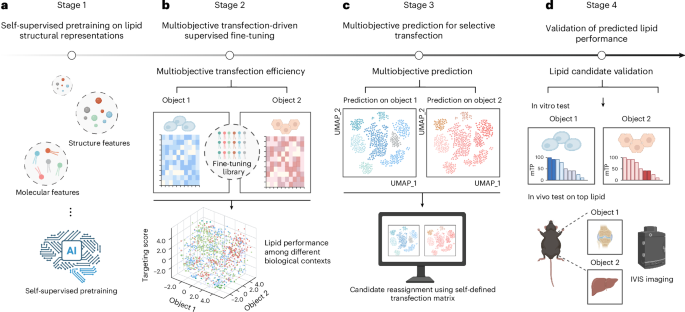
Excited to share our new paper in @NatureBiotech ! We reported MOLEA, an AI framework that simultaneously optimizes potency AND tissue selectivity for LNP design. AI × RNA delivery is just getting started! https://t.co/X298WRRczm
#RNAtherapeutics#LNP#AI#mRNA
We did test repeated dosing with three administrations over days 0-7, showing excellent epithelial selectivity with minimal off-target effects in immune and endothelial cells, which is a significant advantage over systemically dosed LNP approaches. The strong targeting of basal cells (44% in proximal airways), the epithelial progenitor pool, provides a biological basis for durable correction through successive waves of airway renewal. We haven't pursued long-term functional persistence studies because the G542X CF mouse model has severe gastrointestinal dysfunction that limits lifespan to weeks (lung-specific base editing cannot address this systemic phenotype).
Excited to share our latest work just published in @NatureMaterials on inhaled base editing for cystic fibrosis (CF).🫁 Read the full paper here: https://t.co/Km7jEbgQii
While CRISPR-based therapies hold immense potential, delivering these large molecular machineries to the lung has remained a significant challenge due to the complex airway mucus barrier and the need for high-efficiency transfection in target epithelial cells. To address this, we developed a modular platform to rapidly synthesize chemically diverse ionizable lipids. It allows us to incorporate both proteinogenic and non-proteinogenic alpha-amino acids, thereby creating biodegradable lipids with high structural diversity.
🔬 Key Highlights from the Study:
1. Lead Candidate CHCha-10: Through high-throughput screening, we identified CHCha-10, a cyclohexyl amino acid-derived lipid that forms nanoparticles with superior mucus penetration and epithelial-specific transfection.
2. Validation in Ferret Models: Beyond mouse studies, we evaluated CHCha-10 LNPs in juvenile ferrets, a gold-standard model for human lung disease. Our platform achieved robust, widespread editing in the airway epithelium and critical submucosal glands, which are essential sites for CFTR production.
3. Restoring Function in CF: By delivering adenine base editor (ABE) mRNA via inhalation to target the CFTR G542X mutation, we achieved over 12% on-target editing in CF mice. This led to a significant increase in CFTR protein expression and restored chloride channel function in patient-derived HBE cells and intestinal organoids.
4. Safety and Specificity: CHCha-10 LNPs demonstrated an improved biocompatibility profile with minimal off-target delivery to immune or endothelial cells compared to existing benchmarks.
This work establishes a translatable, non-viral platform for RNA-based pulmonary gene correction, moving us a step closer to precise, durable treatments for genetic respiratory disorders.
Huge thanks to my incredible co-authors and collaborators at the University of Toronto, SickKids, University of Iowa, Case Western, and across the network for their dedication to this project, and for the support from @CF_Foundation@CIHR_IRSC@NSERC_CRSNG@NIH@CFCanada@UofTPharmacy@UofTPRiME@UHN
Our scientists developed an amino acid–based lipid nanoparticle, inhalable to deliver mRNA into the lung, which corrected cystic fibrosis mutations in preclinical models, opening ways to treat genetic lung diseases.
Led by @BowenLi_Lab@UHN@UofTPharmacy https://t.co/mB6Nj53T20
🚨 Historic moment for Canadian healthcare 🚨
University Health Network (@UHN ) just reached a new global milestone!
According to Newsweek’s World’s Best Hospitals 2026 ranking:
🏥 Toronto General Hospital — #2 in the world (highest ever for a Canadian hospital)
🎗 Princess Margaret Cancer Centre — #1 oncology program in Canada
🏥 Toronto Western Hospital — Top 10 in Canada
♿ Toronto Rehab & West Park Healthcare Centre — Canada’s largest rehabilitation & complex care network
🎓 Michener Institute of Education — Canada’s only dedicated applied health sciences university
What makes UHN special isn’t a single hospital — it’s the integrated model:
Care + research + education, operating as one system.
Bench to bedside. Innovation to deployment.
Over the past six years, as Chief AI scientist of UHN, I’ve had a front-row seat to how this system works from the inside — clinicians, scientists, trainees, and staff moving together with a shared mission.
This ranking reflects something real:
World-class medicine is happening in Toronto.
At scale.
For everyone.
Congratulations #TeamUHN 🇨🇦🏆 @KevinSmithUHN@bradwouters
LUMI-lab is out today in @CellCellPress! 🚀We built a self-driving lab that closes the loop between an AI foundation model + robotics to accelerate lipid nanoparticle (LNP) discovery for mRNA delivery. Free access to the manuscript: https://t.co/HTAaQPrvSe
Code available on GitHub: https://t.co/OgLJ4OamGa
Check the video here: https://t.co/t3sffZw53i
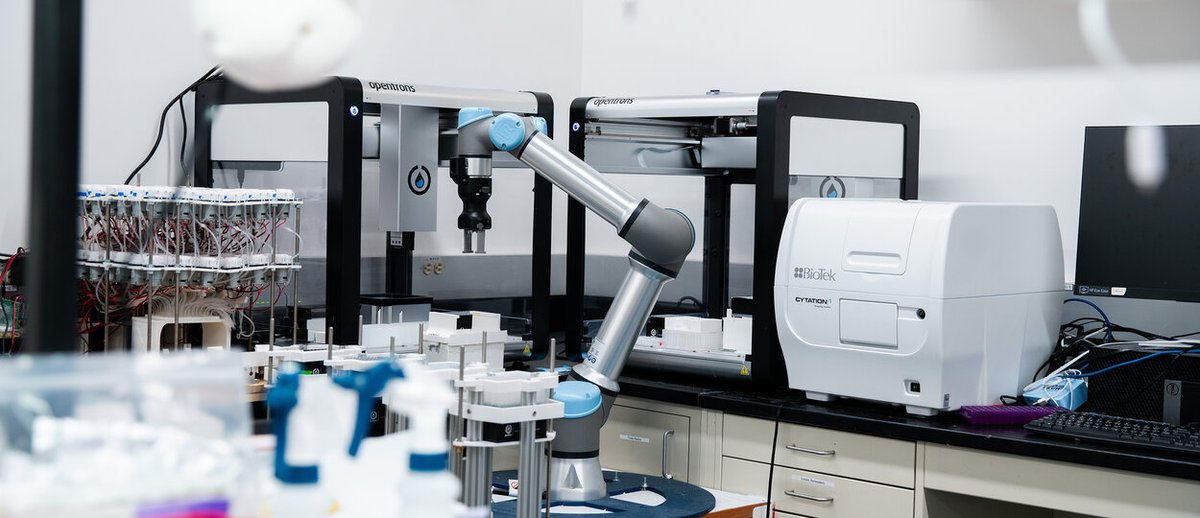
LUMI-lab (Large-scale Unsupervised Modeling followed by Iterative experiments) is a self-driving laboratory that tightly closes the loop between an AI foundation model and automated robotics to accelerate LNP discovery for mRNA delivery.
To tackle data scarcity in emerging mRNA delivery domains, we pretrained the model on 28M+ molecular structures, then iteratively improved it with closed-loop experimental data. This is the kind of workflow we believe can meaningfully expand the accessible chemical space for next-generation RNA medicines.
In this work, across ten active-learning cycles, LUMI-lab synthesized and evaluated 1,700+ new LNPs and unexpectedly identified a new design feature for efficient delivery: brominated lipid tails. These brominated-tail ionizable lipids delivered mRNA into human lung cells more efficiently than approved benchmarks, despite representing only a small fraction of the initial chemical space explored.
Huge thanks to our team @YueXu1995, @HAOTIANCUI1, Kuan Pang, Reagan Li, and collaborator @BoWang87 at @UofT and @PMResearch_UHN, and to @acceleration_c@CIHR_IRSC@NSERC_CRSNG@InnovationCA@GSK for supporting this platform.
#mRNA #LNP #AI #SelfDrivingLab @bradwouters@EricTopol@elonmusk
Our researchers @UHN & @UofTPharmacy have developed a platform called LUMI-lab, driven by AI and robotics, to automate and accelerate the design and evaluation of lipid nanoparticles, for delivering mRNA medicine into human cells.
@BowenLi_Lab@BoWang87
https://t.co/WjtIz5n2tt
Our @NatureNano paper is out! 📄 https://t.co/huf1VQJiLj We built a programmable mRNA 🧬 platform that can be customized to induce tumor-selective immunogenic cell death with minimal toxicity, turning cold tumors hot and sensitizing them to immunotherapy. 🎯@UofTNews@UHN
How can generative AI and Robotics help advance drug discovery?
🚀 Excited to introduce LUMI-lab!
A foundation model-driven Self-Driving Lab (SDL) for autonomous ionizable lipid discovery in mRNA delivery 🤖🔍
🔬 What is LUMI-lab?
LUMI-lab integrates molecular foundation models with autonomous robotic experiments to efficiently explore new LNPs (lipid nanoparticles, mRNA delivery vehicles) with minimal wet-lab data.
🔥 Key Highlights:
- 🧠 Foundation model trained on 28M molecules using a three-step strategy:
- Unsupervised pretraining to capture broad molecular knowledge
- Continual pretraining to specialize in lipid-like molecules
- Active learning fine-tuning within a closed-loop experimental system
- 🤖 1,700+ new LNPs synthesized & tested across 10 iterative cycles
- 🧪 Brominated lipids autonomously identified as a novel structural feature that enhances mRNA transfection—an insight previously unrecognized in LNP design
- 🏆 20.3% in vivo CRISPR gene editing efficiency in lung epithelial cells—the highest reported for inhaled LNPs
🚀 Why it matters?
LNPs are the backbone of mRNA therapeutics, yet discovery has been slow due to data scarcity. LUMI-lab shows that AI-powered autonomous labs can accelerate mRNA delivery innovation🚀💡
🌐 Beyond mRNA drugs, LUMI-lab exemplifies a scalable framework for AI-driven molecular discovery, pushing boundaries in material science & drug delivery.
📜 Read the preprint: 🔗 https://t.co/bezIekapkn
💻 Code available on GitHub: 🔗 https://t.co/g1Cah59BuR
#AI #DrugDiscovery #mRNA #LNP #SyntheticBiology
🙏 A huge team effort behind this work, with special appreciation to @BowenLi_Lab for driving the project. Kudos to @HAOTIANCUI1, @YueXu1995, @KKuanPang, @Gen_Li_Reagan, and @GongFangli36418!