@badcryptobitch@StoffelMPC I see, thanks.
Latest generation of zk is far more performant than your expectations. Jolt for instance proves 1 million RISC-V cycles using only 2-3GB of RAM (soon will go down to <1GB).
In general, zk is converging to ~3 orders of magnitude overhead over native computation
Introducing GLM-5.2: Frontier Intelligence, Open Weights
- Significant improvements in coding and agentic tasks
- Strong long-horizon capabilities with a 1M context window
- Two levels of reasoning effort: GLM-5.2 (max) pushes the limits, while GLM-5.2 (high) strikes a strong balance between performance and token efficiency
- MIT-licensed open weights
- Same API pricing as GLM-5.1
Tech Blog: https://t.co/LAsxUdN0JZ
Weights: https://t.co/g0A1C4UWx4
API: https://t.co/Kc3E22cbN7
Coding Plan: https://t.co/Nk8Y98HNhU
Chat: https://t.co/WCqWT0qCQb
May be @VitalikButerin can verify this proof against the lean kernel contract(https://t.co/0w2qc2C5kz) in solidity/ethereum . @leanprover Can I make a submission to the Lean Kernel Arena? That would be very cool.
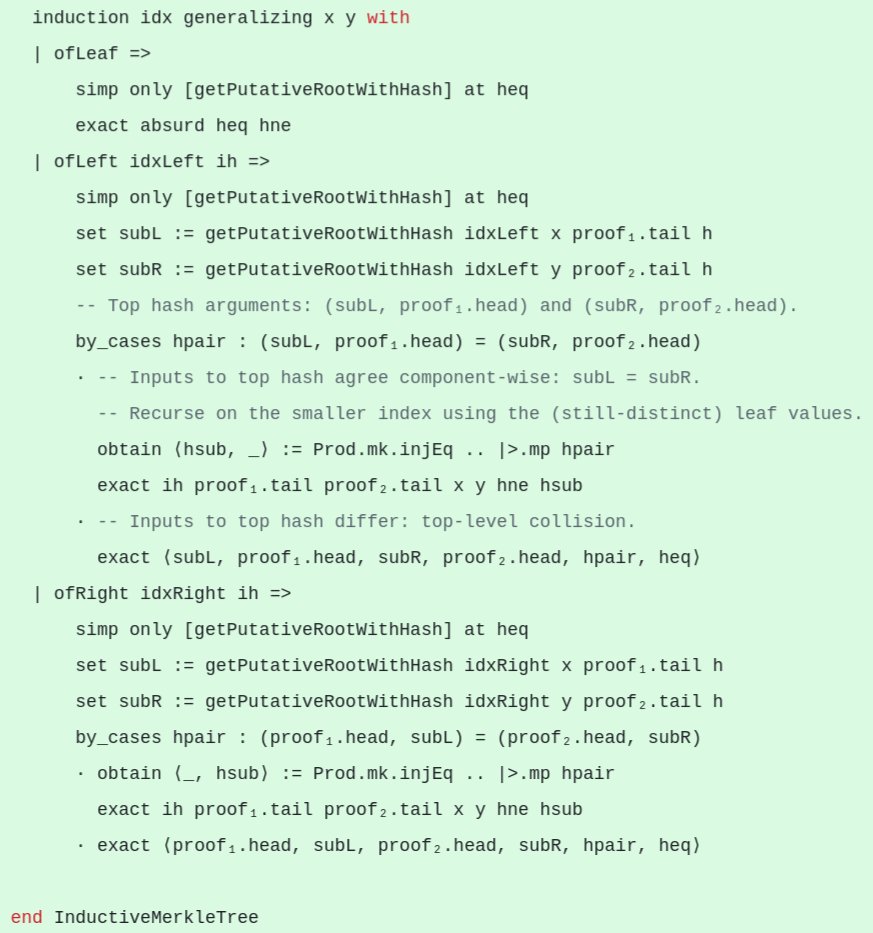
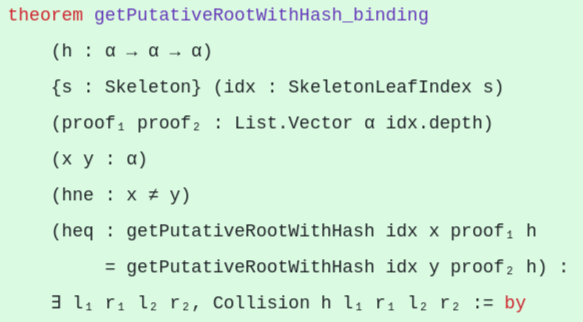
This theorem (left) means, the only way you can make proofs for two different things in the same position in the same Merkle tree, is by breaking the underlying hash function.
As a reviewer, you don't have to verify how Merkle branches are implemented or how the theorem is proven (right), you just have to verify what the theorem says, and that Lean verifies it.
And the beautiful thing is that you can even write live production code (including eg. CLI tools) directly in Lean.
Many people have claimed that with AI-assisted bug finding, secure code (and hence trustless anything) will be impossible.
I have a much more optimistic take, and AI-assisted formal verification is a major part of the reason why:
https://t.co/0ceMBZ6uqj
This theorem (left) means, the only way you can make proofs for two different things in the same position in the same Merkle tree, is by breaking the underlying hash function.
As a reviewer, you don't have to verify how Merkle branches are implemented or how the theorem is proven (right), you just have to verify what the theorem says, and that Lean verifies it.
And the beautiful thing is that you can even write live production code (including eg. CLI tools) directly in Lean.
@QuangVDao hmmm interesting, haven't heard that direction yet, like hax/aeneas in reverse? that would require another tool which itself needs to be verified, no? or may be you are referring to Boole, upcoming framework in CSlib?
@dhsorens always confused by lean is implemented in lean, would love more of an explanation on this @Leonard41111588. Second there is a C/C++ compiler in the pipeline which generates machine code right and that is not formally verified?
@royvanrijn@Leonard41111588 Oh just seeing this, didn’t know an open source model existed just for lean. This is very very cool. But curious what’s the business model here then?
Just a few years ago, combining AI and formal mathematics was science fiction. Now it's happening. Interview with @ETAPSconf on Lean, AI, and why formal methods have never mattered more. https://t.co/IdG121FWAk